Camille Pissarro, Waterworks of the Marly Machine at Bougival, 1871, oil on canvas, 12 3/8 x 17 3/4 in. (31.4 x 45.1 cm), Gift of Henry W. and Marion H. Bloch, 2015.13.16
Toggle Caption
A painting depicting a river cutting through a vast green and brown countryside. Among them, are small towns and a massive and long stone structure in the distance. In the foreground, there is a group of people riding their horses near a tree with a missing limb. Behind them, is a person rowing a small wooden boat through the river. On the bank is a large complex wooden structure. The background consists of a blue sky with white clouds.
Fig. 1. Pierre Denis Martin the Younger (French, 1663–1742), Machine of Marly and the Louveciennes Aqueduct, 1722, oil on canvas, 36 3/16 x 50 3/8 in. (92 x 128 cm), Musée de l’Histoire de France, Château de Versailles, MV 778. Alamy Stock Photo
Toggle Caption
A painting depicting a crowd of people wearing large, feathered hats and colorful dresses. They are standing on the edge of a bank near a blue calm river. The group waves to and greets a man standing on top of a small wooden boat. Also in the river, there is another wooden boat filled with passengers. To the left of the group are three dogs standing on a dirt path that cuts under two tall trees and leads to a town in the distance. In the background are large green hills and tall trees. The sky above is cover by an overcast of large clouds.
Fig. 2. Joseph Mallord William Turner, Marly-sur-Seine, ca. 1831, watercolor touched with bodycolor, 11 3/4 x 16 3/4 in. (28.6 x 42.6 cm), British Museum, London, 1958,0712.433. © The Trustees of the British Museum. Creative Commons Attribution-NonCommercial-ShareAlike 4.0 International (CC BY-NC-SA 4.0)
Toggle Caption
A painting of two red and brown steamboats creating clouds of smoke that sail through a river towards a town. To the left of the vessels are a group of people walk on the dirt path near a wall of trees with brown leaves. The sky above has a faint blue color and some clouds scattered across the sky.
Fig. 3. Camille Pissarro, The Seine near Port Marly, 1872, oil on canvas, 18 1/8 x 22 in. (46 x 55.8 cm), Staatsgalerie Stuttgart, 2727. Photo: © Staatsgalerie Stuttgart
Toggle Caption
A painting of three small wooden boats in a river while a thin wooden bridge crosses over it. The boats rest against a bank covered in green grass with a brown trail. Behind the wooden bridge, there is a long yellow building with six windows. Behind it, there are white buildings that leads to a small town. The sky above is light blue.
Fig. 4. Alfred Sisley, The Machine at Marly, 1873, oil on canvas, 17 3/4 x 25 3/8 in. (45 x 64.5 cm), Ny Carlsberg Glyptotek, Copenhagen, SMK 3272
Toggle Caption
A photograph of a map showing a top-down view of two rivers that merge and the towns in light red squares and bridges near them. Next to the river on the bottom is a red “X.” The map is covered with a grid.
Fig. 5. Édouard Blondel de Rougery (designer and engraver, 1877–before 1955), Map of la Vésinet, Chatou, Croissy-s, le Pecq, Port-Marly and the surrounding area (detail), published 1924, sheet: 29 1/2 x 24 13/16 in. (75 x 63 cm), Bibliothèque National de France, Paris. The red X marks where Pissarro may have painted the Nelson-Atkins canvas.
Toggle Caption
A painting depicting a group of men near a small stream of water in a forest area. On are two small groups of people that are rowing wooden boats through the stream. On the bank, a man is riding on a horse and crossing a small bridge. The sky is covered with large gray clouds.
Fig. 6. John Constable, Study for The Leaping Horse, ca. 1825, oil on canvas, 50 15/16 x 74 in. (129.4 x 188 cm), Victoria and Albert Museum, London, 986-1900
Toggle Caption
Fig. 7. Photomicrograph of the top left corner of Waterworks of the Marly Machine at Bougival (1871). The wood addition attached to the tacking margin is visible where the brown tape has been torn.
Toggle Caption
Fig. 8. Photomicrograph of the bottom edge of Waterworks of the Marly Machine at Bougival (1871), showing green brushstrokes that continue under the now-missing brown paper tape
Toggle Caption
Fig. 9. Photomicrograph of the center of the bottom edge in raking light, Waterworks of the Marly Machine at Bougival (1871). The hard paint edge may be associated with the tape and an application of overpaint.
Toggle Caption
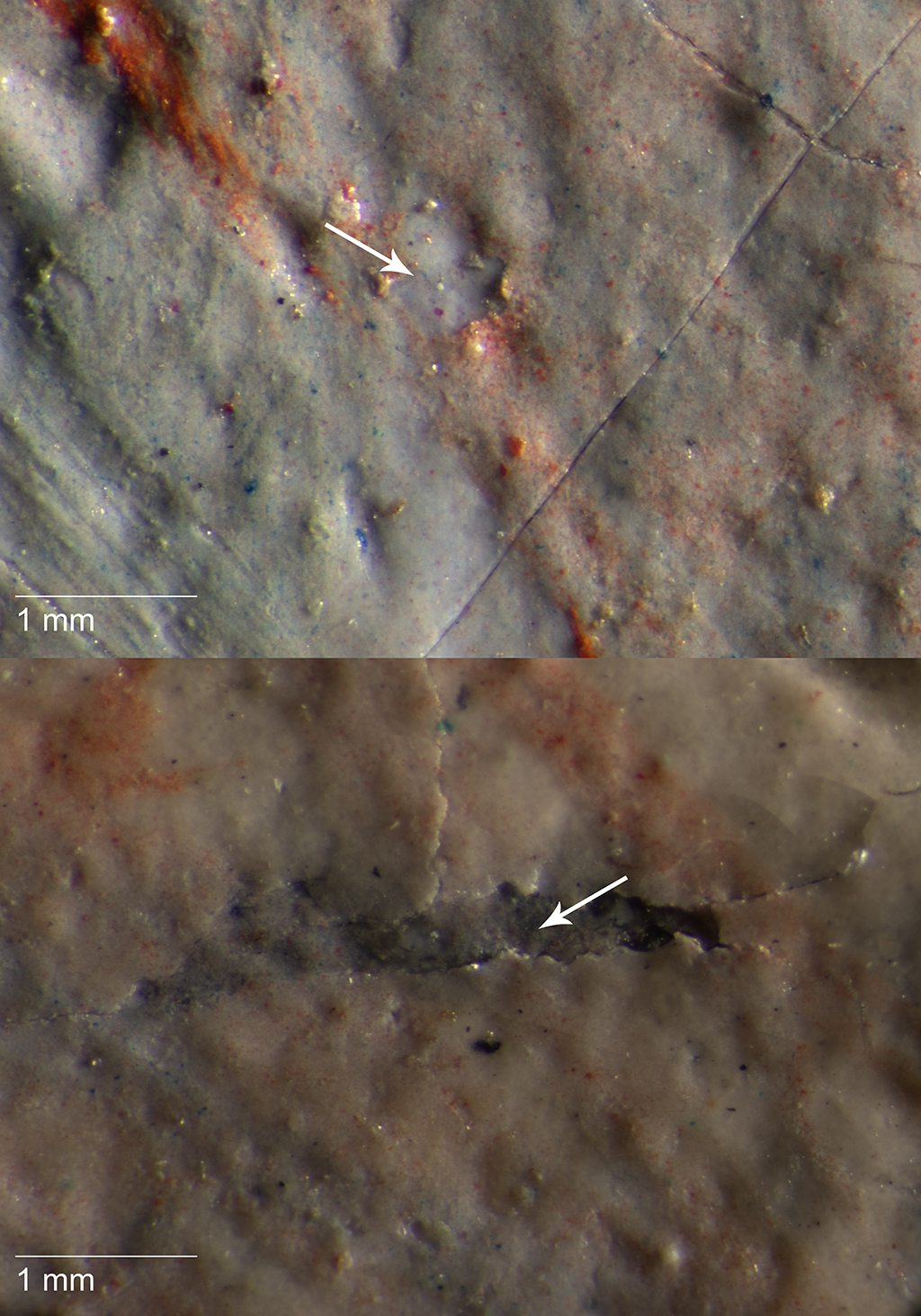
Fig. 10. Photomicrographs in raking light of Waterworks of the Marly Machine at Bougival (1871). Losses in the overpaint reveal the original paint of the sky in the top left corner (top) and the top center (bottom).
Toggle Caption
Fig. 11. Photomicrograph of the exposed ground of Waterworks of the Marly Machine at Bougival (1871). The ground appears slightly yellow due to residues of an old varnish layer.
Toggle Caption
Fig. 12. Photomicrograph of dry black underdrawing medium visible along the contour of the boom and resting on top of the ground layer, Waterworks of the Marly Machine at Bougival (1871)
Toggle Caption
Fig. 13. A mixture of fluid umber paint and a dry black medium was used for some of the preparatory sketching, visible directly under the door of the leftmost building, Waterworks of the Marly Machine at Bougival (1871)
Toggle Caption
Fig. 14. Details of Waterworks of the Marly Machine at Bougival (1871) in visible light (left) and transmitted infrared (right). The structure at left was altered (1), a figure was painted out (2), and a boat may have been painted out (3).
Toggle Caption
Fig. 15. Photomicrographs of the water in raking light, Waterworks of the Marly Machine at Bougival (1871). The area was scraped smooth and subsequently painted over, but unrelated color is still visible beneath the uppermost paint layers (left). A highly textured area that was painted wet-over-dry without scraping first is also present (right).
Toggle Caption
Fig. 16. Details of Waterworks of the Marly Machine at Bougival (1871) in visible light (left) and transmitted infrared (right). The gate (1) and boom (2) were painted out and repositioned.
Toggle Caption
Fig. 17. Photomicrograph in raking light of Waterworks of the Marly Machine at Bougival (1871), indicating that at least one figure was clearly added on top of a steep ridge of dry paint
Toggle Caption
Fig. 18. Photomicrograph of the signature and date of Waterworks of the Marly Machine at Bougival (1871), showing the thin, fluid paint conforming to the underlying brushstrokes
Toggle Caption

Camille Pissarro, Waterworks of the Marly Machine at Bougival, 1871

Download PDF

doi: 10.37764/78973.5.638

ArtistCamille Pissarro, French, 1830–1903
TitleWaterworks of the Marly Machine at Bougival
Object Date1871
Alternate and Variant TitlesBanks of the Seine at Port Marly, Au bord de la Seine à Port Marly, Barrage de la Seine à Pontoise, Barrage sur la Seine à Bougival, Weir on the Seine at Bougival, The Banks of the Seine at Bougival
MediumOil on canvas
Dimensions (Unframed)12 15/16 x 18 1/8 in. (32.9 x 46 cm)
SignatureSigned and dated lower left: C. Pissarro. 1871
Credit LineThe Nelson-Atkins Museum of Art. Gift of Henry W. and Marion H. Bloch, 2015.13.16
Catalogue Entry

curatorial

Citation

Chicago:

Aimee Marcereau DeGalan, “Camille Pissarro, Waterworks of the Marly Machine at Bougival, 1871,” catalogue entry in French Paintings and Pastels, 1600–1945: The Collections of the Nelson-Atkins Museum of Art, ed. Aimee Marcereau DeGalan (Kansas City: The Nelson-Atkins Museum of Art, 2023), https://doi.org/10.37764/78973.5.638.5407.

MLA:

Marcereau DeGalan, Aimee. “Camille Pissarro, Waterworks of the Marly Machine at Bougival, 1871,” catalogue entry. French Paintings and Pastels, 1600–1945: The Collections of The Nelson-Atkins Museum of Art, edited by Aimee Marcereau DeGalan, Nelson-Atkins Museum of Art, 2023. doi: 10.37764/78973.5.638.5407.

In December 1870, with the help of a loan from friends of his neighbor Ludovic Piette, Camille Pissarro and his family sailed from the French port city Saint-Malo to England to escape the dangers of the Prussian invasion in ParisFranco-Prussian War: The war of 1870–71 between France (under Napoleon III) and Prussia, in which Prussian troops advanced into France and decisively defeated the French at Sedan. The defeat marked the end of the French Second Empire. For Prussia, the proclamation of the new German Empire at Versailles was the climax of Bismarck’s ambitions to unite Germany..1Ralph E. Shikes and Paula Harper, Pissarro, His Life and Work (New York: Horizon, 1980), 88. Although the time Pissarro spent in England was financially challenging, it proved to be a fertile period for the growth of ideas and the expansion of his subject matter.2In a letter to his friend Théodore Duret in June 1871, Pissarro wrote, “En fait d’affaires, de vente, je n’ai rien fait, excepté Durand-Ruel qui m’a acheté deux petits tableaux. Ma peinture ne mord pas, mais pas du tout, cela me poursuit un peu partout” (In terms of business, sales, I did nothing, except Durand-Ruel who bought from me two small paintings. My painting does not bite, no, not at all; it pursues me everywhere); Janine Bailly-Herzberg, Correspondance de Camille Pissarro (Saint-Ouen-l’Aumône, France: Éditions du Valhermeil, 2003), 1:64n9. All translations are by Aimee Marcereau DeGalan unless otherwise noted. While there, he took advantage of the opportunity to study English painting by artists such as John Constable (1776–1837) and Joseph Mallord William Turner (1775–1851), whose techniques for depicting the mechanization of water through locks, mills, weirsweir: A dam constructed on a canal or navigable river to retain the water and regulate its flow., and dams proved influential. These works, along with the industrial landscapes surrounding London, introduced Pissarro to new subject matter, inspiring his newfound interest in the expansion of France’s industrial suburbs through its waterways. Waterworks of the Marly Machine at Bougival was painted shortly after Pissarro’s return to France in 1871.

Water enacts a continual process of transformation and fluidity in the landscape, and its representation in painting showcases the artist’s deep understanding of how broader historical and geographical factors play a crucial role in shaping a specific location.3Stephen Daniels expresses this idea in his article “Liquid Landscape: Southam, Constable, and the Art of the Pond,” British Art Studies 10 (November 29, 2018): https://doi.org/10.17658/issn.2058-5462/issue-10/sdaniels. The inclusion of rivers and waterways as an aspect of modernity in art—as opposed to the subject of the industrial landscape—has only more recently become the focus of academic study.4These topics find new form through an ecocritical lens in more recent scholarship, including a thoughtful work by Genevieve Westerby, “Pissarro at Pontoise: Picturing Infrastructure and the Changing Riverine Environment,” Athanor 39 (2022): 155–70. See also Maura Coughlin, “Biotopes and Ecotones: Slippery Images on the Edge of the French Atlantic,” Landscapes: The Journal of the International Centre for Landscape and Language 7, no. 1 (2016): 1–23; and John Ribner, “The Poetics of Pollution,” in Turner, Whistler, Monet: Impressionist Visions, ed. Katharine Lochnan (Toronto: Art Gallery of Ontario, 2004), 51–63. Throughout the nineteenth century, France underwent a range of infrastructure projects aimed at transforming its river systems to meet the demands of an industrializing economy. Starting in 1838, the Seine River, in particular, underwent significant transformations as riverbeds were dredged, locks and dams were constructed to address its inconsistent depth and tendency to flood, and new canals were established to connect major river systems for the efficient transportation of goods.5Sir Edward Thorpe, The Seine: From Havre to Paris (London: Macmillan, 1913), 19–23. Improvements such as these in the fluvial section of the river completely revolutionized the system of tractiontraction: A method of transportation for large stones or boulders in a river. The water rolls the stones along the river bottom since they are too heavy to be suspended in the water. and towage by horses, which was practically abandoned in France by the mid-nineteenth century, with steamers and small motorized boats using internal mechanization to self-propel up the river.6Thorpe, Seine, 24. These aspects of modern life would become a defining characteristic of Impressionist paintings in the 1870s, and the Waterworks of the Marly Machine at Bougival marks one of Pissarro’s first attempts at incorporating this theme into his own practice.7Richard Thomson is among the first scholars to acknowledge this point. See his Camille Pissarro: Impressionism Landscape and Rural Labour, exh. cat. (London: South Bank Centre, 1990), 19. Pissarro painted The Weir at Pontoise (ca. 1868; private collection) with a number of barges on the opposite shore. He repeated the motif with subtle changes around 1872, after his return from London: Camille Pissarro, The Lock at Pontoise, 1872, Cleveland Museum of Art, https://www.clevelandart.org/art/1990.7 In fact, it was one of at least twenty compositions featuring working aspects of the river that the artist realized in the two years after his trip to London, compared to only three that he had created before he left.8Paintings created before the artist’s trip to London: The Weir at Pontoise (1868; private collection, CR 129); The Marly Hydraulic Works at Bougival (1869; current location unknown, CR 132); The Seine at Bougival (1870; Bridgestone Museum of Art, Ishibashi Foundation, CR 154). Paintings created in the two years after his trip to London: The Seine at Bougival (1871; private collection, Switzerland, CR 200); Banks of the Seine at Bougival (1871; stolen in the Netherlands, 1993, CR 201); Barges on the Seine at Bougival (1871; private collection, CR 202); Banks of the River (1871; private collection, CR 204); The Seine at Port-Marly, The Wash-House (1872; Musée d’Orsay, Paris, CR 229); Banks of the Seine at Bougival (1872; Staatsgalerie Stuttgart, CR 234); The Seine at Port-Marly (1872; private collection, UK, CR 236); The Weir at Pontoise (1872; Cleveland Museum of Art, CR 243); The Weir and the Lock at Saint-Quen-l’Aumône (1872; private collection, CR 244); Banks of the Oise at Pontoise (1872; private collection, Chicago, CR 249); View of Pontoise, the Timber Raft (1872; private collection, CR 250); Banks of the Oise, Pontoise (1872; private collection, CR 251); Banks of the Oise near Pontoise (1872; private collection, CR 274); Road on the Banks of the Oise, Pontoise (1872; private collection, CR 275); Factory at St Quen-l’Aumône, the Flood of the Oise (1873; private collection, CR 297); Factory at Saint-Quen-l’Aumône (1873; Springfield [MA] Museum of Fine Arts, CR 298); Factory on the Banks of the Oise, Saint-Quen-l’Aumône (1873; The Israel Museum, Jerusalem, CR 299); Factory on the Banks of the Oise, Saint-Quen-l’Aumône (1873; Sterling and Francine Clark Art Institute, Williamstown, MA, CR 300); The Factory on the Banks of the Oise, Épluches (1873; private collection, CR 302); Route d’Auvers on the Banks of the Oise, Pontoise (1873; Indianapolis Museum of Art at Newfields, CR 303).

The Nelson-Atkins painting depicts a stretch of the lower Seine in Bougival, a town located in the Yvelines department of the Île-de-France region in north-central France, about seventeen miles west of the center of Paris. Villages west of Paris, including Bougival, saw rapid and steady change at this time with the extension of the rail line, putting them within easy reach from the Gare Saint-Lazare (Saint-Lazare train station). Although Bougival was still somewhat rural, its proximity attracted bourgeois day-trippers who boated, promenaded, and dined there. Swimming was also popular at the local swimming hole, La Grenouillère, immortalized in paint by Pissarro’s contemporaries Claude Monet (1840–1926) and Pierre-Auguste Renoir (1841–1919), who set up their easels there in the summer of 1869.9See, for example, Claude Monet, La Grenouillère, 1869, Metropolitan Museum of Art, https://www.metmuseum.org/art/collection/search/437135 In the Nelson-Atkins composition, however, Pissarro looks at the river through the lens of work rather than leisure. He includes a glimpse of the locks of Bougival at the right, in the midground; they were the first to be implemented as part of the canalization project for the Seine in 1838.10Thorpe, Seine, 20. These altered the flow of water into two channels around the Île de la Loge (Island of la Loge), seen on the opposite bank of Pissarro’s painting with the red-roofed house, and the Île Gautier, at the far right, home to the white mansard-roofed house.11Mont Valérien, occupied by the Prussian Army Corps during the Franco-Prussian War just months before Pissarro’s return, is visible in the distance beyond the houses of Croissy. Joachim Pissarro and Claire Durand-Ruel Snollaerts identified this and several other architectural and geographical features in the canvas in their 2005 catalogue raisonné. See Pissarro and Durand-Ruel Snollaerts, Pissarro: Critical Catalogue of Paintings (Paris: Wildenstein Institute Publications, 2005), no. 203, p. 2:173. To access these islands, one needed to traverse the Seine via a small boat, like several of those featured in Pissarro’s composition, two of which are being maneuvered by standing figures wielding a single oar. Most of the boats are working types, including a canoe moored to the black landing at left; a green NorwegianNorwegian: A solid boat for walking and angling. It is a canoe with a very elegant rounded lift often seen in other Impressionist paintings. at center left, which may have been used for fishing; a double bachotbachot: A small flat-bottomwed boat used to cross rivers and reconizable for its lifting front, which facilitates standing on the bank. to its right, which was used as a work boat for the French public works department, which managed the dam; and a single bachot at far right, which may have been used to ferry inhabitants of the islands across the Seine, which was not possible upstream of the dam.12I am extremely grateful for the assistance of Frederic Delaive, associate researcher at the Tempora Laboratory, Rennes 2 University, and president of the Carré des canotiers. Delaive to Aimee Marcereau DeGalan, NAMA, February 22, and 25–26, 2023, NAMA curatorial files. The sketchy nature of the figures in these boats makes it difficult to determine their costume; however, Jean-Louis Lenhof, professor at Université de Caen-Normandiem, feels that at least those in the green boat appear in the bourgeois attire of shirtsleeves and waistcoats, rather than the overalls or plain shirts worn by manual workers. I am thankful for clarifying exchanges with him. Lenhof to Aimee Marcereau DeGalan, NAMA, February 14, 2023, NAMA curatorial files. In the foreground, Pissarro includes a prominent wooden rake-like structure which transects the river and the canvas from left to right. Known as a boom or estacade, it formed an extension of the “Marly Machine,” a remarkable hydraulic pumping system used to provide water uphill to the palace and gardens of Versailles during the late seventeenth century.13For information on the Marly Machine and the king’s garden, see Ian Thompson, The Sun King’s Garden: Louis XIV, André Le Nôtre and the Creation of the Gardens of Versailles (London: Bloomsbury, 2006), 251.

Fig. 1. Pierre Denis Martin the Younger (French, 1663–1742), Machine of Marly and the Louveciennes Aqueduct, 1722, oil on canvas, 36 3/16 x 50 3/8 in. (92 x 128 cm), Musée de l’Histoire de France, Château de Versailles, MV 778. Alamy Stock Photo
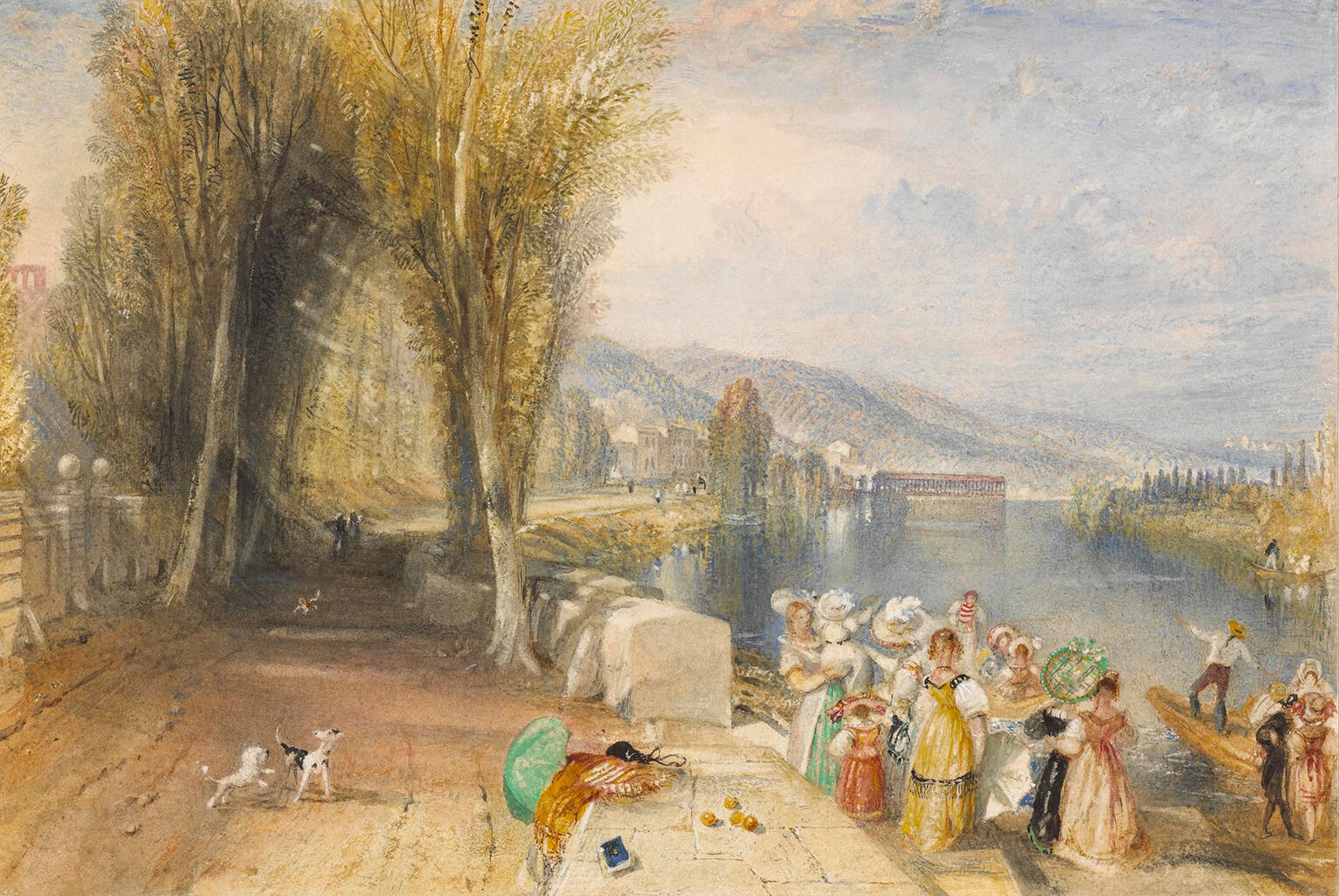
Civil engineering has impacted this section of the river between the town of Bezons, about eight miles upstream of Bougival, and the Marly Machine since the 1680s. Engineered by Arnold de Ville and constructed by Rennequin Sualem (both Flemish natives) from 1681 to 1684 for King Louis XIV (1638–1715), the original Marly Machine consisted of fourteen waterwheels driven by the current of the Seine.14General information on the Marly Machine has been extracted from Bruno Bentz and Éric Soullard, “La Machine de Marly,” Château de Versailles: De l’Ancien régime à nos jours, no. 1 (April/June 2011): 73–77. For more specifics on the early history of the machine, as well as excellent diagrams, see L. A. Barbet, Les grandes eaux de Versailles: Installations mécaniques et étangs artificiels, description des fontaines et de leurs origins (Paris: H. Dunod et E. Pinat, 1907), 95–126. These waterwheels powered more than 220 pumps that delivered water through a series of pumping stations, holding tanks, reservoirs, pipes, and mechanical linkages uphill to the Marly reservoir, which was 108 feet above Versailles (Fig. 1).15For further details, see Thompson, The Sun King’s Garden, 247–51; and Jacques Laÿ and Monique Läy, Louveciennes: Histoire et rencontres (Paris: Éditions Riveneuve, 2016), 46–51. In an effort to establish a waterhead powerful enough to achieve the maximum height at which the pump could move fluid against gravity, the Seine was divided into two arms by a series of islands and earth berms connected by timber or rock dikes. After a series of breakdowns and deteriorating parts, the machine was demolished in 1817. Rebuilt not long after with a smaller but still sizeable footprint, it remained an impressive site and became a tourist destination, including for artists like Turner, who visited several times in the 1820s and 1830s and completed a series of watercolor sketches there (Fig. 2). By Pissarro’s era, the Marly Machine was run by a hydraulic system engineered by Xavier Dufrayer in 1859.16This was eventually replaced by electromechanical pumps in 1968, which continued to draw water from the river. In Turner’s watercolor, we see a picture-postcard view of the machine in the distance while a group of bourgeois tourists alight on the banks, possibly awaiting passage across the river in one of the boats. Here, the machine becomes a part of the river landscape, in harmony with its surroundings, and the focus is more on the leisure activity of the individuals rather than the machine as a working mechanism for disciplining the river.

Fig. 2. Joseph Mallord William Turner, Marly-sur-Seine, ca. 1831, watercolor touched with bodycolor, 11 3/4 x 16 3/4 in. (28.6 x 42.6 cm), British Museum, London, 1958,0712.433. © The Trustees of the British Museum. Creative Commons Attribution-NonCommercial-ShareAlike 4.0 International (CC BY-NC-SA 4.0)
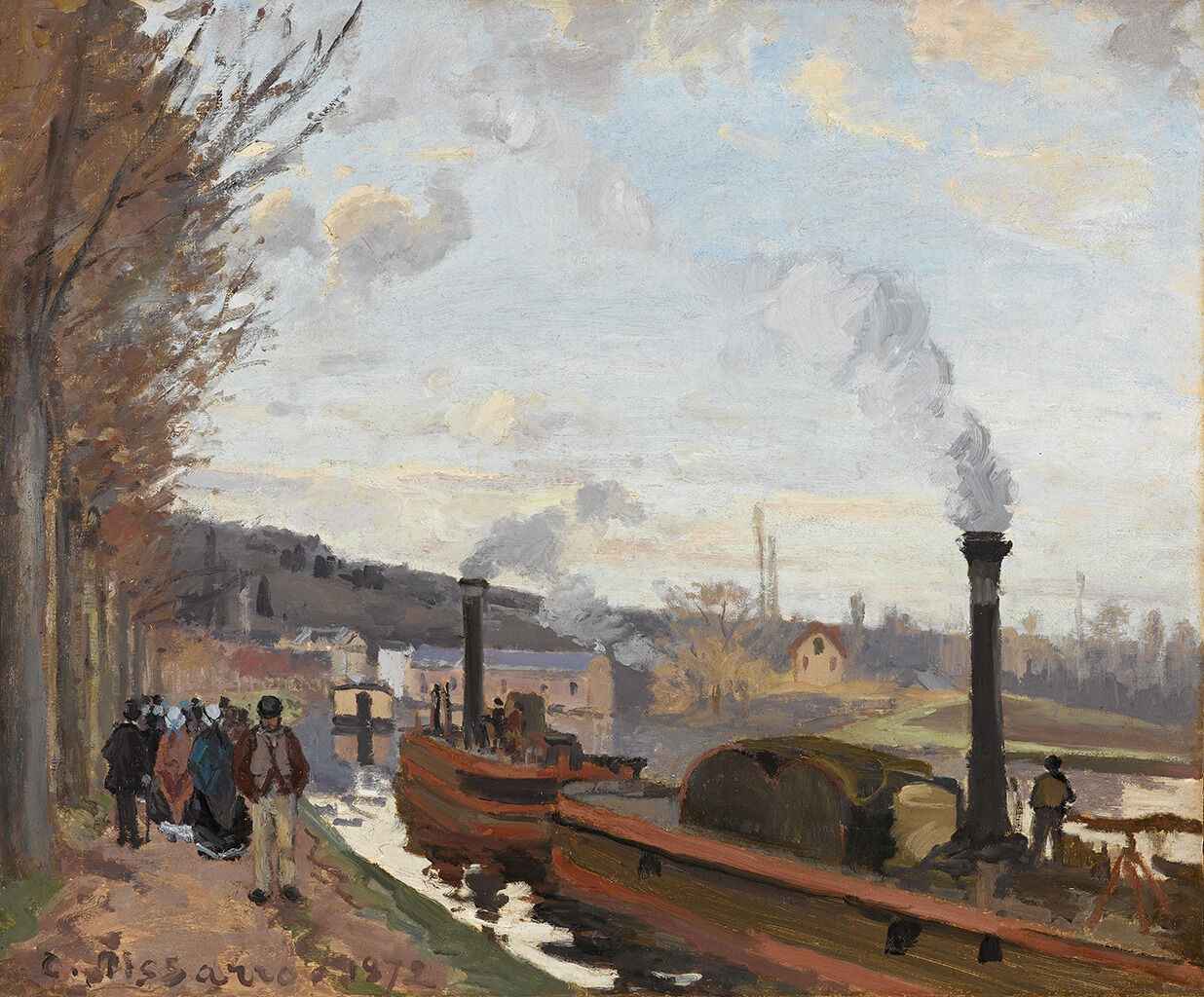
Fig. 3. Camille Pissarro, The Seine near Port Marly, 1872, oil on canvas, 18 1/8 x 22 in. (46 x 55.8 cm), Staatsgalerie Stuttgart, 2727. Photo: © Staatsgalerie Stuttgart
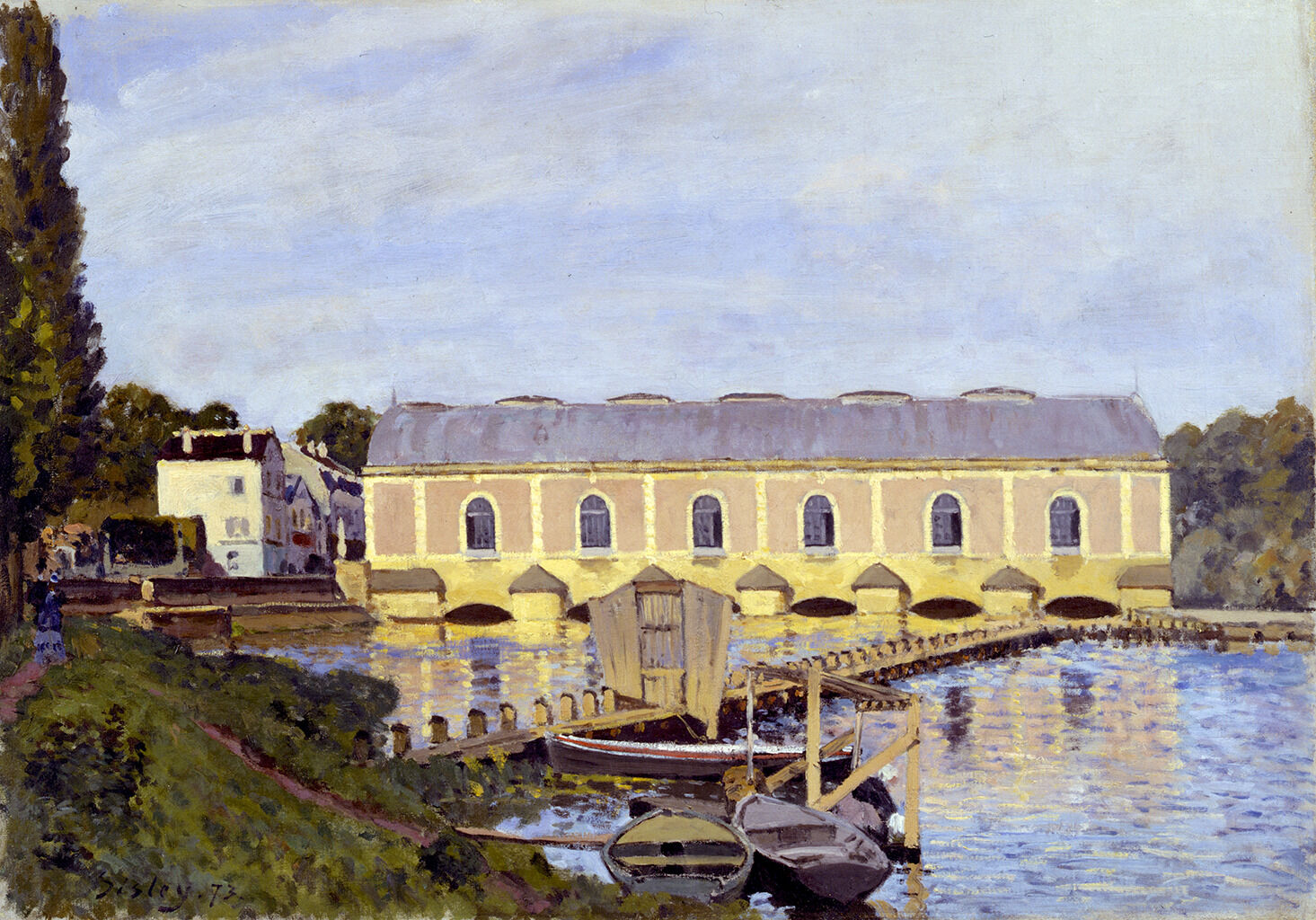
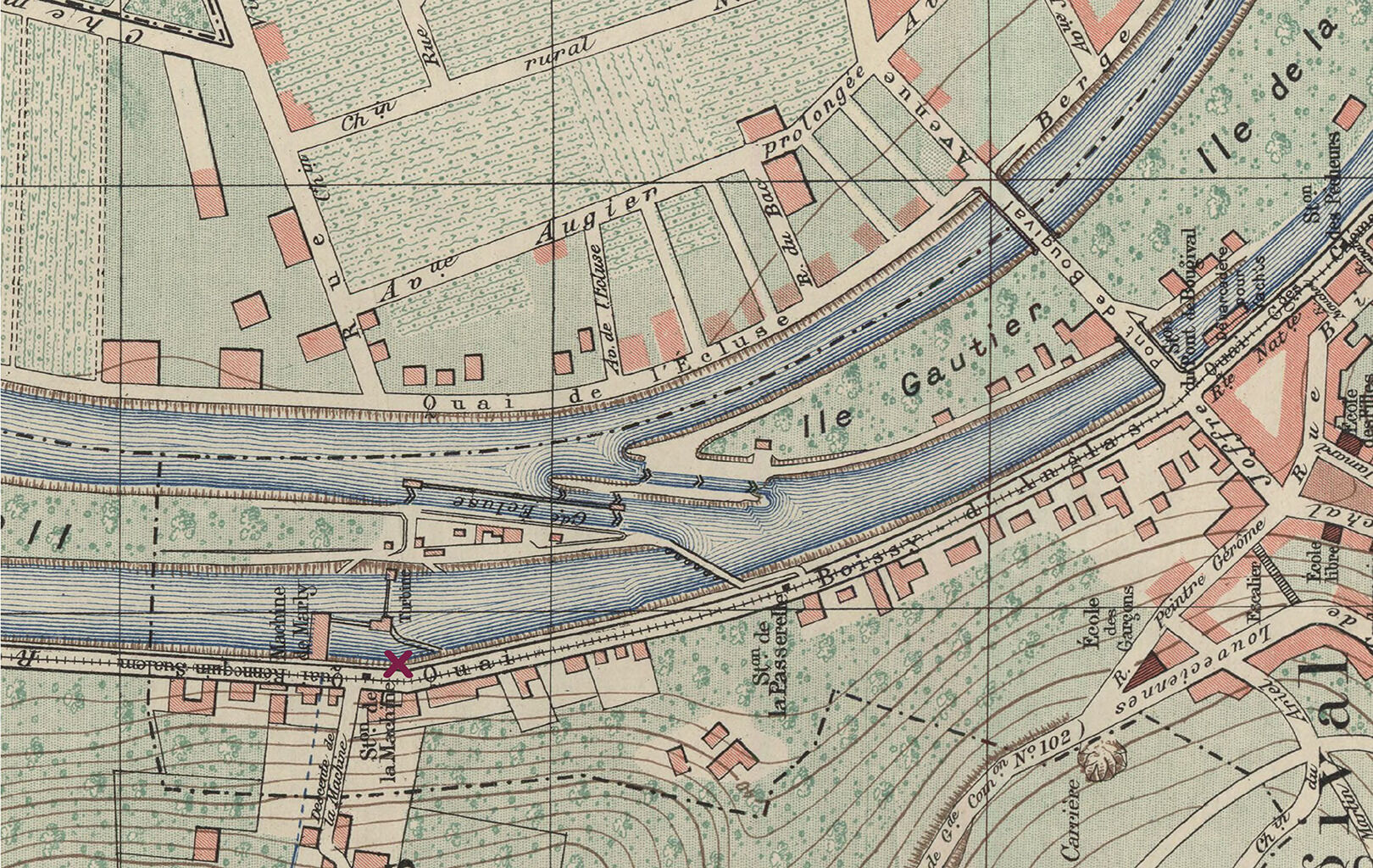
Pissarro included the Marly Machine, or aspects of it, in at least two other compositions, including The Marly Hydraulic Works at Bougival (current location unknown),17Pissarro and Durand-Ruel Snollaerts, Pissarro: Critical Catalogue of Paintings, no. 132, p. 2:124. painted in 1869 before the artist’s prolonged exposure to Turner and Constable. This work features the machine in the distance, with the river relegated to a minor role at the left edge of the composition, and two individuals walking along its banks toward the machine. The second painting, Banks of the Seine at Bougival, was completed in 1872 after Pissarro’s return from London (Fig. 3). Its composition recalls Turner’s work, but it highlights the river as a commercial artery, with its barges and factories that line the banks. In the Nelson-Atkins composition, Pissarro chose a less-than-picturesque vantage point of the Marly Machine, looking southeast from the quai Rennequin-Sualem, named after the machine’s original builder. In contrast to the two other works featuring the Marly Machine, here Pissarro eliminates the pumphouse all together, focusing instead on a working aspect of the pump itself—designed to protect the wheels of the machine from floating objects and to prevent boats from navigating too close to the pump. A near-contemporaneous work by the English artist Alfred Sisley (born Paris, 1839–99), helps situate the boom in relation to the pumphouse (Fig. 4), and it also includes the gate on the boom seen at the far right of Pissarro’s composition. In Sisley’s painting, the gate is closed; however, in the Nelson-Atkins composition, it is open. The gate allowed people to walk out on the boom where they could fish, as seen in another work by Sisley painted around the same time (ca. 1876; Museum of Fine Arts, Boston). Also note the figure on the boom that Pissarro painted out of his finished composition (Fig. 14 in the accompanying technical entry by Becca Goodman). It is possible that Pissarro set up his easel close to the Marly Machine, just to the left of the boom in Sisley’s painting, but compressed the space somewhat, looking toward the end of the Île de la Loge at left and the Île Gautier at right.18I am grateful to Benjamin Ringot, Centre de recherche du château de Versailles, and Jacque Läy, independent historian, and his son Xavier Läy for their help and supplemental images, maps, and photographs in an effort to pinpoint Pissarro’s location. See Ringot and Läy to Aimee Marcereau DeGalan, NAMA, February 13–15, 2023, NAMA curatorial files. The locks of Bougival were in between these islands. A period map provides greater clarity; a red “x” marks where this author believes that Pissarro placed his easel (Fig. 5). The black dashed line to the left of the Marly Machine represents the city boundaries and indicates that the Marly Machine falls somewhat confusingly within the confines of Bougival. Thus, given the position of the boom and the artist’s vantage point, the painting represents Bougival, despite much historical debate.19See the respective provenance and bibliography sections for this painting completed by Danielle Hampton Cullen. When the painting appeared in the sale of George Feydou in 1903, it was listed as a scene of Pontoise; however, when it was sold in 1933 from Galerie Étienne Bignou to Kunsthandel Paul Cassirer in Amsterdam, it was called The Port of Marly. In 1959, when it was exhibited at Wildenstein Gallery in New York, it appeared as The Banks of the Seine at Bougival. It was also Bougival in both Pissarro catalogues raisonnés (1939 and 2005). See Ludovic Rodo Pissarro and Lionello Venturi, Camille Pissarro, Son Art—Son Œuvre (Paris: Paul Rosenberg, 1939), no. 125, pp. 1:97, 2: unpaginated, reproduced as Barrage sur la Seine a [sic] Bougival; and Pissarro and Durand-Ruel Snollaerts, Pissarro: Critical Catalogue of Paintings, no. 203, p. 2:173. However, in 2007, Richard Brettell noted two verso inscriptions on the painting’s paper backing that read “Au bord de la Seine à Port Marly” (Banks of the Seine at Port Marly), which he argued was “probably more accurate than its traditional title, Weir on the Seine at Bougival.” See Richard R. Brettell and Joachim Pissarro, Manet to Matisse: Impressionist Masters from the Marion and Henry Bloch Collection, exh. cat. (Kansas City, MO: Nelson-Atkins Museum of Art, 2007), 51.

Fig. 4. Alfred Sisley, The Machine at Marly, 1873, oil on canvas, 17 3/4 x 25 3/8 in. (45 x 64.5 cm), Ny Carlsberg Glyptotek, Copenhagen, SMK 3272
Fig. 5. Édouard Blondel de Rougery (designer and engraver, 1877–before 1955), Map of la Vésinet, Chatou, Croissy-s, le Pecq, Port-Marly and the surrounding area (detail), published 1924, sheet: 29 1/2 x 24 13/16 in. (75 x 63 cm), Bibliothèque National de France, Paris. The red X marks where Pissarro may have painted the Nelson-Atkins canvas.
Pissarro started this work with an underdrawingunderdrawing: A drawn or painted sketch beneath the paint layer. The underdrawing can be made from dry materials, such as graphite or charcoal, or wet materials, such as ink or paint. in what is possibly charcoal and a fluid medium on the canvas.20See the accompanying technical entry by Becca Goodman. The painting showcases his ability to capture the dynamic interplay of light and shadow as rays of sun make their way through a temperamental sky. The fractured colors of the water’s surface, with dashes of blue, green, white, and red, reflect the houses and foliage on the opposite banks, creating a vivid impression of outdoor light. One also sees the artist’s facturefacture: The artist’s characteristic handling of paint. through his use of broken brushwork of varying lengths and thicknesses in the animated strokes of water at midground. The variety of his paint handling is also visible in the scrubby upright poplars, with their haphazard brushstrokes made in left and right upward wisps that convey their texture. With the unruly branches in place, Pissarro added patches of sky to open up the trees.21See the accompanying technical entry by Goodman. His sky, with its turbulent clouds rendered in wet-into-wetwet-into-wet: An oil painting technique which involves blending of colors on the picture surface. swirls of white, blue, dark gray, and hints of pink, is equally varied with brushwork in every direction, as if to indicate the clouds’ movement across the picture plane. The artist’s technical approach, in concert with his subject of the river and its mechanization, call to mind the work of Constable, whom Pissarro and Monet studied during their forced sojourn to England. Pissarro later recalled: “We used to go to the museum. The watercolors of Turner, as well as the works of John Constable, certainly had their effect on us. . . . We were particularly taken by the landscapists who were nearer to what we were seeking in ‘plein air,’ light and fleeting effects.”22Wynford Dewhurst, Impressionist Painting: Its Genesis and Development (London: G. Newnes, 1904), 31–32.

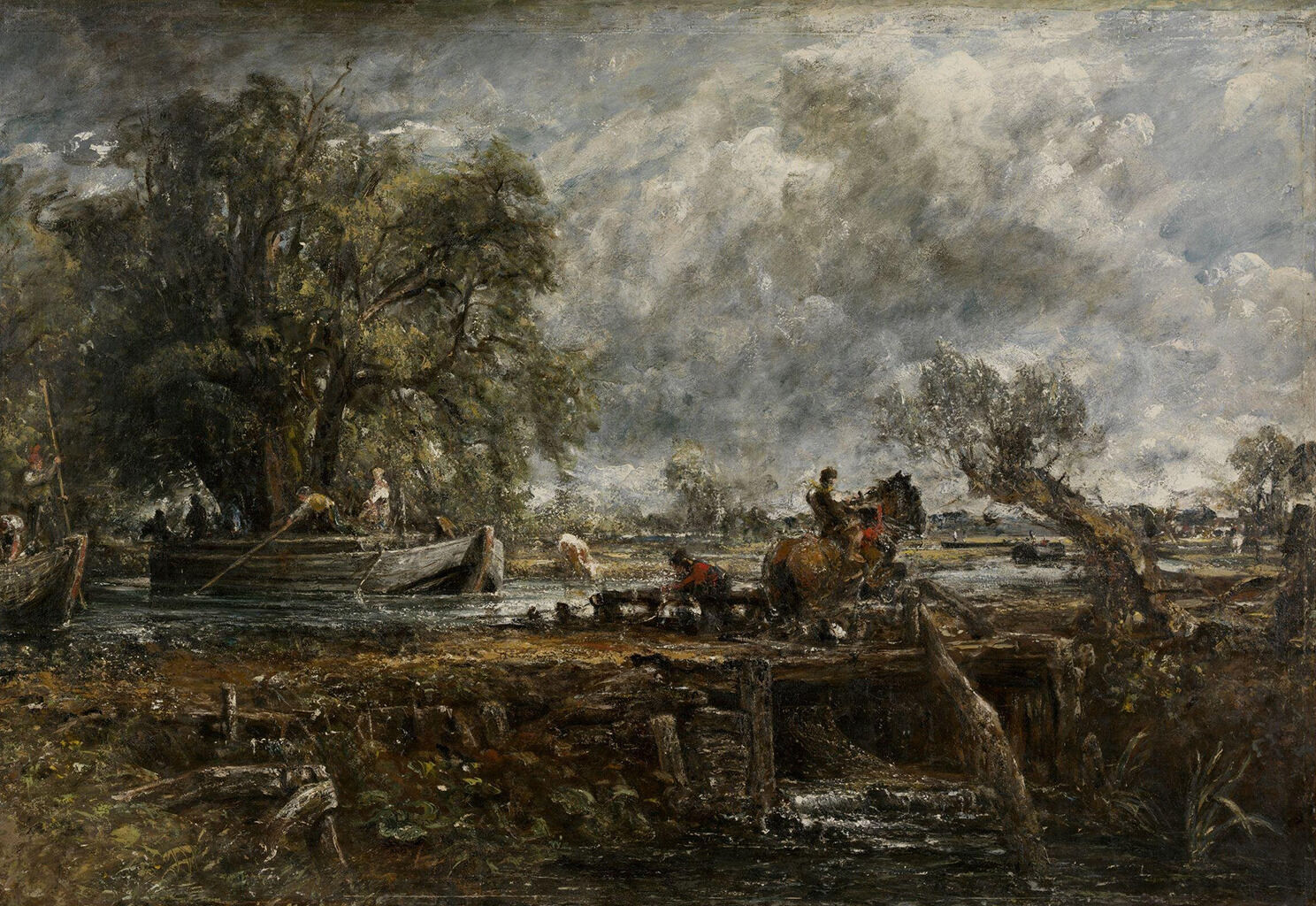
Fig. 6. John Constable, Study for The Leaping Horse, ca. 1825, oil on canvas, 50 15/16 x 74 in. (129.4 x 188 cm), Victoria and Albert Museum, London, 986-1900
Indeed, Pissarro may have been inspired by Constable’s full-scale study for his six-foot canvas, The Leaping Horse, which was on view at the Victoria and Albert Museum when Pissarro was in London (Fig. 6). Its characteristically English sky, as Malcolm Warner poetically writes, evokes “the promise of rain or rain to come.”23Malcolm Warner and Julia Marciari Alexander, This Other Eden: Paintings from the Yale Center for British Art (New Haven: Yale University Press, 1998), 138. Constable’s painting depicts traffic on the River Stour, specifically the Float Bridge or Float Jump, with a sluice and a small wooden bridge and barrier.24Although not formally accessioned into the Victoria and Albert Museum’s collection until 1900, the full-scale study for Constable’s The Leaping Horse, ca. 1825, was on view there since 1862. While these six-footers were completed in his studio due to their size, they were built up from multiple sketches made en plein airen plein air (adjective: plein-air): French for “outdoors.” The term is used to describe the act of painting quickly outside rather than in a studio. and thus communicated a direct link to nature, as Pissarro’s canvas does. Constable’s paint application was varied, like Pissarro’s, and he “piled up or scraped down, aggressively jabbed or lightly and precisely touched, scratched with the end of a brush, splattered and smeared” his paint across the surface of his canvas, as Jonathan Clarkson has described it.25Jonathan Clarkson, Constable (London: Phaidon, 2010), 211. Constable used this varied brushwork to recreate the textures he saw in nature, adding to the mood of his completed works. As the title of Constable’s painting suggests, the subject is a horse leaping over a small wooden bridge. The horse would have been used to pull small boats through the locks, and it is seen jumping over the three-foot-high bridge that serves as a crossing between Essex and Suffolk. The barrier kept cattle from straying but allowed barge traffic to continue. This mechanized subject of river traffic clearly held great interest for Constable, as did the boom in the foreground of the Nelson-Atkins painting, which Pissarro would realize immediately after returning home to France in the summer of 1871.

Aimee Marcereau DeGalan
February 2023
Updated June 2026

Notes

  1. Ralph E. Shikes and Paula Harper, Pissarro, His Life and Work (New York: Horizon, 1980), 88.

  2. In a letter to his friend Théodore Duret in June 1871, Pissarro wrote, “En fait d’affaires, de vente, je n’ai rien fait, excepté Durand-Ruel qui m’a acheté deux petits tableaux. Ma peinture ne mord pas, mais pas du tout, cela me poursuit un peu partout” (In terms of business, sales, I did nothing, except Durand-Ruel who bought from me two small paintings. My painting does not bite, no, not at all; it pursues me everywhere); Janine Bailly-Herzberg, Correspondance de Camille Pissarro (Saint-Ouen-l’Aumône, France: Éditions du Valhermeil, 2003), 1:64n9. All translations are by Aimee Marcereau DeGalan unless otherwise noted.

  3. Stephen Daniels expresses this idea in his article “Liquid Landscape: Southam, Constable, and the Art of the Pond,” British Art Studies 10 (November 29, 2018): https://doi.org/10.17658/issn.2058-5462/issue-10/sdaniels.

  4. These topics find new form through an ecocritical lens in more recent scholarship, including a thoughtful work by Genevieve Westerby, “Pissarro at Pontoise: Picturing Infrastructure and the Changing Riverine Environment,” Athanor 39 (2022): 155–70. See also Maura Coughlin, “Biotopes and Ecotones: Slippery Images on the Edge of the French Atlantic,” Landscapes: The Journal of the International Centre for Landscape and Language 7, no. 1 (2016): 1–23; and John Ribner, “The Poetics of Pollution,” in Turner, Whistler, Monet: Impressionist Visions, ed. Katharine Lochnan (Toronto: Art Gallery of Ontario, 2004), 51–63.

  5. Sir Edward Thorpe, The Seine: From Havre to Paris (London: Macmillan, 1913), 19–23.

  6. Thorpe, Seine, 24.

  7. Richard Thomson is among the first scholars to acknowledge this point. See his Camille Pissarro: Impressionism Landscape and Rural Labour, exh. cat. (London: South Bank Centre, 1990), 19. Pissarro painted The Weir at Pontoise (ca. 1868; private collection) with a number of barges on the opposite shore. He repeated the motif with subtle changes around 1872, after his return from London: Camille Pissarro, The Lock at Pontoise, 1872, Cleveland Museum of Art, https://www.clevelandart.org/art/1990.7.

  8. Paintings created before the artist’s trip to London: The Weir at Pontoise (1868; private collection, CR 129); The Marly Hydraulic Works at Bougival (1869; current location unknown, CR 132); The Seine at Bougival (1870; Bridgestone Museum of Art, Ishibashi Foundation, CR 154). Paintings created in the two years after his trip to London: The Seine at Bougival (1871; private collection, Switzerland, CR 200); Banks of the Seine at Bougival (1871; stolen in the Netherlands, 1993, CR 201); Barges on the Seine at Bougival (1871; private collection, CR 202); Banks of the River (1871; private collection, CR 204); The Seine at Port-Marly, The Wash-House (1872; Musée d’Orsay, Paris, CR 229); Banks of the Seine at Bougival (1872; Staatsgalerie Stuttgart, CR 234); The Seine at Port-Marly (1872; private collection, UK, CR 236); The Weir at Pontoise (1872; Cleveland Museum of Art, CR 243); The Weir and the Lock at Saint-Quen-l’Aumône (1872; private collection, CR 244); Banks of the Oise at Pontoise (1872; private collection, Chicago, CR 249); View of Pontoise, the Timber Raft (1872; private collection, CR 250); Banks of the Oise, Pontoise (1872; private collection, CR 251); Banks of the Oise near Pontoise (1872; private collection, CR 274); Road on the Banks of the Oise, Pontoise (1872; private collection, CR 275); Factory at St Quen-l’Aumône, the Flood of the Oise (1873; private collection, CR 297); Factory at Saint-Quen-l’Aumône (1873; Springfield [MA] Museum of Fine Arts, CR 298); Factory on the Banks of the Oise, Saint-Quen-l’Aumône (1873; The Israel Museum, Jerusalem, CR 299); Factory on the Banks of the Oise, Saint-Quen-l’Aumône (1873; Sterling and Francine Clark Art Institute, Williamstown, MA, CR 300); The Factory on the Banks of the Oise, Épluches (1873; private collection, CR 302); Route d’Auvers on the Banks of the Oise, Pontoise (1873; Indianapolis Museum of Art at Newfields, CR 303).

  9. See, for example, Claude Monet, La Grenouillère, 1869, Metropolitan Museum of Art, https://www.metmuseum.org/art/collection/search/437135.

  10. Thorpe, Seine, 20.

  11. Mont Valérien, occupied by the Prussian Army Corps during the Franco-Prussian War just months before Pissarro’s return, is visible in the distance beyond the houses of Croissy. Joachim Pissarro and Claire Durand-Ruel Snollaerts identified this and several other architectural and geographical features in the canvas in their 2005 catalogue raisonné. See Pissarro and Durand-Ruel Snollaerts, Pissarro: Critical Catalogue of Paintings (Paris: Wildenstein Institute Publications, 2005), no. 203, p. 2:173.

  12. I am extremely grateful for the assistance of Frederic Delaive, associate researcher at the Tempora Laboratory, Rennes 2 University, and president of the Carré des canotiers. Delaive to Aimee Marcereau DeGalan, NAMA, February 22, and 25–26, 2023, NAMA curatorial files. The sketchy nature of the figures in these boats makes it difficult to determine their costume; however, Jean-Louis Lenhof, professor at Université de Caen-Normandiem, feels that at least those in the green boat appear in the bourgeois attire of shirtsleeves and waistcoats, rather than the overalls or plain shirts worn by manual workers. I am thankful for clarifying exchanges with him. Lenhof to Aimee Marcereau DeGalan, NAMA, February 14, 2023, NAMA curatorial files.

  13. For information on the Marly Machine and the king’s garden, see Ian Thompson, The Sun King’s Garden: Louis XIV, André Le Nôtre and the Creation of the Gardens of Versailles (London: Bloomsbury, 2006), 251.

  14. General information on the Marly Machine has been extracted from Bruno Bentz and Éric Soullard, “La Machine de Marly,” Château de Versailles: De l’Ancien régime à nos jours, no. 1 (April/June 2011): 73–77. For more specifics on the early history of the machine, as well as excellent diagrams, see L. A. Barbet, Les grandes eaux de Versailles: Installations mécaniques et étangs artificiels, description des fontaines et de leurs origins (Paris: H. Dunod et E. Pinat, 1907), 95–126.

  15. For further details, see Thompson, The Sun King’s Garden, 247–51; and Jacques Laÿ and Monique Läy, Louveciennes: Histoire et rencontres (Paris: Éditions Riveneuve, 2016), 46–51.

  16. This was eventually replaced by electromechanical pumps in 1968, which continued to draw water from the river.

  17. Pissarro and Durand-Ruel Snollaerts, Pissarro: Critical Catalogue of Paintings, no. 132, p. 2:124.

  18. I am grateful to Benjamin Ringot, Centre de recherche du château de Versailles, and Jacque Läy, independent historian, and his son Xavier Läy for their help and supplemental images, maps, and photographs in an effort to pinpoint Pissarro’s location. See Ringot and Läy to Aimee Marcereau DeGalan, NAMA, February 13–15, 2023, NAMA curatorial files.

  19. See the respective provenance and bibliography sections for this painting completed by Danielle Hampton Cullen. When the painting appeared in the sale of George Feydou in 1903, it was listed as a scene of Pontoise; however, when it was sold in 1933 from Galerie Étienne Bignou to Kunsthandel Paul Cassirer in Amsterdam, it was called The Port of Marly. In 1959, when it was exhibited at Wildenstein Gallery in New York, it appeared as The Banks of the Seine at Bougival. It was also Bougival in both Pissarro catalogues raisonnés (1939 and 2005). See Ludovic Rodo Pissarro and Lionello Venturi, Camille Pissarro, Son Art—Son Œuvre (Paris: Paul Rosenberg, 1939), no. 125, pp. 1:97, 2: unpaginated, reproduced as Barrage sur la Seine a [sic] Bougival; and Pissarro and Durand-Ruel Snollaerts, Pissarro: Critical Catalogue of Paintings, no. 203, p. 2:173. However, in 2007, Richard Brettell noted two verso inscriptions on the painting’s paper backing that read “Au bord de la Seine à Port Marly” (Banks of the Seine at Port Marly), which he argued was “probably more accurate than its traditional title, Weir on the Seine at Bougival.” See Richard R. Brettell and Joachim Pissarro, Manet to Matisse: Impressionist Masters from the Marion and Henry Bloch Collection, exh. cat. (Kansas City, MO: Nelson-Atkins Museum of Art, 2007), 51.

  20. See the accompanying technical entry by Becca Goodman.

  21. See the accompanying technical entry by Goodman.

  22. Wynford Dewhurst, Impressionist Painting: Its Genesis and Development (London: G. Newnes, 1904), 31–32.

  23. Malcolm Warner and Julia Marciari Alexander, This Other Eden: Paintings from the Yale Center for British Art (New Haven: Yale University Press, 1998), 138.

  24. Although not formally accessioned into the Victoria and Albert Museum’s collection until 1900, the full-scale study for Constable’s The Leaping Horse, ca. 1825, was on view there since 1862.

  25. Jonathan Clarkson, Constable (London: Phaidon, 2010), 211.

Technical Entry

conservation

Citation

Chicago:

Becca Goodman, “Camille Pissarro, Waterworks of the Marly Machine at Bougival, 1871,” technical entry in French Paintings and Pastels, 1600–1945: The Collections of the Nelson-Atkins Museum of Art, ed. Aimee Marcereau DeGalan (Kansas City: The Nelson-Atkins Museum of Art, 2026), https://doi.org/10.37764/78973.5.638.2088.

MLA:

Goodman, Becca. “Camille Pissarro, Waterworks of the Marly Machine at Bougival, 1871,” technical entry. French Paintings and Pastels, 1600–1945: The Collections of The Nelson-Atkins Museum of Art, edited by Aimee Marcereau DeGalan, Nelson-Atkins Museum of Art, 2026. doi: 10.37764/78973.5.638.2088.

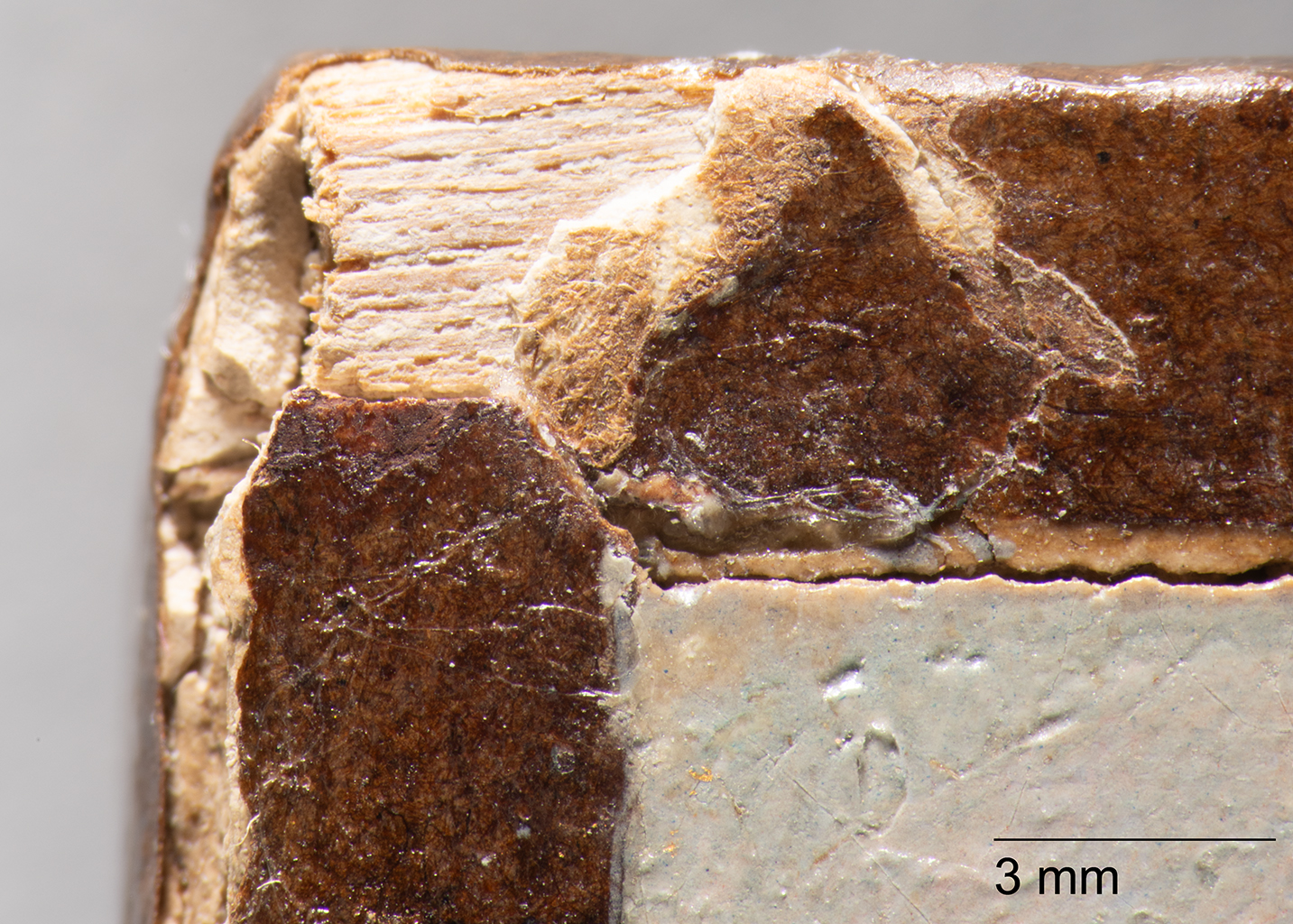
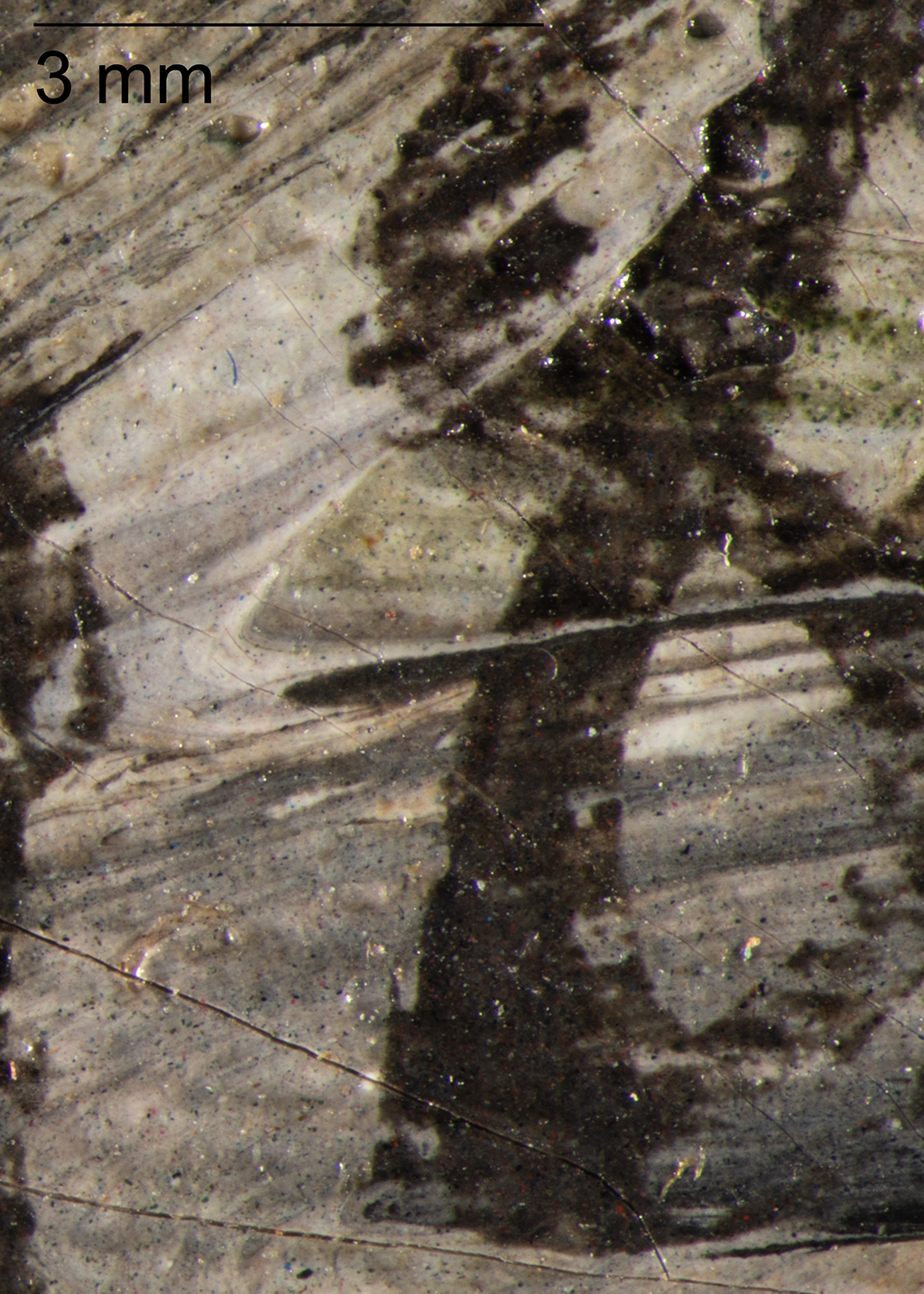
Ignoring the Marly Machine behind him, Pissarro painted this east-facing scene of the Seine on canvas tensioned to a five-member stretcherstretcher: A wooden structure to which the painting’s canvas is attached. Unlike strainers, stretchers can be expanded slightly at the joints to improve canvas tension and avoid sagging due to humidity changes or aging. with a vertical crossbar. The overall dimensions of the work correspond to a standard-formatstandard-format supports: Commercially prepared supports available through art suppliers, which gained popularity in the nineteenth century during the industrialization of art materials. Available in three formats figure (portrait), paysage (landscape), and marine (marine), these were numbered 1 through 120 to indicate their size. For each numbered size, marine and paysage had two options available: a larger format (haute) and smaller (basse) format. no. 8 paysage (46 x 33 cm), but the canvas and stretcher have been modified to meet these dimensions. Sometime before 1966 or 1967,1Swiss customs stamps were placed on top of the brown paper associated with the lining. If these are entry stamps, the painting must have been lined before it arrived in Zurich in 1966; if they are exit stamps, the painting must have been lined before it left Zurich in 1967. the original tacking marginstacking margins: The outer edges of canvas that wrap around and are attached to the stretcher or strainer with tacks or staples. See also tacking edge. were removed, and the painting was linedlining: A procedure used to reinforce a weakened canvas that involves adhering a second fabric support using adhesive, most often a glue-paste mixture, wax, or synthetic adhesive.. The painting was tensioned to the stretcher; then, a wood strip was secured to the top tacking margin to extend the height of the painting. Fill materialfill material: A material added to a loss of paint and/or ground to create an area level with the surrounding original paint. and retouchingretouching: Paint application by a conservator or restorer to cover losses and unify the original composition. Retouching is an aspect of conservation treatment that is aesthetic in nature and that differs from more limited procedures undertaken solely to stabilize original material. Sometimes referred to as inpainting or retouch. were added over the exposed lining fabric and a small sliver of the wood strip to marry them to the original work. Brown paper tape was subsequently applied to all the edges (Fig. 7). Compared to the overall size of the work, which is 32.9 x 46.0 cm, the original painted area measures approximately 31.6 x 45.1 cm, a difference of 1.3 cm in height and 1 cm in width.

Fig. 7. Photomicrograph of the top left corner of Waterworks of the Marly Machine at Bougival (1871). The wood addition attached to the tacking margin is visible where the brown tape has been torn.

The stretcher appears old, but it is not clear if it is original (reused after the lining) or a replacement. While it bears numerous labels and markings, the majority are found on top of the brown paper associated with the lining and therefore postdate that treatment. There are some markings on the wood itself, but there is not enough historical information to date them.

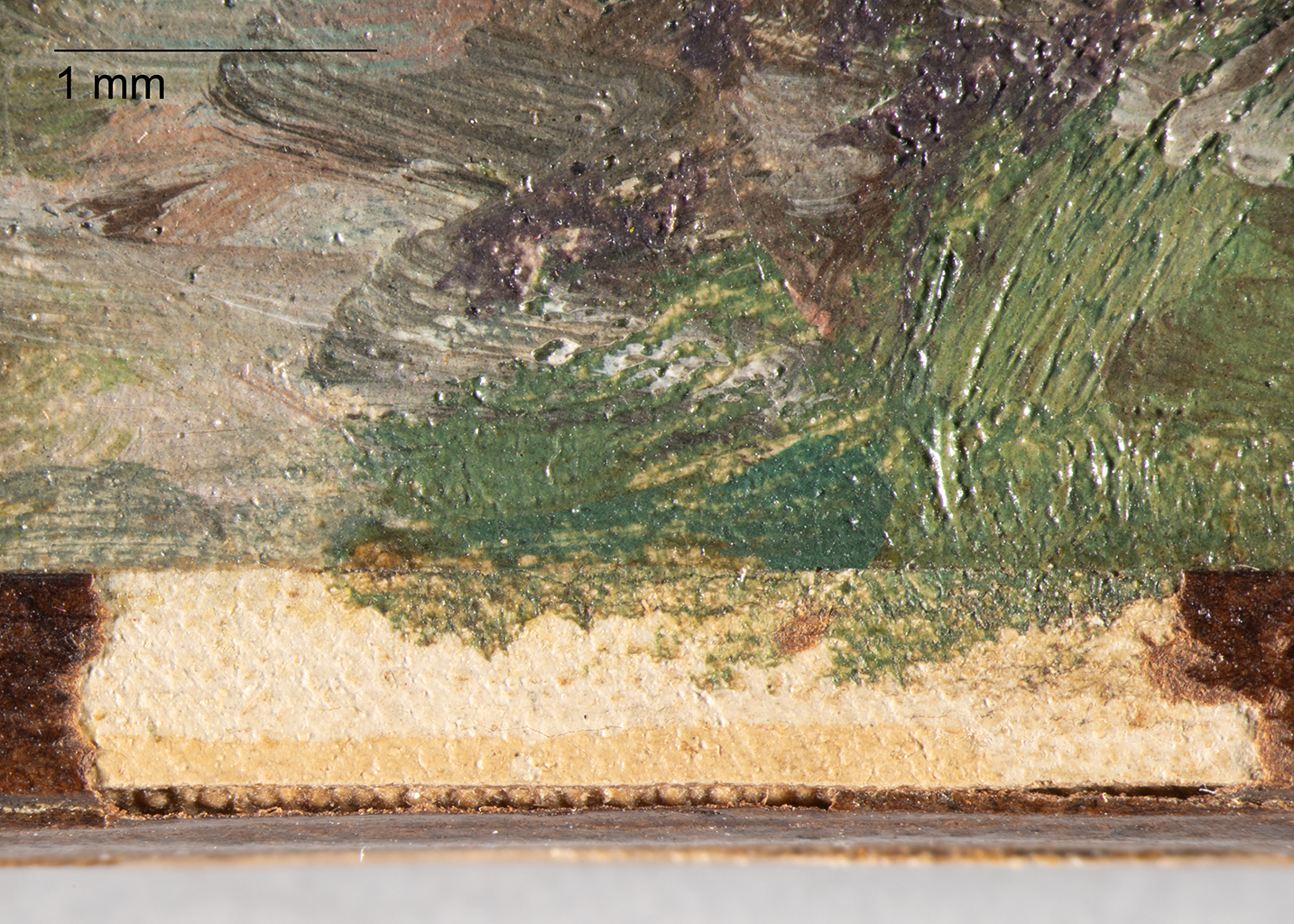
Fig. 8. Photomicrograph of the bottom edge of Waterworks of the Marly Machine at Bougival (1871), showing green brushstrokes that continue under the now-missing brown paper tape
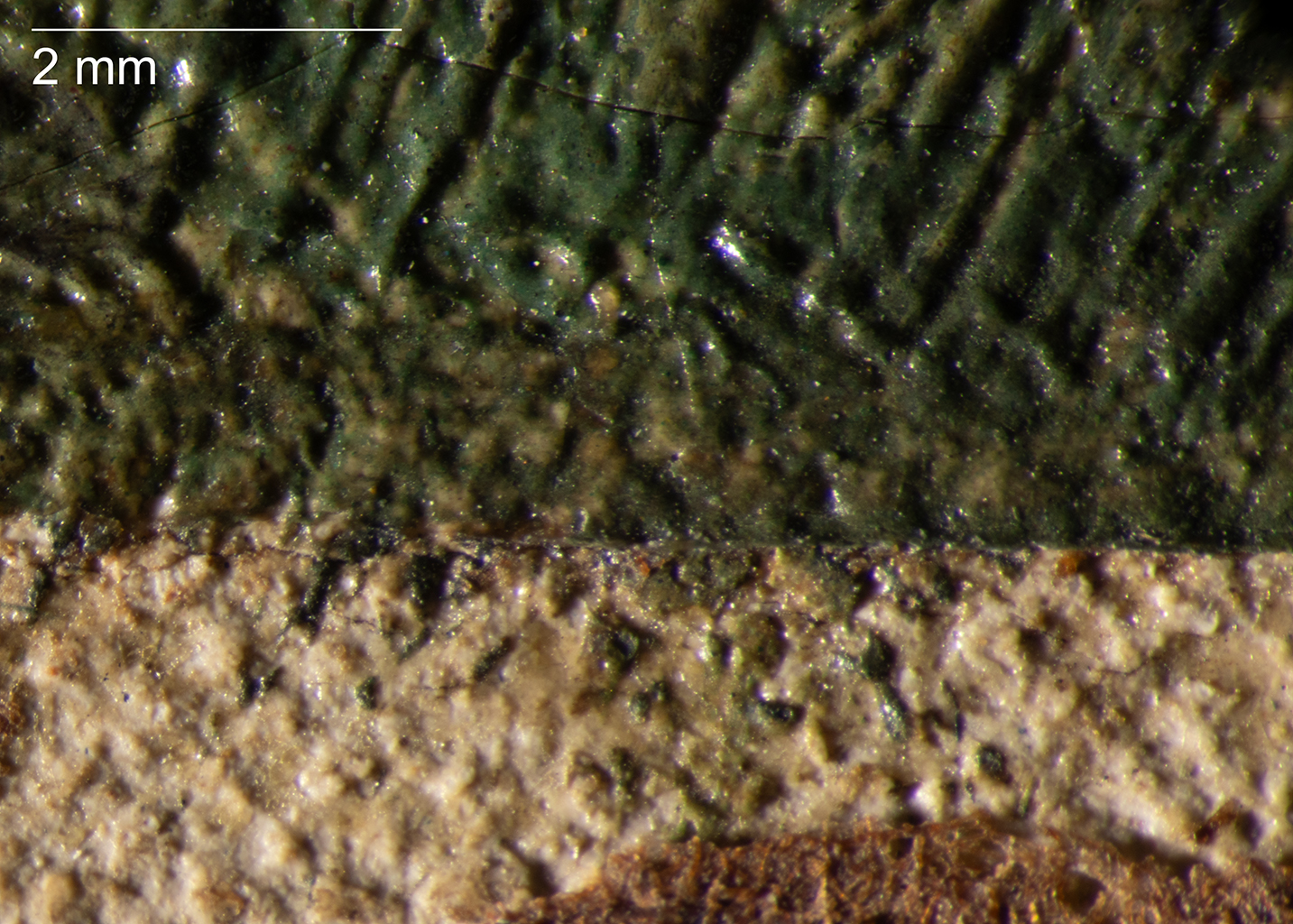
Fig. 9. Photomicrograph of the center of the bottom edge in raking light, Waterworks of the Marly Machine at Bougival (1871). The hard paint edge may be associated with the tape and an application of overpaint.

It is also difficult to estimate how much canvas was cropped during the lining process. Pissarro did not always paint to the edge of the picture plane, and he sometimes left exposed groundground layer: An opaque preparatory layer applied to the support, either commercially or by the artist, to prevent absorption of the paint into the canvas or panel. See also priming layer. that created irregular borders.2For a clear, contemporary example by Pissarro, see the right edge and lower left corner of Fox Hill, Upper Norwood (1870; National Gallery, London), https://www.nationalgallery.org.uk/paintings/camille-pissarro-fox-hill-upper-norwood. Although they were painted much later than Waterworks, the same technique is visible around the edges of two other pieces in the Nelson-Atkins Museum of Art, The Market at Pontoise (1895), https://doi.org/10.37764/78973.5.648.2088, and Rue Saint-Honoré, Sun Effect, Afternoon (1898), https://doi.org/10.37764/78973.5.650.2088. In Waterworks, uninterrupted brushstrokes continue onto the white ground on all edges (except possibly the top, which is obscured with fill and retouching), suggesting the canvas was flat, not folded around a stretcher, when they were applied (Fig. 8). In other words, the white ground along the perimeter of the composition appears to be part of the original picture planepicture plane: The two-dimensional surface where the artist applies paint. rather than part of the tacking margins. Despite the presence of these uninterrupted peripheral brushstrokes, most of the paint ends in an atypical straight edge that corresponds to the inner edge of the paper tape (Fig. 9). It is possible but unlikely that Pissarro initially painted on unstretched canvas, then stretched it before completing the painting. This would have achieved the two types of edges, but the hard edge is not characteristic of paint pushed over a turnover edgeturnover edge: The point at which the canvas begins to wrap around the stretcher, at the junction between the picture plane and tacking margin. See also foldover edge.. Instead, the straight edge looks as if it were formed by masking off the perimeter of the piece during painting and subsequently removing the masking, leaving a precise, raised lip of paint. With no literature or examples to suggest that the Impressionists masked the edges of their works, the most likely scenario is that overpaint was added after the brown tape was adhered along the edges. While the lack of paint on top of the paper is confusing, the paper may have been replaced or a thin second layer may have been added to cover stray brushstrokes. If this is the case, much of the paint near the edges may be later retouching, but because it is similar in age and medium to the original paint, it is not easily detectable at normal viewing distance in visible light, under ultraviolet radiationultraviolet (UV) radiation: A segment of the electromagnetic spectrum, just beyond the sensitivity of the human eye, with wavelengths ranging from 100–400 nanometers. For a description of its use in the study of art objects, see ultraviolet (UV) fluorescence or UV-induced visible fluorescence., or with infrared radiationinfrared radiation: A segment of the electromagnetic spectrum just beyond the red color that can be detected by the human eye. The wavelength region of 700- 2500 nanometers is most frequently used in the study of art. See infrared (IR) photography, infrared reflectography (IRR), and transmitted infrared photography.. Examination under magnification supports this theory, as an upper layer of paint near the top edge contains a red ocher not used elsewhere in the sky, and it is delaminatingdelamination: The separation of layers in a painting. Examples include separation of the original canvas from the lining canvas, or separation of the paint layer from the ground layer. from what is likely the surface of the original paint film (Fig. 10).

Fig. 10. Photomicrographs in raking light of Waterworks of the Marly Machine at Bougival (1871). Losses in the overpaint reveal the original paint of the sky in the top left corner (top) and the top center (bottom).
Fig. 11. Photomicrograph of the exposed ground of Waterworks of the Marly Machine at Bougival (1871). The ground appears slightly yellow due to residues of an old varnish layer.

The canvas was prepared with a white ground layer, which is visible around the perimeter where the brown tape has been removed. It also peeks through the paint layers in parts of the sky and middle ground. The ground appears warm in color because it is covered with remnants of a thin, discolored layer of varnish (Fig. 11).

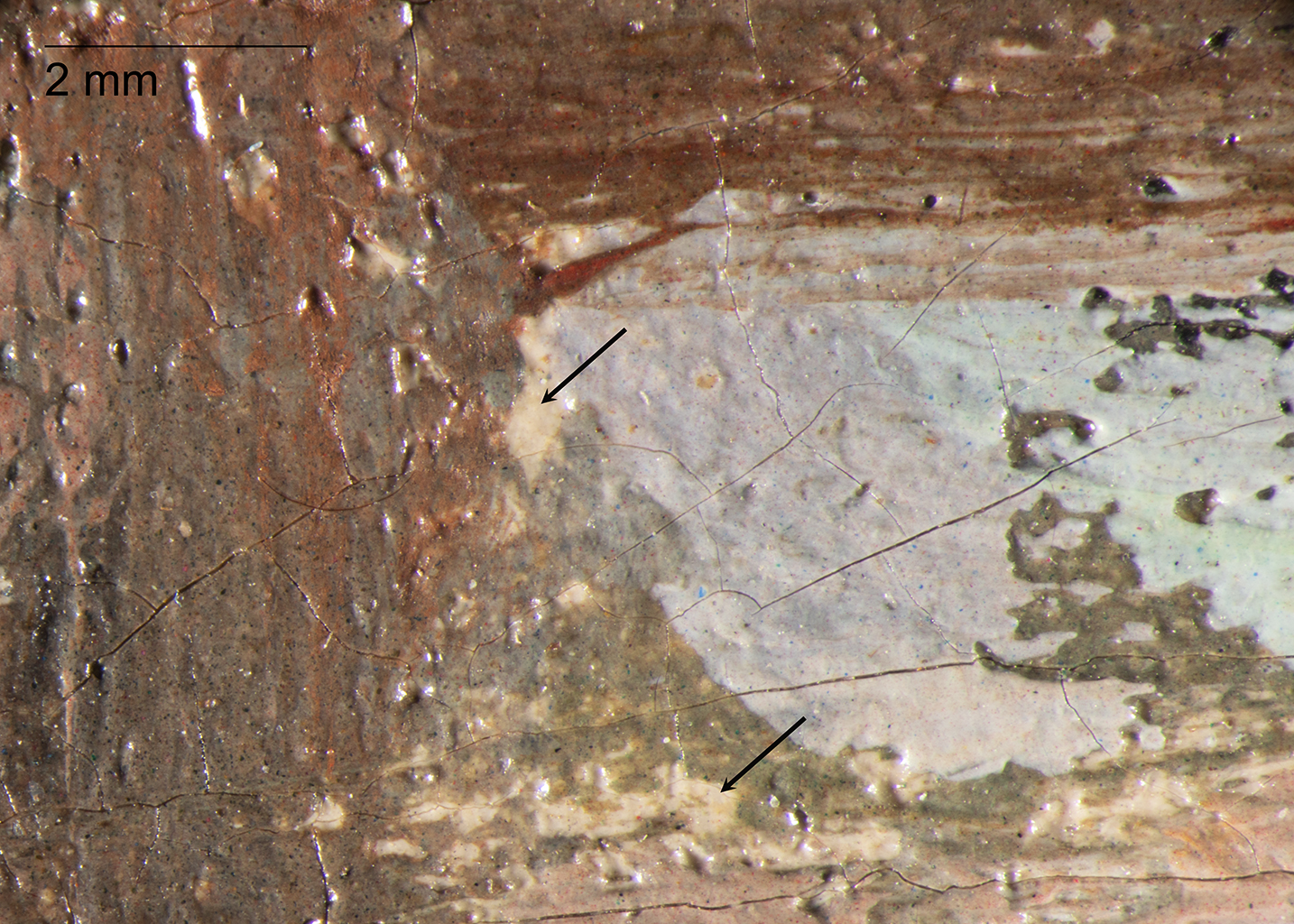
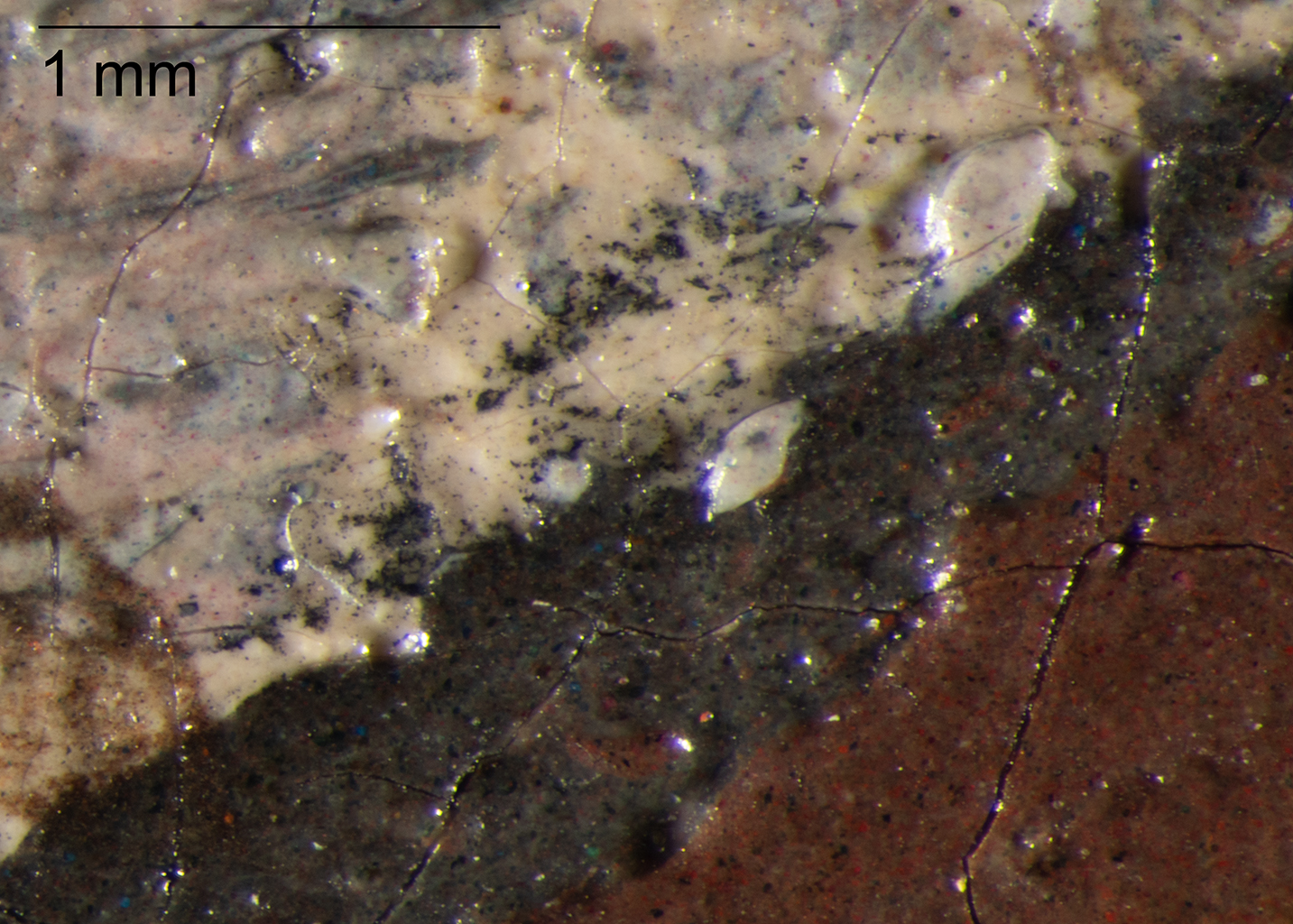
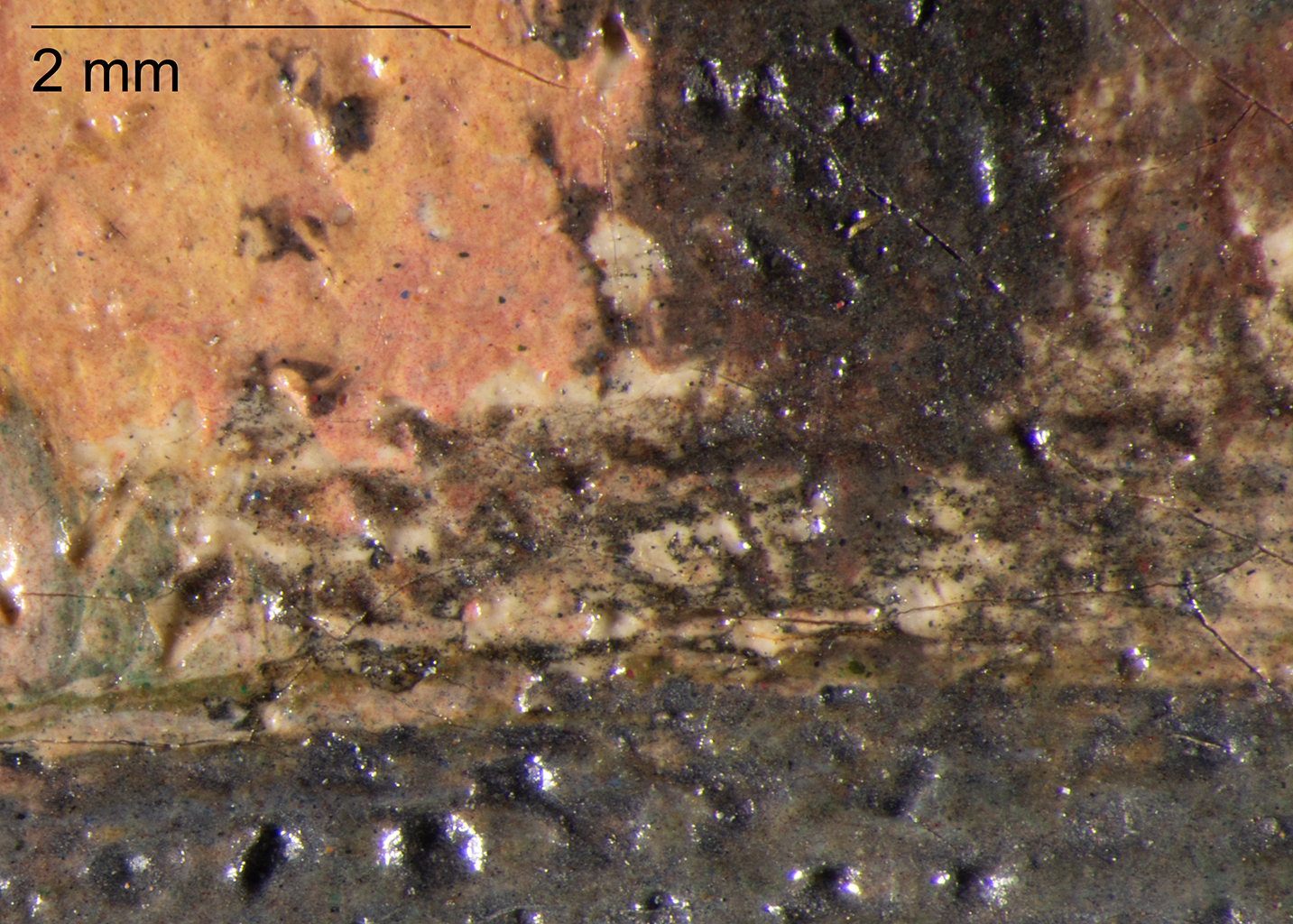
Underdrawingunderdrawing: A drawn or painted sketch beneath the paint layer. The underdrawing can be made from dry materials, such as graphite or charcoal, or wet materials, such as ink or paint. is visible on top of the ground layer. The black, splintery, unbound medium is visually consistent with charcoal (Fig. 12). In at least one instance (directly under the door of the leftmost building), the charcoal seems to have been mixed or reinforced with dilute umber paint (Fig. 13). Pissarro’s use of fluid underdrawing medium is well documented, although it was usually comprised of dry pigment and blue paint.3Mary Schafer, “Camille Pissarro, The Market at Pontoise (or The Market at Gisors), 1895,” technical entry in this catalogue, https://doi.org/10.37764/78973.5.648.2088. See also Alex Chipkin et al., “Woman Washing Her Feet in a Brook (1894),” in Paintings by the Pissarro Family: A Technical Catalogue (Indianapolis: Indianapolis Museum of Art at Newfields, 2024), https://pissarro.discovernewfields.org/technical-reports/48.17/. The major elements were then blocked in with paint, often leaving the ground exposed between the shapes.

Fig. 12. Photomicrograph of dry black underdrawing medium visible along the contour of the boom and resting on top of the ground layer, Waterworks of the Marly Machine at Bougival (1871)
Fig. 13. A mixture of fluid umber paint and a dry black medium was used for some of the preparatory sketching, visible directly under the door of the leftmost building, Waterworks of the Marly Machine at Bougival (1871)

Using thick paint with low impastoimpasto: A thick application of paint, often creating texture such as peaks and ridges., Pissarro built up the surface with various brushes and techniques. The broad strokes in the gate were formed by a much larger brush than the thin strokes comprising the shutters of the building. Pissarro applied paint wet-into-wetwet-into-wet: An oil painting technique which involves blending of colors on the picture surface., blending it to mirror the swirling water. Once the paint was slightly dry, he scraped, drybrushed, and scumbledscumble: A thin layer of opaque or semi-opaque paint that partially covers and modifies the underlying paint. to achieve various textures. The shadows under the roof of the leftmost building, for example, are drybrushed.

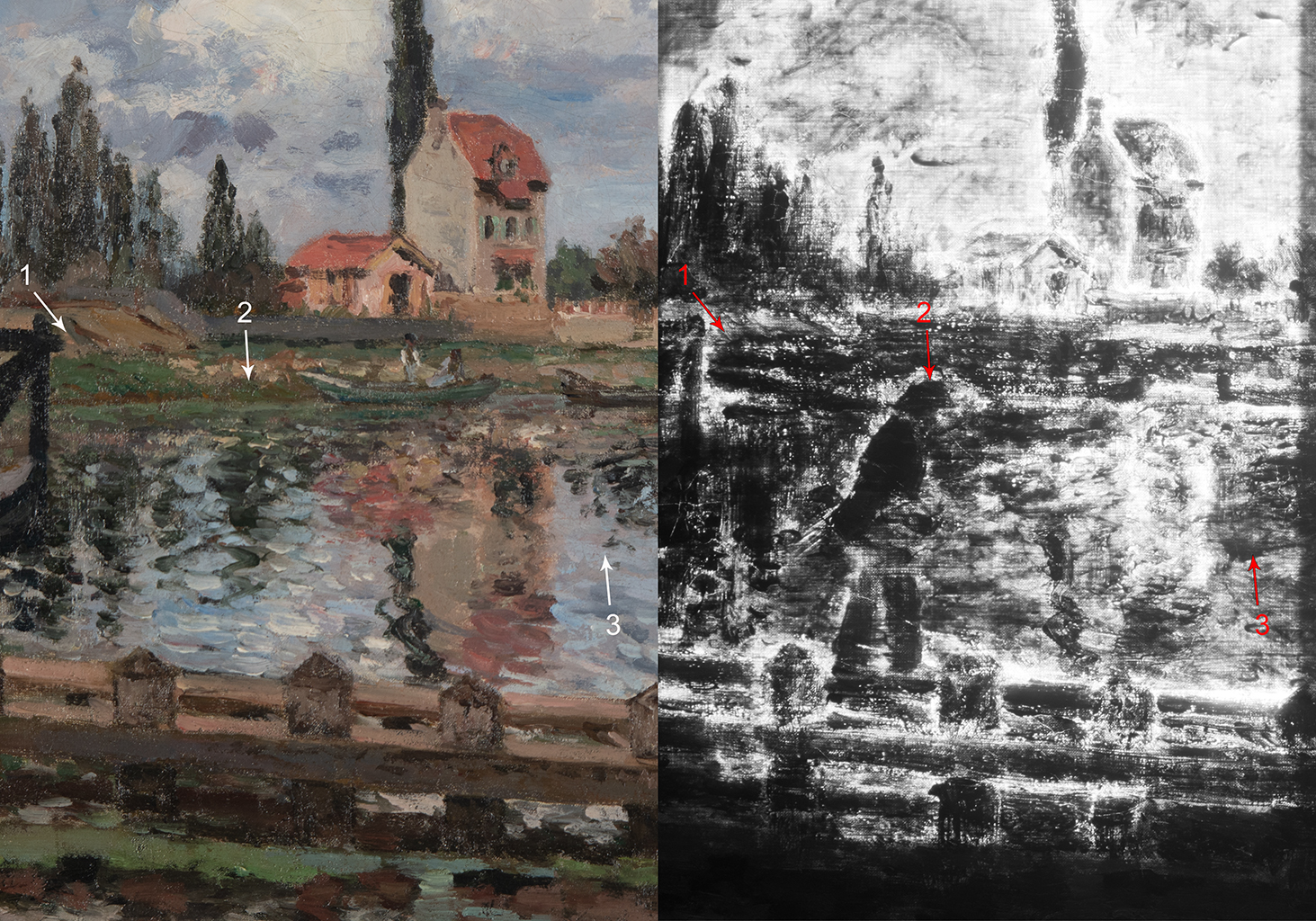
Fig. 14. Details of Waterworks of the Marly Machine at Bougival (1871) in visible light (left) and transmitted infrared (right). The structure at left was altered (1), a figure was painted out (2), and a boat may have been painted out (3).
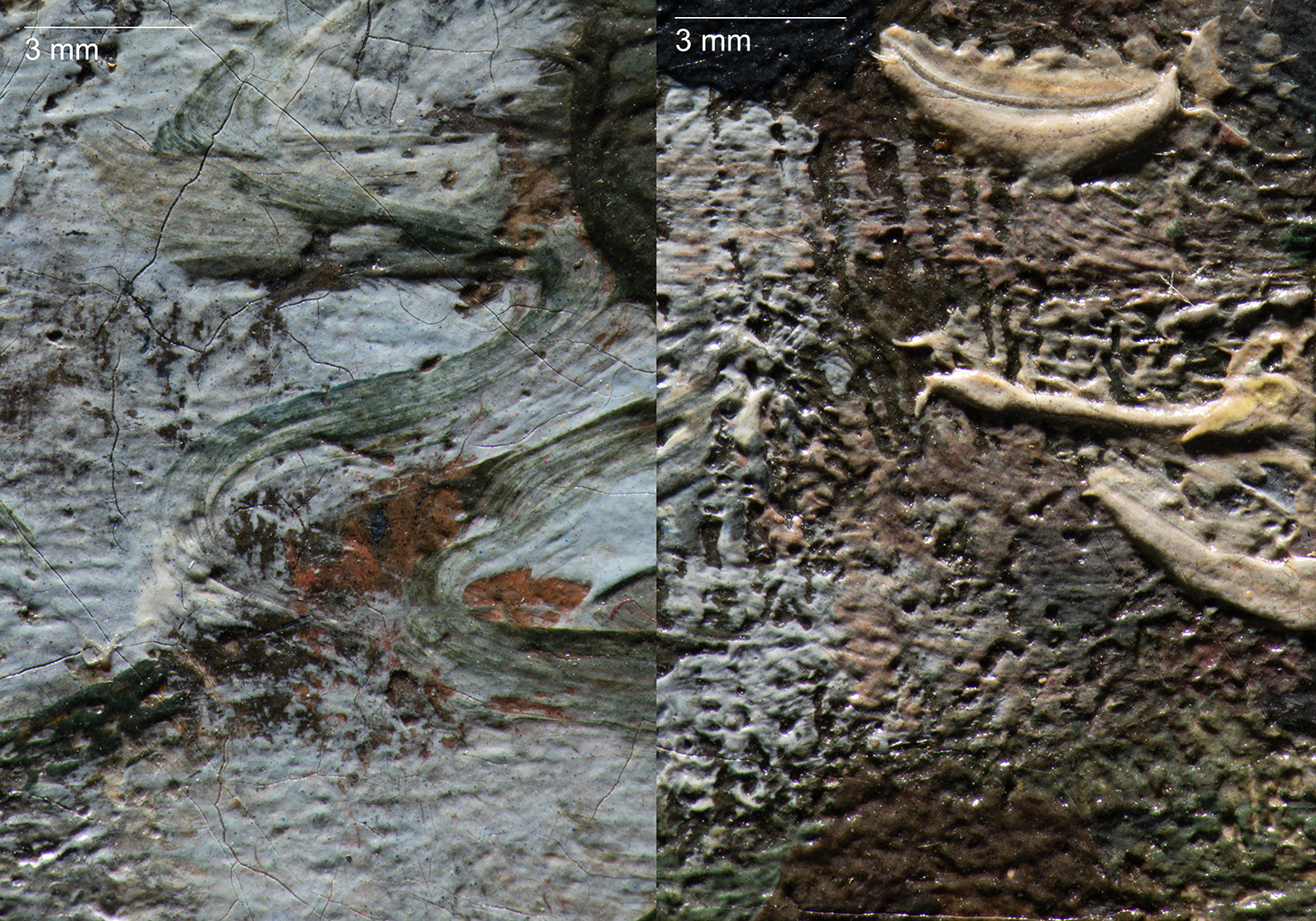
Fig. 15. Photomicrographs of the water in raking light, Waterworks of the Marly Machine at Bougival (1871). The area was scraped smooth and subsequently painted over, but unrelated color is still visible beneath the uppermost paint layers (left). A highly textured area that was painted wet-over-dry without scraping first is also present (right).

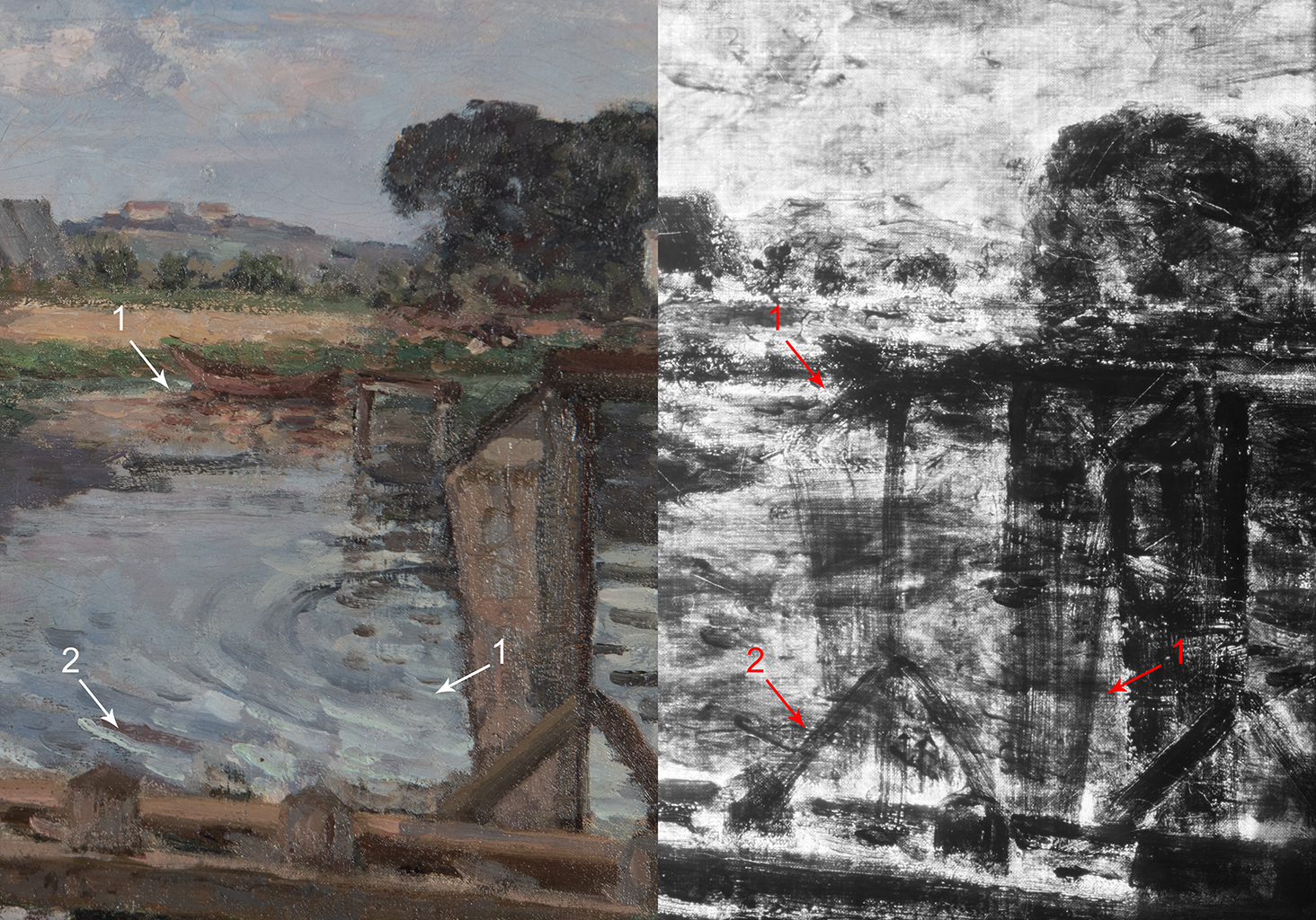
Despite his preparatory steps, the artist made significant changes after the initial painting session. At first, Pissarro painted a figure walking on the boom. The figure was planned, as evidenced by a halo of exposed ground surrounding it (which is visible using transmitted imagingtransmitted light: An examination technique in which light is projected through the painting to examine the painting substrate or to reveal variations in paint application. techniques). After the piece was allowed to dry, Pissarro painted out the figure. He seems to have made changes to the structure on the left of the figure, and he may have eliminated a boat on the right (Fig. 14). These sections are especially textured with some evidence of scraping and repainting (Fig. 15). Additionally, Pissarro painted out the original gate and part of the boom at the right side of the work and repositioned them to their current locations. (Fig. 16).

Fig. 16. Details of Waterworks of the Marly Machine at Bougival (1871) in visible light (left) and transmitted infrared (right). The gate (1) and boom (2) were painted out and repositioned.

Other minor changes were also painted wet-over-drywet-over-dry: An oil painting technique that involves layering paint over an already dried layer, resulting in no intermixing of paint or disruption to the lower paint strokes., such as the reduction in size of the tree grouping at the right edge and the shape of the boat beneath them. Pissarro applied sky blue over the edges of the roofs and trees in the middle ground to refine contours. He used the same color on top of the trees: the sky that seems to be visible through the trees is actually applied on top of them. There is a single incised line above the current gate. Since it is the only one, it is likely the result of an accidental scuff incurred while the paint was still tacky rather than an artifact of an artist-made change.

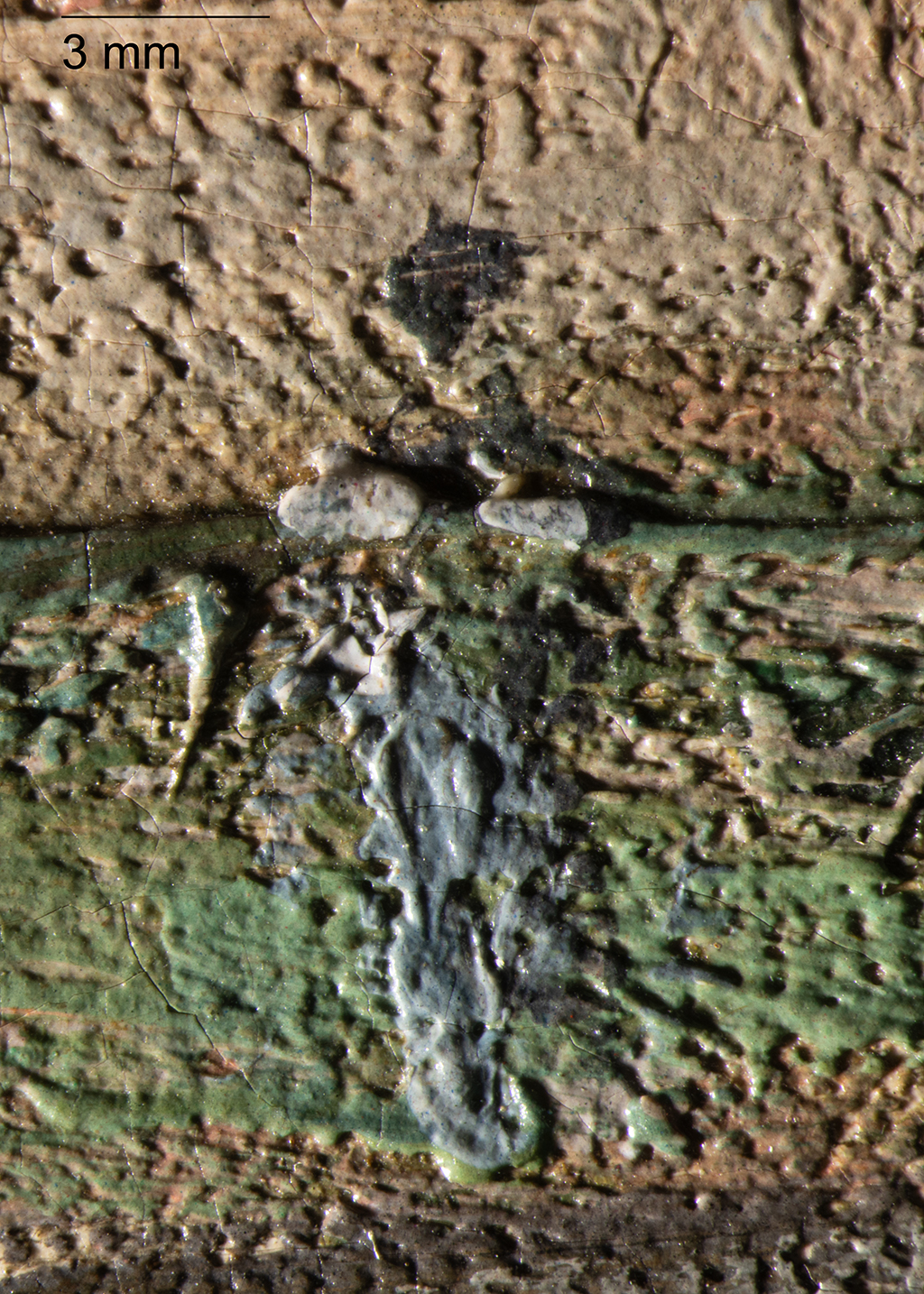
The last details were added wet-over-dry near the end of the painting process. At least one figure was painted over steep, dry peaks of paint (Fig. 17), and the thin, fluid paint used for the signature and date pooled in the low points of the underlying brushstrokes (Fig. 18).

Fig. 17. Photomicrograph in raking light of Waterworks of the Marly Machine at Bougival (1871), indicating that at least one figure was clearly added on top of a steep ridge of dry paint
Fig. 18. Photomicrograph of the signature and date of Waterworks of the Marly Machine at Bougival (1871), showing the thin, fluid paint conforming to the underlying brushstrokes

The lining is beginning to delaminate at the top edge. The impasto has been permanently affected by the heat and pressure of the lining campaign, and it now appears slightly flattened and rounded. There is an overall network of mechanical cracksmechanical cracks: Cracks, either localized or overall, that form in response to movement or stress., but the paint is stable and secure. Significant retouching (overpaint) is present at the perimeter of the painting, and in some areas of the sky, the retouching extends two inches into the picture plane (see Fig. 10). At some point in the past, a yellowed natural resin varnish was removed, leaving some residue in the interstices of the paint and exposed ground (see Fig. 11). Today, a synthetic coating applied prior to the painting’s acquisition remains on the surface.

Becca Goodman
October 2025

Notes

  1. Swiss customs stamps were placed on top of the brown paper associated with the lining. If these are entry stamps, the painting must have been lined before it arrived in Zurich in 1966; if they are exit stamps, the painting must have been lined before it left Zurich in 1967.

  2. For a clear, contemporary example by Pissarro, see the right edge and lower left corner of Fox Hill, Upper Norwood (1870; National Gallery, London), https://www.nationalgallery.org.uk/paintings/camille-pissarro-fox-hill-upper-norwood. Although they were painted much later than Waterworks, the same technique is visible around the edges of two other pieces in the Nelson-Atkins Museum of Art, The Market at Pontoise (1895), https://doi.org/10.37764/78973.5.648.2088 and Rue Saint-Honoré, Sun Effect, Afternoon (1898), https://doi.org/10.37764/78973.5.650.2088.

  3. Mary Schafer, “Camille Pissarro, The Market at Pontoise (or The Market at Gisors), 1895,” technical entry in this catalogue, https://doi.org/10.37764/78973.5.648.2088. See also Alex Chipkin et al., “Woman Washing Her Feet in a Brook (1894),” in Paintings by the Pissarro Family: A Technical Catalogue (Indianapolis: Indianapolis Museum of Art at Newfields, 2024), https://pissarro.discovernewfields.org/technical-reports/48.17/.

Documentation
Citation

Chicago:

Danielle Hampton Cullen, “Camille Pissarro, Waterworks of the Marly Machine at Bougival, 1871,” documentation in French Paintings and Pastels, 1600–1945: The Collections of the Nelson-Atkins Museum of Art, ed. Aimee Marcereau DeGalan (Kansas City: The Nelson-Atkins Museum of Art, 2023), https://doi.org/10.37764/78973.5.638.4033.

MLA:

Hampton Cullen, Danielle. “Camille Pissarro, Waterworks of the Marly Machine at Bougival, 1871,” documentation. French Paintings and Pastels, 1600–1945: The Collections of The Nelson-Atkins Museum of Art, edited by Aimee Marcereau DeGalan, Nelson-Atkins Museum of Art, 2023. doi: 10.37764/78973.5.638.4033.

Provenance

provenance

Citation

Chicago:

Danielle Hampton Cullen, “Camille Pissarro, Waterworks of the Marly Machine at Bougival, 1871,” documentation in French Paintings and Pastels, 1600–1945: The Collections of the Nelson-Atkins Museum of Art, ed. Aimee Marcereau DeGalan (Kansas City: The Nelson-Atkins Museum of Art, 2023), https://doi.org/10.37764/78973.5.638.4033.

MLA:

Hampton Cullen, Danielle. “Camille Pissarro, Waterworks of the Marly Machine at Bougival, 1871,” documentation. French Paintings and Pastels, 1600–1945: The Collections of The Nelson-Atkins Museum of Art, edited by Aimee Marcereau DeGalan, Nelson-Atkins Museum of Art, 2023. doi: 10.37764/78973.5.638.4033.

Georges Feydeau (1862–1921), Paris, by April 4, 1903;

Purchased at his sale, Catalogue des Tableaux Modernes, Aquarelles, Pastels, Dessins appartenant à M. Georges Feydeau, Hôtel Drouot, Paris, April 4, 1903, lot 39, as Barrage de la Seine à Pontoise, by M. Gobe[t]ski, April 4, 1903 [1];

With Raphaël Gérard, Paris [2];

With Galerie Étienne Bignou, Paris, by October 18, 1933;

Purchased from Bignou by Kunsthandel Paul Cassirer, Amsterdam, as Port de Marly, October 18, 1933–July 1934 [3];

Purchased from Kunsthandel Paul Cassirer by Robert “Rudi” Maas (1878–1940), Amsterdam, July 1934–40 [4];

Inherited by his wife, Elisabeth “Lili” Maas (née Jonas, 1885–1954), Amsterdam, 1940–at least 1942 [5];

Prof. Dr. Boss, Zürich, by September 30, 1966 [6];

Purchased from Boss by Marlborough Fine Art Galerie, Zürich, September 30, 1966–July 19, 1967 [7];

Purchased from Marlborough by Thomas D. Neelands Jr. (1902–72), New York, July 19, 1967–72;

Purchased at his posthumous sale, Important 19th and 20th Century Paintings, Drawings and Sculpture, Sotheby Parke-Bernet, New York, April 26, 1972, lot 6, as Barrage sur la Seine à Bougival, by Wildenstein and Co., New York, 1972–May 20, 1987 [8];

Purchased from Wildenstein by Marion (née Helzberg, 1931–2013) and Henry (1922–2019) Bloch, Shawnee Mission, KS, May 20, 1987–June 15, 2015;

Their gift to The Nelson-Atkins Museum of Art, Kansas City, MO, 2015.

Notes

[1] In both the annotated catalogues for his 1903 sale, it is uncertain how the buyer’s name is spelled: either M. Gobetski or M. Gobeski; see copies in NAMA curatorial files. The buyer may have been a member of the artistic Godebski family, whose name was often misspelled in contemporary journals. Sculptor “Cyprian” Quentin Godebski (1835–1909) or his son and composer, François Joseph Joachim “Cyprien” Godebski (1866–1948) are likely candidates. The younger Godebski was in the same social circles as Feydeau. Other candidates are Cyprien’s daughter and pianist, Maria Sofia Olga Zenaida Godebski (1872–1950; later known as Misia Sert), who was also a friend and model to Pierre-Auguste Renoir; or Cyprian’s eldest son, Cyrien Xavier Leonard Godebski (1875–1937), who was a literary man and friends with the Post-Impressionists.

[2] For constituent, see Joachim Pissarro and Claire Durand-Ruel Snollaerts, Pissarro: Critical Catalogue of Paintings (Paris: Wildenstein Institute Publications, 2005), no. 203, p. 2:173.

[3] See email from Walter Feilchenfeldt Jr. to Danielle Hampton Cullen, April 21, 2021, NAMA curatorial files. Walter Feilchenfeldt Sr. was head of Kunstsalon Paul Cassirer, Berlin, from 1926 until 1933, when Hitler’s rise to power forced him to resign from the Berlin firm. The head of the firm became Grete Ring. Feilchenfeldt worked primarily at the Amsterdam branch until 1939, and in 1948, he established his own gallery in Zürich. See http://www.walterfeilchenfeldt.ch/gallery/.

[4] Rudi and Lili Maas were clients of Walter Feilchenfeldt, who looked after their collection, which, beginning before World War II, was in storage with Kunsthandel Paul Cassirer, Amsterdam (the gallery was directed by Dr. Helmuth Lütjens). Rudi and Lili Maas emigrated to California in 1938, but the painting remained in Amsterdam. Feilchenfeldt made notes about the collections he looked after during the war. The Pissarro “Port de Marly” is recorded in the “Maas Collection” twice, in 1937 and 1942. See email from Walter Feilchenfeldt Jr. to Danielle Hampton Cullen, April 20, 2021, NAMA curatorial files.

[5] Robert Maas died in 1940. It is not clear when the painting left Paul Cassirer, Amsterdam, and if or when it was shipped to his widow; see email from Walter Feilchenfeldt Jr. to Danielle Hampton Cullen, April 20, 2021, NAMA curatorial files.

[6] Marlborough Fine Art Galerie identified the collector as “Prof. Dr. Boss, Zürich;” see email from Franz K. Plutschow, director, Marlborough International Fine Art, to Mackenzie Mallon, April 21, 2015, NAMA curatorial files.

This might be Prof. Dr. Medard Boss (1903–90), Zürich, a renowned Swiss psychoanalytic psychiatrist who was a medical faculty member at the University of Zürich. Boss was also an art collector. In 1959, he was a visiting professor at Harvard University, Cambridge, MA; at the University of Washington, Medical School, Washington, DC; and at the University of Madison, WI. That same year, the painting was lent to Wildenstein in New York, although Wildenstein does not have records on the identity of the lender, and the museum is unable to make a direct connection to Medard Boss. See email from Joseph Baillio, Wildenstein and Co., to MacKenzie Mallon, May 4, 2015, NAMA curatorial files.

[7] See email from Franz K. Plutschow, director, Marlborough International Fine Art, to MacKenzie Mallon, April 21, 2015, NAMA curatorial files.

[8] See email from Joseph Baillio, Wildenstein and Co., to Mackenzie Mallon, May 4, 2015, NAMA curatorial files.

Related Works
Citation

Chicago:

Danielle Hampton Cullen, “Camille Pissarro, Waterworks of the Marly Machine at Bougival, 1871,” documentation in French Paintings and Pastels, 1600–1945: The Collections of the Nelson-Atkins Museum of Art, ed. Aimee Marcereau DeGalan (Kansas City: The Nelson-Atkins Museum of Art, 2023), https://doi.org/10.37764/78973.5.638.4033.

MLA:

Hampton Cullen, Danielle. “Camille Pissarro, Waterworks of the Marly Machine at Bougival, 1871,” documentation. French Paintings and Pastels, 1600–1945: The Collections of The Nelson-Atkins Museum of Art, edited by Aimee Marcereau DeGalan, Nelson-Atkins Museum of Art, 2023. doi: 10.37764/78973.5.638.4033.

Camille Pissarro, The Seine at Bougival, 1870, oil on canvas, 20 1/4 x 32 3/8 in. (51.4 x 82.2 cm), Artizon Musuem, Tokyo.

Camille Pissarro, Barges on the Seine at Bougival, 1871, oil on canvas, 16 7/8 x 23 3/8 in. (43 x 59.5 cm), illustrated in Impressionist and Modern Art Evening Sale (New York: Sotheby’s, June 23, 2014), 190, (repro.).

Camille Pissarro, The Seine at Bougival, 1871, oil on canvas, 17 3/8 x 23 5/8 in. (44 x 60 cm), private collection, Switzerland.

Exhibitions
Citation

Chicago:

Danielle Hampton Cullen, “Camille Pissarro, Waterworks of the Marly Machine at Bougival, 1871,” documentation in French Paintings and Pastels, 1600–1945: The Collections of the Nelson-Atkins Museum of Art, ed. Aimee Marcereau DeGalan (Kansas City: The Nelson-Atkins Museum of Art, 2023), https://doi.org/10.37764/78973.5.638.4033.

MLA:

Hampton Cullen, Danielle. “Camille Pissarro, Waterworks of the Marly Machine at Bougival, 1871,” documentation. French Paintings and Pastels, 1600–1945: The Collections of The Nelson-Atkins Museum of Art, edited by Aimee Marcereau DeGalan, Nelson-Atkins Museum of Art, 2023. doi: 10.37764/78973.5.638.4033.

Possibly Exposition de tableaux par C. Pissarro, Bernheim-Jeune, Paris, March 22–April 15, 1899, no. 16, as Barrage à Pontoise.

Contrasts in Landscape: 19th and 20th Century Paintings and Drawings, Wildenstein, New York, closed October 31, 1959, no. 11, as The Banks of the Seine at Bougival.

Nature as Scene: French Landscape Painting from Poussin to Bonnard , Wildenstein, New York, October 29–December 6, 1975, no. 48, as The Weir on the Seine at Bougival.

Impressionists on the Seine: A Celebration of Renoir’s “Luncheon of the Boating Party,” The Phillips Collection, Washington, DC, September 21, 1996–February 23, 1997, no. 5, as The Lock on the Seine at Bougival.

Manet to Matisse: Impressionist Masters from the Marion and Henry Bloch Collection, The Nelson-Atkins Museum of Art, Kansas City, MO, June 9–September 9, 2007, no. 6, as Banks of the Seine at Port Marly (Au bord de la Seine à Port Marly).

References

references

Citation

Chicago:

Danielle Hampton Cullen, “Camille Pissarro, Waterworks of the Marly Machine at Bougival, 1871,” documentation in French Paintings and Pastels, 1600–1945: The Collections of the Nelson-Atkins Museum of Art, ed. Aimee Marcereau DeGalan (Kansas City: The Nelson-Atkins Museum of Art, 2023), https://doi.org/10.37764/78973.5.638.4033.

MLA:

Hampton Cullen, Danielle. “Camille Pissarro, Waterworks of the Marly Machine at Bougival, 1871,” documentation. French Paintings and Pastels, 1600–1945: The Collections of The Nelson-Atkins Museum of Art, edited by Aimee Marcereau DeGalan, Nelson-Atkins Museum of Art, 2023. doi: 10.37764/78973.5.638.4033.

Possibly Exposition de tableaux par C. Pissarro, exh. cat. (Paris: Bernheim-Jeune, 1899), unpaginated, as Barrage à Pontoise.

Catalogue des Tableaux Modernes, Aquarelles, Pastels, Dessins appartenant à M. Georges Feydeau (Paris: Hôtel Drouot, 1903), 26, (repro.), as Barrage de la Seine à Pontoise.

Le Bonhomme, “La vie de Paris,” Le Figaro 49, no. 93 (April 3, 1903): 1.

T. S., “La Collection Feydeau,” Le Temps 43, no. 15,267 (April 3, 1903): [2], as Barrage de la Seine à Pontoise.

“Pour les Collectionneurs et les amateurs,” Journal des artistes 28, no. 15 (April 19, 1903): 4093, as Barrage de la Seine à Pontoise.

G. R., “A Chronicle of the Hôtel Drouot,” Burlington Gazette 1, no. 2 (May 1903): 58.

Ludovic Rodo Pissarro and Lionello Venturi, Camille Pissarro, Son Art—Son Œuvre (Paris: Paul Rosenberg, 1939), no. 125, pp. 1:97, 2: unpaginated, (repro.), as Barrage sur la Seine a [sic] Bougival.

Contrasts in Landscape: 19th and 20th Century Paintings and Drawings, exh. cat. (New York: Wildenstein, 1959), unpaginated, as Barrage of the Seine at Bougival.

Important 19th and 20th Century Paintings, Drawings, and Sculpture (New York: Sotheby, Parke-Bernet, 1972), 22–23, (repro.), as Barrage sur la Seine a [sic] Bougival.

Jacques Lorcey, “Feydeau Peinture et Collectionneur,” Bulletin de la société d’étude et de promotion des arts du spectacle 8 (1973): 39, as Barrage de la Seine à Pontoise.

Nature as Scene: French Landscape Painting from Poussin to Bonnard, exh. cat. (New York: Wildenstein, 1975), unpaginated, as The Weir on the Seine at Bougival.

Ralph E. Shikes and Paula Harper, Pissarro, His Life and Work (New York: Horizon Press, 1980), 97, (repro.), as Dam on the Seine at Louveciennes.

John Rewald et al., Camille Pissarro, 1830-1903, exh. cat. (London: Arts Council of Great Britain, 1980), 86.

Ludovico Rodo Pissarro and Lionello Venturi, Camille Pissarro, Son Art—Son Œuvre, 2nd rev. ed. (San Francisco: Alan Wofsy Fine Arts, 1989), no. 125, pp. 1:97, 2: unpaginated, (repro.), as Barrage sur la Seine a [sic] Bougival.

Richard R. Brettell and Joachim Pissarro, Pissarro and Pontoise: The Painter in a Landscape (New Haven: Yale University Press, 1990), 41, 206n14.

Henry Gidel, Georges Feydeau (Paris: Flammarion, 1991), 187.

Eliza Rathbone et al., Impressionists on the Seine: A Celebration of Renoir’s Luncheon of the Boating Party, exh. cat. (Washington, DC: Counterpoint, 1996), 258, (repro.), as The Lock on the Seine at Bougival.

Jacques Lorcey, L’homme de chez Maxim’s: Georges Feydeau, sa vie (Paris: Séguier, 2004), 1:180.

Joachim Pissarro and Claire Durand-Ruel Snollaerts, Pissarro: Critical Catalogue of Paintings (Paris: Wildenstein Institute Publications, 2005), no. 203, pp. 2:173, 3: 393, 402, 419, (repro.), as Barrage sur la Seine à Bougival.

Rebecca Dimling Cochran and Bobbie Leigh, “100 Top Collectors who have made a difference,” Art and Antiques (March 2006): 90.

Bobbie Leigh, “Magnificent Obsession,” Art and Antiques 29, no. 6 (June 2006): 60, 65, (repro.), as Lock on the Seine at Bougival.

Alice Thorson, “A final countdown—A rare showing of Impressionist paintings from the private collection of Henry and Marion Bloch is one of the inaugural exhibitions at the 165,000-square-foot glass-and-steel structure,” Kansas City Star (June 29, 2006): B1.

“Inaugural Exhibitions Celebrate Kansas City,” Member Magazine (The Nelson-Atkins Museum of Art) (Fall 2006): 3.

Richard R. Brettell and Joachim Pissarro, Manet to Matisse: Impressionist Masters from the Marion and Henry Bloch Collection, exh. cat. (Kansas City, MO: Nelson-Atkins Museum of Art, 2007), 10–11, 13, 48–51, 70, 156, (repro.), as Banks of the Seine at Port Marly (Au bord de la Seine à Port Marly).

Alice Thorson, “A Tiny Renoir Began an Impressive Obsession,” Kansas City Star (June 3, 2007): E4, (repro.), as Banks of the Seine at Port Marly.

“Lasting Impressions: A Tribute to Marion and Henry Bloch,” Member Magazine (The Nelson-Atkins Museum of Art) (Fall 2007): 11–12.

Steve Paul, “Pretty Pictures: Marion and Henry Bloch’s Collection of Superb Impressionist Masters,” Panache 4, no. 3 (Fall 2007): 20.

Alice Thorson, “Museum to Get 29 Impressionist Works from the Bloch Collection,” Kansas City Star (February 5, 2010): A1, as Banks of the Seine at Port Marly.

Carol Vogel, “Inside Art: Kansas City Riches,” New York Times 159, no. 54,942 (February 5, 2010): C26.

Thomas M. Bloch, Many Happy Returns: The Story of Henry Bloch, America’s Tax Man (Hoboken, NJ: John Wiley and Sons, 2011), 175.

Diane Stafford, “Bloch Gift to Go for Nelson Upgrade,” Kansas City Star 135, no. 203 (April 8, 2015): A8.

“Nelson-Atkins Museum of Art Officially Accessions Bloch Impressionist Masterpieces,” Artdaily.org (July 25, 2015): http://artdaily.com/news/80246/Nelson-Atkins-Museum-of-Art-officially-accessions-Bloch-Impressionist-masterpieces#.V6oGwlKFO9I.

Julie Paulais, “Le Nelson-Atkins Museum of Art reçoit des tableaux impressionnistes en échange de leurs répliques,” Le Journal des arts (July 30, 2015): http://www.lejournaldesarts.fr/site/archives/docs_article/129801/le-nelson-atkins-museum-of-art-recoit-des-tableaux-impressionnistes-en-echange-de-leurs-repliques.php.

Josh Niland, “The Nelson-Atkins Museum of Art Acquires a Renowned Collection of Impressionist and Postimpressionist Art,” architecturaldigest.com (August 6, 2015): https://www.architecturaldigest.com/story/nelson-atkins-museum-accessions-bloch-art-collection.

Nina Siegal, “Upon Closer Review, Credit Goes to Bosch,” New York Times 165, no. 57130 (February 2, 2016): C5.

“Nelson-Atkins to unveil renovated Bloch Galleries of European Art in winter 2017,” Artdaily.org (July 20, 2016): http://artdaily.com/news/88852/Nelson-Atkins-to-unveil-renovated-Bloch-Galleries-of-European-Art-in-winter-2017-#.W-NDepNKhaQ.

“Nelson-Atkins Museum of Art celebrates generosity of Henry Bloch with new acquisition,” Artdaily.org (October 18, 2016): http://artdaily.com/news/90923/Nelson-Atkins-Museum-of-Art-celebrates-generosity-of-Henry-Bloch-with-new-acquisition#.W-NDv5NKhaQ.

Catherine Futter et al., Bloch Galleries: Highlights from the Collection of the Nelson-Atkins Museum of Art (Kansas City, MO: Nelson-Atkins Museum of Art, 2016), 72, (repro.), as Banks of the Seine at Port Marly.

Kelly Crow, “Museum Rewards Donor with Fake Art to Hang at Home,” Wall Street Journal (January 25, 2017): https://www.wsj.com/articles/museum-rewards-donor-with-fake-art-to-hang-at-home-1485370768.

Albert Hect, “Henry Bloch’s Masterpieces Collection to Go on Display at Nelson-Atkins Museum,” Jewish Business News (February 26, 2017): http://jewishbusinessnews.com/2017/02/26/henry-bloch-masterpieces-collection/.

David Frese, “Inside the Bloch Galleries: An interactive experience,” Kansas City Star 137, no. 169 (March 5, 2017): 1D, 4D, (repro.), as Banks of the Seine at Port Marly.

“Editorial: Thank you, Henry and Marion Bloch,” Kansas City Star (March 7, 2017): http://www.kansascity.com/opinion/editorials/article137040948.html [repr., “Thank you, Henry and Marion Bloch,” Kansas City Star 137, no. 172 (March 8, 2017): 16A].

Hampton Stevens, “(Not Actually) 12 Things To Do During The Big 12 Tournament,” Flatland: KCPT’s Digital Magazine (March 9, 2017): http://www.flatlandkc.org/arts-culture/sports/not-actually-12-big-12-tournament/.

Laura Spencer, “The Nelson-Atkins’ Bloch Galleries feature Old Masterworks and New Technology,” KCUR (March 10, 2017): http://kcur.org/post/nelson-atkins-bloch-galleries-feature-old-masterworks-and-new-technology#stream/0.

Victoria Stapley-Brown, “Nelson-Atkins Museum’s new European art galleries come with a ‘love story’,” Art Newspaper (March 10, 2017): http://theartnewspaper.com/news/museums/nelson-atkins-museum-s-new-european-art-galleries-come-with-a-love-story/.

Harry Bellet, “Don du ciel pour le Musée Nelson-Atkins,” Le Monde (March 13, 2017): http://www.lemonde.fr/arts/article/2017/03/13/don-du-ciel-pour-le-musee-nelson-atkins_5093543_1655012.html.

Menachem Wecker, “Jewish Philanthropist Establishes Kansas City as Cultural Mecca,” Forward (March 14, 2017): http://forward.com/culture/365264/jewish-philanthropist-establishes-kansas-city-as-cultural-mecca/ [repr., in Menachem Wecker, “Kansas City Collection Is A Chip Off the Old Bloch,” Forward (March 17, 2017): 20–22], as Banks of the Seine at Port Marly.

Juliet Helmke, “The Bloch Collection Takes up Residence in Kansas City’s Nelson Atkins Museum,” BoulinArtInfo International (March 15, 2017): http://www.blouinartinfo.com/news/story/2005267/the-bloch-collection-takes-up-residence-in-kansas-citys.

Erich Hatala Matthes, “Digital replicas are not soulless—they help us engage with art,” Apollo (March 23, 2017): https://www.apollo-magazine.com/digital-replicas-3d-printing-original-artworks/.

Louise Nicholson, “How Kansas City got its magnificent museum,” Apollo (April 7, 2017): https://www.apollo-magazine.com/how-kansas-city-got-its-magnificent-museum/.

Lilly Wei, “Julián Zugazagoitia: ‘Museums should generate interest and open a door that leads to further learning’,” Studio International (August 21, 2017): http://studiointernational.com/index.php/julian-zugazagoitia-director-nelson-atkins-museum-of-art-kansas-city-interview.

Robert D. Hershey Jr., “Henry Bloch, H&R Block’s cofounder, dies at 96,” Boston Globe (April 23, 2019): https://www3.bostonglobe.com/metro/obituaries/2019/04/23/henry-bloch-block-cofounder/?arc404=true.

Robert D. Hershey Jr., “Henry W. Bloch, Tax-Preparation Pioneer (and Pitchman), Is Dead at 96,” New York Times (April 23, 2019): https://www.nytimes.com/2019/04/23/obituaries/henry-w-bloch-dead.html.

Claire Selvin, “Henry Wollman Bloch, Collector and Prominent Benefactor of Nelson-Atkins Museum of Art, Is Dead at 96,” ArtNews (April 23, 2019): http://www.artnews.com/2019/04/23/henry-bloch-dead-96/.

Eric Adler and Joyce Smith, “Henry Bloch, co-founder of H&R Block, dies at 96,” Kansas City Star 139, no. 219 (April 24, 2019): 1A.

“Henry Wollman Bloch (1922-2019),” Art Forum (April 24, 2019): https://www.artforum.com/news/henry-wollman-bloch-1922-2019-79547.

Frank Morris, “Henry Bloch, Co-Founder Of H&R Block, Dies At 96,” npr.org (April 24, 2019): https://www.npr.org/2019/04/24/716641448/henry-bloch-co-founder-of-h-r-block-dies-at-96.

Ignacio Villarreal, “Nelson-Atkins mourns loss of Henry Bloch,” ArtDaily.org (April 24, 2019): http://artdaily.com/news/113035/Nelson-Atkins-mourns-loss-of-Henry-Bloch#.XMB76qR7laQ

Eric Adler and Joyce Smith, “H&R Bloch co-founder, philanthropist Bloch dies,” Cass County Democrat Missourian 140, no. 29 (April 26, 2019): 1A

Eric Adler and Joyce Smith, “KC businessman and philanthropist Henry Bloch dies,” Lee’s Summit Journal 132, no. 79 (April 26, 2019): 3A, (repro.).

Luke Nozicka, “Family and friends remember Henry Bloch of H&R Block,” Kansas City Star 139, no. 225 (April 30, 2019): 4A [repr., Luke Nozicka, “Family and friends remember Henry Bloch of H&R Block,” Kansas City Star 139, no. 228 (May 3, 2019): 3A].

Eric Adler, “Sold for $3.25 million, Bloch’s home in Mission Hills may be torn down,” Kansas City Star 141, no. 90 (December 16, 2020): 2A.
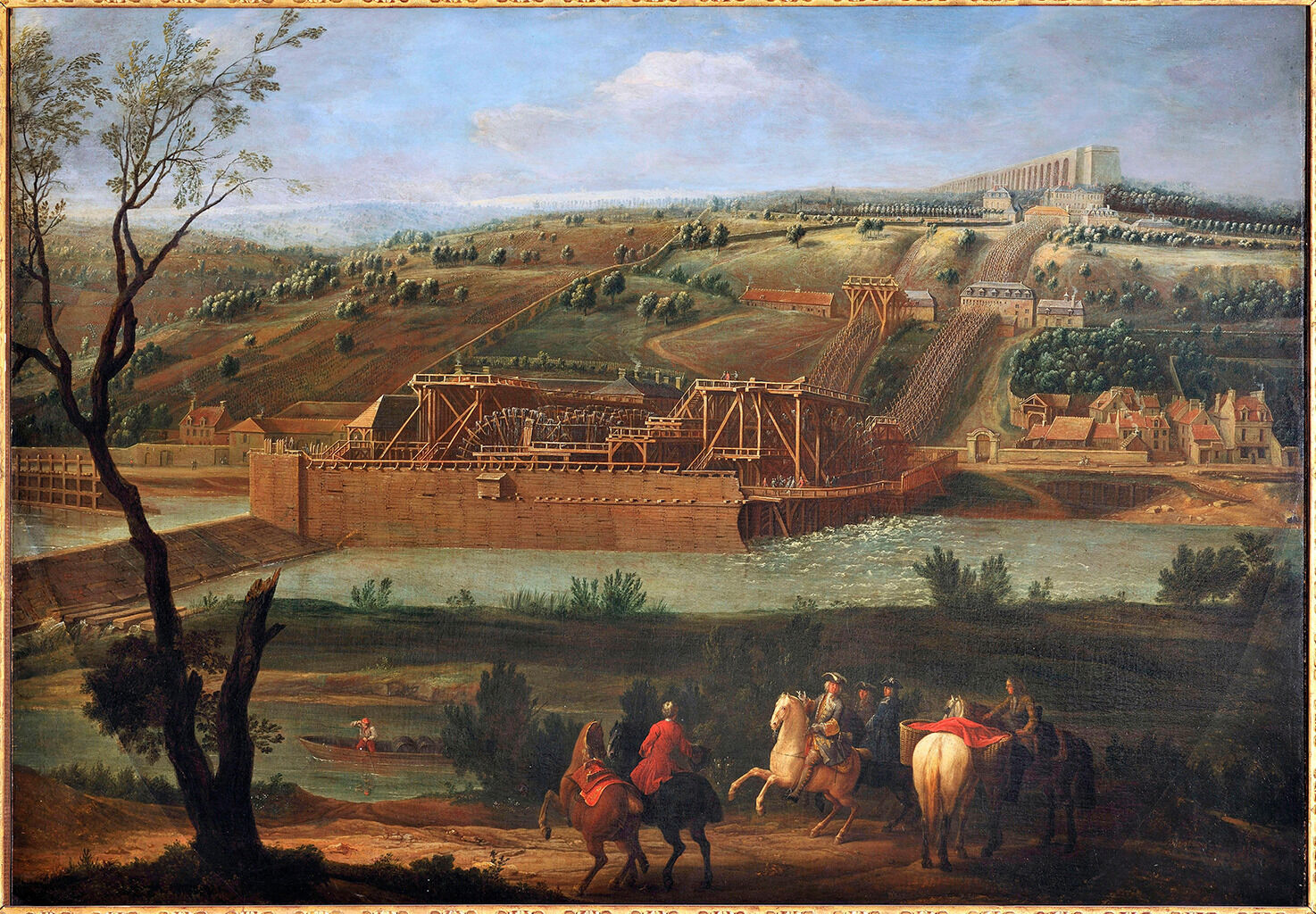
Resize view

Resize view