Catalogue Entry
Citation
Chicago:
Richard Rand, “Claude Joseph Vernet, Seaport with Antique Ruins: Morning, 1751, and Coastal Harbor with a Pyramid: Evening, 1751,” catalogue entry in French Paintings and Pastels, 1600–1945: The Collections of the Nelson-Atkins Museum of Art, ed. Aimee Marcereau DeGalan (Kansas City: The Nelson-Atkins Museum of Art, 2023), https://doi.org/10.37764/78973.5.332.5407.
MLA:
Rand, Richard. “Claude Joseph Vernet, Seaport with Antique Ruins: Morning, 1751, and Coastal Harbor with a Pyramid: Evening, 1751,” catalogue entry. French Paintings and Pastels, 1600–1945: The Collections of The Nelson-Atkins Museum of Art, edited by Aimee Marcereau DeGalan, Nelson-Atkins Museum of Art, 2023. doi: 10.37764/78973.5.332.5407.
This catalogue entry explores two paintings. For the catalogue documentation and technical entry for the associated painting, see Coastal Harbor with a Pyramid: Evening, F84-66/2.
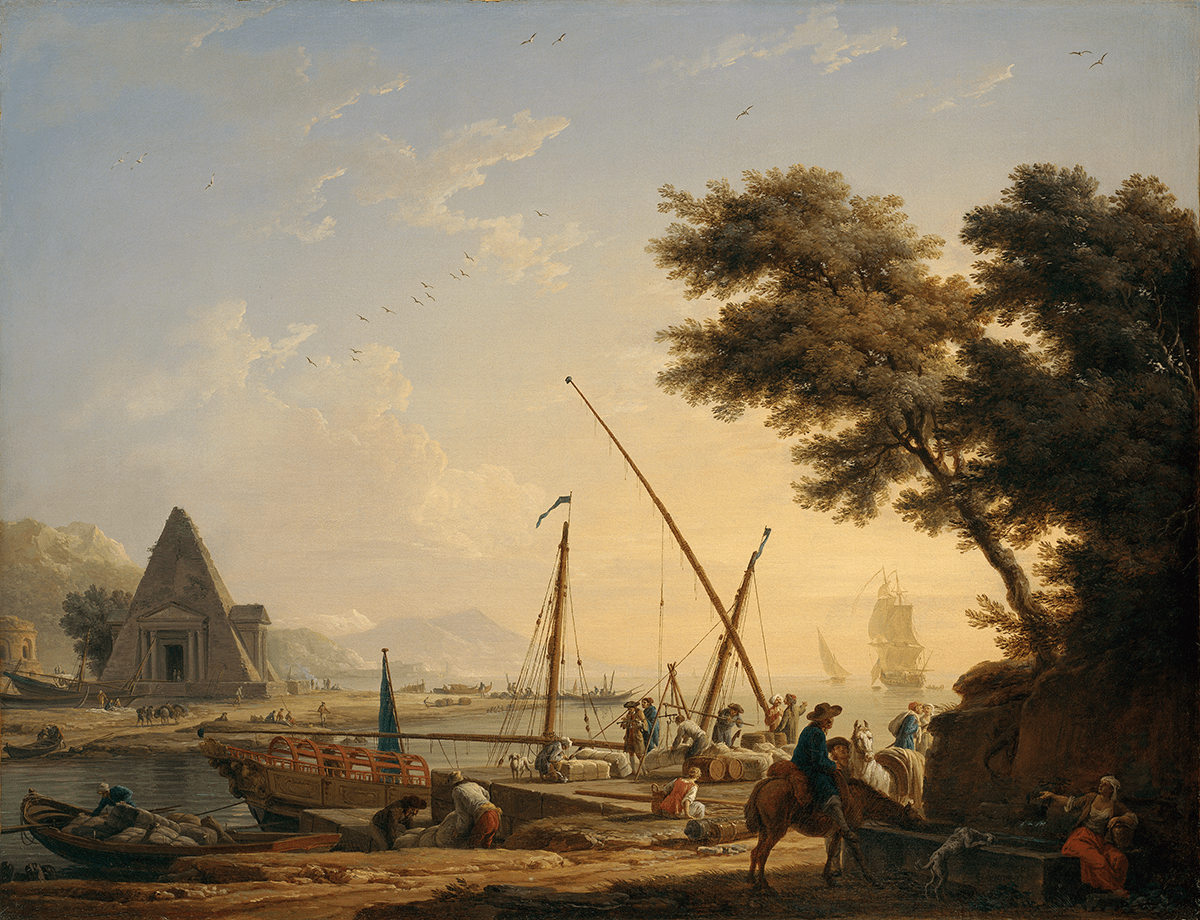
Claude Joseph Vernet painted this pair of pictures (cats. 332 and 333) in Rome just as he was achieving international fame as a landscape and marine painter. They exemplify his innovative approach to the Italian tradition of idealized landscape, combining the particulars of nature and allusions to antiquity within pleasing, harmonious compositions. Vernet frequently produced dramatic, stormy landscapes and marine paintings with shipwrecks, but here he depicted nature at its most calm and beautiful, evoking the pleasures of Italy.
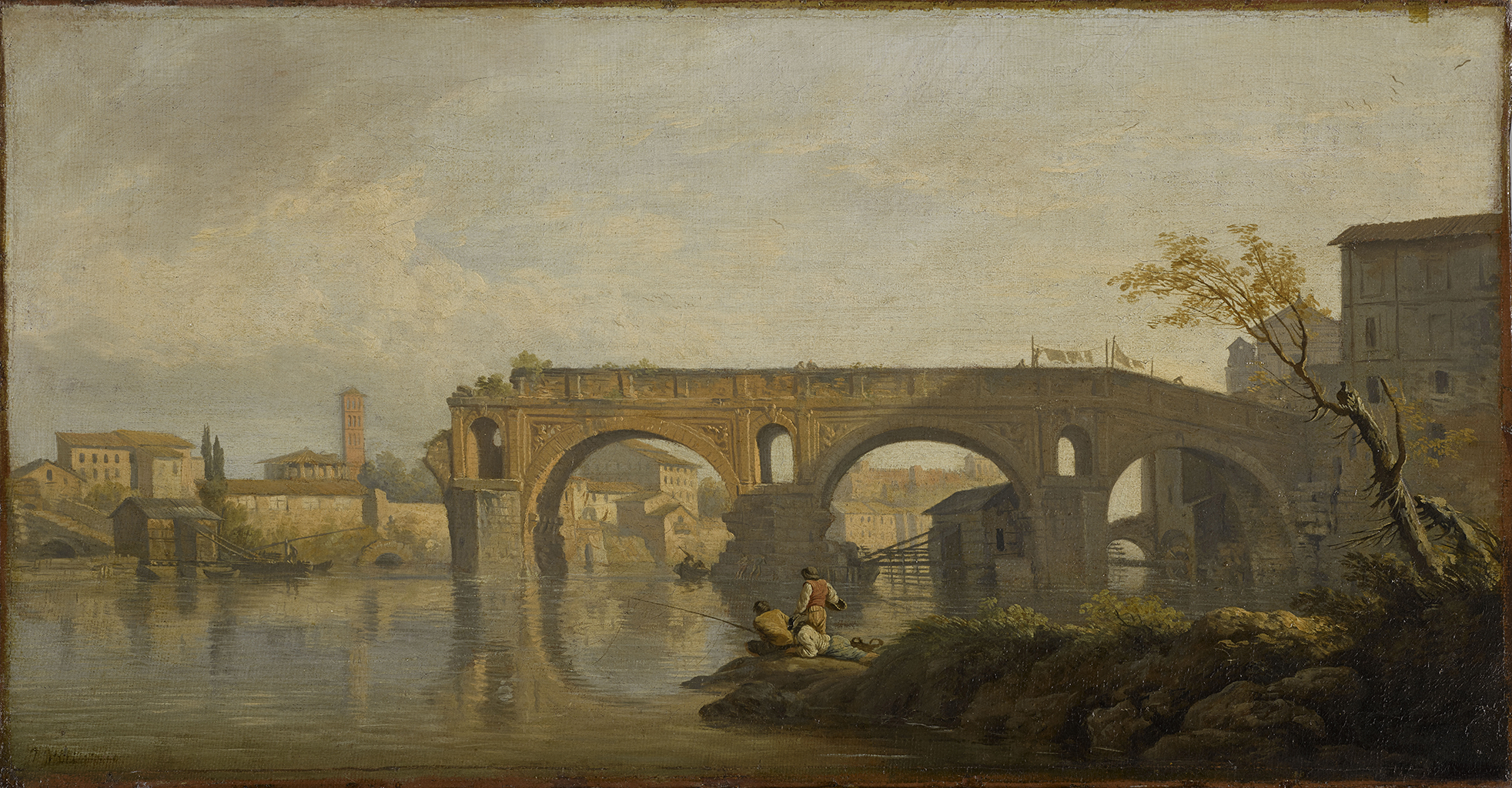
The scenery, with its fortified harbor and snowcapped mountains in the distance, calls to mind the coastline near Naples, a favorite motif for Vernet, although the geography is more fanciful than topographical. In Italy, these pictures would have been called capricci (caprices, i.e., imaginary scenes) rather than vedute (views, i.e., depictions of specific places). Indeed, the architectural ruins in both paintings, while reminiscent of antique structures Vernet had seen in Rome, are the artist’s inventions. Stephen Borys has noted that the arched monument in ruins at the left in Seaport is loosely based on the Ponte Rotto in Rome, the ruin of an ancient bridge crossing the Tiber that Vernet had painted in 1745 (Fig. 1), although here it spans the crest of a rocky outcropping much like an aqueduct.1Stephen D. Borys, The Splendor of Ruins in French Landscape Painting, 1630–1800, exh. cat. (Oberlin, OH: Allen Memorial Art Museum, Oberlin College, 2005), 163–66. The actual name of the bridge was the Ponte Senatorio, but it was colloquially known as the Ponte Rotto (“Broken Bridge”). The pyramidal temple in Coastal Harbor, meanwhile, recalls the Tomb of Gaius Cestius Gallus, known as the Pyramid of Cestius, which is also in Rome. Vernet integrated these elements of the landscape with eighteenth-century boats and numerous figures dressed in contemporaneous clothing to highlight the most appealing aspects of ancient and modern Italy.
For their first owner, Louis Gabriel Peilhon (1700–1762), the pictures served as appropriate souvenirs of his visits to Italy. Peilhon came from the artist’s hometown of Avignon and had risen to the rank of Conseiller-Secrétaire du Roi (royal counsellor-secretary) in Paris; he was therefore a personal friend as well as a well-placed government client.2Peilhon assembled a notable collection of Italian, Flemish, and French Old Masters as well as modern pictures; see Léon Lagrange, Joseph Vernet et la peinture au XVIIIème siècle, 2nd ed. (Paris: Didier, 1864), 53–54. He ordered the paintings in November 1750, and Vernet recorded the commission in his account book, noting that he would charge 1,200 francs for the pair. As was his habit, Vernet indicated the intended size of the paintings and their general subjects—“one depicting a warm and golden sunset, the other a morning scene, crisp and clear”—although the details specified there (“a landscape and a marine with waterfalls or rivers, figures and animals”)3Vernet, “Commande 112,” Livres de raison (Musée Calvet, Avignon), quoted in Lagrange, Joseph Vernet et la peinture, 333: “[No.] 112. Pour M. Peilhon deux tableaux, de deux pieds huits pouces de large, sur deux pieds un pouce de haut devant reppresenter [sic] un soleil couchant, bien chaud et bien doré, et l’autre un matin bien frais, qu’il y aye [sic] du païsage et de la marine, avec des cascades ou des rivières, des figures et des animeaux [sic], ordonnez au mois de novembre 1750 le prix est douze cents francs les deux” (“112. For Mr. Peilhon two paintings, two feet eight inches wide, by two feet one inch high, one depicting a warm and golden sunset, the other a morning scene, crisp and clear, a landscape and a marine, with waterfalls or rivers, figures and animals, ordered in November 1750, the price is twelve hundred francs for the pair”). would change in the end. These were to be the sixth and seventh of twelve total canvases ordered from Vernet by Peilhon, who was happy, in most cases, to leave the particulars to the artist (Vernet wrote “two marines left to my imagination”4“No. 79. Pour M. Peilhon deux marines à ma fantesie” (For Mr. Peilhon, two marines left to my imagination); Vernet, “Commande 79,” Livres de raison, quoted in Lagrange, Joseph Vernet et la peinture, 329. in reference to a December 1748 commission).5Only eight paintings by Vernet appeared in the posthumous 1763 sale of Peilhon’s collection: Catalogue Raisonné des Tableaux du Cabinet de feu M. Peilhon, Secrétaire du Roi et Fermier Général (Paris: Didot, May 16, 1763), nos. 70–72, 81–82. The paintings now in Kansas City were catalogued together under no. 71, “Deux Tableaux du même Maître, peints en 1751, sur toile de deux pieds de haut, sur deux pieds sept poucs & demi de large. Ils représente[nt] des Vues de Mer, des Ruines, des Fabriques & du Paysage avec beaucoup de Figures. Le coloris en est bon, & la touche de ce beau Faire qui caractérise le Peintre Savant. L’un de ces deux Tableaux à été gravé par Jean Daullé, il a pour titre Le Pèlerinage” (Two paintings by the same master, painted in 1751, on canvas two feet high, two feet seven and a half inches wide. They represent views of the sea, ruins, factories and landscape with many figures. The coloring is good, and the touch of that fine craftsman which characterizes the learned painter. One of these two paintings was engraved by Jean Daullé, it is entitled The Pilgrimage). The canvases probably did not arrive in Paris until very late in 1751 at the earliest, for they were not included in Salon, the: Exhibitions organized by the French Royal Academy of Painting and Sculpture (Académie Royale de Peinture et de Sculpture) and its successor the Academy of Fine Arts (Académie des Beaux Arts), which took place in Paris from 1667 onward. exhibition at the Louvre that year, which opened on August 25 and remained on view for a month. Indeed, it is not certain when Peilhon took them into his possession, but it was certainly by late summer 1753, when he lent them to the Salon that year, along with three other Vernets from his collection.6[Abel-François Poisson] De Vandières, Explication des Peintures, Sculptures, et Autres Ouvrages de Messieurs de L’Academie Royale . . . . À commencer le jour de S. Loüis 25. d’Aoust [Août] 1753. pour durer jusqu’au 25. Septembre (Paris: J. J. E. Collombat, 1753), nos. 128–30. The Kansas City pair was recorded together under no. 129. It is possible that Vernet retained the pictures in his possession while in Rome, delivering them to Peilhon only upon his return to Paris in 1753, although he could have delivered them to Peilhon during trips made to Paris in 1751 and 1752. The Kansas City paintings do not appear in Vernet’s account book of payments received; of the six orders made by Peilhon (for a total of twelve paintings), Vernet recorded payments for four (for a total of eight paintings). See Lagrange, Joseph Vernet et la peinture, 359–63.
By that time Vernet had returned to Paris. He had
lived in Rome since 1734, where he moved from Avignon
under the sponsorship of Joseph de Seytres, marquis de
Caumont (1688–1745). Vernet had been recalled to the
French capital by the marquis de Marigny, Surintendant
des Bâtiments (the king’s chief arts minister and the
brother of Madame de Pompadour, the royal mistress),
to take on a great commission: producing a suite of
monumental canvases depicting the principal ports of
France.7The best modern study of these paintings is
Laurent Manœuvre and Eric Rieth,
Joseph Vernet, 1714–1789: Les Ports de
France
(Arcueil, France: Editions Anthèse, 1994). In the
summer of 1756, Vernet took a hiatus from his
grueling work on the Ports, spending
several months in his hometown of Avignon to work
on another painting for Peilhon: a large panoramic
view of the city as ambitious as any of the
canvases for the Ports de France series;
see “L13033,” Sotheby’s, London, July 3, 2013, lot
39,
A View of Avignon, from the Right Bank of the
Rhone near Villeneuve
(signed and dated 1757, oil on canvas, 37 1/2 x 90
1/2 in.),
https://www.sothebys.com
The two Kansas City pictures, painted a few years before Vernet’s return to Paris, are smaller in scale and lack the documentary focus of the topographical works from the Ports de France series. Yet, like those compositions, they exhibit the vivid naturalism that had, by 1750, earned the painter considerable acclaim. Vernet frequently painted pairs of landscapes as contrasting pendants, or even in sets of four, so that they “act together and set each other off,” as he once put it.9Quoted in Conisbee, Claude Joseph Vernet, unpaginated. The contrast between the two Kansas City paintings is subtle, but even here—as Vernet wrote in his account book—he set out to juxtapose two times of day: morning in Seaport with Antique Ruins and evening in Coastal Harbor with a Pyramid. He correspondingly arranged the compositions so that Morning would logically hang to the left of Evening. The character of the landscape in the two scenes is similar enough so that we might almost believe they depict a single continuous panorama: the foreground quayside, the far bank, and the distant mountains line up more or less convincingly. Nevertheless, they should be understood as two separate views of comparable topography, distinguished primarily by the feeling of the “crisp, clear” morning air contrasted with the “warm and golden” light of evening.
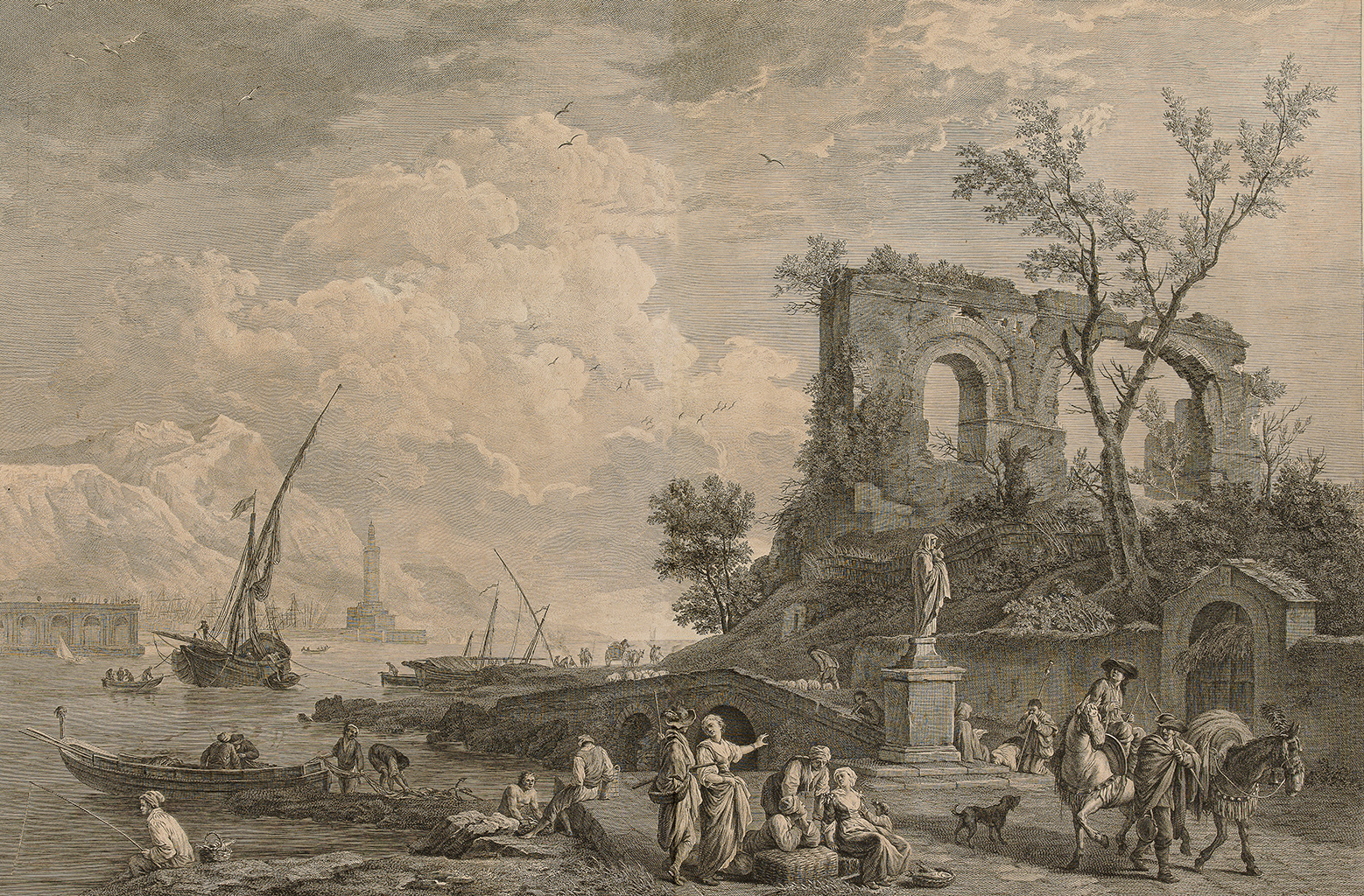
Vernet arranged the forms carefully in each composition. The pair of spindly trees and the arched ruin at the left in Seaport balances the fuller massing of trees at the right in Coastal Harbor, with the effect of framing the two compositions; the tilt of the tree trunks mimics the tilt of the ships’ masts; and the raking light of morning and evening filters through the scenes, throwing long shadows and creating a pleasing rhythm of lights and darks. Vernet populated his scenes with a variety of bustling figures that lead our eye in and around the compositions and add to the pleasure we take in exploring the pictures with care. Only on second glance do certain details become apparent: the pilgrim with a staff kneeling in prayer before the statue of the Virgin Mary in Seaport (this little vignette evidently inspired the title of Jean Daullé’s 1760 reproductive engraving, The Pilgrimage [Fig. 2])10Pierre Arlaud, Catalogue raisonné des estampes gravées d’après Joseph Vernet (Avignon: Rullière-Libeccio, 1976), 37. and the dog drinking out of the fountain in the lower-right corner of Coastal Harbor, apparently upsetting the gesticulating laundress.
Vernet exhibited the two paintings at the Salon of 1753 at a key moment of his career. Although he had been participating in the biennial exhibitions since 1746, sending work from Rome, the year 1753 marked something of an official homecoming. He had returned to the capital to take on the commission to paint the Ports de France series, and it was likely that he saw this Salon as an opportunity to secure his reputation with the Parisian public. He exhibited twelve paintings, including his morceau de reception (the presentation picture that established his full membership in the Royal Academy), thus showing his full repertoire: landscapes, seascapes, stormy views and calm views, sunsets and sunrises.11Explication des Peintures, Sculptures. . . 1753, nos. 128–33. The morceau is no. 133, “Un Tableau . . . représentant une Marine, Païsage & Soleil couchant” (A painting . . . representing a seascape, landscape & setting sun); it is now called Marine—Effet de soleil couchant (Seascape—Sunset Effect) (Musée national du château de Fontainebleau, INV. 8309). Vernet’s stay in Paris would not last long, as the Ports de France project entailed traveling around the country, with his family in tow, for most of the decade; he did not settle definitively in Paris until 1762. His strategy worked for the most part, as his presence at the Salon of 1753 brought a great deal of positive notice from the critics, even if some pictures were admired more than others.12For example, one wrote, “Tous les Tableaux qu’il a donnés cette année, quoique très-beaux, ne sont pas de la même force, il y en a quelques-uns de négligés” (All the paintings he gave this year, although very beautiful, are not of the same strength, there are some neglected); [Pierre] Estève, Lettre à un Ami, Sur l’Exposition des Tableaux faite dans le grand Sallon du Louvre, le 25. Août 1753 [(1753–54)], Bibliothèque nationale de France, Paris, Collection Deloynes, vol. 5, no. 56, p. 12. “So much talent and so little recognized,” decreed one critic. “I am reminded of this artist that we have seen for far too long triumphing on the banks of the Tiber, and that Paris now promises to see settled back in her bosom. . . . Unique in his genre, Vernet has left all those who came before him far behind.”13“Me rappellent cet Artiste qu’on a vû trop long-temps triompher sur les bords du Tibre, & et que Paris desormais se promet de voir reposer dans son sein. . . .Vernet unique dans son genre, laisse bien loin derrière lui tous ceux qui l’on precede dan la même carrière”; [Anonymous], La Peinture: Ode de Milord Telliab (London, 1753), Bibliothèque nationale de France, Paris, Collection Deloynes, vol. 5, no. 57, p. 10.
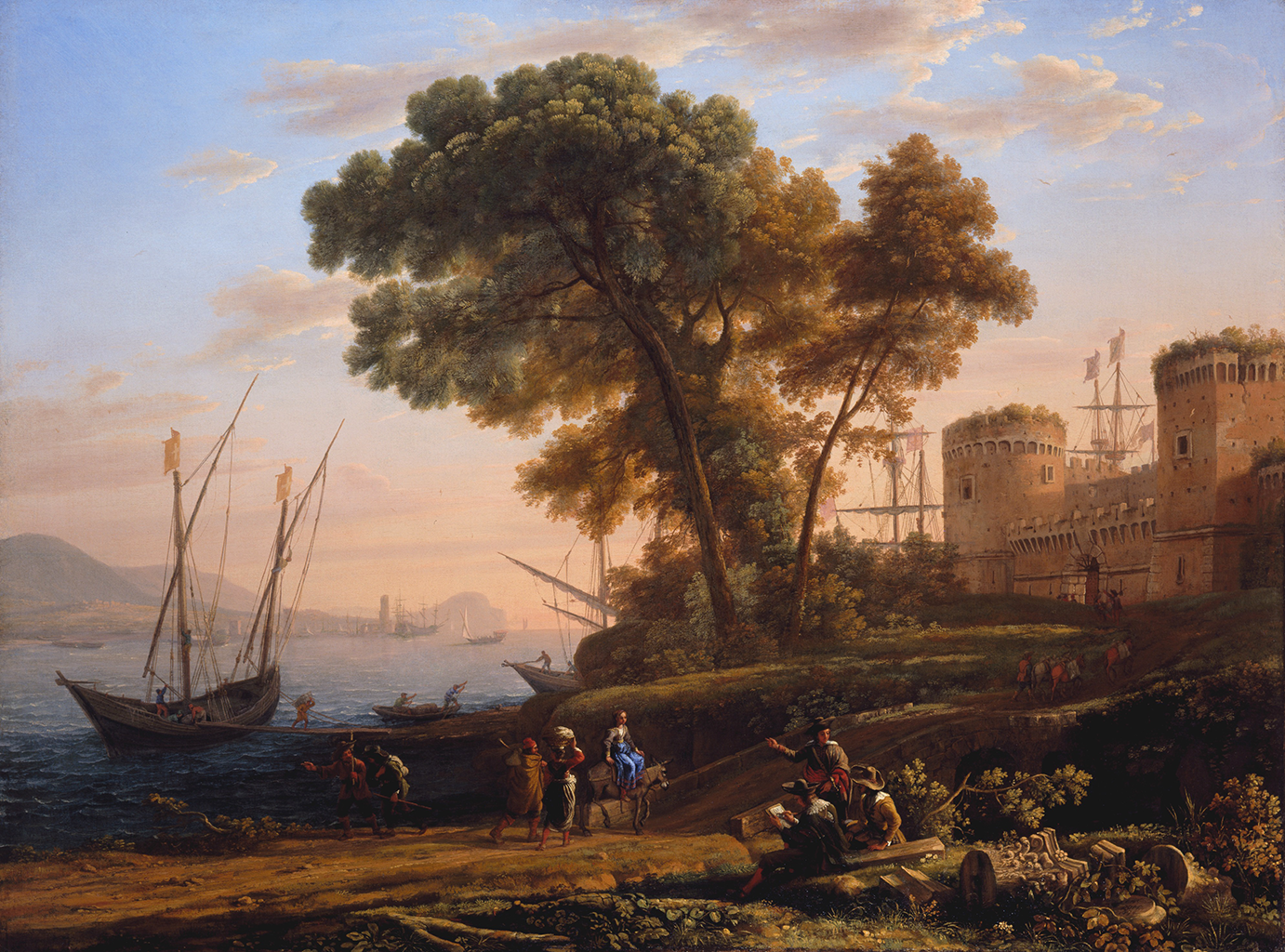
In producing two “calm views,” Vernet was directly evoking the works of Claude Lorrain (1600–82), the seventeenth-century French painter of idealized Roman landscapes and glowing harbor scenes.14Peilhon himself owned three paintings attributed to Claude; see Catalogue Raisonné des Tableaux du Cabinet de feu M. Peilhon, nos. 58 and 59. This was not lost on observers at the Salon: “This able master,” wrote one, “has equaled the famous Claude Lorrain in his landscapes and marines by the freshness of his tones, the vividness of his colors, and the softness of his touch.”15“Cet habile Maître a égalé le fameux Claude Lorrain, dans ses Païsages & ses Marines par la fraîcheur de ses teintes, par la vivacité de son coloris, par la douceur de son pinceau”; Jacque Le Combe, Le Salon ([Paris], 1753), Bibliothèque nationale de France, Paris, Collection Deloynes, vol. 5, no. 55, p. 32. “Mr. Vernet,” wrote another, “is the equal of Claude in many aspects and definitely surpasses him in drawing.”16“M. Vernet égale le Claude Lorrain en plusieurs parties, & certainement le surpasse en celle du dessin”; Jean-Bernard Le Blanc, Observations sur les Ouvrage de MM. de l’Académie de Peinture et de Sculpture, Exposés au Sallon du Louvre, en l’Année 1753, Et sur quelques Ecrits qui ont rapport à la Peinture ([Paris], 1753), Bibliothèque nationale de France, Paris, Collection Deloynes, vol. 5, no. 63, p. 30. When we compare the Kansas City pendants to a characteristic painting by Claude, such as An Artist Studying from Nature, 1639 (Fig. 3), we see just how indebted Vernet was to the earlier master. As was Claude’s habit, Vernet adopted a low point of view, massing the trees or architecture to the sides of the composition and focusing the center on a vista across a body of water to a distant, mountainous shore.17See other examples of Claude Lorrain’s work with similar pictorial structure in this catalogue. Glynnis Napier Stevenson, “Claude Gellée, called Le Lorrain, Mill on the Tiber, ca. 1650, and Claude Gellée, called Le Lorrain, Landscape with a Piping Shepherd, 1667,” catalogue entry in French Paintings and Pastels, 1600–1945: The Collections of the Nelson-Atkins Museum of Art, ed. Aimee Marcereau DeGalan (Kansas City: The Nelson-Atkins Museum of Art, forthcoming).
Vernet brought to his landscapes a keen sense of observation and a naturalism that was greatly admired by critics and collectors in France. Even at his Salon debut in 1746, reformist critics, tired of the decorative confections of the rococo style (represented at the Nelson-Atkins by François Boucher’s Landscape with a Water Mill of 1740), identified Vernet as a painter who could offer an alternative approach, one grounded in the study of nature. “Vernet’s pictures engage our full attention by the force of truth and the charm of his imitation [of nature],” wrote Etienne La Font de Saint-Yenne in his review of the Salon of 1746.18“Attachent avidement nos regards dans les Tableaux de Sieur Vernet par la force de la vérité, & le charme de l’imitation ”; [Etienne de La Font de Saint-Yenne], Réflexions sur Quelques Causes de l’État Présent de la Peinture en France (The Hague: Jean Neaulme, 1747), 101. By the time the Salon of 1753 was held, Vernet could be considered the new touchstone for landscape. The influential connoisseur and academician Charles-Nicolas Cochin offered high praise: “I submit that the modern painter [Vernet] knows even better [than Claude] the varieties of nature, and he produces pictures more diverse in their beauties, that furthermore there is a spirited handling in all the details, that he fills them with figures that are well drawn and painted in a noble and generous manner.”19“J’ajouterai que le Peintre moderne connoît encore mieux les varietiés de la Nature, & qu’il produit des Tableaux plus différens dans leurs beautés; qu’il y a de plus une exécution pleine d’esprit dans tous les détails, & qu’il les orne de figures bien dessinées, & peintes d’une maniere grande & large”; [Charles Nicolas] Cochin, Lettre à un amateur, En réponse aux Critiques qui ont paru sur l’exposition des Tableaux (Paris: Charles-Antoine Jombert, 1753), Bibliothèque nationale de France, Collection Deloynes, vol. 5, no. 61, p. 24. In pictures such as Seaport with Antique Ruins: Morning and Coastal Harbor with a Pyramid: Evening, Vernet struck just this balance—between a beautifully harmonized composition and a convincing representation of the natural world—that would lead, ultimately, to the transformation of landscape painting in the nineteenth century.
Notes
-
Stephen D. Borys, The Splendor of Ruins in French Landscape Painting, 1630–1800, exh. cat. (Oberlin, OH: Allen Memorial Art Museum, Oberlin College, 2005), 163–66. The actual name of the bridge was the Ponte Senatorio, but it was colloquially known as the Ponte Rotto (“Broken Bridge”).
-
Peilhon assembled a notable collection of Italian, Flemish, and French Old Masters as well as modern pictures; see Léon Lagrange, Joseph Vernet et la peinture au XVIIIème siècle, 2nd ed. (Paris: Didier, 1864), 53–54.
-
Vernet, “Commande 112,” Livres de raison (Musée Calvet, Avignon), quoted in Lagrange, Joseph Vernet et la peinture, 333: “[No.] 112. Pour M. Peilhon deux tableaux, de deux pieds huits pouces de large, sur deux pieds un pouce de haut devant reppresenter [sic] un soleil couchant, bien chaud et bien doré, et l’autre un matin bien frais, qu’il y aye [sic] du païsage et de la marine, avec des cascades ou des rivières, des figures et des animeaux [sic], ordonnez au mois de novembre 1750 le prix est douze cents francs les deux” (112. For Mr. Peilhon two paintings, two feet eight inches wide, by two feet one inch high, one depicting a warm and golden sunset, the other a morning scene, crisp and clear, a landscape and a marine, with waterfalls or rivers, figures and animals, ordered in November 1750, the price is twelve hundred francs for the pair).
-
“No. 79. Pour M. Peilhon deux marines à ma fantesie” (For Mr. Peilhon, two marines left to my imagination); Vernet, “Commande 79,” Livres de raison, quoted in Lagrange, Joseph Vernet et la peinture, 329.
-
Only eight paintings by Vernet appeared in the posthumous 1763 sale of Peilhon’s collection: Catalogue Raisonné des Tableaux du Cabinet de feu M. Peilhon, Secrétaire du Roi et Fermier Général (Paris: Didot, May 16, 1763), nos. 70–72, 81–82. The paintings now in Kansas City were catalogued together under no. 71, “Deux Tableaux du même Maître, peints en 1751, sur toile de deux pieds de haut, sur deux pieds sept poucs & demi de large. Ils représente[nt] des Vues de Mer, des Ruines, des Fabriques & du Paysage avec beaucoup de Figures. Le coloris en est bon, & la touche de ce beau Faire qui caractérise le Peintre Savant. L’un de ces deux Tableaux à été gravé par Jean Daullé, il a pour titre Le Pèlerinage” (Two paintings by the same master, painted in 1751, on canvas two feet high, two feet seven and a half inches wide. They represent views of the sea, ruins, factories and landscape with many figures. The coloring is good, and the touch of that fine craftsman which characterizes the learned painter. One of these two paintings was engraved by Jean Daullé, it is entitled The Pilgrimage).
-
[Abel-François Poisson] De Vandières, Explication des Peintures, Sculptures, et Autres Ouvrages de Messieurs de L’Academie Royale . . . . À commencer le jour de S. Loüis 25. d’Aoust [Août] 1753. pour durer jusqu’au 25. Septembre (Paris: J. J. E. Collombat, 1753), nos. 128–30. The Kansas City pair was recorded together under no. 129. It is possible that Vernet retained the pictures in his possession while in Rome, delivering them to Peilhon only upon his return to Paris in 1753, although he could have delivered them to Peilhon during trips made to Paris in 1751 and 1752. The Kansas City paintings do not appear in Vernet’s account book of payments received; of the six orders made by Peilhon (for a total of twelve paintings), Vernet recorded payments for four (for a total of eight paintings). See Lagrange, Joseph Vernet et la peinture, 359–63.
-
The best modern study of these paintings is Laurent Manœuvre and Eric Rieth, Joseph Vernet, 1714–1789: Les Ports de France (Arcueil, France: Editions Anthèse, 1994). In the summer of 1756, Vernet took a hiatus from his grueling work on the Ports, spending several months in his hometown of Avignon to work on another painting for Peilhon: a large panoramic view of the city as ambitious as any of the canvases for the Ports de France series; see “L13033,” Sotheby’s, London, July 3, 2013, lot 39, A View of Avignon, from the Right Bank of the Rhone near Villeneuve (signed and dated 1757, oil on canvas, 37 1/2 x 90 1/2 in.), https://www.sothebys.com/en/auctions/ecatalogue/2013/old-master-british-paintings-evening-l13033/lot.39.html.
-
Philip Conisbee, Claude Joseph Vernet 1714–1789, exh. cat. (London: Greater London Council, 1976), unpaginated.
-
Quoted in Conisbee, Claude Joseph Vernet, unpaginated.
-
Pierre Arlaud, Catalogue raisonné des estampes gravées d’après Joseph Vernet (Avignon: Rullière-Libeccio, 1976), 37.
-
Explication des Peintures, Sculptures. . . 1753, nos. 128–33. The morceau is no. 133, “Un Tableau . . . représentant une Marine, Païsage & Soleil couchant” (A painting . . . representing a seascape, landscape & setting sun); it is now called Marine—Effet de soleil couchant (Seascape—Sunset Effect) (Musée national du château de Fontainebleau, INV. 8309). Vernet’s stay in Paris would not last long, as the Ports de France project entailed traveling around the country, with his family in tow, for most of the decade; he did not settle definitively in Paris until 1762.
-
For example, one wrote, “Tous les Tableaux qu’il a donnés cette année, quoique très-beaux, ne sont pas de la même force, il y en a quelques-uns de négligés” (All the paintings he gave this year, although very beautiful, are not of the same strength, there are some neglected); [Pierre] Estève, Lettre à un Ami, Sur l’Exposition des Tableaux faite dans le grand Sallon du Louvre, le 25. Août 1753 [(1753–54)], Bibliothèque nationale de France, Paris, Collection Deloynes, vol. 5, no. 56, p. 12.
-
“Me rappellent cet Artiste qu’on a vû trop long-temps triompher sur les bords du Tibre, & et que Paris desormais se promet de voir reposer dans son sein. . . .Vernet unique dans son genre, laisse bien loin derrière lui tous ceux qui l’on precede dan la même carrière”; [Anonymous], La Peinture: Ode de Milord Telliab (London, 1753), Bibliothèque nationale de France, Paris, Collection Deloynes, vol. 5, no. 57, p. 10.
-
Peilhon himself owned three paintings attributed to Claude; see Catalogue Raisonné des Tableaux du Cabinet de feu M. Peilhon, nos. 58 and 59.
-
“Cet habile Maître a égalé le fameux Claude Lorrain, dans ses Païsages & ses Marines par la fraîcheur de ses teintes, par la vivacité de son coloris, par la douceur de son pinceau”; Jacque Le Combe, Le Salon ([Paris], 1753), Bibliothèque nationale de France, Paris, Collection Deloynes, vol. 5, no. 55, p. 32.
-
“M. Vernet égale le Claude Lorrain en plusieurs parties, & certainement le surpasse en celle du dessin”; Jean-Bernard Le Blanc, Observations sur les Ouvrages de MM. de l’Académie de Peinture et de Sculpture, Exposés au Sallon du Louvre, en l’Année 1753, Et sur quelques Ecrits qui ont rapport à la Peinture ([Paris], 1753), Bibliothèque nationale de France, Paris, Collection Deloynes, vol. 5, no. 63, p. 30.
-
See other examples of Claude Lorrain’s work with similar pictorial structure in this catalogue. Glynnis Napier Stevenson, “Claude Gellée, called Le Lorrain, Mill on the Tiber, ca. 1650, and Claude Gellée, called Le Lorrain, Landscape with a Piping Shepherd, 1667,” catalogue entry in French Paintings and Pastels, 1600–1945: The Collections of the Nelson-Atkins Museum of Art, ed. Aimee Marcereau DeGalan (Kansas City: The Nelson-Atkins Museum of Art, forthcoming)."
-
“Attachent avidement nos regards dans les Tableaux de Sieur Vernet par la force de la vérité, & le charme de l’imitation”; [Etienne de La Font de Saint-Yenne], Réflexions sur Quelques Causes de l’État Présent de la Peinture en France (The Hague: Jean Neaulme, 1747), 101.
-
“J’ajouterai que le Peintre moderne connoît encore mieux les varietiés de la Nature, & qu’il produit des Tableaux plus différens dans leurs beautés; qu’il y a de plus une exécution pleine d’esprit dans tous les détails, & qu’il les orne de figures bien dessinées, & peintes d’une maniere grande & large”; [Charles Nicolas] Cochin, Lettre à un amateur, En réponse aux Critiques qui ont paru sur l’exposition des Tableaux (Paris: Charles-Antoine Jombert, 1753), Bibliothèque nationale de France, Collection Deloynes, vol. 5, no. 61, p. 24.
Technical Entry
Technical entry forthcoming.
Documentation
Citation
Chicago:
Glynnis Napier Stevenson, “Claude Joseph Vernet, Seaport with Antique Ruins: Morning, 1751, and Coastal Harbor with a Pyramid: Evening, 1751,” documentation in French Paintings and Pastels, 1600–1945: The Collections of the Nelson-Atkins Museum of Art, ed. Aimee Marcereau DeGalan (Kansas City: The Nelson-Atkins Museum of Art, 2023), https://doi.org/10.37764/78973.5.332.4033.
MLA:
Stevenson, Glynnis Napier. “Claude Joseph Vernet, Seaport with Antique Ruins: Morning, 1751, and Coastal Harbor with a Pyramid: Evening, 1751,” documentation. French Paintings and Pastels, 1600–1945: The Collections of The Nelson-Atkins Museum of Art, edited by Aimee Marcereau DeGalan, Nelson-Atkins Museum of Art, 2023. doi: 10.37764/78973.5.332.4033.
Provenance
Commissioned from the artist, along with its pendant, Coastal Harbor with a Pyramid: Evening, by Louis Gabriel Peilhon (1700–1762), Paris, November 1750–1762 [1];
Purchased at his posthumous sale, Tableaux du Cabinet de feu M. Peilhon, Secrétaire du Roi et Fermier Général, Chez Peilhon, Paris, May 16, 1763, no. 71, as Vues de Mer, des Ruines, des Fabriques et du Paysage avec beaucoup de Figures, by Jean Henri Eberts (1726–1793), 1763 [2];
Pieter de Smeth (1753–1809), heer van Alphen en Rietveld, Amsterdam, by September 7, 1809 [3];
Purchased from his posthumous sale, Eene fraaije Verzameling van Uitmuntende Schilderijen, door de Meest Beroemde Nederlandsche Meesters, In vele Jaren met kunde bijeen verzameld door Een Voornaam Liefhebber, Philippus van der Schley, Amsterdam, August 6, 1810, lot 109, as Een Italiaansch Land—en watergezigt, met Gebouwen en Ruine, rijk met Reizigers, Muilezels, Visschers en Vaartuigen gestoffeerd, en een ruim verschiet, through Texier Gerbet en Comp [Teissier], Amsterdam, by Jean-Baptiste-Pierre Lebrun, Paris, 1810–April 16, 1811;
Purchased from his sale, Vente d’une Collection de Tableaux Capitaux et du Plus Beau Choix, des Trois Écoles; Statues de Marbre, Bronzes, Tables Antiques, de Florence, Piscines, et Autres Objets, Provenant de Voyages faits tant en Italie, qu’en Flandres, en Hollande, en Suisse, et à Genève, rue du Gros-Chenet, Paris, April 16, 1811, lot 228, as Deux Marines: l’une offre sur la gauche une route qui conduit à un pont de trois arches; à l’entrée est une statue de la Vierge, au pied de laquelle est un pélerin en prière et une femme prosternée; sur le devant sont deux conducteurs de mulets; dans le milieu du Tableau, un groupe de six figures de femmes et d’hommes en repos; sur la gauche, un pêcheur à la ligne assis; plus loin, une grande barque, quelques autres bâtimens dont un près duquel est une chaloupe; dans le fond, l’on voit le fanal et de hautes montagnes sur la hauteur; sur la hauteur, de gauche, les ruines d’anciens aqueducs. Ces deux précieux Tableaux sont du plus beau temps et des plus parfaits de ce maître, by Jean-Louis Titon La Neuville, called Laneuville (1748–1826), 1811–January 1813 at the latest;
With Irlande l’aîné and Bordier, by January 27, 1813;
Purchased from their sale, Une Collection de Tableaux des Écoles flamande, hollandaise, allemande et française; D’une suite variée de Bronzes de grande et moyenne proportions, dont l’exécution ne laisse rien à désirer, galerie de la rue de l’Échiquier, Paris, January 27, 1813, no. 95, as Deux Marines; l’une offre, sur la gauche, une route qui conduit à un pont de trois arches; à l’entrée est une statue de la Vierge, au pied de laquelle est un pèlerin en prière et une femme prosternée; sur le devant sont deux conducteurs de mulets; dans le milieu du tableau, un groupe de six figures de femmes et d’hommes en repos; sur la gauche, un pêcheur à la ligne, assis; plus loin une barque, quelques autres bâtimens, dont un près duquel est une chaloupe; dans le fond on voit le fanal et de hautes montagnes; sur la hauteur, de gauche, les ruines d’anciens aqueducs, by Jacques Nicolas Brunot (1763–1826), Paris, 1813 [4];
With Bordier, Bareira, and Rioult, by January 27, 1817 [5];
Baron Melchior Roger Portalis (1841–1912), Paris, by May 12, 1873;
His sale, Tableaux anciens formant les collections de M. le Marquis de B[iancourt] et M. le Baron P[ortalis], Hôtel Drouot, Paris, May 12–13, 1873, no. 94, as Paysage.—Marine;
Fould family, Paris, by May 26, 1980 [6];
Purchased from the Fould family descendants, Importants Tableaux Anciens, Sotheby’s, Monte Carlo, May 26, 1980, lot 541, as Matin bien frais, vue d’un port méditerranéen, by Richard Green and Edward Speelman, London, May–September 1980;
Purchased from Richard Green, London, by Charles Agee (b. 1954) and Frances Martin “Marti” (née Bellingrath, b. 1954) Atkins, New York, September 1980 [7];
With Newhouse Galleries, New York, by October 8, 1984 [8];
Purchased from Newhouse by The Nelson-Atkins Museum of Art, Kansas City, MO, 1984.
Notes
[1] Citation of the month of commission can be found in Léon Lagrange, Joseph Vernet: sa vie, sa famille, son siècle, d’après des documents inédits (Brussels: Imprimerie de A. Labroue et Cie, 1858), 48.
[2] For buyer’s name, see annotated sale catalogue at the Philadelphia Museum of Art Library.
[3] The “Mr. Smeth” annotation on the RKD Netherlands Institute for Art History copy of the 1811 catalogue drawn up by the dealer Lebrun almost certainly refers to Pieter de Smeth van Alphen, who died in 1809 and amassed a significant collection offered up in August 1810 after his banking firm went bankrupt. Further support for his presence in the provenance comes from Smeth expert Laurens Meerman, “The French dealer Lebrun bought no fewer than 27 paintings at Pieter’s sale through the Amsterdam art dealers Texier, Gerbet en Co. . . . He sold most of them between 16 and 20 April [1811] in his Paris auction rooms.” See Laurens Meerman, “An Unwritten Chapter of Dutch Collecting History: The Painting Collection of Pieter de Smeth van Alphen (1753–1809),” Simiolus: Netherlands Quarterly for the History of Art 40, no. 1 (2018): 50–51.
[4] The Getty Provenance Index lists “Irlande aîné et Bordier” as the sellers at the January 27, 1813 sale. These are both dealers. “Lot 0095 from Sale Catalog F–421,” The Getty Provenance Index Databases, Los Angeles.
The previous owner of the pendants, the dealer Laneuville, could have still been involved in this sale. See Valérie Lavergne-Durey, Jean-Louis Titon La Neuville, dit Laneuville (1756–1826): Portraitiste et Marchand-Expert, exh. cat. (Vizille, France: Musée de la Révolution française, 2014), 43.
[5] As per the Getty Provenance Index Databases, the pendants were in the dealer Bordier’s stock by 1817. A “M. B***” is noted on the cover of the 1817 catalogue and this could be Jacques Nicolas Brunot, who bought the painting in 1813. It could also be a reference to Bordier. Lot 0077 from Sale Catalog F–717, The Getty Provenance Index Databases, Los Angeles. The two paintings were in the following sale, organized by Laneuville, but were withdrawn after failing to sell: Une Collection de Tableaux de Différens [sic] Maitres des Écoles Italienne, Flamande et Française; Estampes encadrées et Estampes en feuilles, Provenant du Cabinet de M. B[ordier], Hôtel de Bullion, Paris, January 27, 1817, lot 77. The Getty lists “Bordier, Bareira, Rioult” as the seller.
[6] See ongoing email correspondence, begun January 26, 2023, between Clémence Enriquez, cataloguer of old master and nineteenth-century paintings and Russian art liaison expert, Sotheby’s, Paris, and Glynnis Stevenson, NAMA, NAMA curatorial file. This exchange is regarding the identities of the Fould family members who owned the Vernet pendants.
[7] See email from Laura Bergues, personal assistant to Jonathan Green, Richard Green Fine Paintings, London, to Glynnis Napier Stevenson, NAMA, January 24, 2023, NAMA curatorial file.
[8] See ongoing email correspondence from Glynnis Napier Stevenson and MacKenzie Mallon, NAMA, to Meg Newhouse Kirkpatrick, former CEO of Newhouse Galleries, begun October 28, 2019, NAMA curatorial file.
Reproductions
Jean Daullé (1703–1763), after Claude Joseph Vernet, The Pilgrimage, 1760, etching and burin on paper, 21 x 29 1/2 in. (53.3 x 75 cm), Musée d’art et d’histoire, Geneva.
Copies
Unknown artist, after Jean Daullé (1703–1763), after Claude Joseph Vernet, The Pilgrimage, oil on canvas, 24 7/16 x 32 5/16 in. (62 x 82 cm), sold at Helmut Tenner, Heidelberg, November 3–5, 1960, lot 1980a, as Ideale Hafenlandschaft.
Charles François Grenier de Lacroix, called Lacroix de Marseilles (ca. 1700–1782), after Claude Joseph Vernet, Mediterranean Coastal Landscape, 1751–1782, oil on canvas, 31 x 42 3/4 in. (78.8 x 108.3 cm), sold at Old Master Paintings, Sotheby’s, London, April 21, 1993, lot 53.
Exhibitions
Salon of 1753, Paris, August 25–September 25, 1753, no. 129, as Deux Païsages et Marines.
The Splendor of Ruins in French Landscape Painting, 1630–1800, Allen Memorial Art Museum, Oberlin College, OH, March 19–June 19, 2005; The Museum of Fine Arts, Houston, July 17–October 16, 2005, no. 35, as Seaport with Antique Ruins: Morning.
References
Explication des peintures, sculptures, et autres ouvrages de Messieurs de L’Academie royale dont l’exposition a été ordonnée, suivant l’intention de Sa Majesté, par M. De Vandieres, Conseiller du Roy en ses Conseils, Directeur et Ordonnateur Général des Bâtimen[t]s, Jardins, Arts et Manufactures de S.M. dans le grand Salon du Louvre; et l’arrangement conduit par les soins du Sieur Portail, de l’Académie Royale de Peinture et de Sculpture, Garde des Plans et Tableaux du Roy (Paris: Imprimerie de J. J. E. Collombat, 1753), 27, as Deux Païsages et Marines, sous le même Numero.
“Beaux-Arts: Exposition des ouvrages de l’Académie Royale de Peinture et de Sculpture, faite dans une Sal[l]e du Louvre le 25 Août 1753,” Mercure de France (October 1753): 163.
[Charles-Nicolas] Cochin, Lettre à un amateur En réponse aux Critiques qui ont paru sur l’exposition des Tableaux ([Paris: Charles-Antoine Jombert], 1753), Bibliothèque nationale de France, Collection Deloynes, vol. 5, no. 61, p. 25, as celui du Matin, où regne un brouillard léger.
[Anne Claude Phillipe de Pestels de Lévis de Tubiéres-Grimoard, comte de] Caylus, Exposition Des ouvrages de l’Academie Royale de Peinture et Sculpture, faite dans un sal[l]e du Louvre, le 25 Août 1753 [1753–1754], Bibliothèque nationale de France, Collection Deloynes, vol. 5, no. 54, p. 6.
[Pierre] Estève, Lettre à un Ami, Sur l’Exposition des Tableaux faite dans le grand Sallon du Louvre, le 25. Août 1753, [(1753–1754)], Bibliothèque nationale de France, Collection Deloynes, vol. 5, no. 56, p. 12.
P[ierre] Rémy, Catalogue Raisonné des Tableaux du Cabinet de feu M. Peilhon, Secrétaire du Roi et Fermier Général (Paris: Didot, May 16, 1763), 39, as Deux Tableaux du même Maître peints en 1751, sur toile de deux pieds de haut, sur deux pieds sept pouces et demi de large. Ils représente[nt] des Vues de Mer, des Ruines, des Fabriques et du Paysage avec beaucoup de Figures.
Catalogus van eene fraaije Verzameling van Uitmuntende Schilderijen, door de Meest Beroemde Nederlandsche Meesters, In vele Jaren met kunde bijeen verzameld door Een Voornaam Liefhebber (Amsterdam: Schleij, Ijver, roos, Vries, and Spaan, August 6, 1810), 27, as Een Italiaansch Land—en watergezigt, met Gebouwen en Ruine, rijk met Reizigers, Muilezels, Visschers en Vaartuigen gestoffeerd, en een ruim verschiet, het is vangelijke schildering als de voorgaande, kunnende strekken tot de wederga.
Vente d’une collection de tableaux capitaux et du plus beau choix, des trois écoles: statues de marbre, bronzes, tables antiques, de Florence, piscines, et autres objets, provenant de voyages faits tant en Italie, qu’en Flandres, en Hollande, en Suisse, et à Genève (Paris: Jean-Baptiste-Pierre Lebrun, April 16, 1811), 77, as Deux Marines; l’une offre sur la gauche une route qui conduit à un pont de trois arches; à l’entrée est une statue de la Vierge, au pied de laquelle est un pèlerin en prière et une femme prosternée; sur le devant sont deux conducteurs de mulets; dans le milieu du Tableau, un groupe de six figures de femmes et d’hommes en repos; sur la gauche, un pêcheur à la ligne assis; plus loin, une grande barque, quelques autres bâtimens dont un près duquel est une chaloupe; dans le fond, l’on voit le fanal et de hautes montagne sur la hauteur, de gauche, les ruines d’anciens aqueducs. . . . Ces deux précieux Tableaux sont du plus beau temps et des plus parfaits de ce maître.
Jean-Baptiste-Pierre Lebrun, Catalogue d’une Collection de Tableaux des Écoles flamande, hollandaise, allemande et française; D’une suite variée de Bronzes de grande et moyenne proportions, dont l’exécution ne laisse rien à désirer (Paris: Olivier and Jean-Baptiste-Pierre Lebrun, January 27, 1813), 27–28, as Deux Marines: l’une offre, sur la gauche, une route qui conduit à un pont de trois arches; à l’entrée est une statue de la Vierge, au pied de laquelle est un pèlerin en prière et une femme prosternée; sur le devant sont deux conducteurs de mulets; dans le milieu du tableau, un groupe de six figures de femmes et d’hommes en repos; sur la gauche, un pêcheur à la ligne, assis; plus loin une barque, quelques autres bâtimens, dont un près duquel est une chaloupe; dans le fond on voit le fanal et de hautes montagnes; sur la hauteur, de gauche, les ruines d’anciens aqueducs.
Catalogue d’Une Collection de Tableaux de Différens [sic] Maitres des Écoles Italienne, Flamande et Française; Estampes encadrées et Estampes en feuilles, Provenant du Cabinet de M. B*** (Paris: Laneuville et Revenaz, January 27, 1817), 12, as Deux marines: l’une offre, sur la gauche, une route qui conduit à un pont de trois arches; à l’entrée est une statue de la Vierge au pied de laquelle sont un pélerin en prière et une femme prosternée; sur le devant sont deux conducteurs de mulets; dans le milieu du tableau, un groupe de six figures de femmes et d’hommes en repos; sur la gauche, un pêcheur à la ligne, assis; plus loin une barque; quelques autres bâtimens, dont un près duquel est une chaloupe; dans le fond on voit un fanal et de hautes montagnes; sur la hauteur de gauche, les ruines d’anciens aquéducs.
Charles Blanc, Manuel de l’Amateur d’Estampes (Paris: P. Jannet, 1856), 2:98.
Charles Blanc, Le trésor de la curiosité, tiré des catalogues de vente de tableaux, dessins, estampes, livres, marbres, bronzes, ivoires, terres cuites, vitraux, médailles, armes, porcelaines, meubles, émaux, laques et autres objets d’art; avec diverses notes et notices historiques et biographiques (Paris: Veuve Jules Renouard, 1857), 1:115, as Deux Marines peintes en 1751, dont l’une est gravée par Daullé sous le titre du Pèlerinage.
Léon Lagrange, Joseph Vernet: sa vie, sa famille, son siècle, d’après des documents inédits (Brussels: Imprimerie de A. Labroue et Cie, 1858), 48, 105, as un matin bien frais.
Léon Lagrange, Les Vernets: Joseph Vernet et La Peinture au XVIIIe Siècle, 2nd ed. (Paris: Didier, 1864), 187, 215, 333, as un matin bien frais, qu’il y aye [sic] du païsage [sic] et de la marine, avec des cascades ou des rivières, des figures et des animeaux [sic].
Jules Guiffrey, Collection des livrets des anciennes expositions depuis 1673 jusqu’en 1800: Salon de 1753 (Paris: Liepmannssohn et Dufour, 1869), 28, as Deux Païsages et Marines sous le même Numero [sic].
Émile Delignières, Catalogue Raisonné de l’Œuvre Gravé de Jean Daullé d’Abbeville (Abbeville: Imprimerie Briez, C. Paillart, et Retaux, 1872), 116.
Tableaux anciens formant les collections de M. le Marquis de B[iancourt] et M. le Baron P[ortalis] (Paris: Hôtel Drouot, May 12–13, 1873), 44, as Paysage.—Marine.
Félix de Bona [Blanche Besserve], Une famille de peintres: Horace Vernet et ses ancêtres (Lille: Desclée, de Brouwer et Cie, 1891), 13.
Emilia Francis Strong Dilke, French Painters of the XVIIIth Century (London: G. Bell and Sons, 1899), 212, as Deux Païsages et Marines sous le même Numéro.
Hippolyte Mireur, Dictionnaire des ventes d’art faites en France et à l’Étranger pendant les XVIIIe et XIXe siècles (Paris: Maison d’Editions d’Œuvres artistiques, Ch. de Vincenti, 1912), 7:342, as Deux marines peintes en 1751.
Florence Ingersoll-Smouse, Joseph Vernet, peintre de marine, 1714–1789: étude critique suivie d’un catalogue raisonné de son œuvre peint (Paris: Étienne Bignou, 1926), no. 320, p. 1:60, as Matin bien frais.
Emile Dacier, “L’Athénienne et son inventeur,” Gazette des beaux-arts 8, no. 835 (July 1932): 115.
Pierre Arlaud, Catalogue raisonné des estampes gravées d’après Joseph Vernet (Avignon: Impriméries Rullière-Libeccio, 1976), 38, as Matin bien Frais.
Philip Conisbee, Claude-Joseph Vernet, 1714–1789, exh. cat. (London: Greater London Council, 1976), unpaginated.
Importants Tableaux Anciens Principalement de l’Ecole Française du XVIIIe Siècle (Monte Carlo: Sotheby Parke Bernet Monaco S.A., May 26, 1980), 40–41, (repro.), as Matin bien frais, vue d’un port méditerranéen.
Pierre Kjellberg, “Rome et Ses Ruines dans la Peinture du 18e siècle,” Connaissance des Arts, no. 356 (October 1981): 116–17, (repro.), as Vue d’un port méditerranéen.
Enrique Mayer, International Auction Records: 1981 (n.p.: Éditions Mayer, 1981), 15:1243, as Matin bien frais, vue d’un port méditerranéen.
“Behind the Scenes: Curatorial Travel is No Vacation,” Calendar of Events (The Nelson-Atkins Museum of Art) (November 1984): unpaginated, as Morning.
“New at the Nelson: Pair of Paintings by Vernet Given to the Nelson,” Calendar of Events (The Nelson-Atkins Museum of Art) (January 1985): unpaginated, (repro.), as Seaport with antique ruins: morning.
“Calendar,” Burlington Magazine 127, no. 984 (March 1985): 195–96, (repro.), as Seaport with antique ruins: morning.
Roger Ward, ed., A Bountiful Decade: Selected Acquisitions, 1977–1987, exh. cat. (Kansas City, MO: Nelson-Atkins Museum of Art, 1987), 144, as Seaport with antique ruins: morning.
Michael Churchman and Scott Erbes, High Ideals and Aspirations: The Nelson-Atkins Museum of Art, 1933–1993 (Kansas City, MO: Nelson-Atkins Museum of Art, 1993), 108, as Seaport with Antique Ruins: Morning.
Roger Ward and Patricia J. Fidler, eds., The Nelson-Atkins Museum of Art: A Handbook of the Collection (New York: Hudson Hills Press, in association with Nelson-Atkins Museum of Art, 1993), 188, (repro.), as Seaport with Antique Ruins: Morning.
Helge Siefert, Claude-Joseph Vernet, 1714–1789, exh. cat. (Munich: Bayerische Staatsgemäldesammlungen, 1997), 10, as die römischen und neapolitanischen Veduten mit Szenen des täglichen Lebens.
Pierre Sanchez, Dictionnaire des Artistes Exposant dans les Salons des XVII et XVIIIème Siècles à Paris et en Province 1673–1800 (Dijon: L’Échelle de Jacob, 2004), 3:1679, as Deux Païsages et Marines sous le même Numéro.
Stephen D. Borys, The Splendor of Ruins in French Landscape Painting, 1630–1800, exh. cat. (Oberlin, OH: Allen Memorial Art Museum, 2005), 163–66, (repro.) as Seaport with Antique Ruins: Morning.
Deborah Emont Scott, ed., The Nelson-Atkins Museum of Art: A Handbook of the Collection, 7th ed. (Kansas City, MO: Nelson-Atkins Museum of Art, 2008), 99, (repro.), as Seaport with Antique Ruins: Morning.
Valérie Lavergne-Durey, Jean-Louis Titon La Neuville, dit Laneuville (1756–1826): Portraitiste et Marchand-Expert, exh. cat. (Vizille, France: Musée de la Révolution française, 2014), 50, 71n426, as Marines.