Catalogue Entry
Read more about this painting at the associated catalogue entry.
Technical Entry
Citation
Chicago:
Diana M. Jaskierny, “Eugène Boudin, Trouville, Beach Scene, 1874,” technical entry in ed. Aimee Marcereau DeGalan French Paintings and Pastels, 1600–1945: The Collections of the Nelson-Atkins Museum of Art (Kansas City: The Nelson-Atkins Museum of Art, 2021), https://doi.org/10.37764/78973.5.603.2088.
MLA:
Jaskierny, Diana M. “Eugène Boudin, Trouville, Beach Scene, 1874,” technical entry. French Paintings and Pastels, 1600–1945: The Collections of the Nelson-Atkins Museum of Art, edited by Aimee Marcereau DeGalan, The Nelson-Atkins Museum of Art, 2021. doi: 10.37764/78973.5.603.2088.
Trouville, Beach Scene was completed on wood panel, approximately five millimeters in thickness and beveled on the top and bottom verso edges. The format of this painting does not correspond with a standard-format supports: Commercially prepared supports available through art suppliers, which gained popularity in the nineteenth century during the industrialization of art materials. Available in three formats figure (portrait), paysage (landscape), and marine (marine), these were numbered 1 through 120 to indicate their size. For each numbered size, marine and paysage had two options available: a larger format (haute) and smaller (basse) format. but is similar in size to other panels completed by Boudin.1Documentation of Boudin’s painting supports has shown that he employed both standard- and nonstandard-size supports. See Lara Broecke, “Notes on the Technique of Eugène Boudin,” Hamilton Kerr Institute Bulletin, no. 4 (2013): 50. With no artist supplier(s): Also called colormen and color merchants. Artist suppliers prepared materials for artists. This tradition dates back to the Medieval period, but the industrialization of the nineteenth century increased their commerce. It was during this time that ready-made paints in tubes, commercially prepared canvases, and standard-format supports were available to artists for sale through these suppliers. It is sometimes possible to identify the supplier from stamps or labels found on the reverse of the artwork. See also canvas stamp, supplier mark, and color merchant. markings on the panel’s reverse, it is unclear where Boudin acquired this support, as he is known to have purchased his materials from a variety of sources.2Suppliers included artists’ colormen, marchands de malles (trunk-salesmen), and carpenters. Virginia Nouwen, “An Investigation into the Materials and Techniques of Eugène Louis Boudin (1824–1898)” (Postgraduate Diploma in the Conservation of Easel Paintings, Final Year Project, The Courtauld Institute of Art, London, 2018), 7-8. Small in size, panels such as these were often used for painting en plein air (adjective: plein-air): French for “outdoors.” The term is used to describe the act of painting quickly outside rather than in a studio. and could be completed quickly, capturing a moment of everyday life.
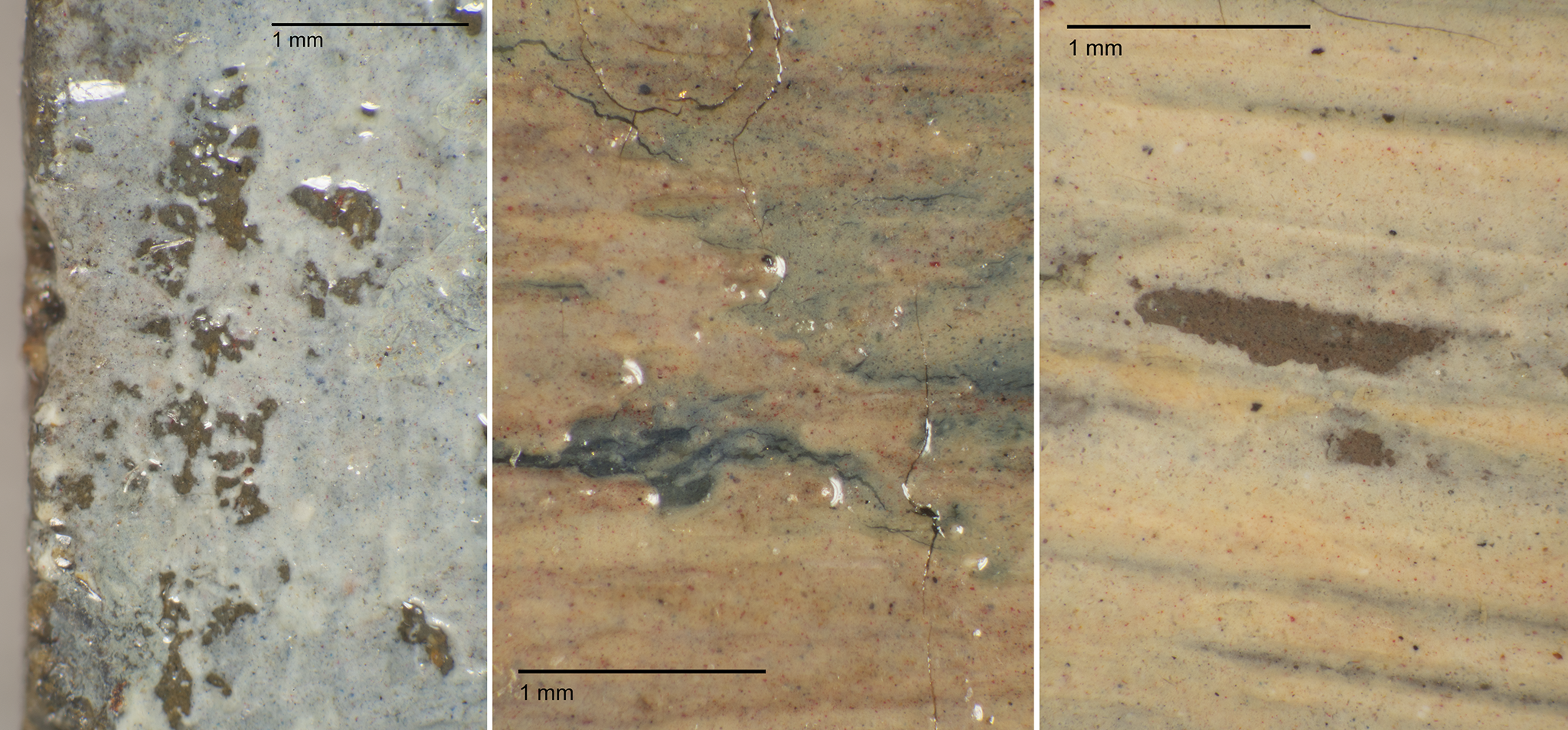
During examination with a stereomicroscope, no ground layer: An opaque preparatory layer applied to the support, either commercially or by the artist, to prevent absorption of the paint into the canvas or panel. See also priming layer. could be identified.3No samples were taken during this examination. It is possible that a ground layer is present; however, this layer could not be identified through microscopy. Boudin often used commercially prepared supports with light-colored grounds. Nouwen, “An Investigation into the Materials and Techniques of Eugène Louis Boudin (1824–1898),” 14-15. However, unprimed wood panels were available at this time from artists’ suppliers at a reduced cost and were especially common in small sizes suitable for plein-air painting.4Iris Schaefer, Caroline von Saint-George, and Katja Lewerentz, Painting Light: The Hidden Techniques of the Impressionists (Milan: Skira, 2008), 53. A continuous dark-colored underpainting: The first applications of paint that begin to block in color and loosely define the compositional elements. Also called ébauche. was found across the picture plane: The two-dimensional surface where the artist applies paint. and is visible within drying cracks: Also known as traction cracks, these are formed as the paint dries. They are usually the result of a "lean" paint with a small percentage of oil drying faster than an underlying "fat" paint layer with a higher percentage of oil. The quick drying of the top layer causes the paint layer to shrink and crack. and skips in the paint. In most instances, this layer appears dark green, with two exceptions: in the sand near the left side this layer appears blue, and in the sand near the figures above the signature it appears brown (Fig. 11).5Similar underpaintings have been identified on paintings in the collection of The National Gallery of London. Nouwen, “An Investigation into the Materials and Techniques of Eugène Louis Boudin (1824–1898),” 18. Although Boudin did experiment with differing underpainting hues relating to the compositional fields,6Nouwen, “An Investigation into the Materials and Techniques of Eugène Louis Boudin (1824–1898),” 19-20. here the differing hues are small and isolated. They do not appear to be related to the composition, and it is possible this variation was created when he mixed extra paint to reload his brush. Throughout, it appears that this underpainting was allowed to dry completely before the composition of the beach scene began, as illustrated by the numerous examples of wet-over-dry: An oil painting technique that involves layering paint over an already dried layer, resulting in no intermixing of paint or disruption to the lower paint strokes. applications.
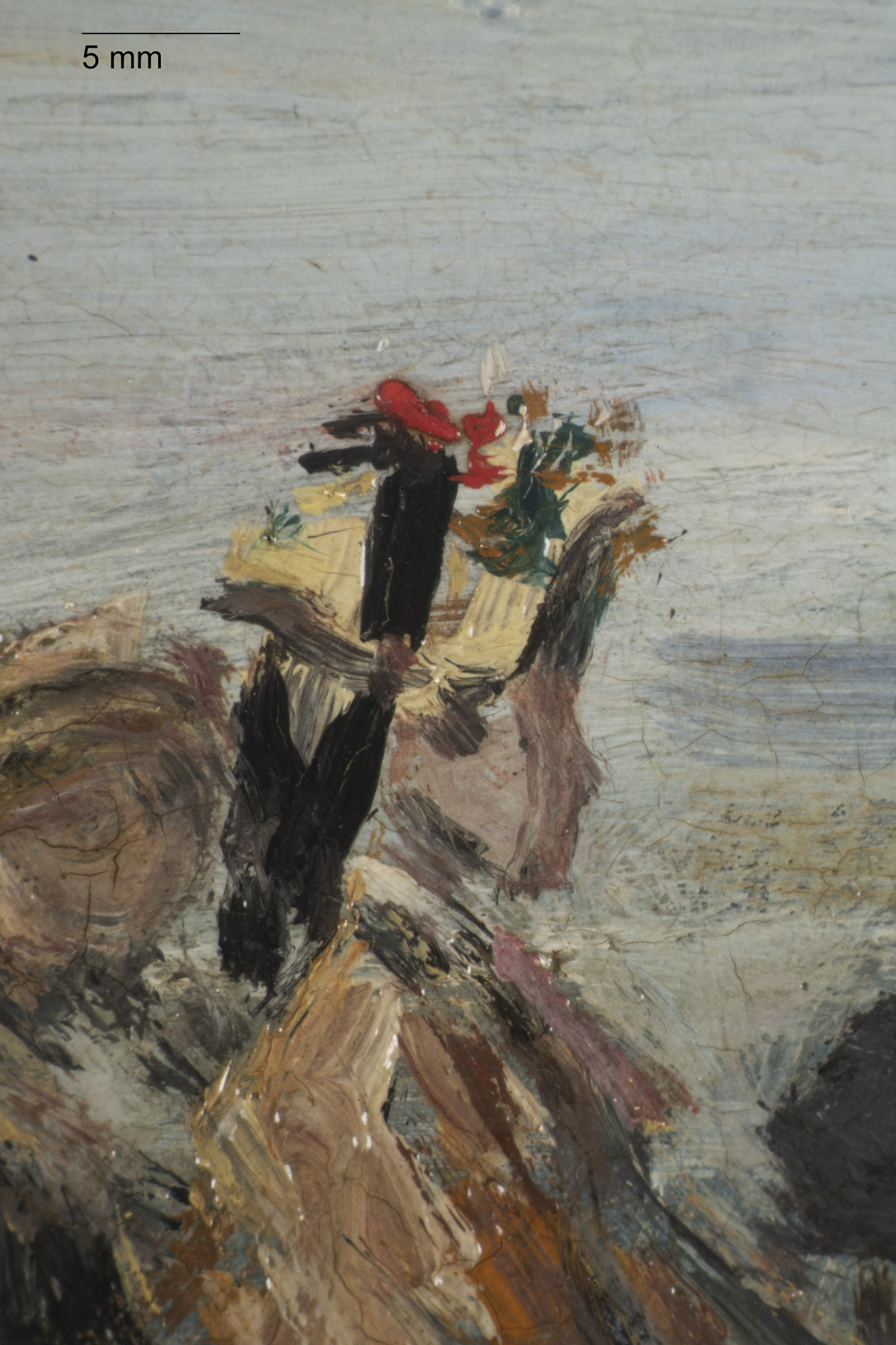
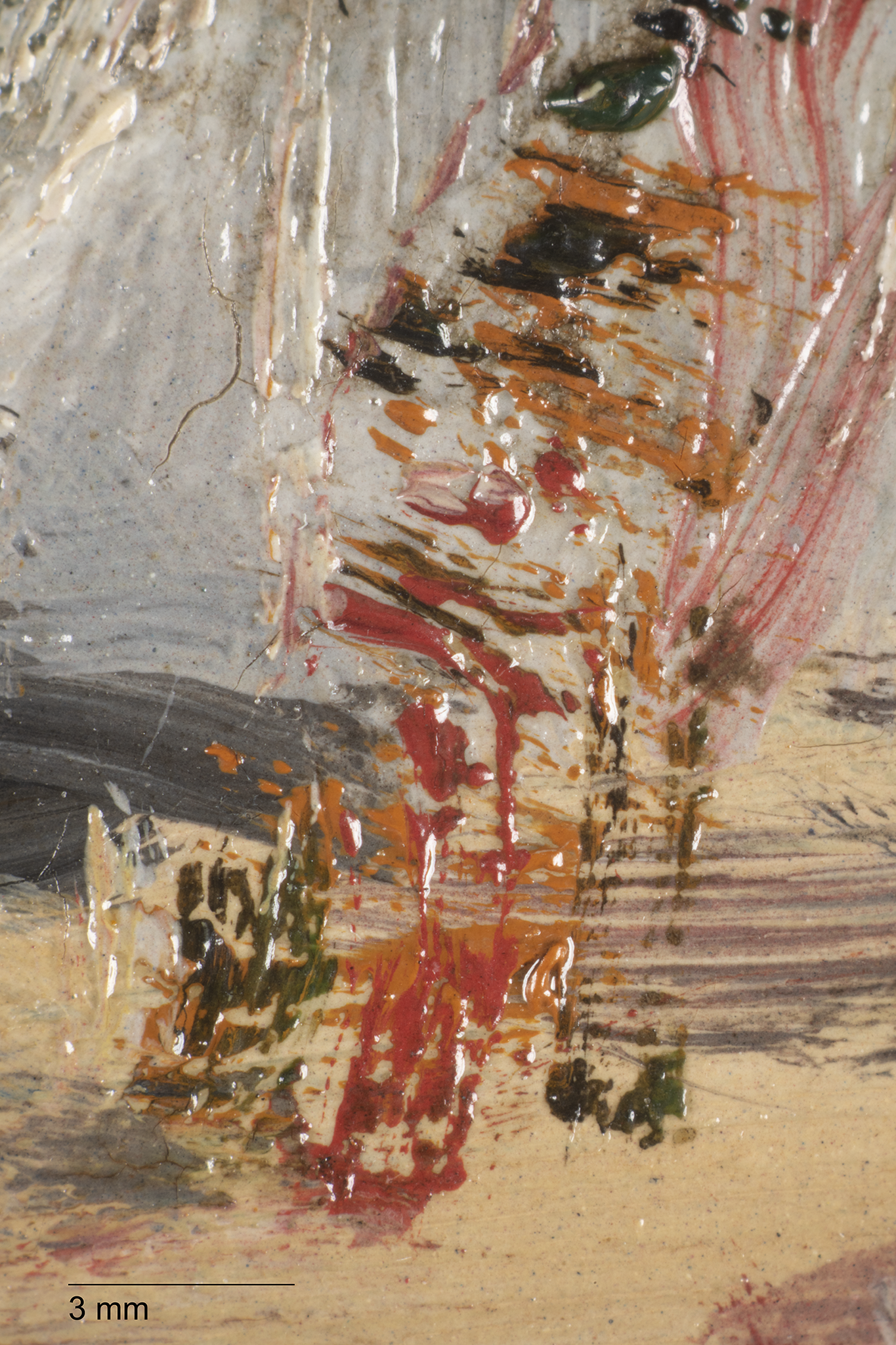
Immediately on top of the underpainting, Boudin blocked in the sky and beach, leaving glimpses of this lower layer visible between the various paint strokes of the figures, as shown in Figure 12. There is no clear indication of an underdrawing: A drawn or painted sketch beneath the paint layer. The underdrawing can be made from dry materials, such as graphite or charcoal, or wet materials, such as ink or paint. or built-up ébauche: The first applications of paint that begin to block in color and loosely define the compositional elements. Also called underpainting. layer to further form the scene. As with the underpainting, this initial blocking-in layer was also allowed to dry fully before the scene was created, indicating that while the majority of the composition may have been completed en plein air, colored preparation for the panel and early layers were likely applied in advance in a studio. The figures were painted quickly and appear to have been executed in one session as wet-over-wet: An oil painting technique which involves drawing a stroke of one color across the wet paint of another color. application is visible throughout. Some details, such as the bow on the standing girl’s dress, were applied with such a delicate touch that almost no underlying paint was transferred between brushstrokes (Fig. 13). In contrast, Boudin created the folded parasols with wet-into-wet: An oil painting technique which involves blending of colors on the picture surface. technique, with the swirls of paint resembling a floral pattern on the parasol to the left (Fig. 14). Once the figures were near completion, Boudin added detail to the background, such as the cloudy atmosphere of the sky. Brushstrokes wrap around the heads of the figures, adjusting the silhouettes, and sometimes pulling the paint wet-over-wet (Fig. 15).
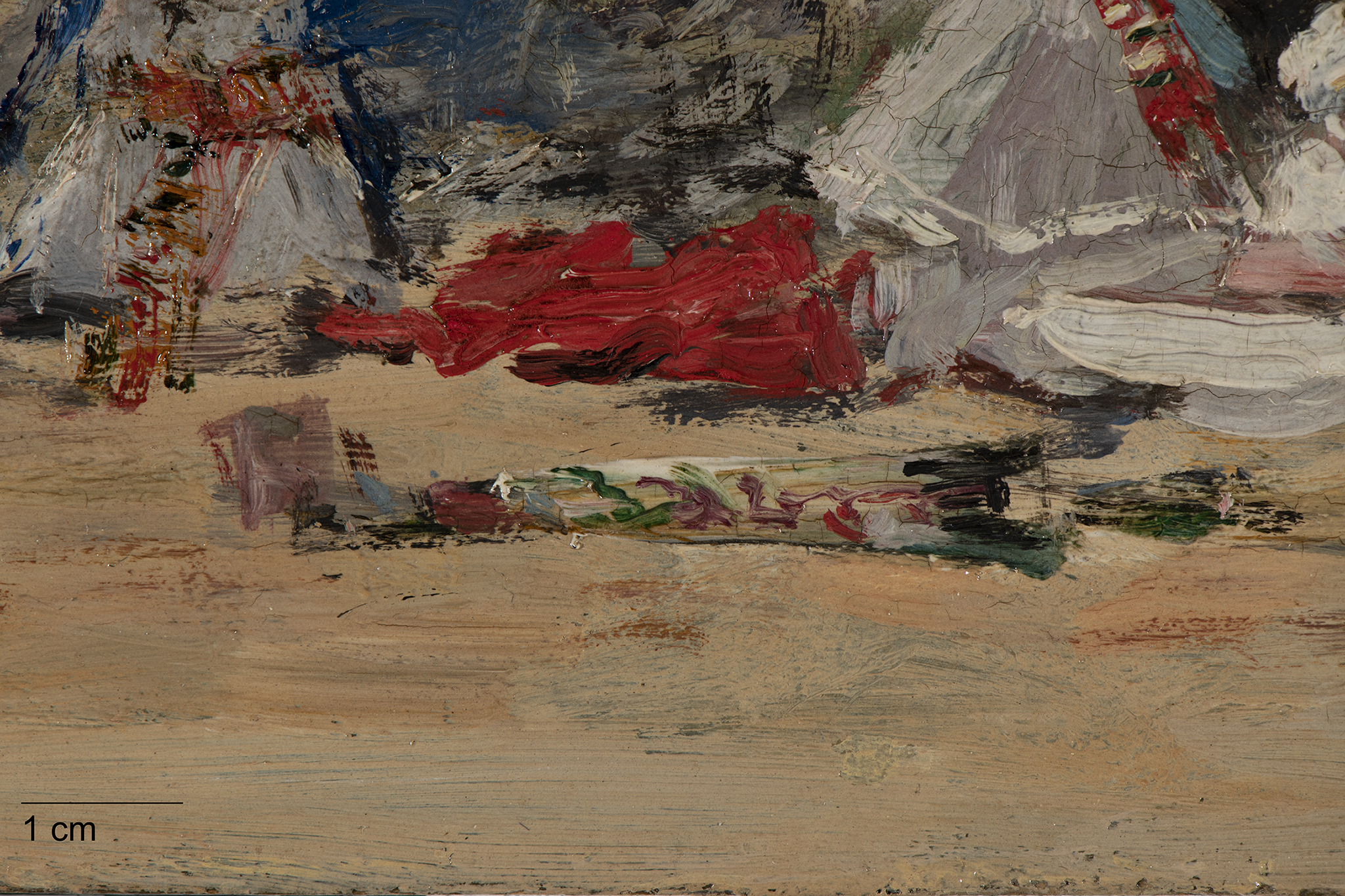
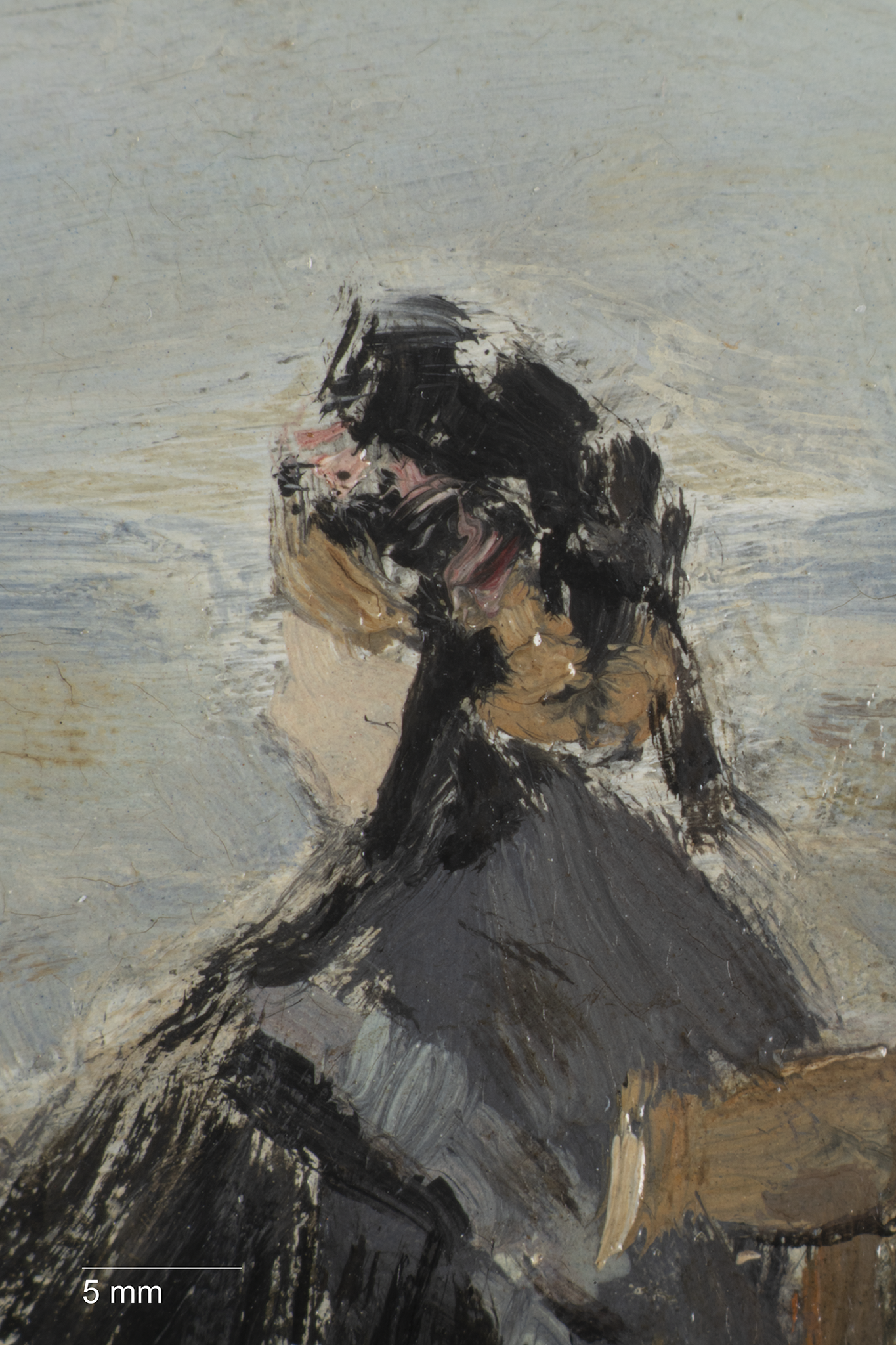
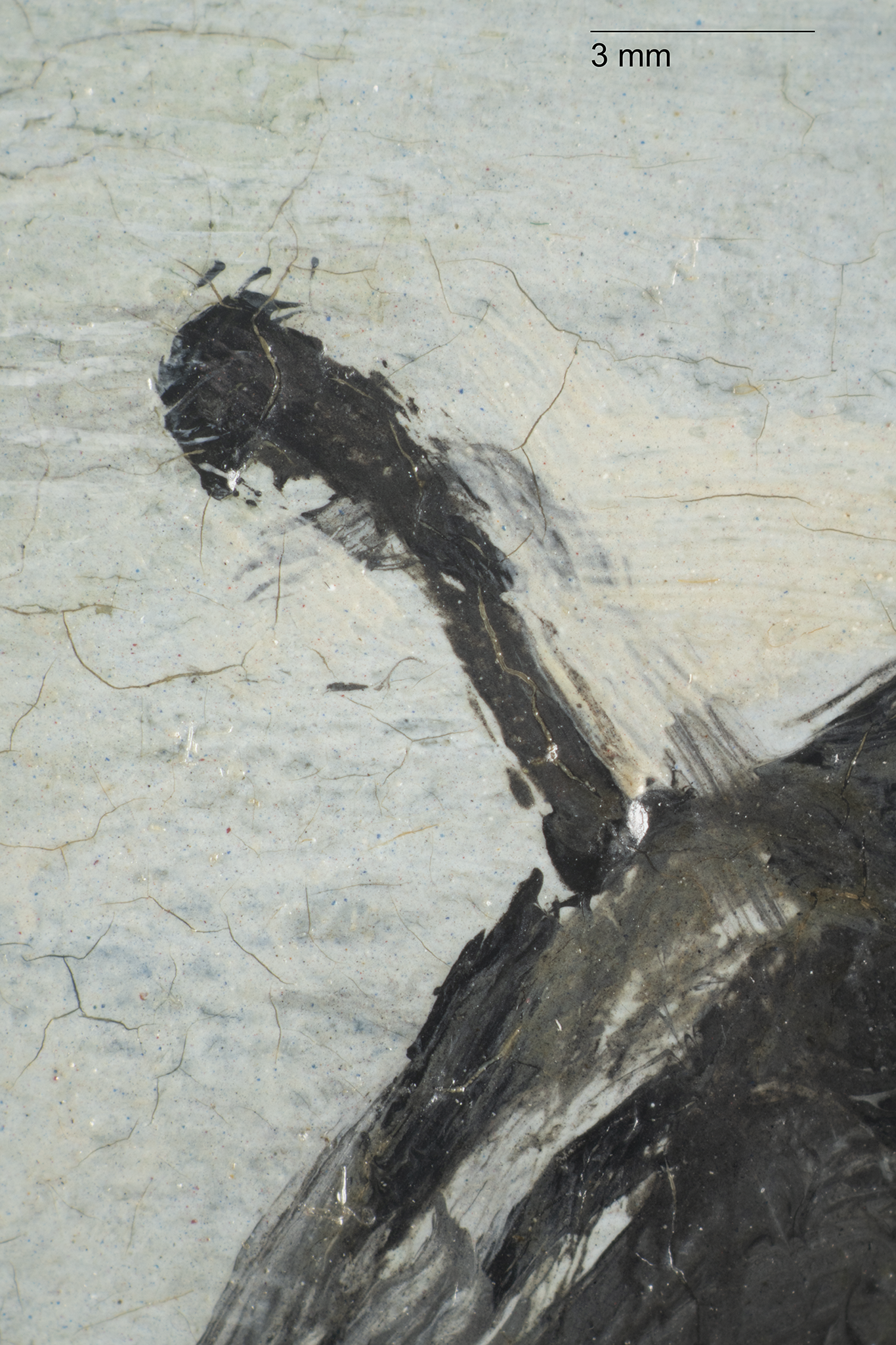
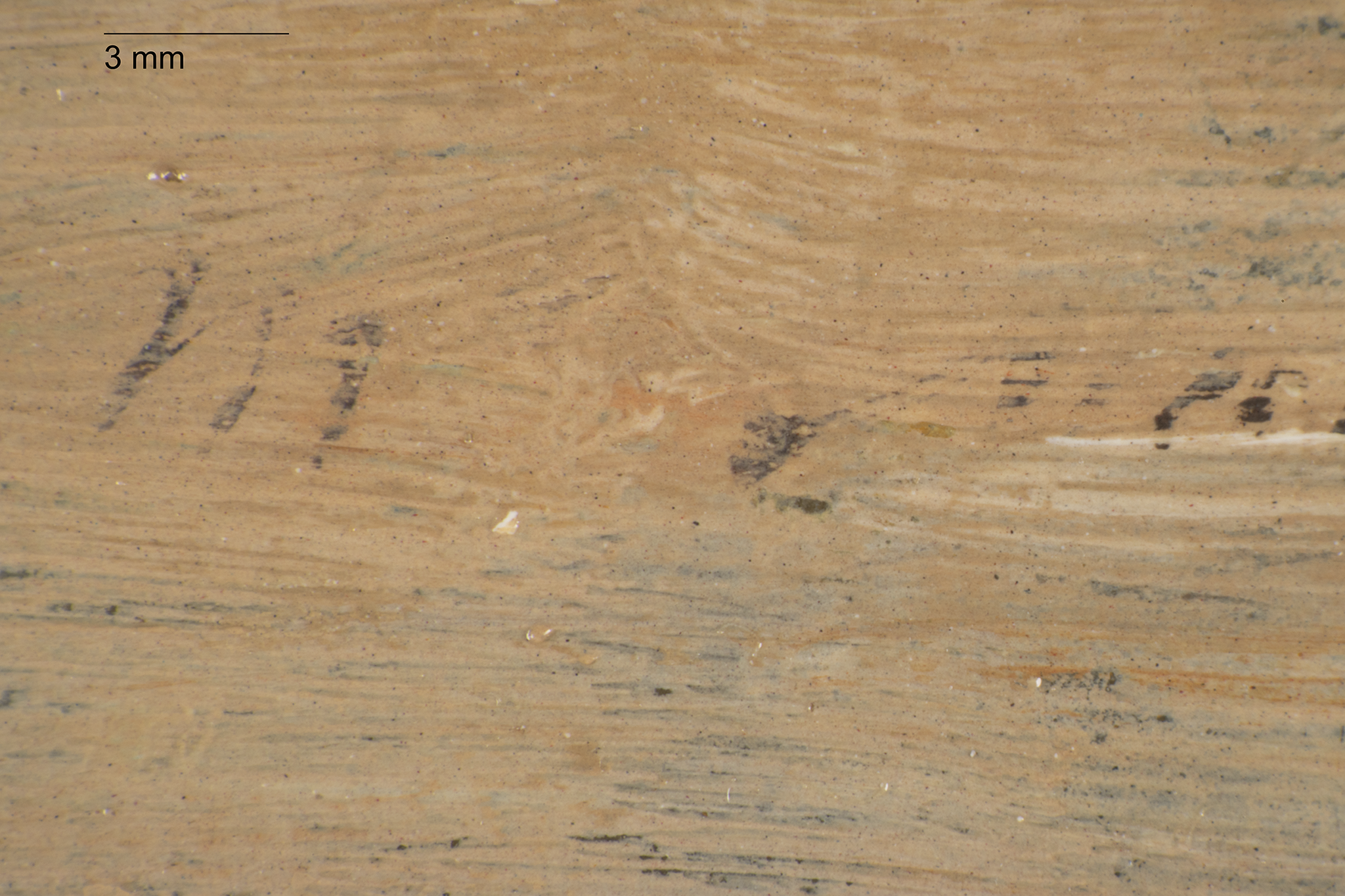
Few artist changes are found within this rapidly-executed painting. The ferrule of the central parasol shifted slightly, with the original placement still visible under the blue sky (Fig. 16). Another clear artist change is located at the bottom edge. Here an inscription is partially visible to the left of Boudin’s signature. The content of this inscription is unknown, as it was painted over by Boudin and could not be deciphered with infrared reflectography (IRR): A form of infrared imaging that exploits the behavior of painting materials at wavelengths beyond those accessible to infrared photography. These advantages sometimes include a continuing increase in the transparency of pigments beyond wavelengths accessible to infrared photography (i.e, beyond 1,000 nanometers), rendering underdrawing more clearly. The resulting image is called an infrared reflectogram. Devices that came into common use in the 1980s such as the infrared vidicon effectively revealed these features but suffered from lack of sharpness and uneven response. Vidicons continue to be used out to 2,200 nanometers but several newer pixelated detectors including indium gallium arsenide and indium antimonide array detectors offer improvements. All of these devices are optimally used with filters constraining their response to those parts of the infrared spectrum that reveal the most within the constraints of the palette used for a given painting. They can be used for transmitted light imaging as well as in reflection. or X-ray radiography (also referred to as x-radiography or radiography): Radiography is an examination tool analogous to the use of X-rays in medicine whereby denser components of a painted composition can be recorded as an inverted shadow image cast on film or a digital X-ray imaging plate from a source such as an X-ray tube. The method has been used for more than a century and is most effective with dense pigments incorporating metallic elements such as lead or zinc. It can reveal artist changes, underlying compositions, and information concerning the artwork’s construction and condition. The resulting image is called an x-radiograph or radiograph. It differs from the uses of X-ray spectrometry in being dependent on the density of the paint to absorb X-rays before they reach the film or image plate and being non-specific as to which elements are responsible for the resulting shadow image.. The only identifiable letter is an “M” painted in script (Fig. 17).
The paint layer is in excellent condition, with few losses and minimal retouching: Paint application by a conservator or restorer to cover losses and unify the original composition. Retouching is an aspect of conservation treatment that is aesthetic in nature and that differs from more limited procedures undertaken solely to stabilize original material. Sometimes referred to as inpainting or retouch.. In addition to an overall craquelure: The network or pattern of cracks that develop on a paint surface as it ages. pattern, there are isolated regions of drying cracks. One horizontal split is present in the panel, following the wood grain. Hairline cracks have formed from this split; however, both the panel and paint layer are stable. The varnish layer, estimated natural resin varnish, has discolored slightly and has some isolated microscopic delamination: The separation of layers in a painting. Examples include separation of the original canvas from the lining canvas, or separation of the paint layer from the ground layer..
Notes
-
Documentation of Boudin’s painting supports has shown that he employed both standard- and nonstandard-size supports. See Lara Broecke, “Notes on the Technique of Eugène Boudin,” Hamilton Kerr Institute Bulletin, no. 4 (2013): 50.
-
Suppliers included artists’ colormen, marchands de malles (trunk-salesmen), and carpenters. Virginia Nouwen, “An Investigation into the Materials and Techniques of Eugène Louis Boudin (1824–1898)” (Postgraduate Diploma in the Conservation of Easel Paintings, Final Year Project, Courtauld Institute of Art, London, 2018), 7–8.
-
No samples were taken during this examination. It is possible that a ground layer is present; however, this layer could not be identified through microscopy. Boudin often used commercially prepared supports with light-colored grounds. Nouwen, “An Investigation into the Materials and Techniques of Eugène Louis Boudin (1824–1898),” 14–15.
-
Iris Schaefer, Caroline von Saint-George, and Katja Lewerentz, Painting Light: The Hidden Techniques of the Impressionists (Milan: Skira, 2008), 53.
-
Similar underpaintings have been identified on paintings in the collection of The National Gallery of London. Nouwen, “An Investigation into the Materials and Techniques of Eugène Louis Boudin (1824–1898),” 18.
-
Nouwen, “An Investigation into the Materials and Techniques of Eugène Louis Boudin (1824–1898),” 19–20.
Documentation
Citation
Chicago:
Brigid M. Boyle, “Eugène Boudin,
Trouville, Beach Scene, 1874,”
documentation in ed. Aimee Marcereau DeGalan
French Paintings and Pastels, 1600–1945: The
Collections of the Nelson-Atkins Museum of
Art
(Kansas City: The Nelson-Atkins Museum of Art,
2021),
https://doi.org/10.37764/78973.5.603.4033.
MLA:
Boyle, Brigid M. “Eugène Boudin, Trouville, Beach Scene, 1874,” documentation. French Paintings and Pastels, 1600–1945: The Collections of the Nelson-Atkins Museum of Art, edited by Aimee Marcereau DeGalan, The Nelson-Atkins Museum of Art, 2021. doi: 10.37764/78973.5.603.4033
Provenance
Acquired from the artist by Jean Théodore Elie Bullier (1831–1909), Paris, by 1898–October 26, 1909 [1];
Given to his granddaughter, Emma Jarry (née Marchand, 1888–1982), Paris, October 26, 1909–no later than April 7, 1982 [2];
By descent to her daughter, Madeleine-Françoise Jarry (1917–1982), Paris, by April 7, 1982–June 29, 1982 [3];
Inherited by her brother, Pierre Jarry (1913–1999), Paris, June 29, 1982–November 27, 1984 [4];
Purchased from Jarry by Adolphe Stein, Paris, on joint account with Richard Green, London, stock no. RH 594, November 27, 1984–February 1985 [5];
Half-share purchased from Adolphe Stein by Richard Green, February 1985–November 13, 1985 [6];
Purchased from Richard Green by Marion (née Helzberg, 1931–2013) and Henry (1922–2019) Bloch, Shawnee Mission, KS, November 13, 1985–June 15, 2015;
Their gift to The Nelson-Atkins Museum of Art, Kansas City, MO, 2015.
Notes
[1] Boudin sold or gifted the painting to Bullier at an unknown date, but certainly before his death in 1898. The owner of a famous Parisian dance hall, Bullier had a wide circle of acquaintances that included many artists. See email from Bruno Jarry, great-great-grandson of Jean Théodore Elie Bullier, to Brigid M. Boyle, NAMA, December 29, 2020, NAMA curatorial files.
[2] Jean Théodore Elie Bullier’s daughter, Ernestine Françoise Bullier (1866–1942), married Gustave Honoré-Léon Raoul Marchand (1875–1935) on July 4, 1887. Their daughter, Emma Marchand, received the painting as a wedding gift from her grandfather when she married Paul Jarry (1883–1934) on October 26, 1909, three weeks before her grandfather’s death. See emails from Bruno Jarry to Brigid M. Boyle, NAMA, December 29, 2020 and January 25, 2021, NAMA curatorial files.
[3] It is unclear precisely when Emma Jarry bequeathed Trouville, Beach Scene to her daughter, but she did so prior to her death on April 7, 1982. The two women shared an apartment in Paris beginning in 1946, and the painting remained on view in their salon until Madeleine-Françoise Jarry’s death on June 29, 1982, only a few months after her mother’s passing. See emails from Bruno Jarry to Brigid M. Boyle, NAMA, December 29, 2020 and January 25, 2021, NAMA curatorial files.
[4] Pierre Jarry, a resident of Marseille, inherited his sister’s apartment and belongings, including Trouville, Beach Scene, upon her death. The painting remained in Paris until its sale in 1984. See emails from Bruno Jarry to Brigid M. Boyle, NAMA, January 25–26, 2021, NAMA curatorial files.
[5] Jarry received payment for the painting on November 27, 1984, but it took several months for the export license to receive approval. See email from Bruno Jarry to Brigid M. Boyle, NAMA, December 29, 2020, and letter from M. Jacot, International Art Transport, to Pierre Jarry, July 10, 1985, NAMA curatorial files. Richard Green stock number from verso label.
[6] For the purchase date of February 1985, see email from Penny Marks, Richard Green, to MacKenzie Mallon, NAMA, April 21, 2015, NAMA curatorial files.
Exhibitions
Manet to Matisse: Impressionist Masters from the Marion and Henry Bloch Collection, The Nelson-Atkins Museum of Art, Kansas City, MO, June 9–September 9, 2007, no. 4, as Trouville, Beach Scene (Trouville, scène de plage).
Magnificent Gifts for the 75th, The Nelson-Atkins Museum of Art, Kansas City, MO, February 13–April 4, 2010, no cat.
References
Robert and Manuel Schmit, Eugène Boudin, 1824–1898: Deuxième supplément (Paris: Éditions Galerie Schmit, 1993), no. 3919, pp. 28, 182–84, (repro.), as Trouville. Scène de plage.
Rebecca Dimling Cochran and Bobbie Leigh, “100 Top Collectors who have made a difference,” Art and Antiques 28, no. 3 (March 2006): 90.
Bobbie Leigh, “Magnificent Obsession,” Art and Antiques 28, no. 6 (June 2006): 61.
Richard R. Brettell and Joachim Pissarro, Manet to Matisse: Impressionist Masters from the Marion and Henry Bloch Collection, exh. cat. (Kansas City, MO: Nelson-Atkins Museum of Art, 2007), 14, 38, 42–43, 110, 155, (repro.), as Trouville, Beach Scene (Trouville, scène de plage).
Alice Thorson, “A Tiny Renoir Began Impressive Obsession,” Kansas City Star 127, no. 269 (June 3, 2007): E4.
“Lasting Impressions: A Tribute to Marion and Henry Bloch,” Member Magazine (The Nelson-Atkins Museum of Art) (Fall 2007): 11–12.
Steve Paul, “Pretty Pictures: Marion and Henry Bloch’s collection of superb Impressionist masters,” Panache 4, no. 3 (Fall 2007): 20.
Alice Thorson, “Blochs add to Nelson treasures,” Kansas City Star 130, no. 141 (February 5, 2010): A1, A8.
Carol Vogel, “O! Say, You Can Bid on a Johns,” New York Times 159, no. 54,942 (February 5, 2010): C26.
Thomas M. Bloch, Many Happy Returns: The Story of Henry Bloch, America’s Tax Man (Hoboken: John Wiley and Sons, 2011), 174–75.
Diane Stafford, “Bloch gift to go for Nelson upgrade,” Kansas City Star 135, no. 203 (April 8, 2015): A8.
“Nelson-Atkins Museum of Art officially accessions Bloch Impressionist masterpieces,” Artdaily.org (July 25, 2015): http://artdaily.com/news/80246/Nelson-Atkins-Museum-of-Art-officially-accessions-Bloch-Impressionist-masterpieces.
Julie Paulais, “Le Nelson-Atkins Museum of Art reçoit des tableaux impressionnistes en échange de leurs répliques,” Le Journal des arts (July 30, 2015): https://www.lejournaldesarts.fr/patrimoine/le-nelson-atkins-museum-art-recoit-des-tableaux-impressionnistes-en-echange-de-leurs.
Josh Niland, “The Nelson-Atkins Museum of Art Acquires a Renowned Collection of Impressionist and Postimpressionist Art,” architecturaldigest.com (July 31, 2015): https://www.architecturaldigest.com/story/nelson-atkins-museum-accessions-bloch-art-collection.
Nancy Staab, “Van Gogh is a Go!” 435: Kansas City’s Magazine (September 2015): 76.
“Nelson-Atkins to unveil renovated Bloch Galleries of European Art in winter 2017,” Artdaily.org (July 20, 2016): http://artdaily.com/news/88852/Nelson-Atkins-to-unveil-renovated-Bloch-Galleries-of-European-Art-in-winter-2017-.
“Nelson-Atkins Museum of Art celebrates generosity of Henry Bloch with new acquisition,” Artdaily.org (October 18, 2016): https://artdaily.cc/news/90923/Nelson-Atkins-Museum-of-Art-celebrates-generosity-of-Henry-Bloch-with-new-acquisition#.XnKATqhKiUk.
Catherine Futter et al., Bloch Galleries: Highlights from the Collection of the Nelson-Atkins Museum of Art (Kansas City, MO: Nelson-Atkins Museum of Art, 2016), 57, (repro.), as Trouville, Beach Scene.
Kelly Crow, “Museum Rewards Donor with Fake Art to Hang at Home,” Wall Street Journal (January 25, 2017): https://www.wsj.com/articles/museum-rewards-donor-with-fake-art-to-hang-at-home-1485370768.
David Frese, “Bloch savors paintings in redone galleries,” Kansas City Star 137, no. 161 (February 25, 2017): 1A.
Albert Hecht, “Henry Bloch’s Masterpieces Collection to Go On Display at Nelson-Atkins Museum,” Jewish Business News (February 26, 2017): http://jewishbusinessnews.com/2017/02/26/henry-bloch-masterpieces-collection/.
David Frese, “Inside the Bloch Galleries: An interactive experience,” Kansas City Star 137, no. 169 (March 5, 2017): 5D, (repro.) as Trouville, Beach Scene.
“Editorial: Thank you, Henry and Marion Bloch,” Kansas City Star (March 7, 2017): http://www.kansascity.com/opinion/editorials/ article137040948.html [repr. “Thank you, Henry and Marion Bloch,” Kansas City Star 137, no. 172 (March 8, 2017): 16A].
Hampton Stevens, “(Not Actually) 12 Things To Do During The Big 12 Tournament,” Flatland: KCPT’s Digital Magazine (March 9, 2017): http://www.flatlandkc.org/arts-culture/sports/not-actually-12-big-12-tournament/.
Laura Spencer, “The Nelson-Atkins’ Bloch Galleries Feature Old Masterworks and New Technology,” KCUR (March 10, 2017): http://kcur.org/post/nelson-atkins-bloch-galleries-feature-old-masterworks-and-new-technology#stream/0.
Victoria Stapley-Brown, “Nelson-Atkins Museum’s new European art galleries come with a ‘love story,’” Art Newspaper (March 10, 2017): http://theartnewspaper.com/news/museums/nelson-atkins-museum-s-new-european-art-galleries-come-with-a-love-story/.
Harry Bellet, “Don du ciel pour le Musée Nelson-Atkins,” Le Monde (March 13, 2017): http://www.lemonde.fr/arts/article/2017/03/13/don-du-ciel-pour-le-musee-nelson-atkins_5093543_1655012.html.
Menachem Wecker, “Jewish Philanthropist Establishes Kansas City as Cultural Mecca,” Forward (March 14, 2017): http://forward.com/culture/365264/jewish-philanthropist-establishes-kansas-city-as-cultural-mecca/ [repr. in Menachem Wecker, “Kansas City Collection Is A Chip Off the Old Bloch,” Forward (March 17, 2017): 20–22].
Juliet Helmke, “The Bloch Collection Takes up Residence in Kansas City’s Nelson Atkins Museum,” Blouin ArtInfo International (March 15, 2017): http://www.blouinartinfo.com/news/story/2005267/the-bloch-collection-takes-up-residence-in-kansas-citys.
Louise Nicholson, “How Kansas City got its magnificent museum,” Apollo: The International Art Magazine (April 7, 2017): https://www.apollo-magazine.com/how-kansas-city-got-its-magnificent-museum/.
Lilly Wei, “Julián Zugazagoitia: ‘Museums should generate interest and open a door that leads to further learning,’” Studio International (August 21, 2017): http://studiointernational.com/index.php/julian-zugazagoitia-director-nelson-atkins-museum-of-art-kansas-city-interview.
Robert D. Hershey Jr., “Henry Bloch, H&R Block’s cofounder, dies at 96,” Boston Globe (April 23, 2019): https://www3.bostonglobe.com/metro/obituaries/ 2019/04/23/henry-bloch-block-cofounder/?arc404=true.
Robert D. Hershey Jr., “Henry W. Bloch, Tax-Preparation Pioneer (and Pitchman), Is Dead at 96,” New York Times (April 23, 2019): https://www.nytimes.com/2019/04/23/obituaries/henry-w-bloch-dead.html.
Claire Selvin, “Henry Wollman Bloch, Collector and Prominent Benefactor of Nelson-Atkins Museum of Art, Is Dead at 96,” ArtNews (April 23, 2019): http://www.artnews.com/2019/04/23/henry-bloch-dead-96/.
Eric Adler and Joyce Smith, “Henry Bloch, co-founder of H&R Block, dies at 96,” Kansas City Star 139, no. 219 (April 24, 2019): 1A.
“Henry Wollman Bloch (1922-2019),” Artforum (April 24, 2019): https://www.artforum.com/news/henry-wollman-bloch-1922-2019-79547.
Frank Morris, “Henry Bloch, Co-Founder Of H&R Block, Dies At 96,” NPR (April 24, 2019): https://www.npr.org/2019/04/24/716641448/henry-bloch-co-founder-of-h-r-block-dies-at-96.
Ignacio Villarreal, “Nelson-Atkins mourns loss of Henry Bloch,” ArtDaily.org (April 24, 2019): http://artdaily.com/news/113035/Nelson-Atkins-mourns-loss-of-Henry-Bloch#.XMB76qR7laQ.
Eric Adler and Joyce Smith, “H&R Block co-founder, philanthropist Bloch dies,” Cass County Democrat Missourian 140, no. 29 (April 26, 2019): 1A.
Eric Adler and Joyce Smith, “KC businessman and philanthropist Henry Bloch dies,” Lee’s Summit Journal 132, no. 79 (April 26, 2019): 1A.
Luke Nozicka, “Family and friends remember Henry Bloch of H&R Block,” Kansas City Star 139, no. 225 (April 30, 2019): 4A [repr. Luke Nozicka, “Family and friends remember Henry Bloch of H&R Block,” Kansas City Star 139, no. 228 (May 3, 2019): 3A].
Eric Adler, “Sold for $3.25 million, Bloch’s home in Mission Hills may be torn down,” Kansas City Star 141, no. 90 (December 16, 2020): 2A.