Catalogue Entry
Citation
Chicago:
Brigid M. Boyle, “Eugène Boudin, The Beach, ca. 1865, and Trouville, Beach Scene, 1874,” catalogue entry in ed. Aimee Marcereau DeGalan French Paintings and Pastels, 1600–1945: The Collections of the Nelson-Atkins Museum of Art (Kansas City: The Nelson-Atkins Museum of Art, 2021), https://doi.org/10.37764/78973.5.602.5407.
MLA:
Boyle, Brigid M. “Eugène Boudin, The Beach, ca. 1865, and Trouville, Beach Scene, 1874,” catalogue entry. French Paintings and Pastels, 1600–1945: The Collections of the Nelson-Atkins Museum of Art, edited by Aimee Marcereau DeGalan, The Nelson-Atkins Museum of Art, 2021. doi: 10.37764/78973.5.602.5407.
This catalogue entry explores two paintings. For the catalogue documentation and technical entry for the associated painting, see Trouville, Beach Scene, 2015.13.4.
“I was desperate; I had to get out of this stone prison at all costs, and I resolved to visit Trouville. The crush of dazed travelers proved that I was not alone in feeling the urgent need for a little bit of fresh air.”1Léon Arbaud [Mme Lenormant], “Chronique du bord de la mer,” La Semaine des familles, no. 50 (September 12, 1863): 797–800. “J’étais au désespoir; à tout prix il me fallait sortir de cette prison de pierres, et je résolus de venir à Trouville. La cohue de voyageurs ahuris me prouva que je n’étais pas seul à ressentir l’impérieux besoin d’un peu d’air libre.” All translations by Brigid M. Boyle. So begins a travel piece by the Parisian journalist Léon Arbaud from the summer of 1863. Like many residents of the City of Light, Arbaud felt confined by the narrow streets and crowded spaces—the urban renewal scheme undertaken by Napoleon III’s appointee, Baron Haussmann, was still ongoing—and so he decided that the only solution was a weekend getaway to the coast of Normandy. Seaside holidays were already a well-established tradition in many parts of Europe; French aristocrats had borrowed this practice from their British peers early in the nineteenth century.2Vivien Hamilton, Boudin at Trouville, exh. cat. (London: John Murray, 1992), 53. However, advances in rail technology and a midcentury surge in trains de plaisir (round-trip rail service from Paris to the shore) made littoral towns more accessible than ever before.3Sylvie Gache-Patin and Scott Schaefer, “Impressionism and the Sea,” in Andrea P. A. Belloli, A Day in the Country: Impressionism and the French Landscape, exh. cat. (Los Angeles: Los Angeles County Museum of Art, 1984), 273–78. For a period rendering of Parisians jostling to board such a train, see Honoré Daumier, Les trains de plaisir, 1864, lithograph, National Gallery of Art, Washington, DC, Rosenwald Collection, 1964.8.577. Each summer, Parisians seeking a respite from urban life flocked to the beaches in greater numbers than the previous year.
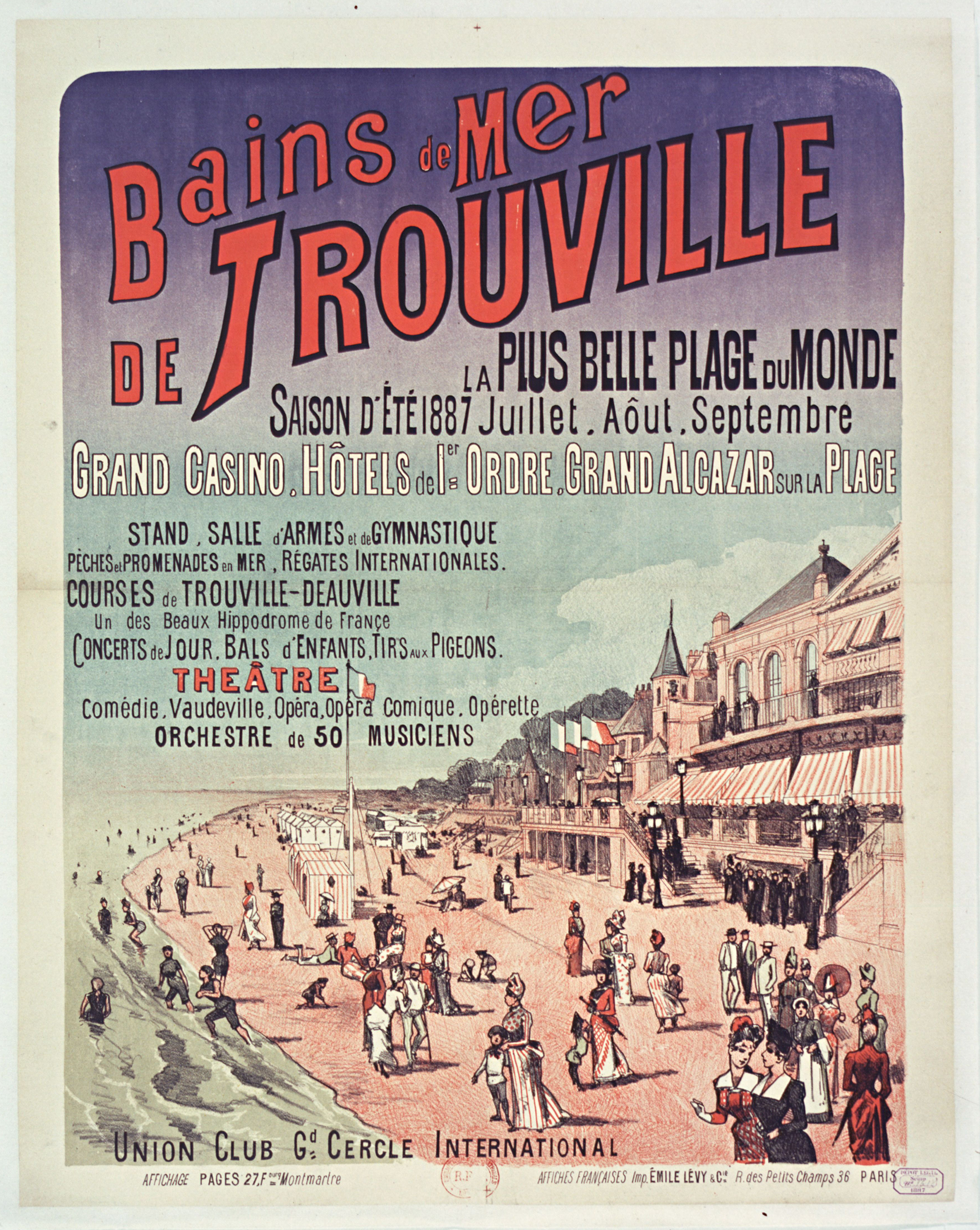
One of the most popular destinations from the 1860s on was Trouville. Originally a Viking port, it was still an unspoiled village with “its houses piled on top of one another, black, gray, red, white, facing every which way without alignment and without symmetry” when a teenage Gustave Flaubert vacationed there with his family in 1838.4Gustave Flaubert, Mémoires d’un fou: Roman (Paris: H. Floury, 1901), 63. “Ses maisons entassées les unes sur les autres, noires, grises, rouges, blanches, tournées de tous côtés, sans alignement et sans symétrie.” Flaubert wrote Mémoires d’un fou in 1838, but it was not published until 1901, some two decades after his death. For the Viking history of Trouville, see Adrienne Farrell, “Trouville, Normandy: Faces by Flaubert, Skies by Boudin,” New York Times (January 23, 1977). That changed dramatically in the ensuing decades. Several new hotels were constructed to entice tourists, including the Hôtel de la Plage in 1840, the Hôtel Bellevue in 1843, the Hôtel de la Mer in 1855, and the Hôtel des Roches Noires in 1866.5Hamilton, Boudin at Trouville, 78–80. Some out-of-towners came for the casino: Louis Philippe I had abolished the Royal Lottery in 1836 and Parisian gambling houses in 1837, but he tolerated gambling outside the capital, especially at seaside resorts.6Jean-Louis Harouel, “From Francis I to Online Betting: The History of Gambling in France,” Pouvoirs 139, no. 4 (2011): 12. The main draw, however, was the waterfront, billed in advertisements as “the most beautiful beach in the world” (Fig. 1). In an 1887 poster by Émile Lévy et Cie, elegantly dressed men, women, and children parade along the shore, which stretches as far as the eye can see. Many visitors preferred Trouville’s soft white sand to Le Havre’s pebbles, which were less forgiving on the feet and often bombarded the legs of swimmers.7As one period commentator put it: “En cinq heures et tout directement, Paris est à Trouville! C’est une heure de plus que pour Le Havre . . . mais on trouve sur la rive du Calvados une délicieuse plage de sable fin, au lieu de ce terrible galet qui roule là-bas tant d’entorses sous vos pieds, quand, agité par le flot, il ne vous bombarde les jambes de projectiles au moins incommodes et souvent inquiétants.” See “Courier de Paris,” Le Monde illustré, no. 333 (August 29, 1863): 130–31. Trouville also boasted an expansive bathing area with separate zones for each sex and one coed section, all with different dress codes.8Hamilton, Boudin at Trouville, 55. By the early 1860s, it was attracting not only Parisians craving rejuvenation but also important dignitaries like Empress Eugénie and the Ottoman ambassador to France.9Boudin commemorated the Empress’s excursion in a painting; see The Burrell Collection, Glasgow, no. 35.45. For the ambassador’s visit, see “Courier de Paris,” 130.
Trouville was also a magnet for artists. Eugène Boudin (1824–98) is believed to have first visited this resort in June 1862.10Georges Jean-Aubry, Eugène Boudin d’après des documents inédits: L’Homme et l’œuvre (Paris: Editions Bernheim-Jeune, 1922), 51. Other artists who painted at Trouville include Jules Achille Noël (1815–81), Richard Parkes Bonington (1802–28), Louis Alexandre Dubourg (1821–91), Charles Louis Mozin (1806–62), and Charles François Pécrus (1826–1907). Born in Normandy, he typically spent the winter in Paris and the summer closer to home, often at Trouville or its sister town, Deauville. During those summer sojourns, Boudin produced hundreds of beach scenes, two of which belong to the Nelson-Atkins. The earlier of these two is a pastel known simply as The Beach. Boudin began experimenting with pastel in the late 1840s, making rapid studies of cloud formations that earned the praise of both the writer Charles Baudelaire and the painter Jean-Baptiste-Camille Corot (1796–1875).11Gustave Cahen, Eugène Boudin, sa vie et son oeuvre (Paris: H. Flory, 1900), 113. These studies likely served as aide-mémoires for his oil paintings. He continued to use pastel masterfully throughout his five-decade career, even though he rarely exhibited his pastel drawings or considered them autonomous works.12John House, “Boudin’s Modernity,” in Hamilton, Boudin at Trouville, 16. The Nelson-Atkins pastel bears no date, but it must have been created in the mid-1860s since it passed through the Galerie Cadart et Luquet in Paris, a short-lived partnership between Alfred Cadart (1828–75) and Jules Joseph Luquet (b. 1824) that existed from October 1863 to October 1867.13For more on this gallery, see Monique Nonne, “Alfred Cadart (1828–1875), marchand de tableaux modernes,” Bulletin de la Société de l’Histoire de l’Art français (2009): 363–73. At that time, Boudin was still struggling to make ends meet, and most of his patrons were from Le Havre, where his parents lived.14Michael Clarke, “Boudin: Le Havre,” Burlington Magazine 158, no. 1364 (November 2016): 921.
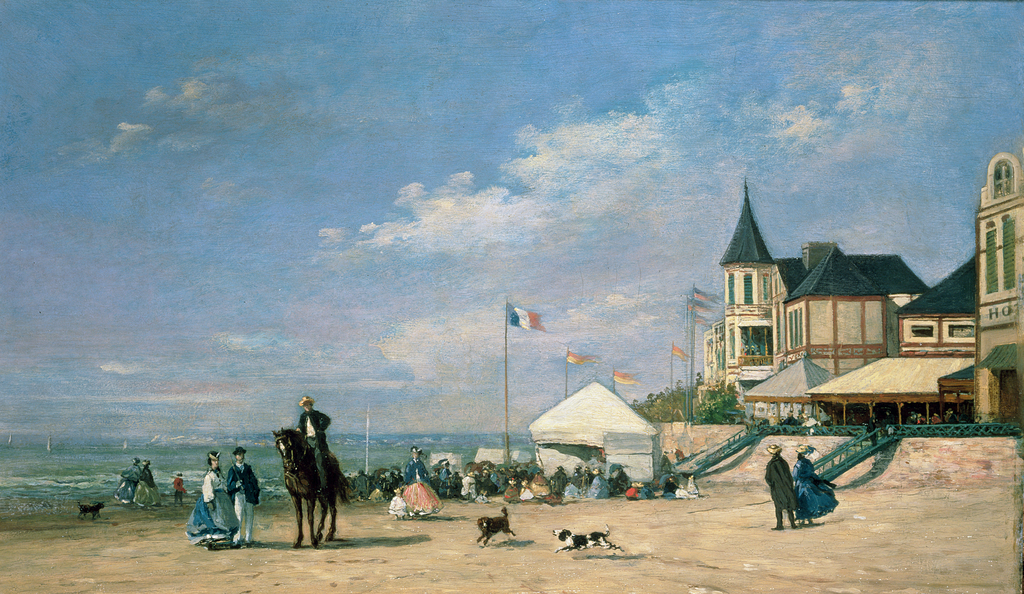
The setting for The Beach is uncertain, but Trouville is a strong candidate.15Its paper support is mounted, so any extant verso inscriptions about its location are obscured from view. See technical notes by Nancy Heugh, Heugh-Edmondson Conservation Services, February–June 2016, NAMA conservation files. Not only did Boudin visit this town annually during the mid-1860s, staying at 23 rue Farabe in 1864 and 9 rue d’Isly from 1865 onward, but also he produced two paintings at Trouville during this period that feature a mounted horse in the foreground, just like the Kansas City pastel.16For Boudin’s lodgings, see Hamilton, Boudin at Trouville, 60. For the paintings in question, see Robert Schmit, Eugène Boudin, 1824–1898, vol. 1 (Paris: Galerie Schmit, 1973), cats. 261 and 272. Richard R. Brettell wrongly asserted that “None of the numerous beach paintings done in Deauville and Trouville in the mid-1860s has a horse and rider.” See Richard R. Brettell and Joachim Pissarro, Manet to Matisse: Impressionist Masters from the Marion and Henry Bloch Collection, exh. cat. (Kansas City, MO: Nelson-Atkins Museum of Art, 2007), 41. Though Boudin frequently depicted horses pulling cabines de bain (bathing cabins) to and from the sea, he rarely portrayed beachgoers on horseback.17For examples of horses pulling bathing cabins, see Schmit, Eugène Boudin, 1824–1898, vol. 1, cats. 271, 275, and 294. An exception is the privately owned painting The Beach at Trouville (Fig. 2). Gazing directly at the viewer is a stationary equestrian who seems to have paused from chatting with the stylish couple beside him. All three figures are conscious of being captured on canvas, and the scene itself is carefully composed: a diagonal line could be traced from the horseman’s hat to the tip of the French flag to the spire of the adjacent building. By contrast, the horse and rider in the Nelson-Atkins pastel are on the move and evidently unaware of Boudin’s presence. The scene is also ephemeral in nature. A few seconds later, it seems, and they would have passed out of sight.
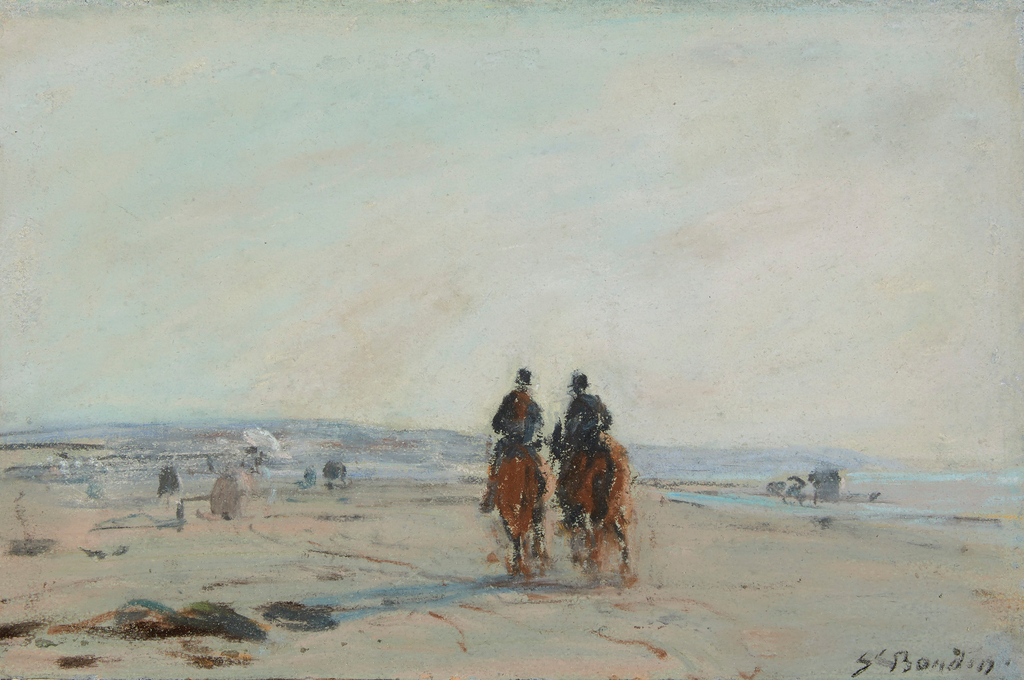
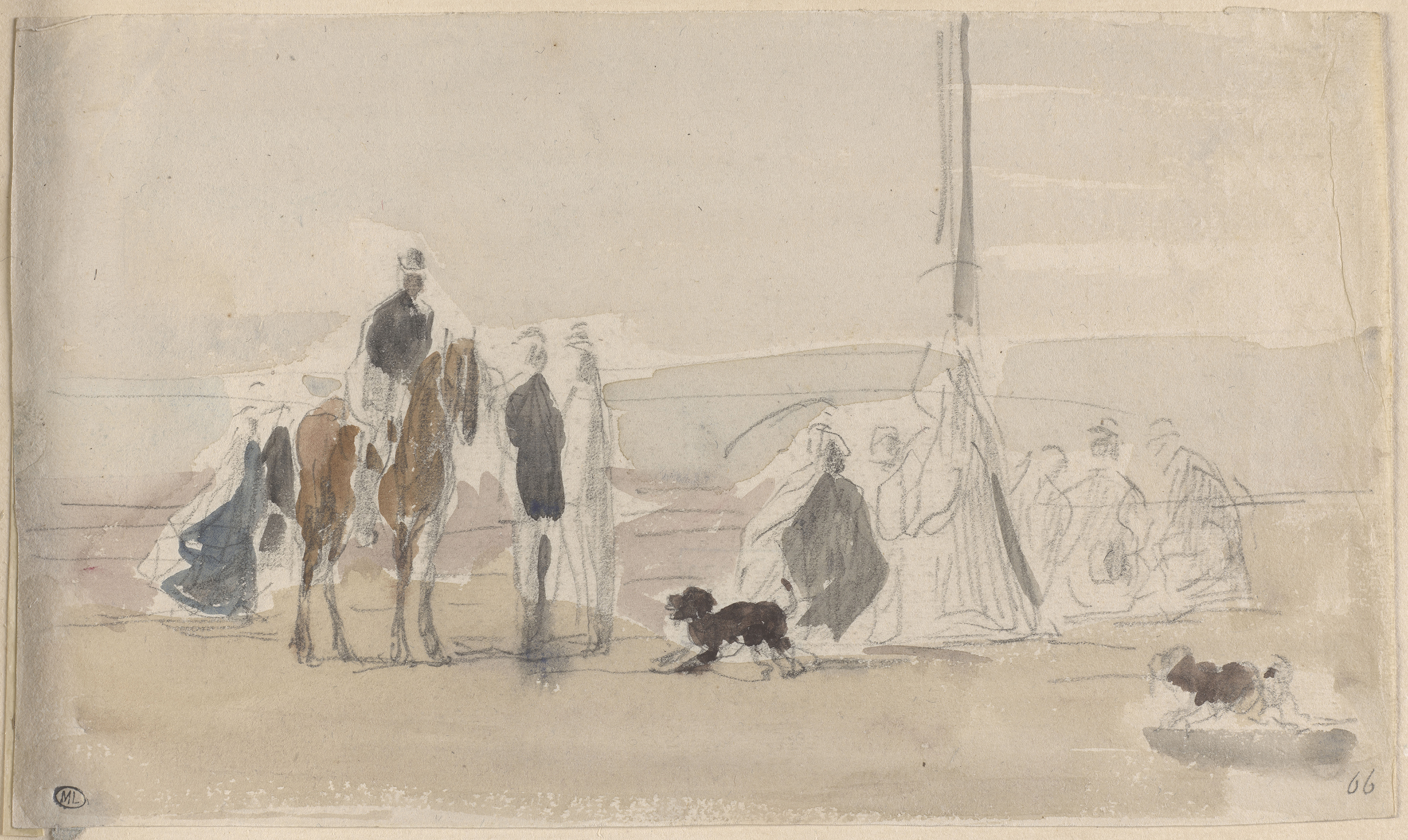
In this respect, The Beach has more in common with works like Two Riders on the Beach and A Rider and Elegant People on a Beach (Figs. 3, 4). The former, a pastel in private hands, shows two equestrians on a deserted beach heading away from the viewer. Their pace is unhurried, and the light suggests early morning or dusk. The latter, a watercolor-and-graphite drawing from an album belonging to the Musée d’Orsay, offers a side view of a mounted horse, two dogs, and several pedestrians on the beach. Boudin plotted the figures first and then added the surrounding scenery—the same technique that he used for the Nelson-Atkins pastel.18See technical notes by Nancy Heugh, Heugh-Edmondson Conservation Services, February–June 2016, NAMA conservation files. All three images record a fleeting moment witnessed by Boudin and were probably executed sur le motif: French for “in front of the object.” A term used for sketching or painting from life., as was the artist’s custom for small-scale sketches.19Brettell and Pissarro, Manet to Matisse, 38. A prolific draughtsman, Boudin may have revisited these riding scenes when painting more finished works like The Beach at Trouville (see Fig. 2).
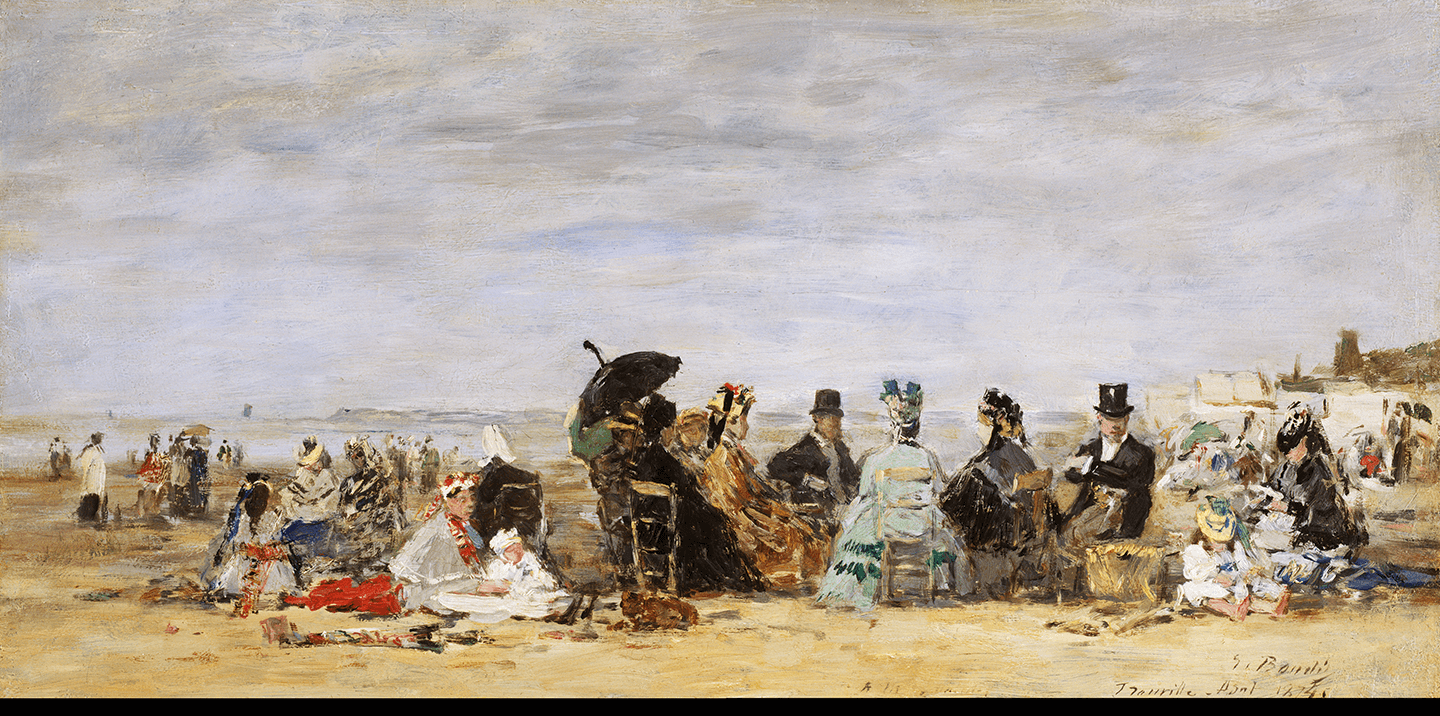
Boudin continued to represent the beach on and off for the rest of his professional life. He even developed his own subcategory of seaside images—bands of chic bourgeois holidaymakers socializing on the coast of Trouville or Deauville. According to Scottish art historian Vivien Hamilton’s tally, Boudin completed more than three hundred such paintings between 1862 and 1895, an astounding number that does not take into account his many renditions of this theme in pastel and watercolor.20Hamilton, Boudin at Trouville, 64. The Nelson-Atkins picture Trouville, Beach Scene is a prime example of this subgenre. Boudin painted it in August 1874, a few months after participating in the inaugural Impressionist exhibition and one month after his fiftieth birthday. By that point in time, most of Boudin’s beach scenes were intended for a small circle of personal acquaintances.21Laurent Manœuvre, “Eugène Boudin’s Beach Scenes at the Salon during the 1860s,” Burlington Magazine 161, no. 1394 (May 2019): 374. The Nelson-Atkins panel was acquired from Boudin by Jean Théodore Elie Bullier (1831–1909), owner of a famous Parisian dance hall known as le bal Bullier, and it remained within his family for four generations.22Jean Théodore Elie Bullier succeeded his uncle François Bullier (1796–1869) as owner of le bal Bullier in 1869. Bruno Jarry, great-great-grandson of Jean Théodore Elie Bullier, to Brigid M. Boyle, NAMA, December 29, 2020, NAMA curatorial files.
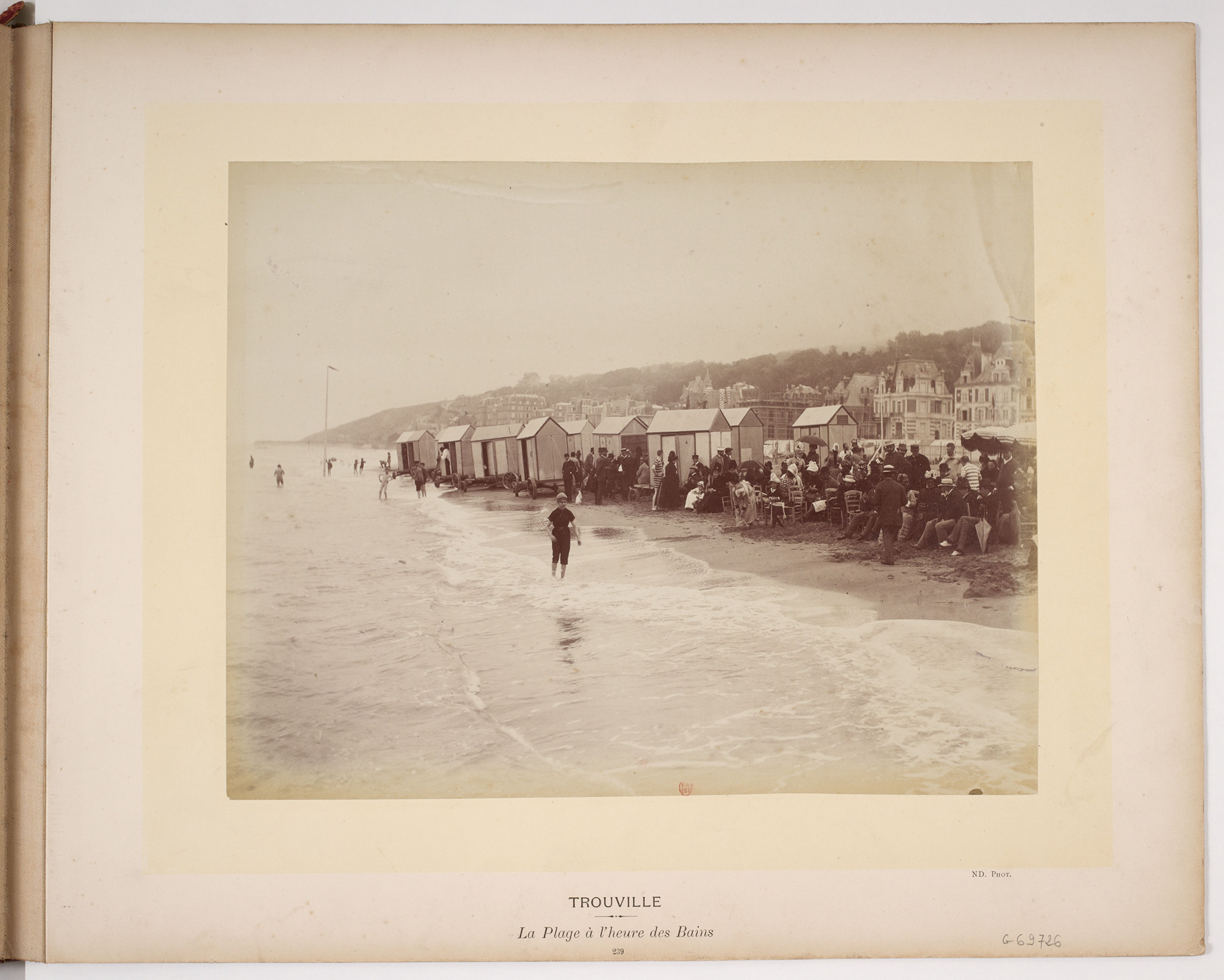
The painting portrays more than a dozen vacationers dressed to the nines and seated in a frieze-like arrangement. Most of the figures occupy chairs, but the nursemaid and children are settled directly on the sand—a subtle sign of their difference in class and age, respectively.23Boudin painted several studies of nursemaids, including La Nourrice sur la plage, ca. 1883–87, oil on panel, 5 3/4 x 9 1/4 in. (14.5 x 23.5 cm), sold by Pandolfini at the Palazzo Ramirez-Montalvo in Florence on November 23, 2016. See “Town, Country and Lady,” Bbys Magazine, November 20, 2016, https://www.barnebys.co.uk/blog/town-country-and-lady. Boudin’s contemporaries often commented on his fondness for representing masses of people. Historian Albert Sorel said of him in 1899: “In his paintings, he likes groups [and] he depicts the dense, lively crowd more willingly than the individual.”24Quoted in Jean-Aubry, Eugène Boudin d’après des documents inédits, 190. “Dans ses tableaux, il aime les groupes, il représente la foule dense et remuante, plus volontiers que l’individu.” There is no denying this predilection, but it is also true that Boudin was simply recording what he saw. Period photographs of Trouville beach show tightly packed clusters of fashionable people. In a photo by Neurdein frères, more than fifty beachgoers congregate near the shoreline, flanked by cabins and umbrellas (Fig. 5).25Neurdein frères was a major photographic enterprise and publishing house active from 1863 to 1918. Run by Étienne (1832–1918) and Louis-Antonin (before 1840–after 1912) Neurdein, the business employed more than one hundred people, including several uncredited “operators” who handled the camera equipment. See Marie-Ève Brouillon, “Photographes et opérateurs: Le travail des Neurdein frères (1863–1918),” Mil neuf cent, no. 36 (2018): 95–114. The men wear striped bathing costumes or suits and boater hats, while the women are clad in the latest Third Republic trends. Many lounge in the same wooden chairs with horizontal slats that appear in the Nelson-Atkins panel.
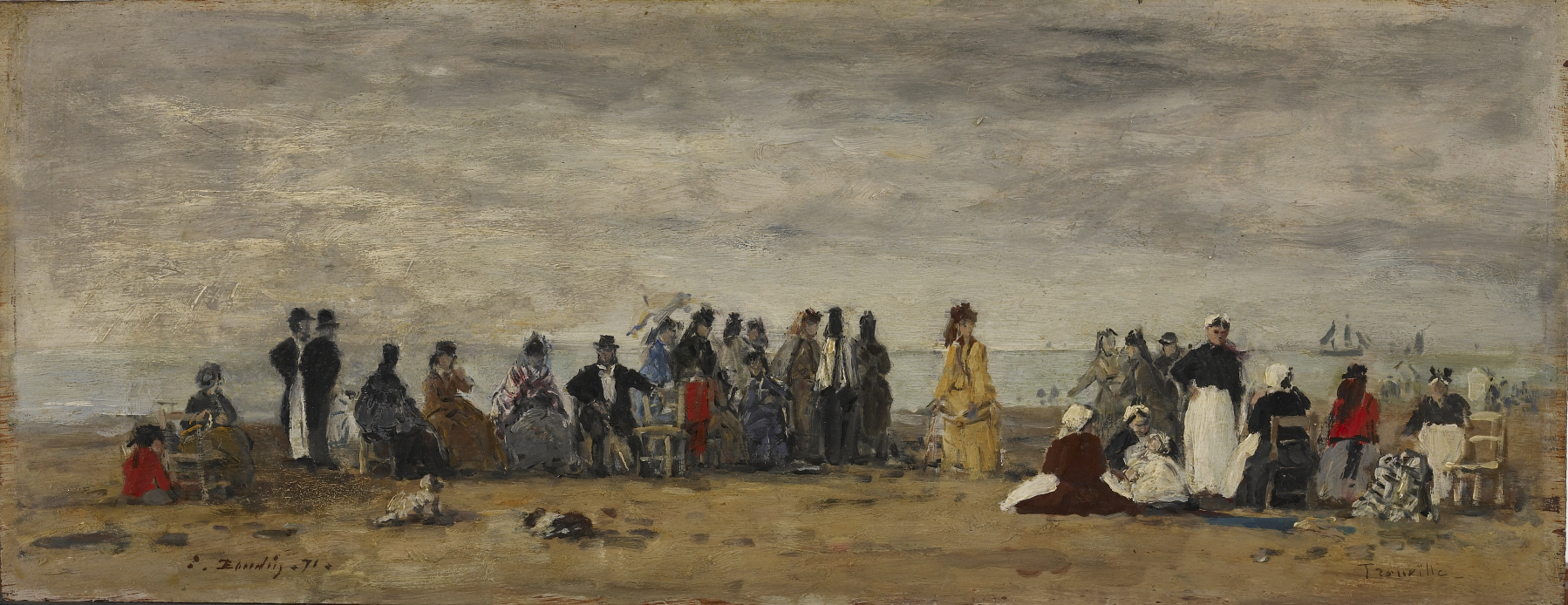
Some critics, in an effort to assimilate Boudin into the narrative of Impressionism, have overstated his desire to capture the effects of light and atmosphere at Trouville and downplayed his interest in studying high society.26Although Boudin befriended Claude Monet and exhibited with the Impressionists in 1874, he considered himself a loner who did not belong to a particular school: “Je n’eus point de maître à proprement parler; j’ai cherché tout seul sans être d’aucune coterie, d’aucune école.” Quoted in Cahen, Eugène Boudin, sa vie et son oeuvre, 133. Art columnist Dorothy Odenheimer, for example, waxed poetic about Boudin’s treatment of “the prismatic dust of sunlight and the filter of moist air” and claimed that the beachgoers in his painting Approaching Storm (1864; Art Institute of Chicago) were “merely a foil to set off the sky.”27Dorothy Odenheimer, “Boudin, Forerunner of Impressionism,” Bulletin of the Art Institute of Chicago 33, no. 5 (September–October 1939): 79–80. Boudin was certainly attentive to the nuances of weather, but he was also an astute observer of social dynamics, and his figures often communicate much through small gestures. In the Nelson-Atkins panel, the central group of bourgeois men and women form a closed ring from which the nanny, children, and viewer are excluded. One top-hatted gentleman stares pointedly at us, as if to emphasize our interloper status. This unstinting gaze was a recurring pictorial device for Boudin: many works depict one or more figures looking squarely at the viewer.28See, for example, Schmit, Eugène Boudin, 1824–1898, vol. 1, cats. 612, 619, 623, and 853. The Walters Art Museum’s Trouville of 1871 (Fig. 6), for instance, shows several beachgoers gazing directly at us, including the seated man at left, the woman in yellow, and the servant with a hand on her hip. If their stares do not amount to “legible anecdotal interchanges,” as art historian John House put it, they do attest to Boudin’s skills of perception and his curiosity about the socialites who flocked to Trouville.29House, “Boudin’s Modernity,” 19.
Notes
-
Léon Arbaud [Mme Lenormant], “Chronique du bord de la mer,” La Semaine des familles, no. 50 (September 12, 1863): 797–800. “J’étais au désespoir; à tout prix il me fallait sortir de cette prison de pierres, et je résolus de venir à Trouville. La cohue de voyageurs ahuris me prouva que je n’étais pas seul à ressentir l’impérieux besoin d’un peu d’air libre.” All translations by Brigid M. Boyle.
-
Vivien Hamilton, Boudin at Trouville, exh. cat. (London: John Murray, 1992), 53.
-
Sylvie Gache-Patin and Scott Schaefer, “Impressionism and the Sea,” in Andrea P. A. Belloli, A Day in the Country: Impressionism and the French Landscape, exh. cat. (Los Angeles: Los Angeles County Museum of Art, 1984), 273–78. For a period rendering of Parisians jostling to board such a train, see Honoré Daumier, Les trains de plaisir, 1864, lithograph, National Gallery of Art, Washington, DC, Rosenwald Collection, 1964.8.577.
-
Gustave Flaubert, Mémoires d’un fou: Roman (Paris: H. Floury, 1901), 63. “Ses maisons entassées les unes sur les autres, noires, grises, rouges, blanches, tournées de tous côtés, sans alignement et sans symétrie.” Flaubert wrote Mémoires d’un fou in 1838, but it was not published until 1901, some two decades after his death. For the Viking history of Trouville, see Adrienne Farrell, “Trouville, Normandy: Faces by Flaubert, Skies by Boudin,” New York Times (January 23, 1977).
-
Hamilton, Boudin at Trouville, 78–80.
-
Jean-Louis Harouel, “From Francis I to Online Betting: The History of Gambling in France,” Pouvoirs 139, no. 4 (2011): 12.
-
As one period commentator put it: “En cinq heures et tout directement, Paris est à Trouville! C’est une heure de plus que pour Le Havre . . . mais on trouve sur la rive du Calvados une délicieuse plage de sable fin, au lieu de ce terrible galet qui roule là-bas tant d’entorses sous vos pieds, quand, agité par le flot, il ne vous bombarde les jambes de projectiles au moins incommodes et souvent inquiétants.” See “Courier de Paris,” Le Monde illustré, no. 333 (August 29, 1863): 130–31.
-
Hamilton, Boudin at Trouville, 55.
-
Boudin commemorated the Empress’s excursion in a painting; see The Burrell Collection, Glasgow, no. 35.45. For the ambassador’s visit, see “Courier de Paris,” 130.
-
Georges Jean-Aubry, Eugène Boudin d’après des documents inédits: L’Homme et l’œuvre (Paris: Editions Bernheim-Jeune, 1922), 51. Other artists who painted at Trouville include Jules Achille Noël (1815–81), Richard Parkes Bonington (1802–1828), Louis Alexandre Dubourg (1821–91), Charles Louis Mozin (1806–62), and Charles François Pécrus (1826–1907).
-
Gustave Cahen, Eugène Boudin, sa vie et son oeuvre (Paris: H. Flory, 1900), 113. These studies likely served as aide-mémoires for his oil paintings.
-
John House, “Boudin’s Modernity,” in Hamilton, Boudin at Trouville, 16.
-
For more on this gallery, see Monique Nonne, “Alfred Cadart (1828–1875), marchand de tableaux modernes,” Bulletin de la Société de l’Histoire de l’Art français (2009): 363–73.
-
Michael Clarke, “Boudin: Le Havre,” Burlington Magazine 158, no. 1364 (November 2016): 921.
-
Its paper support is mounted, so any extant verso inscriptions about its location are obscured from view. See technical notes by Nancy Heugh, Heugh-Edmondson Conservation Services, February–June 2016, NAMA conservation files.
-
For Boudin’s lodgings, see Hamilton, Boudin at Trouville, 60. For the paintings in question, see Robert Schmit, Eugène Boudin, 1824–1898, vol. 1 (Paris: Galerie Schmit, 1973), cats. 261 and 272. Richard R. Brettell wrongly asserted that “None of the numerous beach paintings done in Deauville and Trouville in the mid-1860s has a horse and rider.” See Richard R. Brettell and Joachim Pissarro, Manet to Matisse: Impressionist Masters from the Marion and Henry Bloch Collection, exh. cat. (Kansas City, MO: Nelson-Atkins Museum of Art, 2007), 41.
-
For examples of horses pulling bathing cabins, see Schmit, Eugène Boudin, 1824–1898, vol. 1, cats. 271, 275, and 294.
-
See technical notes by Nancy Heugh, Heugh-Edmondson Conservation Services, February–June 2016, NAMA conservation files.
-
Brettell and Pissarro, Manet to Matisse, 38.
-
Hamilton, Boudin at Trouville, 64.
-
Laurent Manœuvre, “Eugène Boudin’s Beach Scenes at the Salon during the 1860s,” Burlington Magazine 161, no. 1394 (May 2019): 374.
-
Jean Théodore Elie Bullier succeeded his uncle François Bullier (1796–1869) as owner of le bal Bullier in 1869. Bruno Jarry, great-great-grandson of Jean Théodore Elie Bullier, to Brigid M. Boyle, NAMA, December 29, 2020, NAMA curatorial files.
-
Boudin painted several studies of nursemaids, including La Nourrice sur la plage, ca. 1883–87, oil on panel, 5 3/4 x 9 1/4 in. (14.5 x 23.5 cm), sold by Pandolfini at the Palazzo Ramirez-Montalvo in Florence on November 23, 2016. See “Town, Country and Lady,” Bbys Magazine, November 20, 2016, https://www.barnebys.co.uk/blog/town-country-and-lady.
-
Quoted in Jean-Aubry, Eugène Boudin d’après des documents inédits, 190. “Dans ses tableaux, il aime les groupes, il représente la foule dense et remuante, plus volontiers que l’individu.”
-
Neurdein frères was a major photographic enterprise and publishing house active from 1863 to 1918. Run by Étienne (1832–1918) and Louis-Antonin (before 1840–after 1912) Neurdein, the business employed more than one hundred people, including several uncredited “operators” who handled the camera equipment. See Marie-Ève Brouillon, “Photographes et opérateurs: Le travail des Neurdein frères (1863–1918),” Mil neuf cent, no. 36 (2018): 95–114.
-
Although Boudin befriended Claude Monet and exhibited with the Impressionists in 1874, he considered himself a loner who did not belong to a particular school: “Je n’eus point de maître à proprement parler; j’ai cherché tout seul sans être d’aucune coterie, d’aucune école.” Quoted in Cahen, Eugène Boudin, sa vie et son oeuvre, 133.
-
Dorothy Odenheimer, “Boudin, Forerunner of Impressionism,” Bulletin of the Art Institute of Chicago 33, no. 5 (September–October 1939): 79–80.
-
See, for example, Schmit, Eugène Boudin, 1824–1898, vol. 1, cats. 612, 619, 623, and 853.
House, “Boudin’s Modernity,” 19.
Technical Entry
Citation
Chicago:
Rachel Freeman, “Eugène Boudin, The Beach, ca. 1865,” technical entry in ed. Aimee Marcereau DeGalan French Paintings and Pastels, 1600–1945: The Collections of the Nelson-Atkins Museum of Art (Kansas City: The Nelson-Atkins Museum of Art, 2021), https://doi.org/10.37764/78973.5.602.2088.
MLA:
Freeman, Rachel. “Eugène Boudin, The Beach, ca. 1865,” technical entry. French Paintings and Pastels, 1600–1945: The Collections of the Nelson-Atkins Museum of Art, edited by Aimee Marcereau DeGalan, The Nelson-Atkins Museum of Art, 2021. doi: 10.37764/78973.5.602.2088.
Eugène Boudin (1824–98) was the most skilled en plein air (adjective: plein-air): French for “outdoors.” The term is used to describe the act of painting quickly outside rather than in a studio. pastellist of his generation. By his mid-40s he had completed so many studies of skies, sea, and beaches that he could quickly lay down an image that accurately described the weather and time of day. The Beach is an example of one of Boudin’s quickly executed, but studied, sea and shoreline paintings, in which he captures the pastimes of a windy day and realistically records the cool tones of the sand, water, and sky.
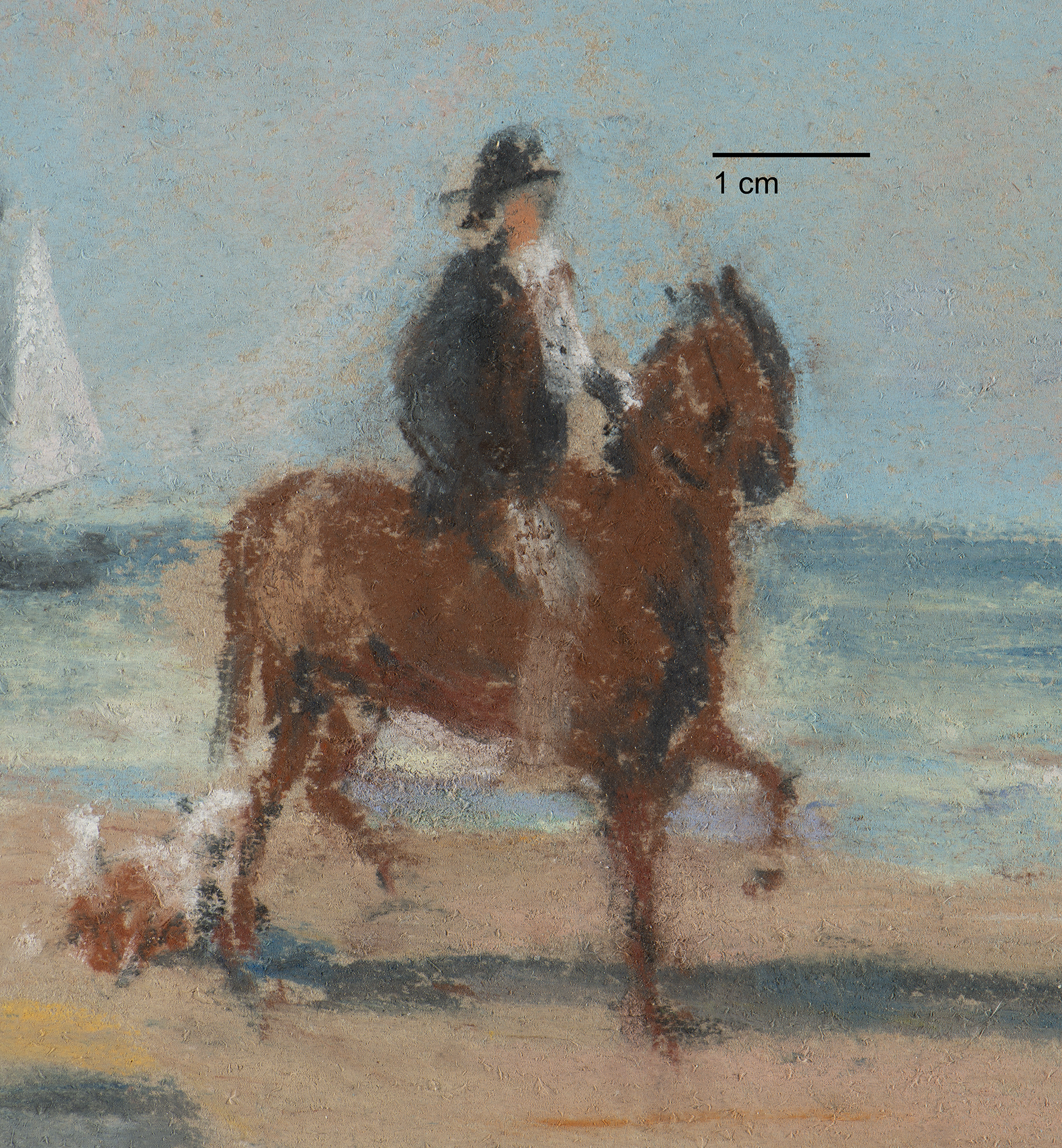
Unfortunately, there is no comprehensive study of Boudin’s pastel materials and techniques. A survey of his work in other collections revealed that he frequently used colored papers, and blue or gray tones may have appealed to him as a base color for his drawings. The Nelson-Atkins Museum of Art’s pastel is on a machine-made wove paper: One of the two types of paper. Wove papers may be either machine or handmade, and are produced from molds that have a woven wire mesh. The weave of the mesh can be so tight that it produces no visible pattern within the paper sheet, and often wove papers have a smoother surface than laid papers. Wove papers were developed during the mid-eighteenth century, but did not come into widespread use until later. The other type of paper is laid paper.. The current paper color is beige, and there is a pink cast to the paper; however, it may have originally been closer to cream.1The description of paper color/texture/thickness follows the standard set forth in Elizabeth Lunning and Roy Perkinson, The Print Council of America Paper Sample Book: A Practical Guide to the Description of Paper (Boston: Print Council of America, 1996), unpaginated. A moderately thick application of pastel obscures much of the paper and its texture. Where visible, around the clouds at upper left and the horse and human figures in the foreground, the paper finish appears uniform, and there is very little texture (Fig. 7). There is no watermark: An identifying mark in a paper sheet which is created by tying wires to the papermaking mold. Watermarks are most easily viewed with transmitted light; however, some can be read with raking light. or deckle edge: The edge of a paper sheet that is formed by pulp caught between the deckle, metal or wooden frame, and the papermaking screen. The deckle edge typically has less fiber than the remainder of the sheet and is characterized by a lacy appearance., and the small, nonstandard dimensions indicate that the paper was cut from a larger sheet. The dominant media is pastel, applied dry and blended with a soft cloth or tortillon: Also called a blending stump, the tortillon is a cylindrical blending tool for loose drawing media such as pastel, charcoal, chalk, and graphite pencil. Tortillons are traditionally made of rolled paper; however, at present, it is possible to purchase similar implements made of cast paper pulp. These are much easier to clean and have a longer lifetime than the traditional rolled paper tool.; however, graphite pencil is also present. The work is signed “E. Boudin” in blue pastel.
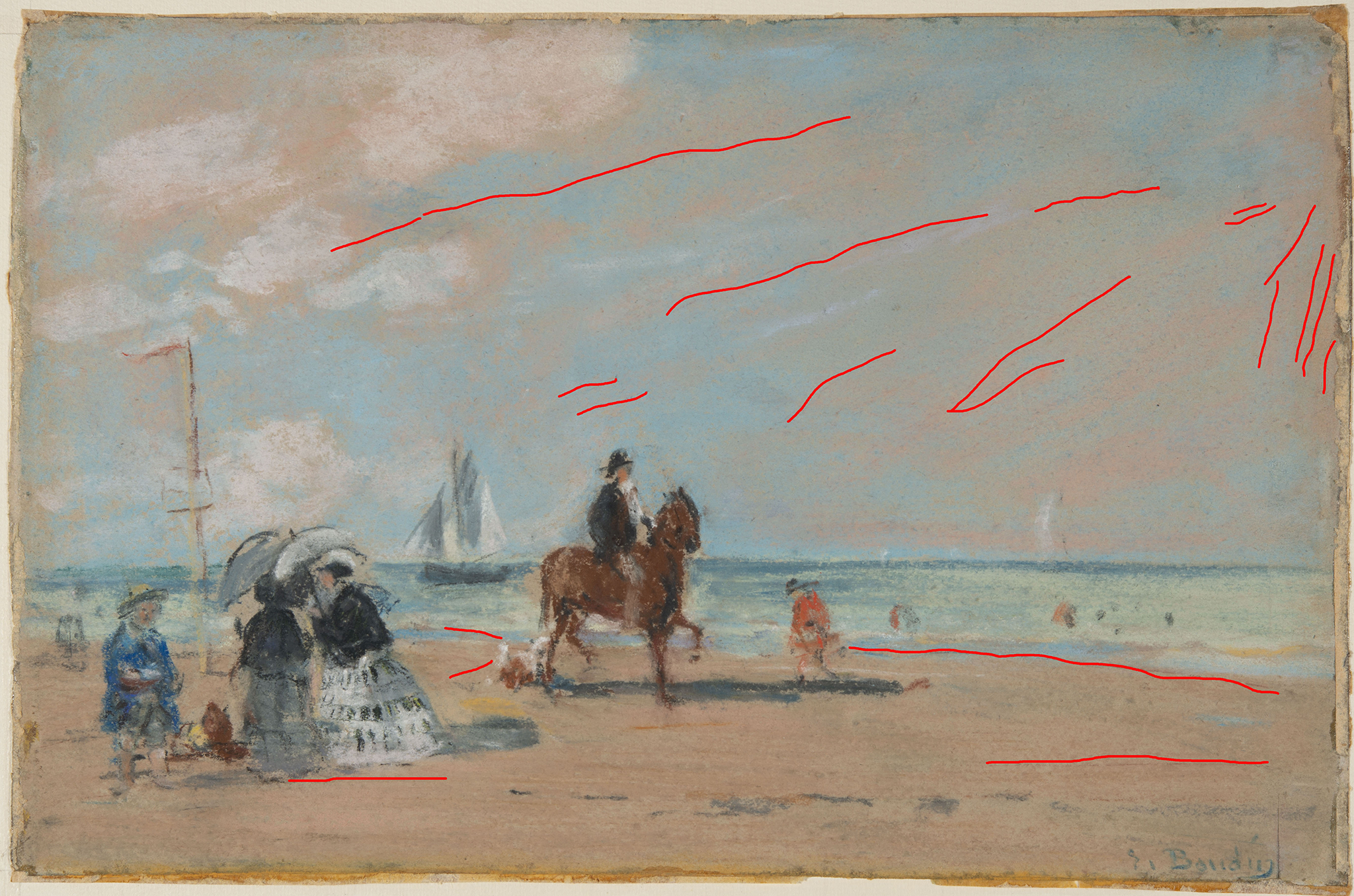
The artist started with an underdrawing: A drawn or painted sketch beneath the paint layer. The underdrawing can be made from dry materials, such as graphite or charcoal, or wet materials, such as ink or paint. in a brown medium capable of producing a hard and fine line (Fig. 8). The tone of the media appears slightly pink when contrasted with the blues and buff colors of Boudin’s palette, and the fast, gestural diagonal lines visible in the sky indicate the placement of clouds, or possibly the direction of the wind. In the beach, the underdrawing indicates dunes or undulations in the sand. Although underdrawing in the sea is obscured by layers of pastel, Boudin likely laid in a horizon line where the water and sky meet.
Similar to his use of ébauche: The first applications of paint that begin to block in color and loosely define the compositional elements. Also called underpainting. for oil paintings,2Virginia Nouwen, “An Investigation into the Materials and Techniques of Eugène Louis Boudin (1824–1898)” (Postgraduate Diploma in the Conservation of Easel Paintings, Final Year Project, Courtauld Institute of Art, London, 2018), 18–21. the major elements of the seascape, the sky with the clouds, the water in the middle ground, and the beach and foreground were laid in with blue, white, green, beige, and pink. Boudin frequently used the broad side of pastel sticks. The sea was blended at left so that the green and dark blue pastel applications mix. However, in the right half of the scene, the pastel strokes were applied on top of each other to create the impression of a sandbar or other features of the shallows. The colors of the beach were initially blended, with strokes of gray, yellow, light blue, and brown likely added at the end of the painting process to give the sand some relief. The painting is dominated by the figures in the foreground, and the paper below the horse and rider and the two women was left blank, with no evidence of either an underdrawing or an applied undertone.
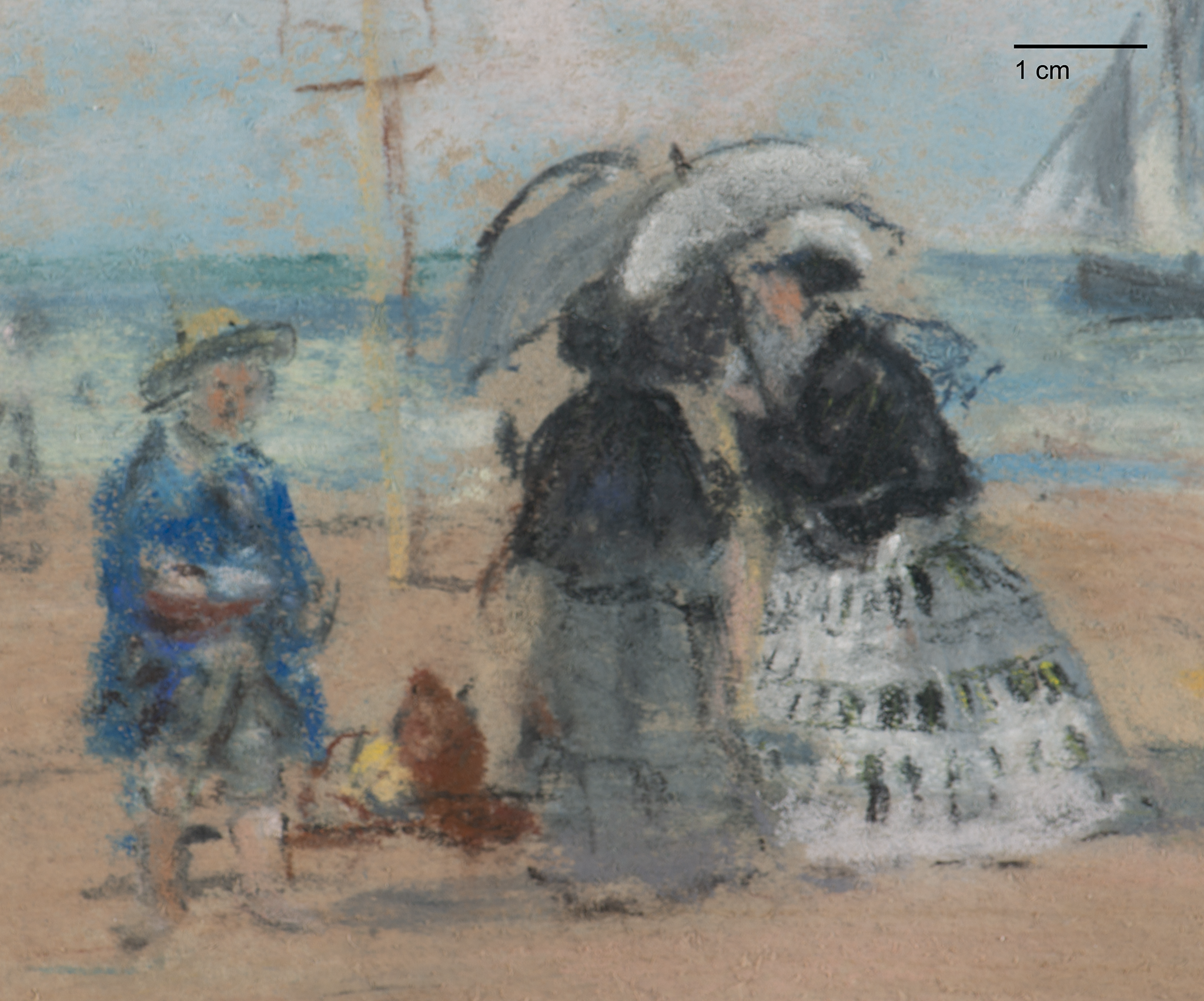
Quick strokes of brown, black, and white pastel were used to lay in the forms of the man and the horse. Blending is present along the horse’s flanks and the man’s coat, but individual lines from the pointed tips of pastel sticks dominate (Fig. 7). The women were laid in using a similar method; however, Boudin appears to have started with a black pastel and initially focused on dominant features like the bell shape of the white dress and the domes of the parasols (Fig. 9). Blending is present in the gray skirt of the woman at left and the coats of both women. White and a cool gray were blended to indicate the shadow on the back of the white skirt. Boudin paid special attention to some sartorial details by placing fine, short strokes of yellow and black next to each other to indicate either pleating or a surface decoration.
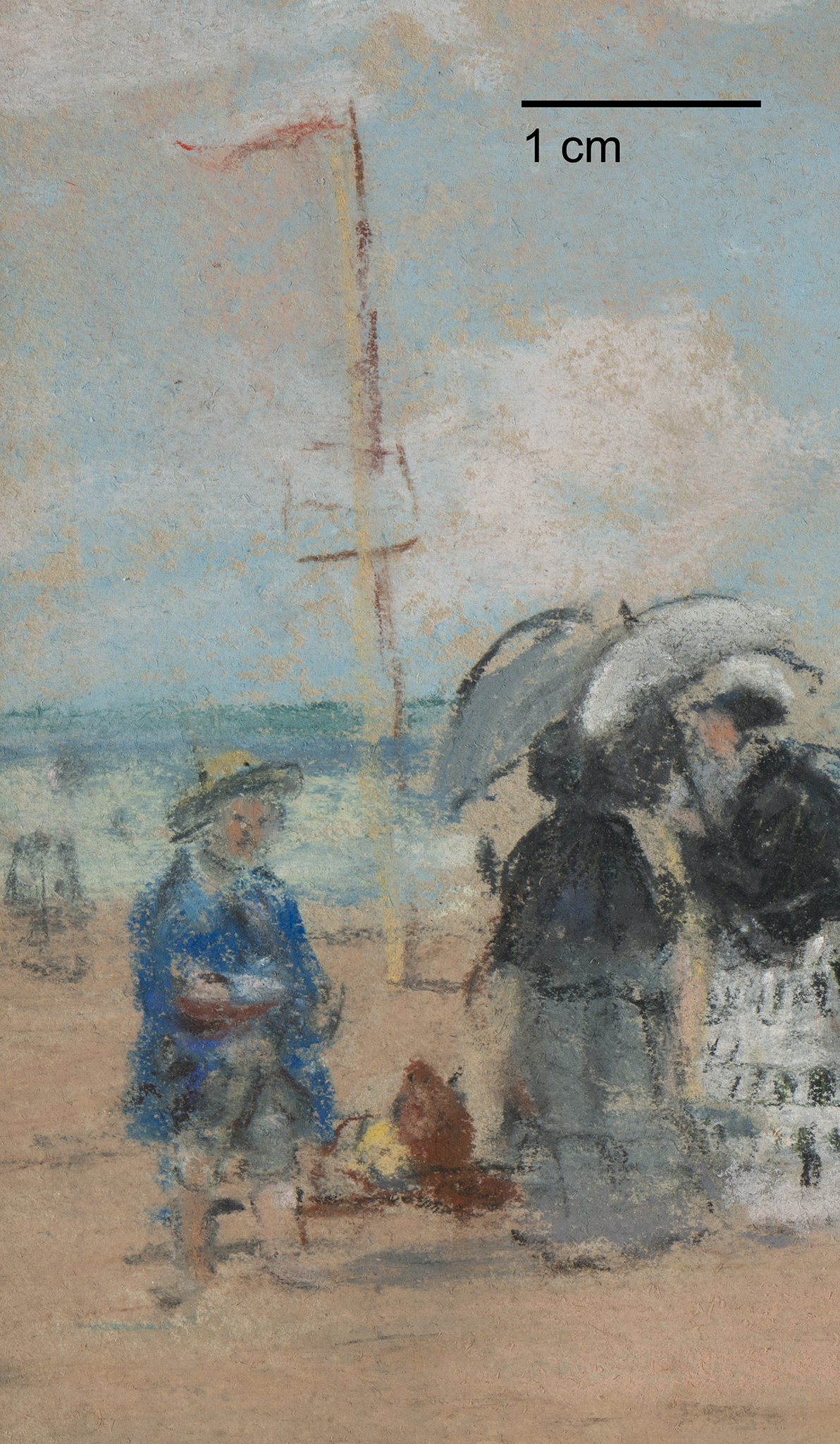
Boudin populated the scene with other figures and features. The man in the orange coat at center causes the eye to travel away from the figures in the foreground and linger in the sky and on the tiny stokes of black and orange that indicate people wading in the shallows. The sailboat, vignetted by the women and the equestrian, was applied directly over the blue underlayers (Fig. 10). It was executed with black and white pointed pastel sticks and a moderate amount of blending to indicate shadows in the sails. The flag indicates the direction of the wind, and the flagpole shows the oblique angle of the sun. The pole consists of a single stroke of ocher for the light, abutted by a few strokes of reddish brown to indicate shadow. The figure in the blue coat is the only figure with facial features. He is applied over the pastel used for the water and the beach. Like the other foreground figures, he was laid in with the tip of a pastel pencil. There is no blending except for his trousers; and the eyes, nose, and mouth, as well as the shadow of the flagpole, are the only occurrences of graphite pencil in the artwork (Fig. 9).
Boudin did not use a fixative, although it would have aided him when he layered the sailboat and the figure in the blue coat over the underlayers of pastel.
Most of the elements in the image are in motion. The horse is mid-prance; the rider turns his head toward the women who lean forward in conversation; the man in orange walks along the shore; and the figure in blue appears to be headed in the direction of the artist. The clouds and the sailboat are being pushed out of the picture frame by the wind. Boudin was able to record the scene with rapidity because he had substantial practice. According to Charles Baudelaire, who saw sketches by the artist in 1859, Boudin made numerous tiny drawings of the sky, sea, and shore and annotated the margins of the drawings with date, time, and weather. Of these drawings, Baudelaire stated:
If you sometimes have the leisure to get to know these meteorological beauties, you could check, by memory, the accuracy of Mr. Boudin’s observations. You could hide the caption with your hand and you will easily guess the season, the time, and the wind. I am not exaggerating.3
Œuvres Complètes de Charles Baudelaire, ed. F. F. Gautier (Paris: Éditions de la Nouvelle Revue Française, 1925), 307, https://www.google.com
/books /edition /OEuvres _compl %C3 %A8tes _de _Charles _Baudelaire /zrnwAAAAMAAJ.“Si vous avez eu quelquefois le loisir de faire connaissance avec ces beautés météorologiques, vous pourriez vérifier par mémoire l’exactitude des observations de M. Boudin. La légende cachée avec la main, vous devineriez, la saison, l’heure et le vent. Je n’exagère rien.” Any mistakes or inconsistencies in the translation are the fault of the author.
Although the pastel does faithfully record a morning or afternoon on a windy day, probably in the late summer, any inscription was lost when the edges of the artwork were cut down after the work was executed. A two-centimeter-long cut parallel to the right edge occurs immediately after the signature. The cut was made with a sharp blade and appears to be very old. The upper corners of the sheet are missing, and there are three pin or tack holes present along the upper edge at left. The holes appear to have been made later and do not indicate that the pastel was attached to a board during execution.
The work is currently edge-mounted to a late twentieth-century cream laid paper, and the back is not available for examination. There is evidence of at least two other mounting campaigns. During one, the artwork was attached to a window mat with gummed linen tape applied to the back of the artwork. Before that, brown paper tape was applied to the front edges of the artwork. Removal of the brown tape from the first matting campaign apparently resulted in image loss along the lower left and lower edges. To make the artwork look undamaged, the losses were covered with a yellow beige pastel which does not quite match the tones Boudin used for the sand.
Notes
-
The description of paper color, texture, and thickness follows the standard set forth in Elizabeth Lunning and Roy Perkinson, The Print Council of America Paper Sample Book: A Practical Guide to the Description of Paper (Boston: Print Council of America, 1996), unpaginated.
-
Virginia Nouwen, “An Investigation into the Materials and Techniques of Eugène Louis Boudin (1824–1898)” (Postgraduate Diploma in the Conservation of Easel Paintings, Final Year Project, Courtauld Institute of Art, London, 2018), 18–21.
-
Œuvres Complètes de Charles Baudelaire, ed. F. F. Gautier (Paris: Éditions de la Nouvelle Revue Française, 1925), 307, https://www.google.com/books/edition/OEuvres_ compl%C3%A8tes_de_ Charles_Baudelaire /zrnwAAAAMAAJ.
“Si vous avez eu quelquefois le loisir de faire connaissance avec ces beautés météorologiques, vous pourriez vérifier par mémoire l’exactitude des observations de M. Boudin. La légende cachée avec la main, vous devineriez, la saison, l’heure et le vent. Je n’exagère rien.” Any mistakes or inconsistencies in the translation are the fault of the author.
Documentation
Citation
Chicago:
Brigid M. Boyle, “Eugène Boudin,
The Beach, ca. 1865,” documentation in
ed. Aimee Marcereau DeGalan
French Paintings and Pastels, 1600–1945: The
Collections of the Nelson-Atkins Museum of
Art
(Kansas City: The Nelson-Atkins Museum of Art,
2021),
https://doi.org/10.37764/78973.5.602.4033.
MLA:
Boyle, Brigid M. “Eugène Boudin, The Beach, ca. 1865,” documentation. French Paintings and Pastels, 1600–1945: The Collections of the Nelson-Atkins Museum of Art, edited by Aimee Marcereau DeGalan, The Nelson-Atkins Museum of Art, 2021. doi: 10.37764/78973.5.602.4033
Provenance
With Galerie Cadart et Luquet, Paris, by October 15, 1867 [1];
Hembert collection, Paris;
With Raphaël Gérard, Paris, by 1963 [2];
With Rogers and Co., by December 7, 1966 [3];
Purchased from Rogers and Co. at Barbizon and Nineteenth-Century Paintings, Drawings and Sculpture, Sotheby’s, London, December 7, 1966, lot 98, as La Plage à Trouville, by H. M. Cohen, 1966 [4];
With Galerie Schmit, Paris, by February 17, 1981–March 26, 1981 [5];
Purchased from Galerie Schmit by Marion (née Helzberg, 1931–2013) and Henry (1922–2019) Bloch, Shawnee Mission, KS, March 26, 1981–June 15, 2015;
Their gift to The Nelson-Atkins Museum of Art, Kansas City, MO, 2015.
Notes
[1] Alfred Cadart (1828–75) and Jules Joseph Luquet (b. 1824) formed a partnership in October 1863. They published etchings and operated a gallery together at 79 rue de Richelieu until October 15, 1867, when they dissolved their partnership. In November 1867, Cadart went into business with Léandre Luce at 58 rue Neuve-des-Mathurins. See Monique Nonne, “Alfred Cadart (1828–1875), marchand de tableaux modernes,” Bulletin de la Société de l’Histoire de l’Art français (2009): 363–73; and Janine Bailly-Herzberg, L’Eau-forte de peintre au dix-neuvième siècle: La Société́ des Aquafortistes, 1862–1867, vol. 1 (Paris: Leonce Laget, 1972), 252.
[2] Raphaël Louis Félix Gerard (1886–1963) passed away in 1963.
[3] For confirmation that the dealer “Rogers and Co.” consigned The Beach to Sotheby’s, see email from Carly Murphy, Sotheby’s, to Brigid M. Boyle, NAMA, September 17, 2020, NAMA curatorial files. The consignor may have been T. Rogers and Co. Ltd, London, a packing and shipping agency that sometimes sold pictures at auction on behalf of clients. However, the records of T. Rogers and Co. do not extend back to the 1960s, so it has not been possible to confirm this identification; see email from Wil Russell, T. Rogers and Co., to Brigid M. Boyle, NAMA, October 15, 2020, NAMA curatorial files.
[4] For confirmation that H. M. Cohen purchased The Beach, see email from Carly Murphy, Sotheby’s, to Brigid M. Boyle, NAMA, September 17, 2020, NAMA curatorial files. Murphy did not know Cohen’s full name or city of residence.
[5] See email from Robert Schmit, Galerie Schmit, to Henry Bloch, February 17, 1981, NAMA curatorial files.
Exhibitions
Regards sur une collection: XIXe–XXe siècles, Galerie Schmit, Paris, May 13–July 18, 1981, no. 5, as Sur la plage de Trouville.
The Bloch Collection, The Nelson-Atkins Museum of Art, Kansas City, MO, June–August 1982, no cat.
Manet to Matisse: Impressionist Masters from the Marion and Henry Bloch Collection, The Nelson-Atkins Museum of Art, Kansas City, MO, June 9–September 9, 2007, no. 3, as The Beach (La plage).
Painters and Paper: Bloch Works on Paper, The Nelson-Atkins Museum of Art, Kansas City, MO, February 20, 2017–March 11, 2018, no cat.
References
Catalogue of Part I, Barbizon and Nineteenth-Century Paintings, Drawings and Sculpture, and Part II, Impressionist and Modern Paintings, Drawings and Sculpture (London: Sotheby’s, December 7, 1966), 30–31, (repro.), as La Plage à Trouville.
Art Prices Current: A Record of Sales Prices at the Principal London, Continental, and American Auction Rooms, vol. 44, August 1966 to July 1967 (Havant, England: Art Trade Press, 1968), A66, A294, as La Plage à Trouville.
Regards sur une collection: XIXe–XXe siècles, exh. cat. (Paris: Galerie Schmit, 1981), unpaginated, (repro.), as Sur la plage de Trouville.
“Exhibitions,” Gallery Events (The William Rockhill Nelson Gallery of Art and Mary Atkins Museum of Fine Arts) (June–August 1982): unpaginated.
Rebecca Dimling Cochran and Bobbie Leigh, “100 Top Collectors who have made a difference,” Art and Antiques 28, no. 3 (March 2006): 90.
Bobbie Leigh, “Magnificent Obsession,” Art and Antiques 28, no. 6 (June 2006): 61.
Richard R. Brettell and Joachim Pissarro, Manet to Matisse: Impressionist Masters from the Marion and Henry Bloch Collection, exh. cat. (Kansas City, MO: Nelson-Atkins Museum of Art, 2007), 14, 38–41, 43, 94, 110, 155, (repro.), as The Beach (La plage).
Alice Thorson, “A Tiny Renoir Began Impressive Obsession,” Kansas City Star 127, no. 269 (June 3, 2007): E4.
“Lasting Impressions: A Tribute to Marion and Henry Bloch,” Member Magazine (The Nelson-Atkins Museum of Art) (Fall 2007): 11–12.
Steve Paul, “Pretty Pictures: Marion and Henry Bloch’s collection of superb Impressionist masters,” Panache 4, no. 3 (Fall 2007): 20.
Alice Thorson, “Blochs add to Nelson treasures,” Kansas City Star 130, no. 141 (February 5, 2010): A1.
Carol Vogel, “O! Say, You Can Bid on a Johns,” New York Times 159, no. 54,942 (February 5, 2010): C26.
Thomas M. Bloch, Many Happy Returns: The Story of Henry Bloch, America’s Tax Man (Hoboken: John Wiley and Sons, 2011), 174–75.
Diane Stafford, “Bloch gift to go for Nelson upgrade,” Kansas City Star 135, no. 203 (April 8, 2015): A8.
“Nelson-Atkins Museum of Art officially accessions Bloch Impressionist masterpieces,” Artdaily.org (July 25, 2015): http://artdaily.com/news/80246/Nelson-Atkins-Museum-of-Art-officially-accessions-Bloch-Impressionist-masterpieces.
Julie Paulais, “Le Nelson-Atkins Museum of Art reçoit des tableaux impressionnistes en échange de leurs répliques,” Le Journal des arts (July 30, 2015): https://www.lejournaldesarts.fr/patrimoine/le-nelson-atkins-museum-art-recoit-des-tableaux-impressionnistes-en-echange-de-leurs.
Josh Niland, “The Nelson-Atkins Museum of Art Acquires a Renowned Collection of Impressionist and Postimpressionist Art,” architecturaldigest.com (July 31, 2015): https://www.architecturaldigest.com/story/nelson-atkins-museum-accessions-bloch-art-collection.
Nancy Staab, “Van Gogh is a Go!” 435: Kansas City’s Magazine (September 2015): 76.
“Nelson-Atkins to unveil renovated Bloch Galleries of European Art in winter 2017,” Artdaily.org (July 20, 2016): http://artdaily.com/news/88852/Nelson-Atkins-to-unveil-renovated-Bloch-Galleries-of-European-Art-in-winter-2017.
“Nelson-Atkins Museum of Art celebrates generosity of Henry Bloch with new acquisition,” Artdaily.org (October 18, 2016): https://artdaily.cc/news/90923/Nelson-Atkins-Museum-of-Art-celebrates-generosity-of-Henry-Bloch-with-new-acquisition#.XnKATqhKiUk.
Catherine Futter et al., Bloch Galleries: Highlights from the Collection of the Nelson-Atkins Museum of Art (Kansas City, MO: Nelson-Atkins Museum of Art, 2016), 88, (repro.), as The Beach.
Kelly Crow, “Museum Rewards Donor with Fake Art to Hang at Home,” Wall Street Journal (January 25, 2017): https://www.wsj.com/articles/museum-rewards-donor-with-fake-art-to-hang-at-home-1485370768.
David Frese, “Bloch savors paintings in redone galleries,” Kansas City Star 137, no. 161 (February 25, 2017): 1A.
Albert Hecht, “Henry Bloch’s Masterpieces Collection to Go On Display at Nelson-Atkins Museum,” Jewish Business News (February 26, 2017): http://jewishbusinessnews.com/2017/02/26/henry-bloch-masterpieces-collection/.
David Frese, “Inside the Bloch Galleries: An interactive experience,” Kansas City Star 137, no. 169 (March 5, 2017): 5D, (repro.), as The Beach.
“Editorial: Thank you, Henry and Marion Bloch,” Kansas City Star (March 7, 2017), http://www.kansascity.com/opinion/editorials/ article137040948.html [repr. “Thank you, Henry and Marion Bloch,” Kansas City Star 137, no. 172 (March 8, 2017): 16A].
Hampton Stevens, “(Not Actually) 12 Things To Do During The Big 12 Tournament,” Flatland: KCPT’s Digital Magazine (March 9, 2017): http://www.flatlandkc.org/arts-culture/sports/not-actually-12-big-12-tournament/.
Laura Spencer, “The Nelson-Atkins’ Bloch Galleries Feature Old Masterworks and New Technology,” KCUR (March 10, 2017): http://kcur.org/post/nelson-atkins-bloch-galleries-feature-old-masterworks-and-new-technology#stream/0.
Victoria Stapley-Brown, “Nelson-Atkins Museum’s new European art galleries come with a ‘love story,’” Art Newspaper (March 10, 2017): http://theartnewspaper.com/news/museums/nelson-atkins-museum-s-new-european-art-galleries-come-with-a-love-story/.
Harry Bellet, “Don du ciel pour le Musée Nelson-Atkins,” Le Monde (March 13, 2017): http://www.lemonde.fr/arts/article/2017/03/13/don-du-ciel-pour-le-musee-nelson-atkins_5093543_1655012.html.
Menachem Wecker, “Jewish Philanthropist Establishes Kansas City as Cultural Mecca,” Forward (March 14, 2017): http://forward.com/culture/365264/jewish-philanthropist-establishes-kansas-city-as-cultural-mecca/ [repr. in Menachem Wecker, “Kansas City Collection Is A Chip Off the Old Bloch,” Forward (March 17, 2017): 20–22].
Juliet Helmke, “The Bloch Collection Takes up Residence in Kansas City’s Nelson Atkins Museum,” Blouin ArtInfo International (March 15, 2017): http://www.blouinartinfo.com/news/story/2005267/the-bloch-collection-takes-up-residence-in-kansas-citys.
Louise Nicholson, “How Kansas City got its magnificent museum,” Apollo: The International Art Magazine (April 7, 2017): https://www.apollo-magazine.com/how-kansas-city-got-its-magnificent-museum/.
Lilly Wei, “Julián Zugazagoitia: ‘Museums should generate interest and open a door that leads to further learning,’” Studio International (August 21, 2017): http://studiointernational.com/index.php/julian-zugazagoitia-director-nelson-atkins-museum-of-art-kansas-city-interview.
Robert D. Hershey Jr., “Henry Bloch, H&R Block’s cofounder, dies at 96,” Boston Globe (April 23, 2019): https://www3.bostonglobe.com/metro/obituaries/ 2019/04/23/henry-bloch-block-cofounder/?arc404=true.
Robert D. Hershey Jr., “Henry W. Bloch, Tax-Preparation Pioneer (and Pitchman), Is Dead at 96,” New York Times (April 23, 2019): https://www.nytimes.com/2019/04/23/obituaries/henry-w-bloch-dead.html.
Megan McDonough, “Henry Bloch, whose H&R Block became world’s largest tax-services provider, dies at 96,” Washington Post (April 23, 2019): https://www.washingtonpost.com/local/obituaries/henry-bloch-whose-handr-block-became-worlds-largest-tax-services-provider-dies-at-96/2019/04/23/19e95a90-65f8-11e9-a1b6-b29b90efa879_story.html.
Claire Selvin, “Henry Wollman Bloch, Collector and Prominent Benefactor of Nelson-Atkins Museum of Art, Is Dead at 96,” ArtNews (April 23, 2019): http://www.artnews.com/2019/04/23/henry-bloch-dead-96/.
Eric Adler and Joyce Smith, “Henry Bloch, co-founder of H&R Block, dies at 96,” Kansas City Star 139, no. 219 (April 24, 2019): 1A.
“Henry Wollman Bloch (1922–2019),” Artforum (April 24, 2019): https://www.artforum.com/news/henry-wollman-bloch-1922-2019-79547.
Frank Morris, “Henry Bloch, Co-Founder Of H&R Block, Dies At 96,” NPR (April 24, 2019): https://www.npr.org/2019/04/24/716641448/henry-bloch-co-founder-of-h-r-block-dies-at-96.
Ignacio Villarreal, “Nelson-Atkins mourns loss of Henry Bloch,” ArtDaily.org (April 24, 2019): http://artdaily.com/news/113035/Nelson-Atkins-mourns-loss-of-Henry-Bloch#.XMB76qR7laQ.
Eric Adler and Joyce Smith, “H&R Block co-founder, philanthropist Bloch dies,” Cass County Democrat Missourian 140, no. 29 (April 26, 2019): 1A.
Eric Adler and Joyce Smith, “KC businessman and philanthropist Henry Bloch dies,” Lee’s Summit Journal 132, no. 79 (April 26, 2019): 1A.
Luke Nozicka, “Family and friends remember Henry Bloch of H&R Block,” Kansas City Star 139, no. 225 (April 30, 2019): 4A [repr. Luke Nozicka, “Family and friends remember Henry Bloch of H&R Block,” Kansas City Star 139, no. 228 (May 3, 2019): 3A].
Eric Adler, “Sold for $3.25 million, Bloch’s home in Mission Hills may be torn down,” Kansas City Star 141, no. 90 (December 16, 2020): 2A.