Catalogue Entry
Read more about this painting at the associated catalogue entry.
Technical Entry
Citation
Chicago:
Diana M. Jaskierny, “Claude Monet, Snow Effect at Argenteuil, 1875 (2015.13.14),” technical entry in ed. Aimee Marcereau DeGalan French Paintings and Pastels, 1600–1945: The Collections of the Nelson-Atkins Museum of Art (Kansas City: The Nelson-Atkins Museum of Art, 2021), https://doi.org/10.37764/78973.5.629.2088.
MLA:
Jaskierny, Diana M. “Claude Monet, Snow Effect at Argenteuil, 1875 (2015.13.14),” technical entry. French Paintings and Pastels, 1600–1945: The Collections of the Nelson-Atkins Museum of Art, edited by Aimee Marcereau DeGalan, The Nelson-Atkins Museum of Art, 2021. doi: 10.37764/78973.5.629.2088.
Snow Effect at Argenteuil (20215.13.14) provides us with important information about the working style of Claude Monet and his use of materials, not only from the year this painting was completed, but also the years prior. Completed on fine-weave canvas, the painting corresponds with a standard-format supports: Commercially prepared supports available through art suppliers, which gained popularity in the nineteenth century during the industrialization of art materials. Available in three formats figure (portrait), paysage (landscape), and marine (marine), these were numbered 1 through 120 to indicate their size. For each numbered size, marine and paysage had two options available: a larger format (haute) and smaller (basse) format. no. 15 paysage, and likely retains its original size and format.1David Bomford, Jo Kirby, John Leighton, and Ashok Roy, Art in the Making: Impressionism (London: Yale University Press, 1991), 46. For more information on French canvas weaves, see also Anthea Callen, The Art of Impressionism: Painting Technique and the Making of Modernity (New Haven: Yale University Press, 2000), 31–32. Paper tape on all four tacking margins: The outer edges of canvas that wrap around and are attached to the stretcher or strainer with tacks or staples. See also tacking edge. limits visibility; however, there is pronounced cusping: A scalloped pattern along the canvas edges that relates to how the canvas was stretched. Primary cusping reveals where tacks secured the canvas to the support while the ground layer was applied. Secondary cusping can form when a pre-primed canvas is re-stretched by the artist prior to painting. on at least the right and bottom margins.2Because of the paper tape, it is difficult to determine if cusping is present on the top and left tacking margins. The current stretcher: A wooden structure to which the painting’s canvas is attached. Unlike strainers, stretchers can be expanded slightly at the joints to improve canvas tension and avoid sagging due to humidity changes or aging., which was commercially planed and has mortise and tenon joins, appears to be original to the painting.
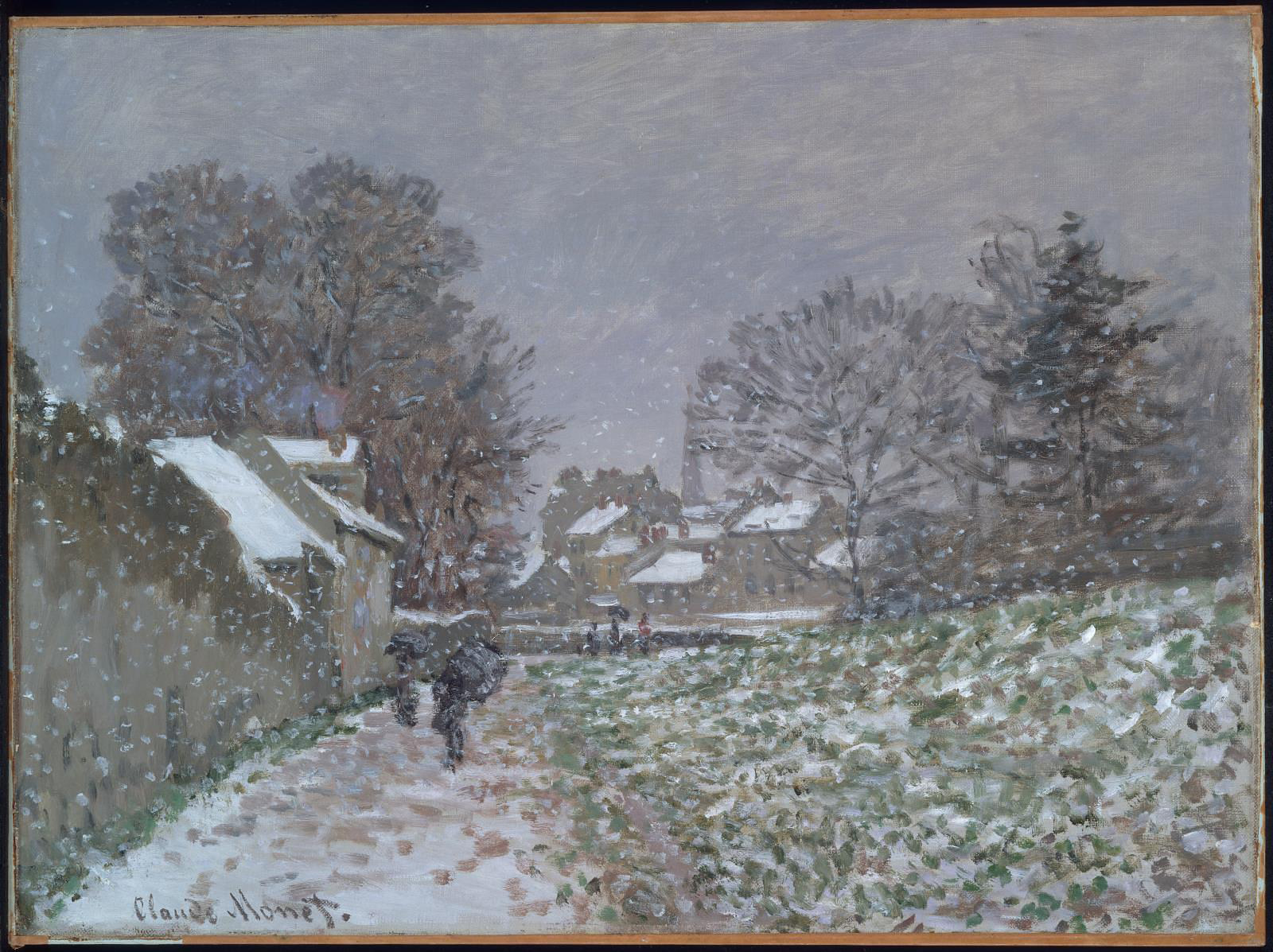
Compositionally, this painting is nearly identical to Snow at Argenteuil (Fig. 16; about 1874), located at The Museum of Fine Arts, Boston. Painted from the same vantage point, the Boston version depicts figures walking through a snow flurry early in the winter season, while the Nelson-Atkins painting is later in the season, with snow on the ground but the warmth of the coming spring present.3For more information on the series of Argenteuil snow paintings, see the accompanying curatorial entry by Glynnis Napier Stevenson. Although the Boston version may have been painted earlier in the winter season, it is slightly larger,4The Nelson-Atkins painting measures 50.2 x 64.5 centimeters. The Museum of Fine Arts Boston painting measures 54.6 x 73.7 centimeters. “Snow at Argenteuil,” The Museum of Fine Arts Boston, accessed July 27, 2020, https://collections.mfa.org/objects/31899/snow-at-argenteuil?ctx=509c6320-c57a-4933-b444-74faf1e92736&idx=18. corresponding to a standard-format paysage no. 20,5Callen, The Art of Impressionism, 15. and it appears somewhat more rendered and detailed than the later Nelson-Atkins version.
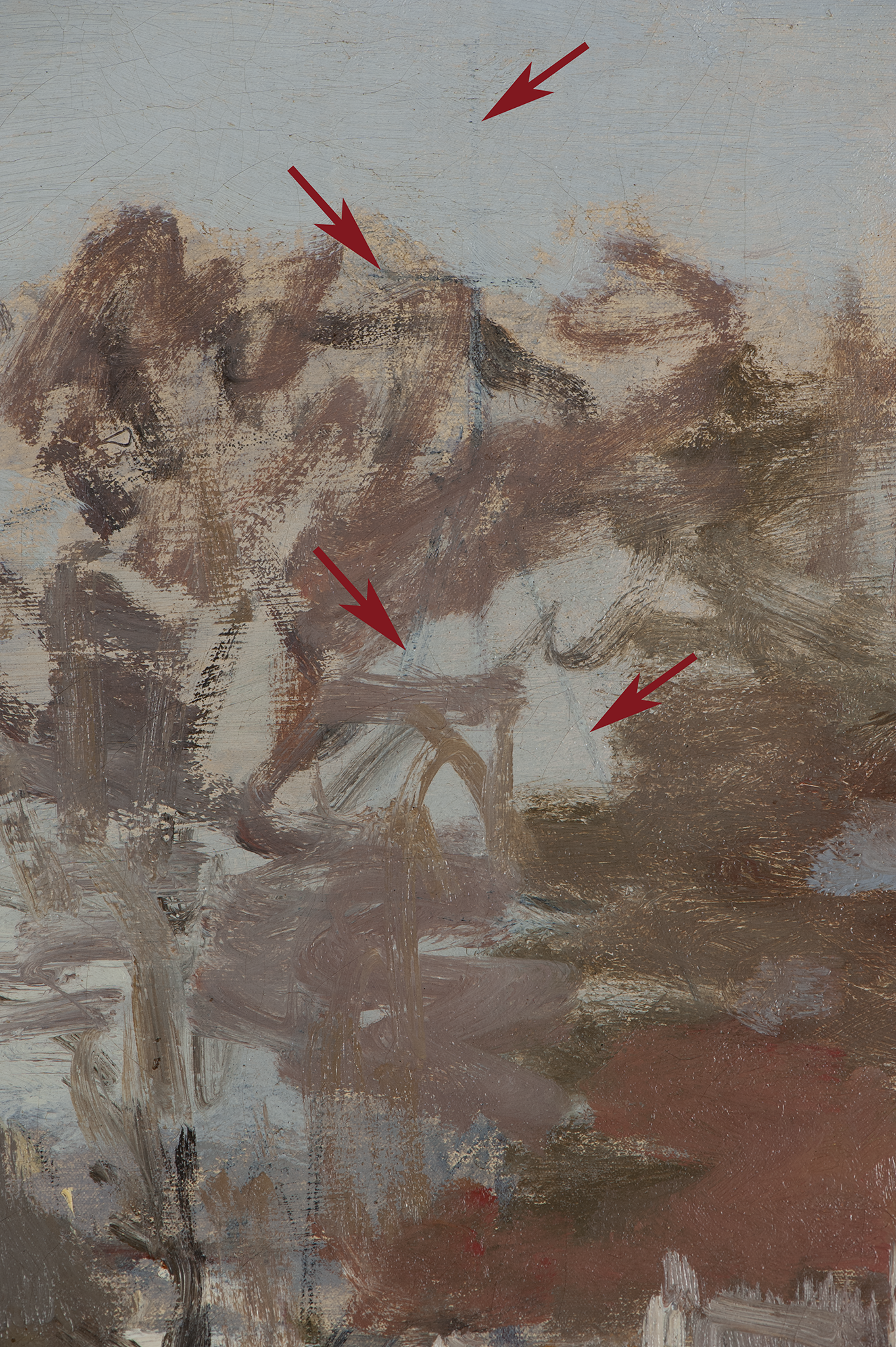
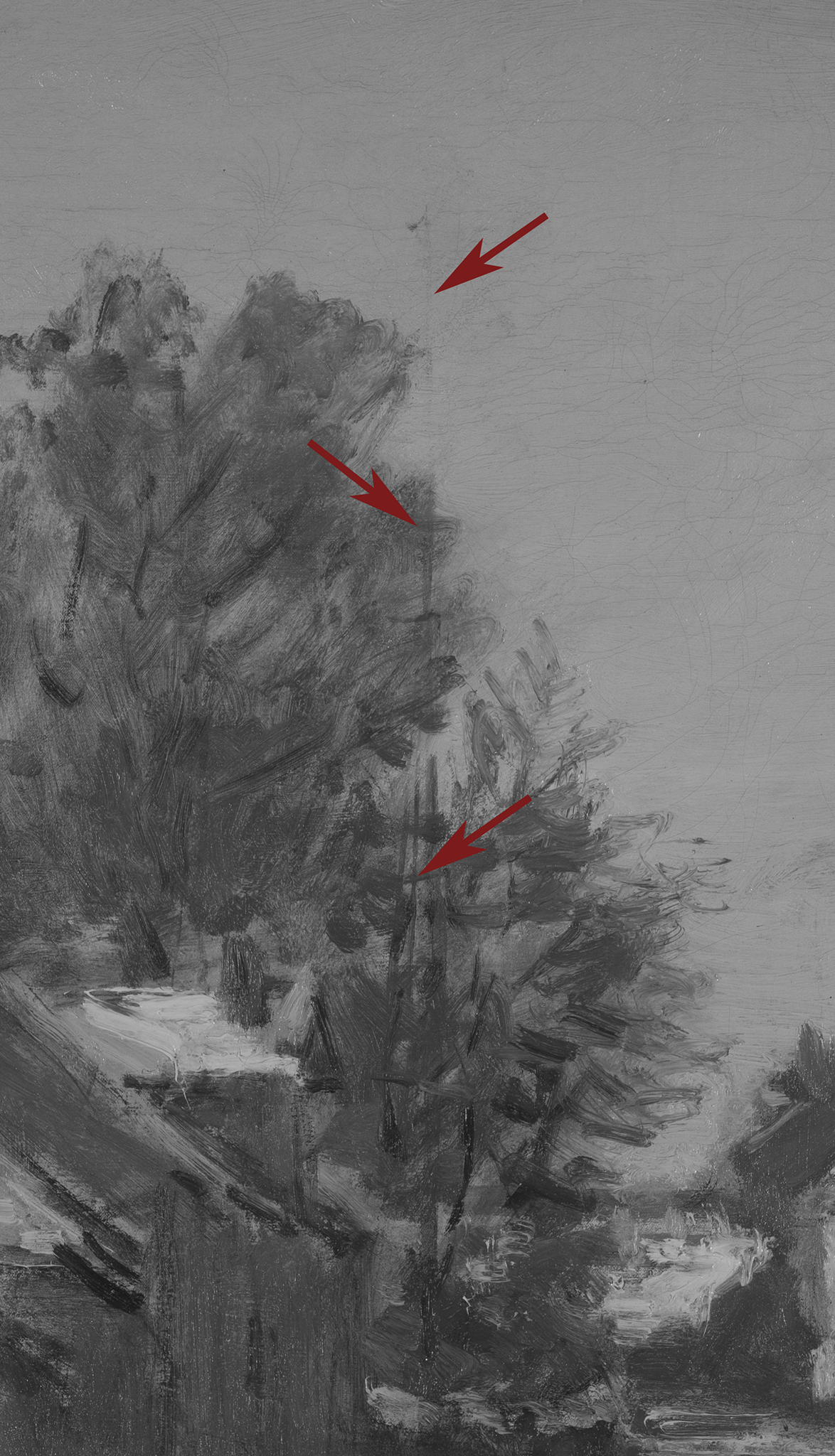
pentimento (pl: pentimenti): A change to the composition made by the artist that is visible on the paint surface. Often with time, pentimenti become more visible as the upper layers of paint become more transparent with age. Italian for "repentance" or "a change of mind." found throughout the Nelson-Atkins painting reveal that Monet abandoned an earlier composition and reused the canvas. Within the trees on the right, there is a vertical structure beneath the paint layer, still visible in normal viewing light (Fig. 17). Through infrared reflectography (IRR): A form of infrared imaging that exploits the behavior of painting materials at wavelengths beyond those accessible to infrared photography. These advantages sometimes include a continuing increase in the transparency of pigments beyond wavelengths accessible to infrared photography (i.e, beyond 1,000 nanometers), rendering underdrawing more clearly. The resulting image is called an infrared reflectogram. Devices that came into common use in the 1980s such as the infrared vidicon effectively revealed these features but suffered from lack of sharpness and uneven response. Vidicons continue to be used out to 2,200 nanometers but several newer pixelated detectors including indium gallium arsenide and indium antimonide array detectors offer improvements. All of these devices are optimally used with filters constraining their response to those parts of the infrared spectrum that reveal the most within the constraints of the palette used for a given painting. They can be used for transmitted light imaging as well as in reflection., two additional vertical shapes were found: one near the right edge of the painting, and one in the center left, peeking out from behind the trees (Fig. 18). In all instances, these shapes are mostly covered with sky and landscape paint, though glimpses of them are visible between compositional elements.
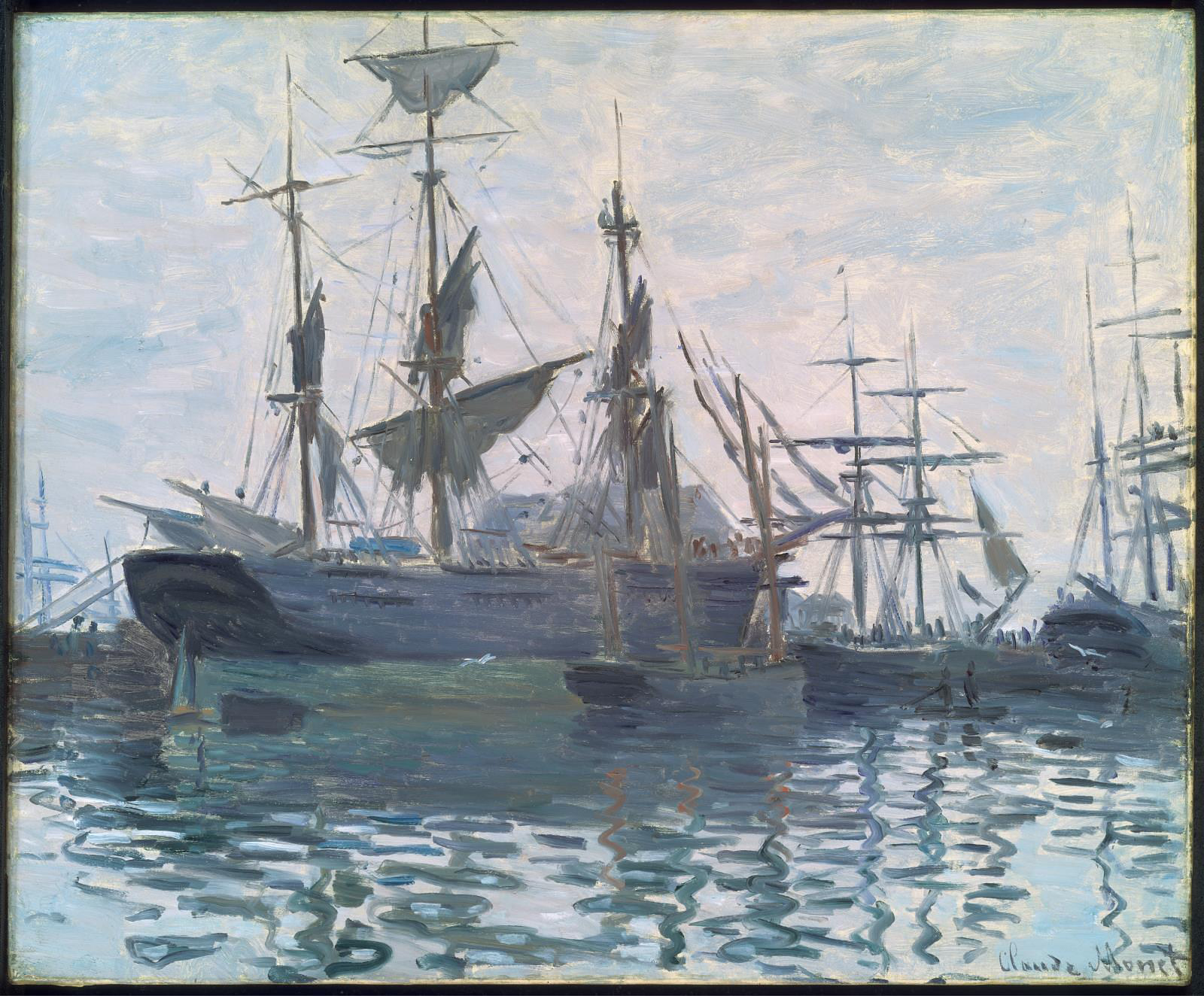
When examining the painting under a microscope, it is clear that these structures were the first elements painted on the Nelson-Atkins version, directly on top of the ground layer: An opaque preparatory layer applied to the support, either commercially or by the artist, to prevent absorption of the paint into the canvas or panel. See also priming layer., along with other shapes not clearly identifiable with a microscope or IRR. Consulting Monet’s oeuvre for the years prior to 1875 when this composition was completed, the vertical underlying shapes closely resemble his depictions of ship masts in maritime scenes. While it is unlikely the pentimenti in Snow Effect at Argenteuil directly correspond to a specific painting, of his completed and known maritime scenes the proportions and placements of these shapes echo masts in Ships in a Harbor (Fig. 19; about 1873; The Museum of Fine Arts, Boston).6From the mid-1860s to the mid-1870s, Monet moved frequently, often finding himself in port cities such as Honfleur and Le Havre. During this time, he painted many scenes of ships and shipyards, with Ships in a Harbor being one example. Monet: The Early Years (New Haven: Yale University Press, 2017), 71–77. Similar in size, though a different format,7The Museum of Fine Arts Boston painting Ships in a Harbor measures 49.8 x 61.0 centimeters, which roughly corresponds to a standard-format no. 12 portrait. “Ships in Harbor,” The Museum of Fine Arts Boston, accessed August 8, 2020, https://collections.mfa.org/objects/31270/ships-in-a-harbor?ctx=521deba2-9cf4-4795-84a9-c9560ca94b83&idx=5. See also Callen, The Art of Impressionism, 15. this scene portrays several large ships near one another and filling the canvas so that no view of a distant horizon or land is visible. The ships’ masts span half the height of the canvas or more, similar to the vertical shapes found beneath the paint layers of Snow Effect at Argenteuil.
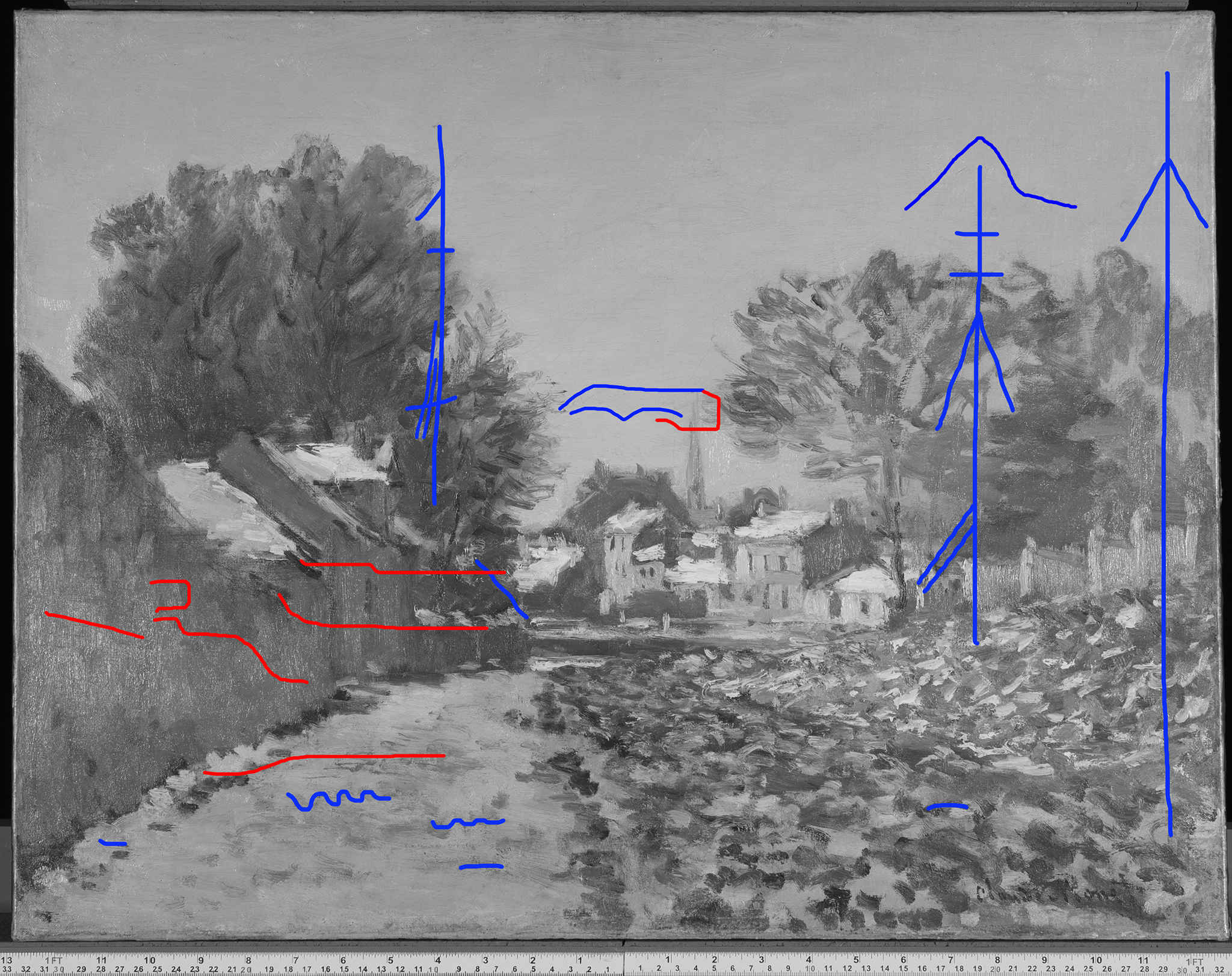
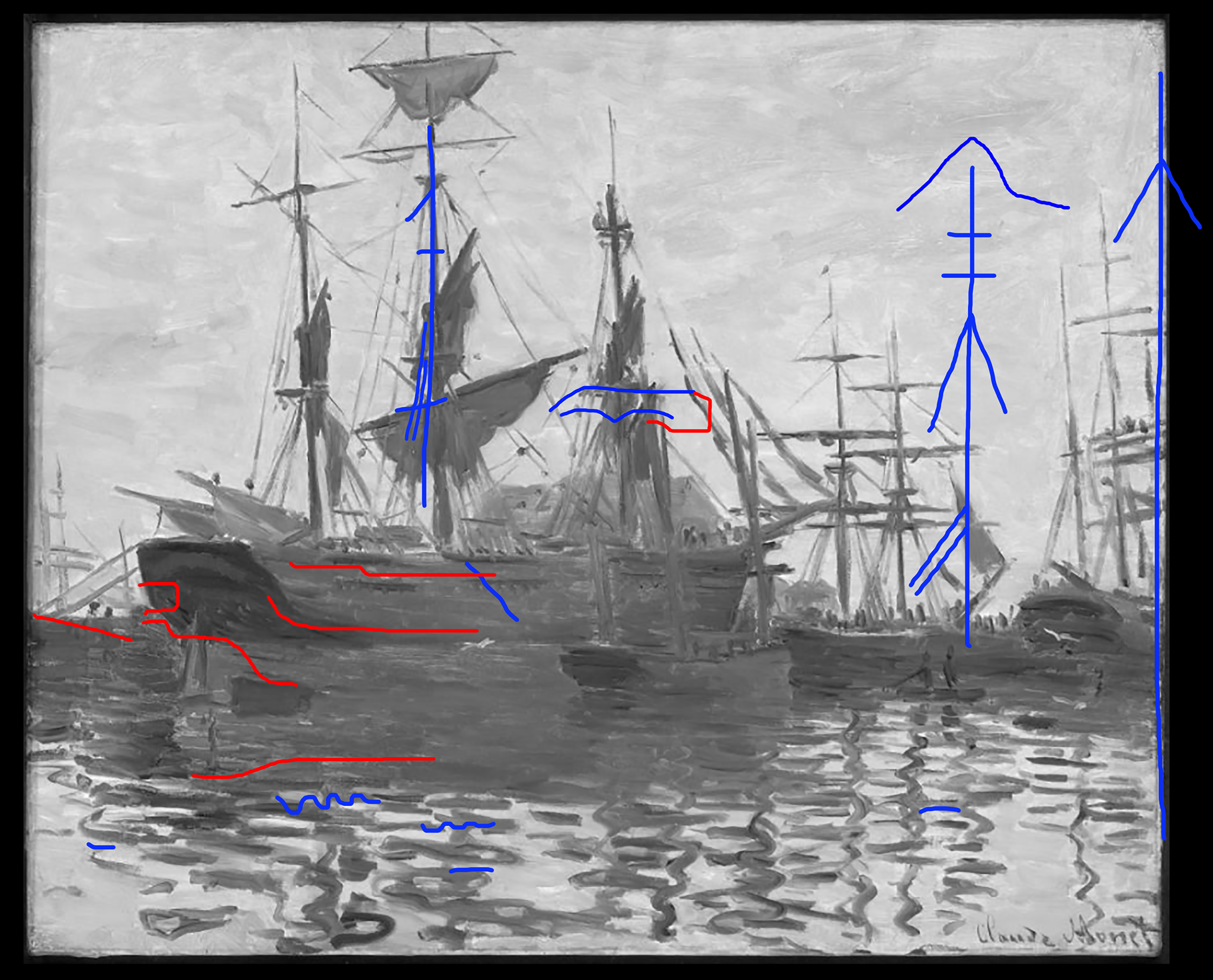
The similarities between the two compositions become even clearer when accounting for unidentifiable large, dark central shapes detected in IRR. X-ray radiography (also referred to as x-radiography or radiography): Radiography is an examination tool analogous to the use of X-rays in medicine whereby denser components of a painted composition can be recorded as an inverted shadow image cast on film or a digital X-ray imaging plate from a source such as an X-ray tube. The method has been used for more than a century and is most effective with dense pigments incorporating metallic elements such as lead or zinc. It can reveal artist changes, underlying compositions, and information concerning the artwork’s construction and condition. The resulting image is called an x-radiograph or radiograph. It differs from the uses of X-ray spectrometry in being dependent on the density of the paint to absorb X-rays before they reach the film or image plate and being non-specific as to which elements are responsible for the resulting shadow image. revealed some changes in the composition, mostly to the center and left. Although these changes could not be positively identified in relation to compositional forms, their placement falls in line with the hull of a ship. In a digital overlay illustrating the findings in Snow Effect at Argenteuil (Fig. 20), blue lines indicate shapes detected in IRR and red lines indicate shapes detected in x-radiography. While the underlying image appears to be only a painted initial sketch, if the overlay is placed on Ships in a Harbor, the similarities between the shapes becomes clear, with the blue signifying the masts and the red likely signifying the structure of a ship’s hull (Fig. 21).
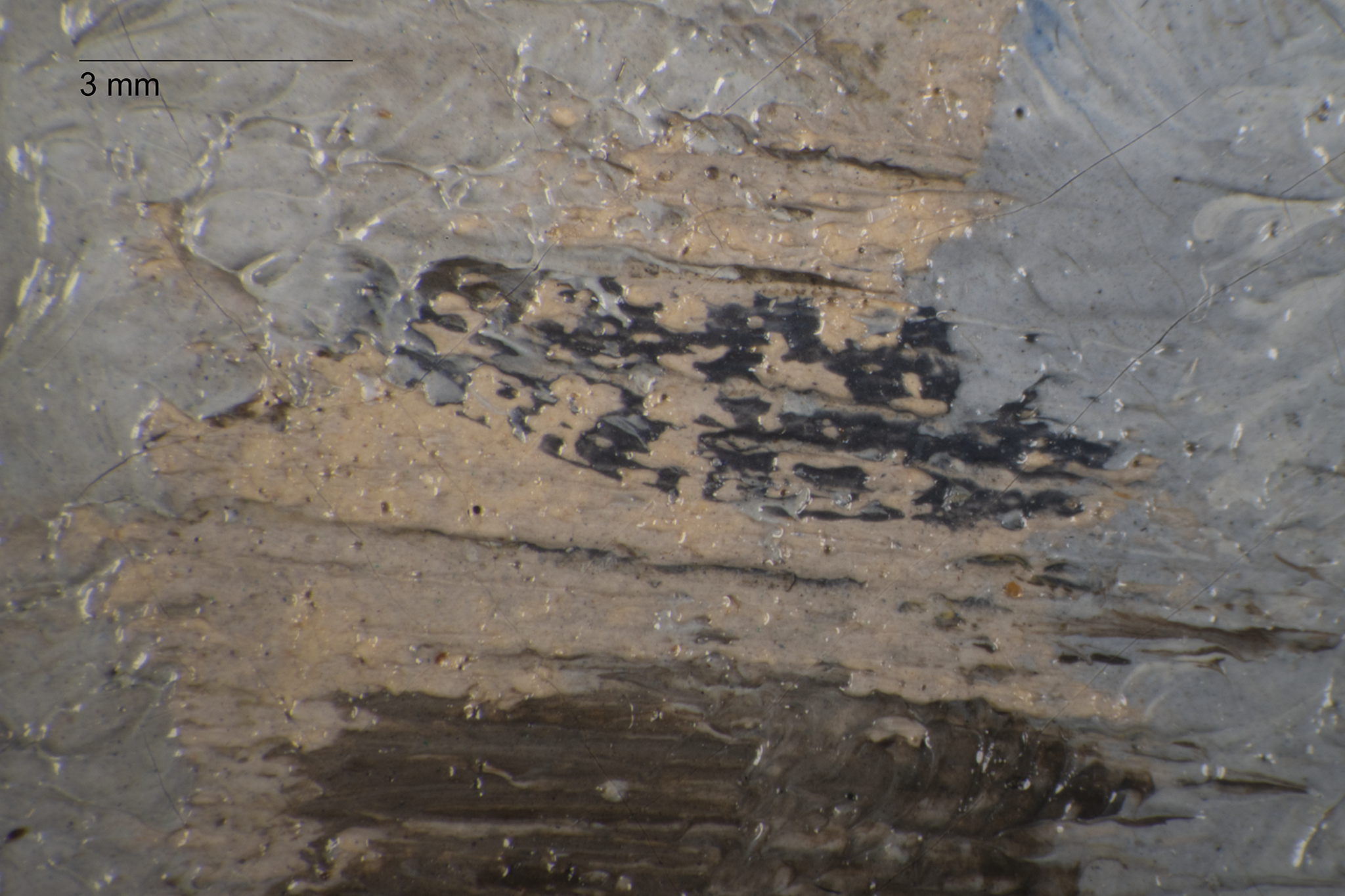
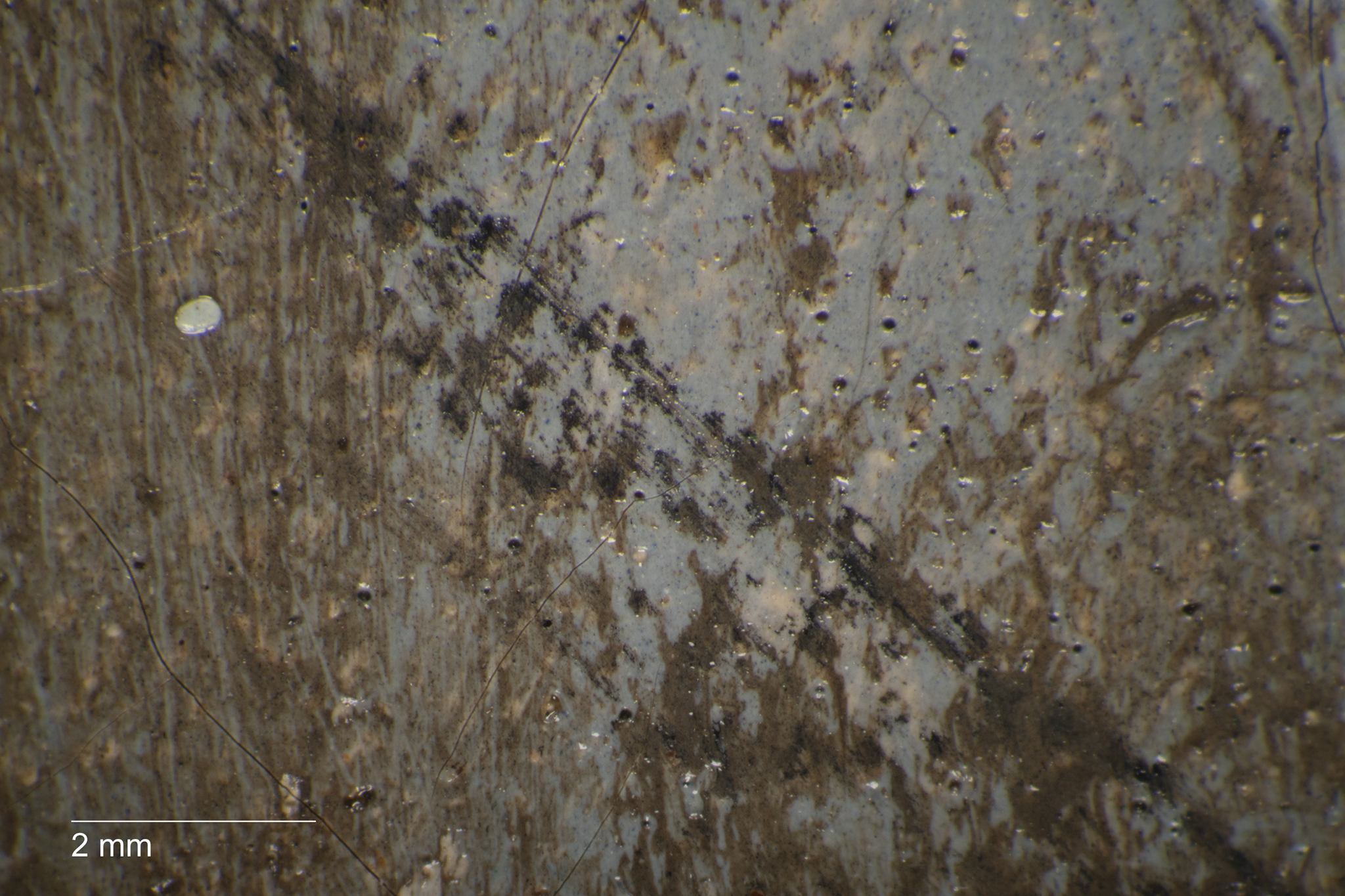
Monet began work on this canvas by sketching the underlying maritime scene in paint over an off-white ground layer, likely commercially applied.8Monet frequently purchased canvases with commercial grounds. Although he often applied a second tinted ground, paper tape around the tacking margins of the Nelson-Atkins painting makes it difficult to definitely state whether he followed this practice on Snow Effect at Argenteuil. The painting’s ground layer is off-white in color, and it is possible that no second layer was added by the artist. Bomford et al., Art in the Making: Impressionism, 144–45. A few black strokes beneath the foreground paint, identified with a microscope and IRR, may also relate to the earlier composition (Fig. 22). Neither the ship masts nor these black strokes, some of which are “zigzag” in application and may have been placed to reference water,9Wavy or “zigzag” brushstrokes are not uncommon for Monet’s representation of water and have been previously described in relation to his Bathing at La Grenouillère (1869; National Gallery, London). Anthea Callen, Techniques of the Impressionists (London: Tiger Books International, 1988), 56. intermix with the upper paint layers of the current composition. This indicates that enough time had passed between uses of the canvas for the lower paint to dry fully and prevent wet-over-wet: An oil painting technique which involves drawing a stroke of one color across the wet paint of another color. application.10Most of the black strokes found in the foreground are beneath the current composition and thus have wet-onto-dry application. However, there is one black stroke in the center of the foreground that was painted contemporaneous to the current composition. With the ground layer somewhat visible throughout Snow Effect at Argenteuil, it is clear Monet had only just started the underlying scene before setting the canvas aside. During the years prior to his time in Argenteuil, Monet found himself struggling financially, likely prompting him to retain and reuse a canvas of a composition he had abandoned.11During the late 1860s Monet had immense financial struggles, frequently borrowing money from family and attempting suicide in 1868 because of his debts. Kermit Swiler Champa, Studies in Early Impressionism (New Haven: Yale University Press, 1973), 22-24. It was not until Monet fled to London in 1870 that he met the dealer Paul Durand-Ruel and became more financially stable. George T.M. Shackelford, Monet: The Early Years (New Haven: Yale University Press, 2017), 174. For a more complete timeline of Monet’s career, see pages 72-79.,12Although Monet had become more financially stable after meeting Durand-Ruel, he continued to struggle with sales. For a discussion on Monet’s financial status in the 1870s, see the accompanying curatorial entry by Glynnis Stevenson.
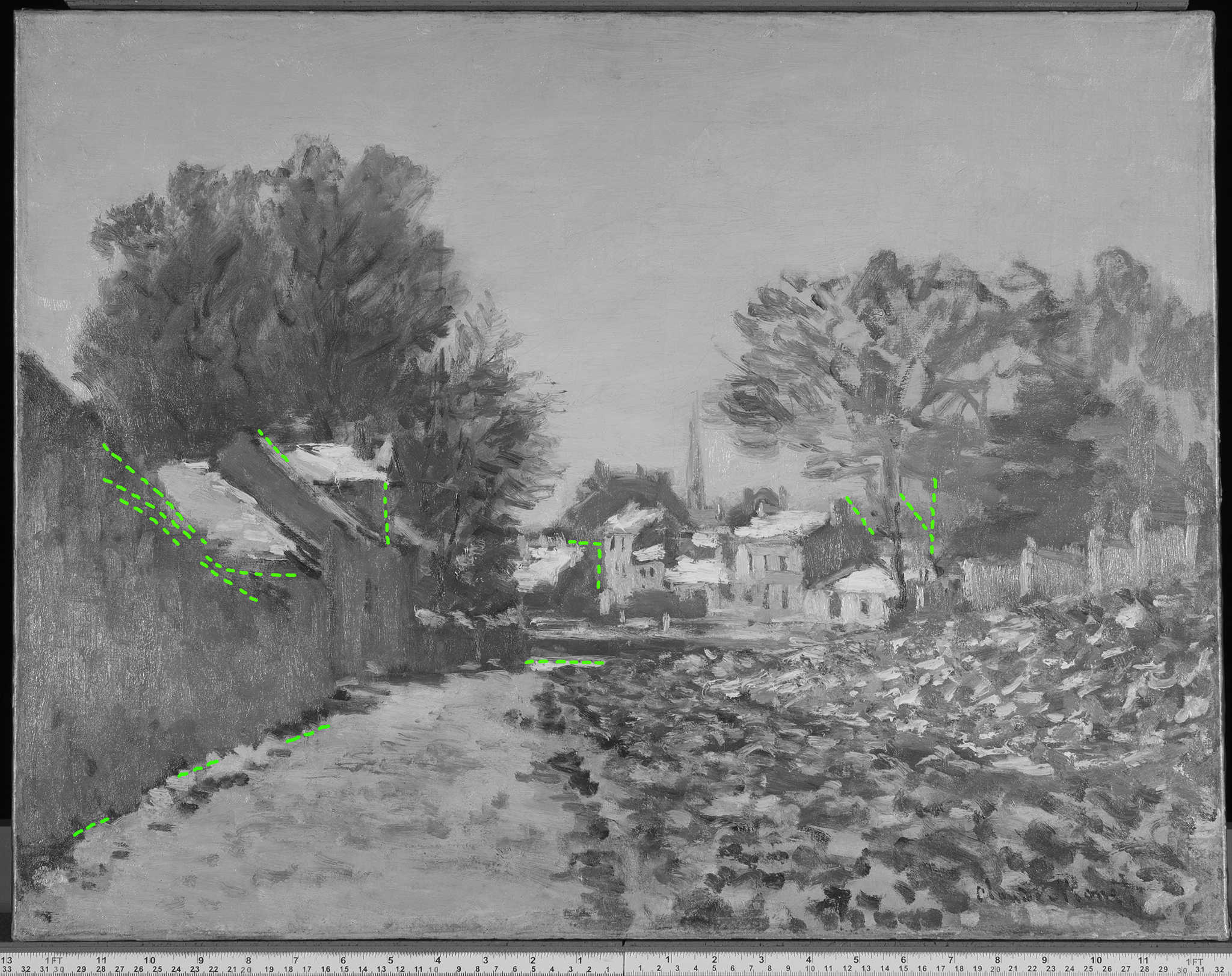
While there is no overall underdrawing: A drawn or painted sketch beneath the paint layer. The underdrawing can be made from dry materials, such as graphite or charcoal, or wet materials, such as ink or paint., thin black lines are found throughout the painting and likely relate to a partial underdrawing. These lines appear to have been created with charcoal,13While the academic tradition of underdrawing was not a fundamental concern for Monet, quick and sporadic charcoal lines for shape placements are present on some of his paintings, such as Houses by the Bank of the River Zaan (1871; Städel Museum). Felix Kramer, ed., Monet and the Birth of Impressionism (Munich: Prestel, 2015), 261–62. possibly oiled vine charcoal since the lines have been so well preserved.14Oiled vine charcoal has stronger binding properties than compressed charcoal, allowing for its possible preservation through restoration or conservation campaigns. Paul Goldman, Looking at Prints, Drawings and Watercolours (Los Angeles: The British Museum Press, 2006), 20. Some pressure was used to apply these lines, as the surrounding oil paint was displaced as they were drawn. In Figure 23, the green overlay corresponds to the charcoal lines and indicates that most relate to the present wintertime scene. Along the building at the left, they appear to relate directly to the current compositional elements of the snow scene, and lie between the blue and brown paint layers of the buildings (Fig. 24). It is not as clear how the charcoal lines on the right side relate to the painting. On this side, they appear to lie below the blue paint of the sky of the current composition and above a lower gray-blue that could relate to the early maritime scene. However, they do not clearly follow any compositional elements of Snow Effect at Argenteuil.
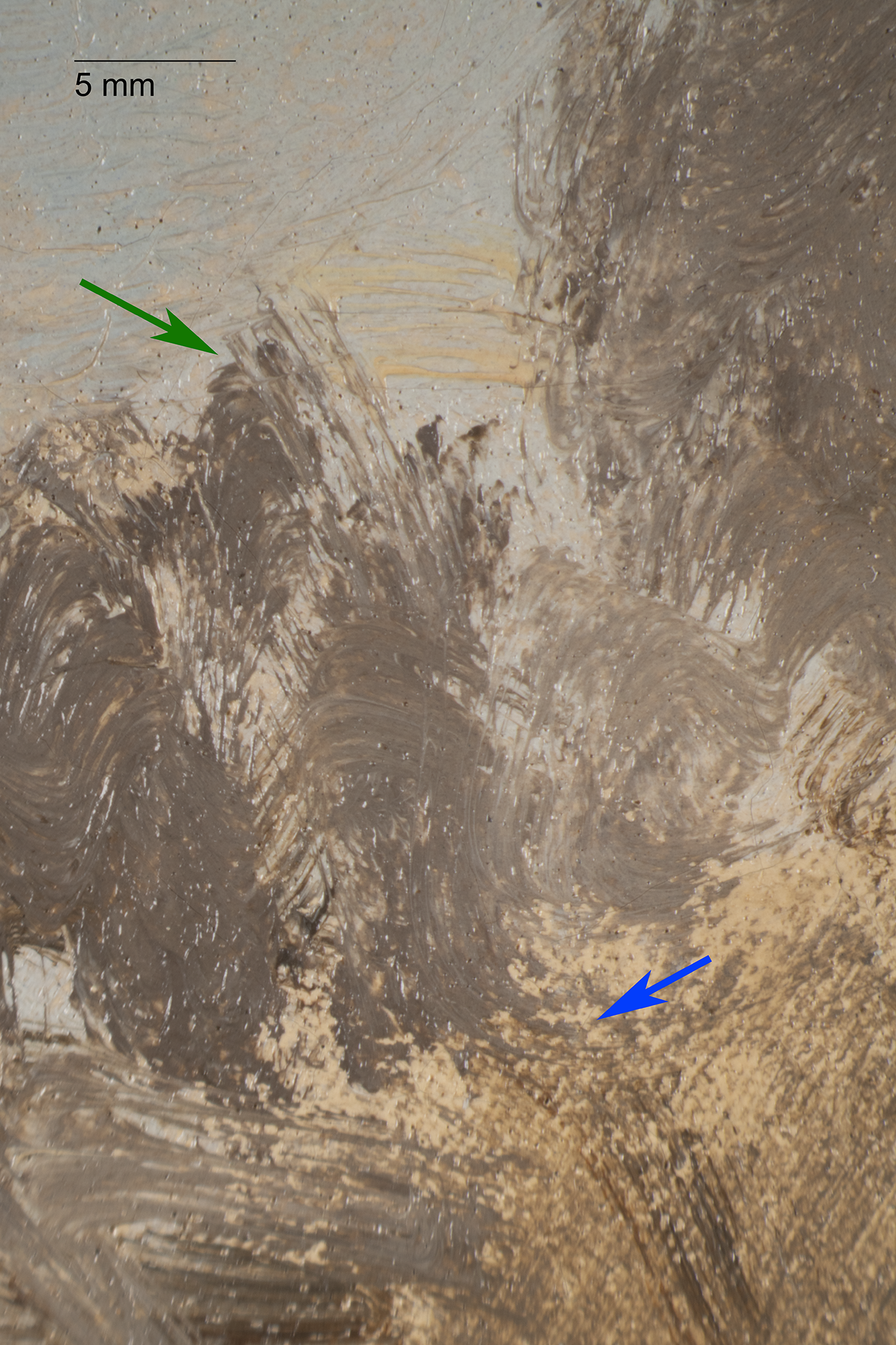
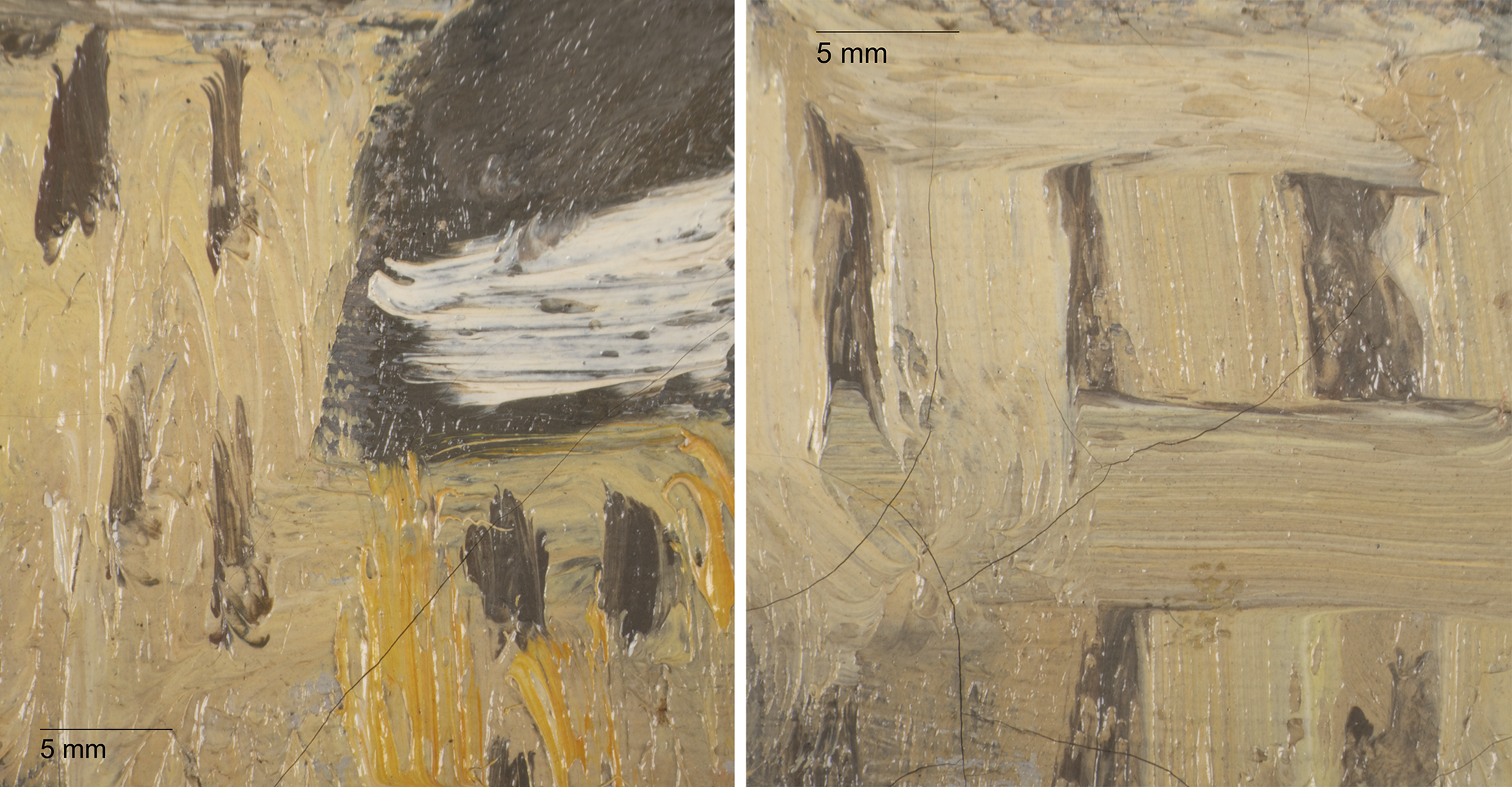
After returning to the canvas, Monet began with the placement of the trees, both to the right and left, covering much of the masts. Initially these trees were laid in quickly with thin scumble: A thin layer of opaque or semi-opaque paint that partially covers and modifies the underlying paint., allowing the off-white ground to show through. The buildings on the left were blocked in but were revisited with the mauve strokes and snowy rooftops added with wet-over-dry: An oil painting technique that involves layering paint over an already dried layer, resulting in no intermixing of paint or disruption to the lower paint strokes. application and no blending to the lower paint. The town, sky, and foreground were likely painted together, with each of these elements displaying wet-over-wet paint application at their neighboring junction. At this time, Monet added to the outer branches of the trees, pulling through the still wet paint in the sky (Fig. 25). Within the town, Monet rendered the buildings two different ways. To the left, the windows were added as final details. But to the right, it appears the brown windows were painted first, and then the surrounding yellow of the building was painted, dragging the brown with it in many places (Fig. 26).
The painting is in good condition overall, with a glue-based lining: A procedure used to reinforce a weakened canvas that involves adhering a second fabric support using adhesive, most often a glue-paste mixture, wax, or synthetic adhesive. likely from an early date, though there are no records of when this was performed. There is minimal retouching: Paint application by a conservator or restorer to cover losses and unify the original composition. Retouching is an aspect of conservation treatment that is aesthetic in nature and that differs from more limited procedures undertaken solely to stabilize original material. Sometimes referred to as inpainting or retouch. present, with most relating to abrasion: A loss of surface material due to rubbing, scraping, frequent touching, or inexpert solvent cleaning. along the edges. In 1988, a synthetic varnish was applied, which remains in good condition.
Notes
-
David Bomford, Jo Kirby, John Leighton, and Ashok Roy, Art in the Making: Impressionism (London: Yale University Press, 1991), 46. For more information on French canvas weaves, see also Anthea Callen, The Art of Impressionism: Painting Technique and the Making of Modernity (New Haven: Yale University Press, 2000), 31–32.
-
Because of the paper tape, it is difficult to determine if cusping is present on the top and left tacking margins.
-
For more information on the series of Argenteuil snow paintings, see the accompanying curatorial entry by Glynnis Napier Stevenson.
-
The Nelson-Atkins painting measures 50.2 x 64.5 centimeters. The Museum of Fine Arts Boston painting measures 54.6 x 73.7 centimeters. “Snow at Argenteuil,” The Museum of Fine Arts Boston, accessed July 27, 2020, https://collections.mfa.org/objects/31899/snow-at-argenteuil?ctx=509c6320-c57a-4933-b444-74faf1e92736&idx=18.
-
Callen, The Art of Impressionism, 15.
-
From the mid-1860s to the mid-1870s, Monet moved frequently, often finding himself in port cities such as Honfleur and Le Havre. During this time, he painting many scenes of ships and shipyards, with Ships in a Harbor being one example. Monet: The Early Years (New Haven: Yale University Press, 2017), 71–77.
-
The Museum of Fine Arts Boston painting Ships in a Harbor measures 49.8 x 61.0 centimeters, which roughly corresponds to a standard-format no. 12 portrait. “Ships in Harbor,” The Museum of Fine Arts Boston, accessed August 8, 2020, https://collections.mfa.org/objects/31270/ships-in-a-harbor?ctx=521deba2-9cf4-4795-84a9-c9560ca94b83&idx=5. See also Callen, The Art of Impressionism, 15.
-
Monet frequently purchased canvases with commercial grounds. Although he often applied a second tinted ground, paper tape around the tacking margins of the Nelson-Atkins painting makes it difficult to definitely state whether he followed this practice on Snow Effect at Argenteuil. The painting’s ground layer is off-white in color, and it is possible that no second layer was added by the artist. Bomford et al., Art in the Making: Impressionism, 144–45.
-
Wavy or “zigzag” brushstrokes are not uncommon for Monet’s representation of water and have been previously described in relation to his Bathing at La Grenouillère (1869; National Gallery, London). Anthea Callen, Techniques of the Impressionists (London: Tiger Books International, 1988), 56.
-
Most of the black strokes found in the foreground are beneath the current composition and thus have wet-onto-dry application. However, there is one black stroke in the center of the foreground that was painted contemporaneous to the current composition.
-
During the late 1860s Monet had immense financial struggles, frequently borrowing money from family and attempting suicide in 1868 because of his debts. Kermit Swiler Champa, Studies in Early Impressionism (New Haven: Yale University Press, 1973), 22–24. It was not until Monet fled to London in 1870 that he met the dealer Paul Durand-Ruel and became more financially stable. George T. M. Shackelford, Monet: The Early Years (New Haven: Yale University Press, 2017), 174. For a more complete timeline of Monet’s career, see pages 72–79.
-
Although Monet had become more financially stable after meeting Durand-Ruel, he continued to struggle with sales. For a discussion on Monet’s financial status in the 1870s, see the accompanying curatorial entry by Glynnis Napier Stevenson.
-
While the academic tradition of underdrawing was not a fundamental concern for Monet, quick and sporadic charcoal lines for shape placements are present on some of his paintings, such as Houses by the Bank of the River Zaan (1871; Städel Museum). Felix Kramer, ed., Monet and the Birth of Impressionism (Munich: Prestel, 2015), 261–62.
-
Oiled vine charcoal has stronger binding properties than compressed charcoal, allowing for its possible preservation through restoration or conservation campaigns. Paul Goldman, Looking at Prints, Drawings and Watercolours (Los Angeles: The British Museum Press, 2006), 20.
Documentation
Citation
Chicago:
Glynnis Napier Stevenson, “Claude Monet,
Snow Effect at Argenteuil, 1875
(2015.13.14),” documentation in ed. Aimee
Marcereau DeGalan
French Paintings and Pastels, 1600–1945: The
Collections of the Nelson-Atkins Museum of
Art
(Kansas City: The Nelson-Atkins Museum of Art,
2021),
https://doi.org/10.37764/78973.5.629.4033.
MLA:
Stevenson, Glynnis Napier. “Claude Monet, Snow Effect at Argenteuil, 1875 (2015.13.14),” documentation. French Paintings and Pastels, 1600–1945: The Collections of the Nelson-Atkins Museum of Art, edited by Aimee Marcereau DeGalan, The Nelson-Atkins Museum of Art, 2021. doi: 10.37764/78973.5.629.4033
Provenance
Probably with the artist, until at least June 21, 1889 [1];
With Galerie Georges Petit, Paris, by October 19, 1892;
Purchased from Galerie Georges Petit, Paris, by Boussod, Valadon, et Cie, Paris, stock no. 22538, as Entrée de Village, neige, October 19, 1892 [2];
Transferred from Boussod, Valadon, et Cie, Paris, to Boussod, Valadon et Cie, New York, by April 15, 1898;
Purchased from Boussod, Valadon, et Cie, New York, by Henry Osborne (1847–1907) and Louisine Waldron (née Elder, 1855–1929) Havemeyer, New York, 1898–December 4, 1907;
Inherited by Louisine Waldron Elder Havemeyer, New York, 1907–January 6, 1929;
Purchased at her posthumous sale, Important Paintings from the Havemeyer Estate, Part I, American Art Association, New York, April 10, 1930, lot 85, as Village Street, by H. E. Russell for David Melville (1891–1984) and Ruth (née Stein, 1899–1979) Heyman, 1930–84;
Purchased at their posthumous sale, Impressionist and Modern Paintings and Sculpture, Christie’s, New York, May 16, 1984, lot 8, as Neige a [sic] Argenteuil, by Alex Reid and Lefèvre Ltd., London, 1984–June 8, 1988 [3];
Purchased from Alex Reid and Lefèvre Ltd., through Susan L. Brody Associates, New York, by Marion (née Helzberg, 1931–2013) and Henry (1922–2019) Bloch, Shawnee Mission, KS, 1988–June 15, 2015 [4];
Their gift to The Nelson-Atkins Museum of Art, Kansas City, MO, 2015.
Notes
[1] The painting was exhibited at Claude Monet; A. Rodin at Galerie Georges Petit, Paris, which opened on June 21, 1889. Many of the other pictures exhibited have a specified lender, but not lot 18, titled Effet de neige; Argenteuil, which means that Monet probably lent the work from his private collection. Pictures owned by Georges Petit in 1889 were listed as such in the exhibition catalogue.
[2] This picture entered the Boussod, Valadon, et Cie stockbook on October 19, 1892. See “Goupil Book 14, Stock No. 22538, Page 31, Row 2,” The Getty Research Institute, Los Angeles, Dealer Stock Books, as Entrée de Village, neige.
[3] See email from Darragh O’Donoghue, Tate Archives, to Glynnis Stevenson, NAMA, October 30, 2018, NAMA curatorial files.
[4] Phone call from Susan Brody to Brigid Boyle, NAMA, June 10, 2015, see notes in NAMA curatorial files.
Exhibitions
Claude Monet; A. Rodin, Galerie Georges Petit, Paris, opened June 21, 1889, no. 18, as Effet de neige; Argenteuil.
A Loan Exhibition of Paintings by Claude Monet For the Benefit of The Children of Giverny, Wildenstein, New York, April 11–May 12, 1945, no. 10, as Rue de Village en Normandie.
Important XIX and XX Century Works of Art, The Lefevre Gallery, London, June 20–July 27, 1985, no. 10, as Neige à Argenteuil.
Manet to Matisse: Impressionist Masters from the Marion and Henry Bloch Collection, The Nelson-Atkins Museum of Art, Kansas City, MO, June 9–September 9, 2007, no. 9, as Snow at Argenteuil (Neige à Argenteuil).
References
Claude Monet; A. Rodin, exh. cat. (Paris: Galerie Georges Petit, 1889), 29 [repr., in Theodore Reff, ed., Modern Art in Paris: Two-Hundred Catalogues of the Major Exhibitions Reproduced in Facsimile in Forty-Seven Volumes, vol. 34, Miscellaneous Group Exhibitions (New York: Garland, 1981), unpaginated], as Effet de neige; Argenteuil.
Possibly Gustave Geffroy, Claude Monet, sa vie, son œuvre, vol. 1 (Paris: Les Éditions G. Crès et Cie, 1924), 156, as Effet de neige à Argenteuil.
The Estate of Mrs. H. O. Havemeyer, Part I: Oil Paintings (New York: American Art Association, Anderson Galleries, April 10, 1930), 63, (repro.), as Village Street.
The H. O. Havemeyer Collection: Catalogue of Paintings, Prints, Sculpture and Objects of Art (Portland, ME: Southworth Press, 1931), 504, as Landscape—Village Street.
A Loan Exhibition of Paintings by Claude Monet For the Benefit of the Children of Giverny, exh. cat. (New York: Wildenstein, 1944), 24, as Rue de Village en Normandie.
Impressionism in the collection of the Museum of Fine Arts, Boston (Boston: Museum of Fine Arts, 1973), unpaginated.
Daniel Wildenstein, Claude Monet: Biographie et catalogue raisonné, vol. 1, 1840–1881: Peintures (Lausanne: La Bibliothèque des Arts, 1974), no. 349, pp. 73, 262–63, 460, as Neige à Argenteuil.
Impressionist and Modern Paintings and Sculpture (New York: Christie’s, May 16, 1984), 26, (repro.), as Neige a [sic] Argenteuil.
Important XIX and XX Century Works of Art, exh. cat. (London: Lefevre Gallery, 1985), 22–23, as Neige à Argenteuil.
John House, Monet: Nature into Art (New Haven, CT: Yale University Press, 1986), 167–68, (repro.), as Snow at Argenteuil.
Frances Weitzenhoffer, The Havemeyers: Impressionism Comes to America (New York: Harry N. Abrams, 1986), 130, 237, (repro.), as Snow at Argenteuil.
Daniel Wildenstein, Claude Monet: Catalogue raisonné, vol. 5, Supplément aux peintures, Dessins, Pastels, Index (Lausanne: Wildenstein Institute, 1991), no. 349, pp. 29, 292, 328, 332, 336, as Neige à Argenteuil.
Alice Cooney Frelinghuysen, et al., Splendid Legacy: The Havemeyer Collection, exh. cat. (New York: Metropolitan Museum of Art, 1993), 223, 362–63, (repro.), as Snow at Argenteuil.
Daniel Wildenstein, Monet or the Triumph of Impressionism (Cologne: Benedikt Taschen Verlag GmbH, 1996), no. 349, p. 114.
Daniel Wildenstein, Monet: Catalogue Raisonné-Werkverzeichnis, vol. 2, Nos. 1–968 (Cologne: Benedikt Taschen Verlag GmbH, 1996), no. 349, p. 144, (repro.), as Neige à Argenteuil, Snow at Argenteuil, and Schnee in Argenteuil.
Charles S. Moffett et al., Impressionists in Winter: Effets de Neige, exh. cat. (Washington, DC: Phillips Collection, 1998), 96–97, (repro.), as Snow at Argenteuil.
Rebecca Dimling and Bobbie Leigh, “100 Top Collectors Who Have Made a Difference,” Art and Antiques (March 2006): 90.
Bobbie Leigh, “Magnificent Obsession,” Art and Antiques 29, no. 6 (June 2006): 62, 64–65, (repro.).
“Inaugural Exhibitions Celebrate Kansas City,” Member Magazine (The Nelson-Atkins Museum of Art) (Fall 2006): 3.
Richard R. Brettell and Joachim Pissarro, Manet to Matisse: Impressionist Masters from the Marion and Henry Bloch Collection, exh. cat. (Kansas City, MO: Nelson-Atkins Museum of Art, 2007), 10, 14, 60–65, 68–69, 157, (repro.), as Snow at Argenteuil (Neige à Argenteuil).
Alice Thorson, “A final countdown—A rare showing of Impressionist paintings from the private collection of Henry and Marion Bloch is one of the inaugural exhibitions at the 165,000-square-foot glass-and-steel structure,” Kansas City Star (June 29, 2006): B1.
Alice Thorson, “First Public Exhibition-Marion and Henry Bloch’s art collection: A tiny Renoir began impressive obsession Bloch collection gets its first public exhibition-After one misstep, Blochs focused, successfully, on French paintings,” Kansas City Star (June 3, 2007): E4.
“Lasting Impressions: A Tribute to Marion and Henry Bloch,” Member Magazine (The Nelson-Atkins Museum of Art) (Fall 2007): 11.
Steve Paul, “Pretty Pictures: Marion and Henry Bloch’s collection of superb Impressionist masters,” Panache 4, no. 3 (Fall 2007): 24, (repro.), as Snow at Argenteuil.
Joseph Baillio, Claude Monet (1840–1926): A Tribute to Daniel Wildenstein and Katia Granoff, exh. cat. (New York: Wildenstein, 2007), 144, as Snow at Argenteuil.
Alice Thorson, “Museum to Get 29 Impressionist Works from the Bloch Collection,” The Kansas City Star (February 5, 2010): A1.
Carol Vogel, “Inside Art: Kansas City Riches,” New York Times 159, no. 54,942 (February 5, 2010): C26, (repro.), as Snow at Argenteuil.
Mary Mathews Gedo, Monet and his Muse: Camille Monet in the Artist’s Life (Chicago: University of Chicago Press, 2010), 155.
Daniel Wildenstein, Monet or the Triumph of Impressionism (Cologne: Benedikt Taschen Verlag GmbH, 2010), no. 349, p. 114.
Thomas M. Bloch, Many Happy Returns: The Story of Henry Bloch, America’s Tax Man (Hoboken, NJ: John Wiley and Sons, 2011), 174–75.
Possibly Jean-François Demeure, Monet en Creuse: Le printemps d’une méthode (Limoges, France: Éditions Culture et Patrimoine en Limousin, 2011), 38, as Effet de neige à Argenteuil.
Diane Stafford, “Bloch gift to go for Nelson upgrade,” Kansas City Star 135, no. 203 (April 8, 2015): A8.
“Nelson-Atkins Museum of Art officially accessions Bloch Impressionist masterpieces,” artdaily.org (July 25, 2015): http://artdaily.com/news/80246/Nelson-Atkins-Museum-of-Art-officially-accessions-Bloch-Impressionist-masterpieces#.V6oGwlKFO9I.
Julie Paulais, “Le Nelson-Atkins Museum of Art reçoit des tableaux impressionnistes en échange de leurs répliques,” Le Journal des arts (July 30, 2015): http://www.lejournaldesarts.fr/site/archives/docs_article/129801/le-nelson-atkins-museum-of-art-recoit-des-tableaux-impressionnistes-en-echange-de-leurs-repliques.php.
Josh Niland, “The Nelson-Atkins Museum of Art Acquires a Renowned Collection of Impressionist and Postimpressionist Art,” architecturaldigest.com (August 6, 2015): https://www.architecturaldigest.com/story/nelson-atkins-museum-accessions-bloch-art-collection.
Nancy Staab, “Van Gogh is a Go!” 435: Kansas City’s Magazine (September 2015): 76.
Nina Siegal, “Upon Closer Review, Credit Goes to Bosch,” New York Times 165, no. 57130 (February 2, 2016): C5.
“Nelson-Atkins to unveil renovated Bloch Galleries of European Art in winter 2017,” Artdaily.org (July 20, 2016): http://artdaily.com/news/88852/Nelson-Atkins-to-unveil-renovated-Bloch-Galleries-of-European-Art-in-winter-2017-#.W-NDepNKhaQ.
“Nelson-Atkins Museum of Art celebrates generosity of Henry Bloch with new acquisition,” Artdaily.org (October 18, 2016): http://artdaily.com/news/90923/Nelson-Atkins-Museum-of-Art-celebrates-generosity-of-Henry-Bloch-with-new-acquisition#.W-NDv5NKhaQ.
Ross King, Mad Enchantment: Claude Monet and the Painting of the Water Lilies (New York: Bloomsbury, 2016), 120.
Catherine Futter et al., Bloch Galleries: Highlights from the Collection of the Nelson-Atkins Museum of Art (Kansas City, MO: Nelson-Atkins Museum of Art, 2016), 61, (repro.), as Snow at Argenteuil.
David Frese, “Bloch savors paintings in redone galleries,” Kansas City Star (February 25, 2017): 1A.
Albert Hect, “Henry Bloch’s Masterpieces Collection to Go on Display at Nelson-Atkins Museum,” Jewish Business News (February 26, 2017): http://jewishbusinessnews.com/2017/02/26/henry-bloch-masterpieces-collection/.
David Frese, “Inside the Bloch Galleries: An interactive experience,” Kansas City Star 137, no. 169 (March 5, 2017): 1D, 5D, (repro.), as Snow at Argenteuil.
“The Nelson-Atkins Museum of Art: Presenting the Bloch Galleries,” New York Times (March 5, 2017).
“Editorial: Thank you, Henry and Marion Bloch”, Kansas City Star (March 7, 2017): http://www.kansascity.com/opinion/editorials/ article137040948.html [repr., “Thank you, Henry and Marion Bloch,” Kansas City Star 137, no. 172 (March 8, 2017): 16A].
Hampton Stevens, “(Not Actually) 12 Things To Do During The Big 12 Tournament,” Flatland: KCPT’s Digital Magazine (March 9, 2017): http://www.flatlandkc.org/arts-culture/sports/not-actually-12-big-12-tournament/.
Laura Spencer, “The Nelson-Atkins’ Bloch Galleries Feature Old Masterworks and New Technology,” KCUR (March 10, 2017): http://kcur.org/post/nelson-atkins-bloch-galleries-feature-old-masterworks-and-new-technology#stream/0.
Victoria Stapley-Brown, “Nelson-Atkins Museum’s new European art galleries come with a ‘love story,’” Art Newspaper (March 10, 2017): http://theartnewspaper.com/news/museums/nelson-atkins-museum-s-new-european-art-galleries-come-with-a-love-story/.
Harry Bellet, “Don du ciel pour le Musée Nelson-Atkins,” Le Monde (March 13, 2017): http://www.lemonde.fr/arts/article/2017/03/13/don-du-ciel-pour-le-musee-nelson-atkins_5093543_1655012.html.
Menachem Wecker, “Jewish Philanthropist Establishes Kansas City as Cultural Mecca,” Forward (March 14, 2017): http://forward.com/culture/365264/jewish-philanthropist-establishes-kansas-city-as-cultural-mecca/ [repr., in Menachem Wecker, “Kansas City Collection Is A Chip Off the Old Bloch,” Forward (March 17, 2017): 20-22], as Snow at Argenteuil.
Juliet Helmke, “The Bloch Collection Takes up Residence in Kansas City’s Nelson Atkins Museum,” BlouinArtInfo International (March 15, 2017): http://www.blouinartinfo.com/news/story/2005267/the-bloch-collection-takes-up-residence-in-kansas-citys.
Erich Hatala Matthes, “Digital replicas are not soulless – they help us engage with art,” Apollo (March 23, 2017): <a href=“https://www.apollo-magazine.com/digital-replicas-3d-printing-original-artworks/” target="_blank>https://www.apollo-magazine.com/digital-replicas-3d-printing-original-artworks/.
Louise Nicholson, “How Kansas City got its magnificent museum,” Apollo (April 7, 2017): https://www.apollo-magazine.com/how-kansas-city-got-its-magnificent-museum/.
Lilly Wei, “Julián Zugazagoitia: ‘Museums should generate interest and open a door that leads to further learning,’” Studio International (August 21, 2017): http://studiointernational.com/index.php/julian-zugazagoitia-director-nelson-atkins-museum-of-art-kansas-city-interview.
Richard Thomson, Monet and Architecture, exh. cat. (London: National Gallery Company, 2018), 218.
Robert D. Hershey Jr., “Henry Bloch, H&R Block’s cofounder, dies at 96,” Boston Globe (April 23, 2019): https://www3.bostonglobe.com/metro/obituaries/2019/04/23/henry-bloch-block-cofounder/?arc404=true>.
Robert D. Hershey Jr., “Henry W. Bloch, Tax-Preparation Pioneer (and Pitchman), Is Dead at 96,” New York Times (April 23, 2019), https://www.nytimes.com/2019/04/23/obituaries/henry-w-bloch-dead.html.
Claire Selvin, “Henry Wollman Bloch, Collector and Prominent Benefactor of Nelson-Atkins Museum of Art, Is Dead at 96,” ArtNews (April 23, 2019): http://www.artnews.com/2019/04/23/henry-bloch-dead-96/](http://www.artnews.com/2019/04/23/henry-bloch-dead-96/.
“Henry Wollman Bloch (1922-2019),” Art Forum (April 24, 2019): https://www.artforum.com/news/henry-wollman-bloch-1922-2019-79547.
Frank Morris, “Henry Bloch, Co-Founder Of H&R Block, Dies At 96,” npr.org (April 24, 2019): https://www.npr.org/2019/04/24/716641448/henry-bloch-co-founder-of-h-r-block-dies-at-96.
Ignacio Villarreal, “Nelson-Atkins mourns loss of Henry Bloch,” ArtDaily.org (April 24, 2019): http://artdaily.com/news/113035/Nelson-Atkins-mourns-loss-of-Henry-Bloch#.XMB76qR7laQ.
Eric Adler and Joyce Smith, “H&R Block co-founder, philanthropist Bloch dies,” Cass County Democrat Missourian 140, no. 29 (April 26, 2019): 1A.
Eric Adler and Joyce Smith, “KC businessman and philanthropist Henry Bloch dies,” Lee’s Summit Journal 132, no. 79 (April 26, 2019): 1A.
Luke Nozicka, “Family and friends remember Henry Bloch of H&R Block,” Kansas City Star 139, no. 225 (April 30 2019): 4A [repr., Luke Nozicka, “Family and friends remember Henry Bloch of H&R Block,” Kansas City Star 139, no. 228 (May 3, 2019): 3A].