Catalogue Entry
Citation
Chicago:
Nicole R. Myers, “After Jean François de Troy, A Lady Attaching a Bow to a Gentleman’s Sword, and A Lady Showing a Bracelet Miniature to Her Suitor, 1764 (?),” catalogue entry in French Paintings and Pastels, 1600–1945: The Collections of the Nelson-Atkins Museum of Art, ed. Aimee Marcereau DeGalan (Kansas City: The Nelson-Atkins Museum of Art, 2024), https://doi.org/10.37764/78973.5.312.5407.
MLA:
Myers, Nicole R. “After Jean François de Troy, A Lady Attaching a Bow to a Gentleman’s Sword, and A Lady Showing a Bracelet Miniature to Her Suitor, 1764 (?),” catalogue entry. French Paintings and Pastels and Pastels, 1600–1945: The Collections of The Nelson-Atkins Museum of Art, edited by Aimee Marcereau DeGalan, Nelson-Atkins Museum of Art, 2024. doi: 10.37764/78973.5.312.5407.
This catalogue entry explores two paintings. For the catalogue documentation and technical entry for the associated painting, see A Lady Showing a Bracelet Miniature to Her Suitor, 82-36/2.
In 1724, on the day of the Fête Dieu (the feast of Corpus Christi, May 30), Jean François de Troy (1679–1752) presented his work publicly for the first time in an exhibition of young painters held in Paris in the Place Dauphine. Among his submissions was a small genre: Figural scenes of ordinary people engaged in the activities of everyday life. painting, The Declaration of Love (ca. 1724; Metropolitan Museum of Art, New York), which caught the attention of the important collector, dealer, and author Pierre Jean Mariette. He wrote: “We note from M. de Troy le fils [the son], already known for his large paintings, a work that brings much honor to his brush, thanks to the harmony, the gallant taste, and the truthfulness with which it is composed.”1“On voyait de M. de Troye, le fils, déjà connu par de plus grands ouvrages, un Tableau qui fait beaucoup d’honneur à son pinceau, par l’entente et le goût galant et vrai dont il est composé. C’est un jeune Cavalier en habit de velours, dont l’étoffe est véritablement moëlleuse, auprès d’une Dame assise sur un canapé.” “Extraits de diverses Lettres,” Mercure de France (June 1724): 1391; repr. Mercure de France VI January–June 1724 (Geneva: Slatkine Reprints, 1968), 370. Translated in Colin Bailey, Philip Conisbee, and Thomas W. Gaetgens, The Age of Watteau, Chardin, and Fragonard: Masterpieces of French Genre Painting, ed. Colin B. Bailey (New Haven: Yale University, 2003), 10. As Mariette observed, the painting marked a departure for the young artist, who until then had made his name as a history painter, the category ranked highest by the prestigious Salon, the: Exhibitions organized by the French Royal Academy of Painting and Sculpture (Académie Royale de Peinture et de Sculpture) and its successor the Academy of Fine Arts (Académie des Beaux Arts), which took place in Paris from 1667 onward. in its hierarchy of subjects.
Born in 1679, De Troy was trained by his father, the eminent portraitist François de Troy (1645–1730), in addition to receiving formal lessons at the academy. Around 1699, his father sent him to continue his studies in Italy, and he spent considerable time in Rome, Florence, and Pisa before returning to Paris in 1706. Two years later, De Troy was simultaneously agréé (accepted) and reçu (received) by the academy as a history painter, with Niobe and Her Children (1708; Musée Fabre, Montpellier) as his morceau de reception (reception piece). De Troy went on to build his reputation with such monumental works as The Plague at Marseilles (ca. 1722; Musée des Beaux-Arts, Marseilles) and a series of paintings commemorating the life of Saint Vincent de Paul (commissioned for the Mission Saint-Lazare, Paris, in 1729; now in various locations). In the category of history painting, De Troy was considered second only to one during his lifetime: his rival François Lemoyne (1688–1737).
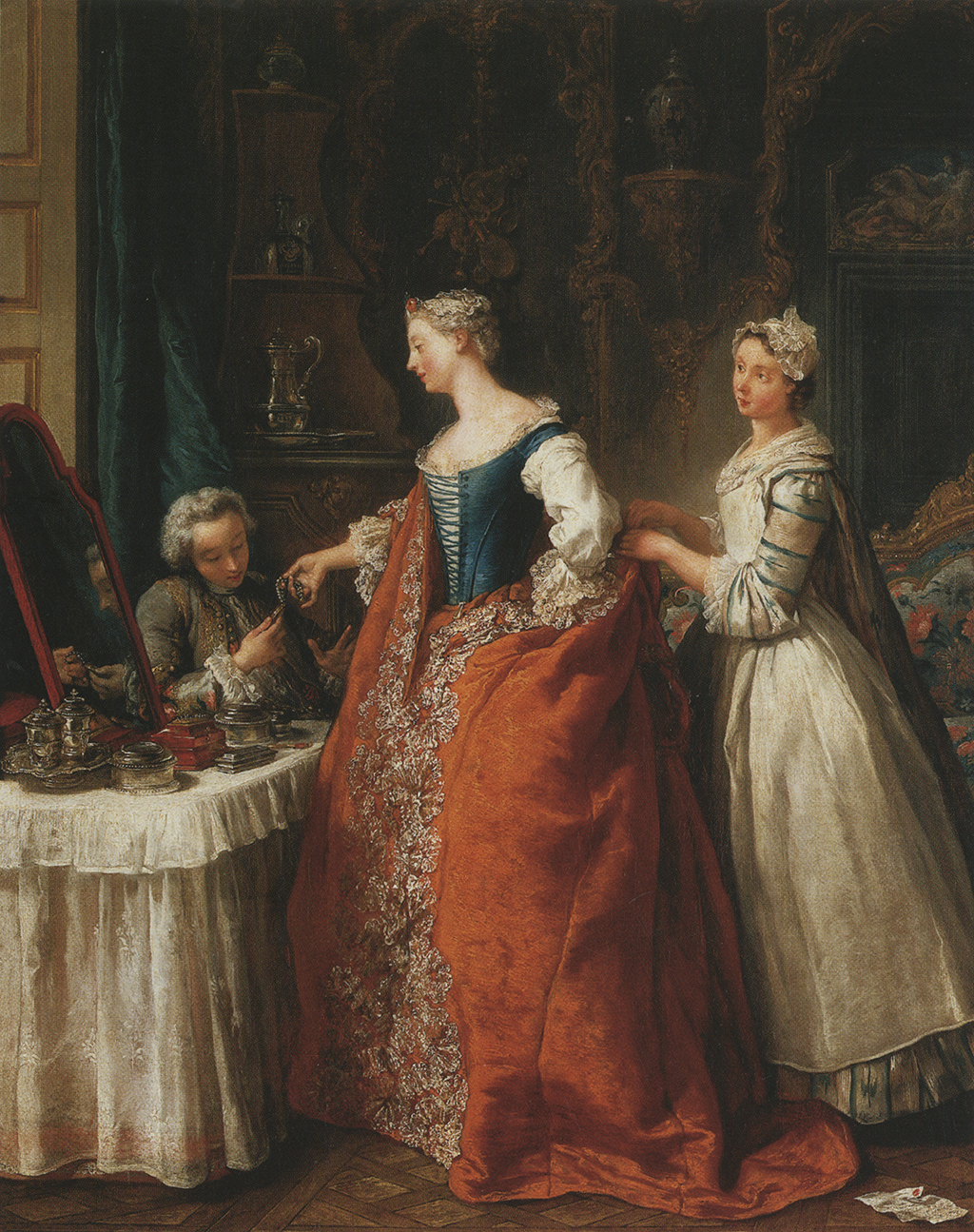
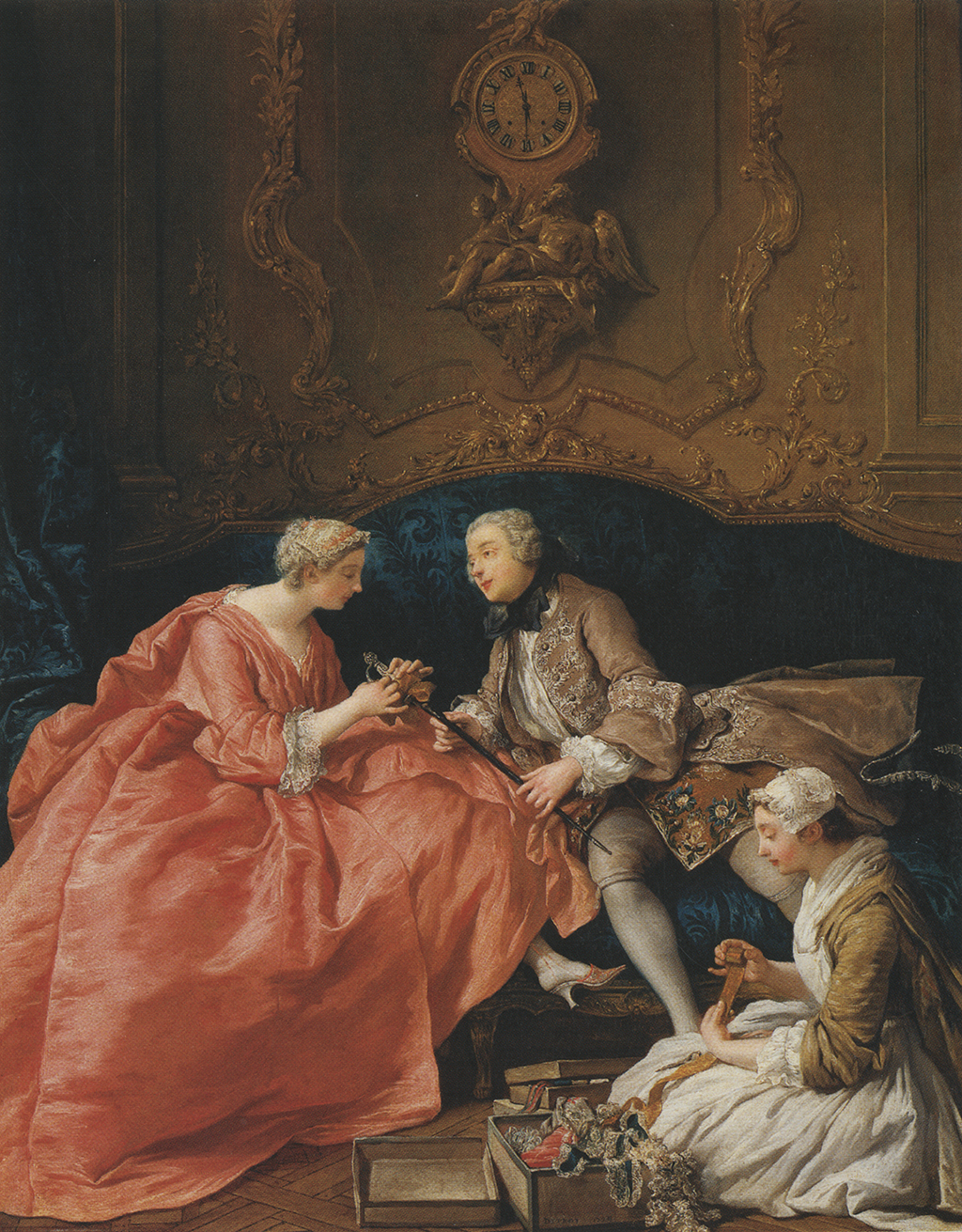
Mariette might thus have been surprised to discover The Declaration of Love, De Troy’s first foray into genre painting, but it nonetheless seduced him with its charm, refinement, and novelty. With the painting and its pendant: One of two paintings conceived as a pair and intended to be displayed togther., The Garter (1724; Metropolitan Museum of Art), which debuted the following year at the Salon of 1725, De Troy introduced a new pictorial form. Dubbed tableaux de mode (pictures of fashionable society) by his contemporaries, these paintings took as their subjects the leisure activities, social rituals, and intimate moments of the eighteenth-century Parisian elite.2The term tableaux de mode appears in texts by Jean Pierre Mariette and in the Mercure de France. Christophe Leribault, Jean-François de Troy (1679–1752), cat. rais. (Paris: Arthena, 2002), 72. The original versions of A Lady Showing a Bracelet Miniature to Her Suitor and A Lady Attaching a Bow to a Gentleman’s Sword (Figs. 1, 2)—of which the Nelson-Atkins paintings are copies—are among the approximately ten tableaux de mode that De Troy created in Paris between 1724 and 1738, the year he was appointed director of the French Academy in Rome. Differing from his large-scale religious and civic commissions, which were broadly painted in loose, sweeping strokes, his tableaux de mode were executed in a highly detailed and polished style reminiscent of seventeenth-century Dutch and Flemish genre paintings. Indeed, the rising popularity of paintings from the Low Countries among connoisseurs and collectors during the first half of the eighteenth century provided the background against which the tableaux de mode were developed, received, and collected in France.3Colin B. Bailey, “Surveying Genre in Eighteenth-Century French Painting,” in Bailey et al., The Age of Watteau, 18–19; and Leribault, Jean-François de Troy, 60.
In addition to northern European cabinet pictures, De Troy was probably influenced by the French art forms they inspired, such as the fêtes galantes painted by Jean-Antoine Watteau (1684–1721), which feature groups of elite upper-class men and women in conversation, role playing, dancing, or flirting outdoors.4Michael Levey, Painting and Sculpture in France, 1700–1789 (New Haven, CT: Yale University Press, 1993), 21. However, unlike Dutch and Flemish genre painters, De Troy did not portray scenes of lower- and middle-class life or bawdy subjects such as taverns and brothels; nor did he create fantasy worlds within which his aristocratic characters played, as did Watteau and his followers.5Richard Rand, Intimate Encounters: Love and Domesticity in Eighteenth-Century France (Hanover, NH: Hood Museum of Art, Dartmouth College, 1997), 5. De Troy’s tableaux de mode instead portray everyday upper-class life with the narrative clarity of history painting. As Christophe Leribault has argued, De Troy employed strategies drawn from his experience as a history painter—the rhetoric of gesture, compositional organization, and details of setting and costume—to relay anecdotal stories of upper-class sociability. Although the subjects of tableaux de mode were considered trite by the second half of the eighteenth century—due in part to their widespread circulation as engravings—they were entirely innovative in the mid-1720s.6Leribault, Jean-François de Troy, 62; Bailey et al., The Age of Watteau, p. 166, entry no. 24. Indeed, the tableau de mode was regarded by contemporary viewers as a truly French pictorial form that reflected the taste and refinement of France’s elite in both subject and style.7Barbara Anderman, “La notion de peinture de genre à l’époque de Watteau” in Patrick Ramade and Martin P. Eidelberg, Watteau et la fête galante, exh. cat. (Paris: Réunion des musées nationaux, 2004), 35. See also Jörg Ebeling, “Upwardly Mobile: Genre Painting and the Conflict between Landed and Moneyed Interests,” in Philip Conisbee, ed., French Genre Painting in the Eighteenth Century (Washington, DC: National Gallery of Art, 2007), 73–89.
De Troy probably designed his tableaux de mode with their final destinations in mind. The growing appreciation of detailed, small-scale paintings depicting pleasant subjects coincided with a shift in the living conditions of the French aristocracy and haute bourgeoisie: French for ”the upper middle class“. Following the death of Louis XIV in 1715 and the subsequent loosening of rules demanding that nobles live public lives at Versailles, members of the aristocracy were eager to relocate to Paris. They sparked a veritable housing boom with the construction of hôtel particulier: A grand, urban mansion for a private citizen that does not share party walls with residences nearby., a trend that quickly spread to the new class of socially aspiring nouveaux riches. These townhouses feature private rooms on an intimate scale, a first in upper-class living. Paintings took on a decorative function within these new interiors and presented lighthearted subjects deemed appropriate for the informal rooms in which they were displayed.8Thomas W. Gaetgens, “Genre Painting in Eighteenth-Century Collections,” in Bailey et al., The Age of Watteau, 81; Joan DeJean, “A New Interiority: The Architecture of Privacy in Eighteenth-Century Paris,” in Charissa Bremer-David, ed. Paris: Life and Luxury in the Eighteenth Century (Los Angeles: J. Paul Getty Museum, 2011), 34; and Penelope Hunter-Stiebel, “French Painting in the Age of Madame de Pompadour,” in Penelope Hunter-Stiebel et al., La Volupté du Gout: French Painting in the Age of Madame de Pompadour, exh. cat. (Paris: Somogy éditions d’art, 2008), 20. Within this context, De Troy’s tableaux de mode—and even copies after them—found a ready market among almost all levels of elite society: nobles at court, aristocrats, and wealthy members of the haute bourgeoisie, such as financiers and fermier général: French for “general farmer.” A private citizen who collects taxes on behalf of the French monarchy..9De Troy was also a member of the social elite, having married a wealthy woman whose fortune allowed him to purchase the rank of secrétaire du roi du grand collège (secretary to the king of the grand college) in 1737. Many of de Troy’s contemporaries remarked on his elevated social position and the worldly milieu with which he associated. See Ebeling, “Upwardly Mobile,” 73; A[ntoine]-J[oseph] Dézallier d’Argenville, Abrégé de la vie des plus fameux peintres (1762; repr. Geneva: Minkoff Reprint, 1972), 4:368; and Chevalier de Valory, “Jean-François de Troy,” in L. Dussieux et al., Mémoires Inédits sur la Vie et les Ouvrages des Membres de l’Académie Royale de Peinture et de Sculpture (1854; Paris: F. de Nobele, 1968), 2:260–61. Collectively, in their depiction of chivalrous scenarios unfolding in salons, boudoirs, and private gardens, tableaux de mode mirrored the social activities and aspirations of the collectors who bought them and hung them in their homes.
The two Nelson-Atkins pictures are high-quality copies of the original set of paintings (see Figs. 1, 2), which De Troy first exhibited in the place Dauphine in 1734 and were presumably purchased shortly thereafter by Germain-Louis Chauvelin (1685–1762), keeper of seals and secretary of state for foreign affairs.10Germain Louis Chauvelin, a financier, belonged to the class of nouveaux riches and haute bourgeois that made up part of de Troy’s clientele. Denise Amy Baxter, “Parvenu or honnête homme: The Collecting Practices of Germain-Louis de Chauvelin,” Journal of the History of Collections 20, no. 2 (2008): 273–89. Conceived as pendants, A Lady Showing a Bracelet Miniature to Her Suitor and A Lady Attaching a Bow to a Gentleman’s Sword represent the gallantry, harmony, and truthfulness so admired by Mariette. Both paintings reveal an intimate yet genteel moment shared between lovers within private living quarters and rendered in seductive detail.
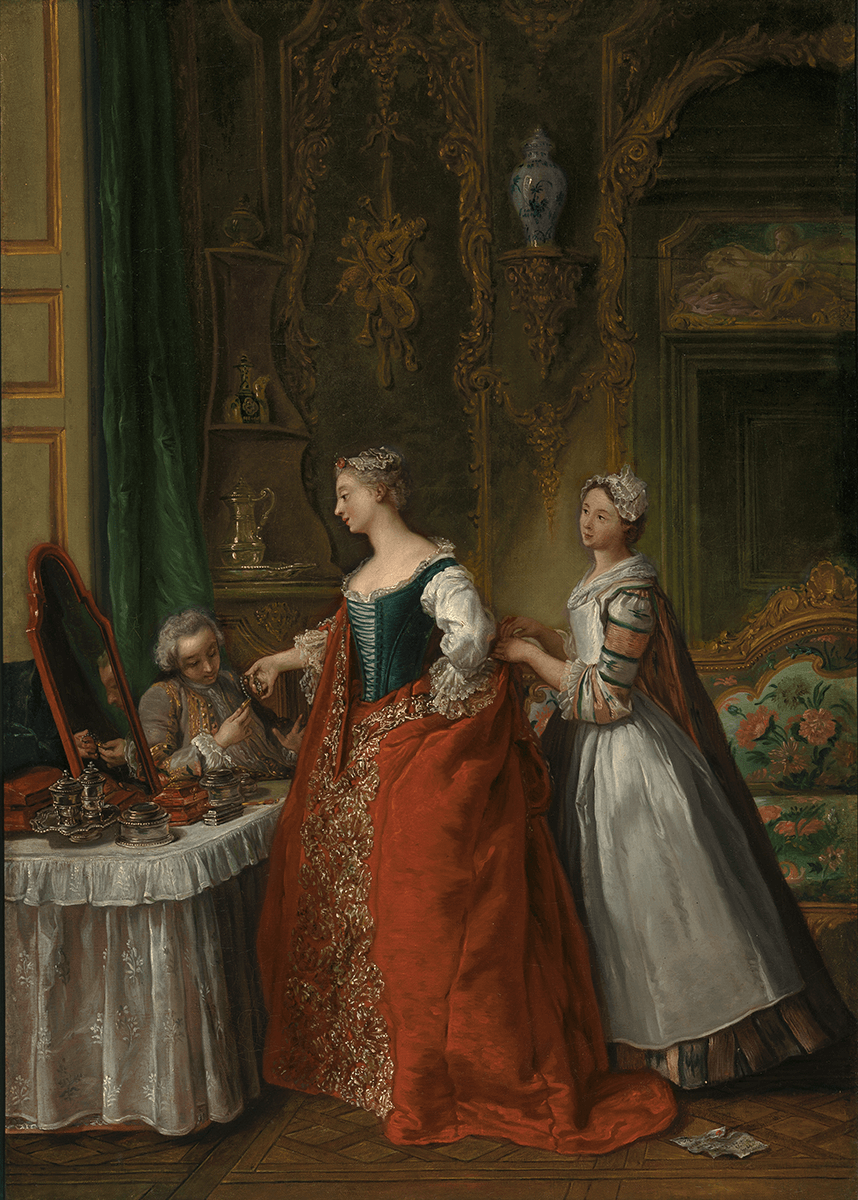
The costumes and furnishings within these scenes are depicted so accurately that they could serve as historical illustrations of fashion and décor during the French Regency period (ca. 1710–35). Indeed, nearly all the decorative objects can be identified and matched to extant examples. A Lady Showing a Bracelet Miniature to Her Suitor features an elegant woman completing the last steps of her morning toilette. A chambermaid helps her into a richly brocaded silk gown known as a robe volante, while she shows her male companion a piece of jewelry that presumably will complete her ensemble. She stands before the red-lacquered mirror of her toilette service, a lavish set of silver and lacquer boxes used to store essential articles such as brushes, wigs, powders, and makeup.11Monika Kopplin, European Lacquer: Selected Works for the Museum für Lackkunst Münster (Munich: Hirmer, 2010), 110. Few complete toilette sets have survived intact; this is in fact a rare illustration of Regency silver that closely resembles a toilette set made in ca. 1695 by Philip Rollos (English, ca. 1660–after 1715) in the Rosalinde and Arthur Gilbert Collection on loan to the Victoria and Albert Museum, London, nos. LOAN:GILBERT.623–37:1-2008; see Denise Amy Baxter, “Fashions of Sociability in Jean-François de Troy’s tableaux de mode, 1725–1738: Defining a Fashionable Genre in Early Eighteenth-Century France,” in Alden Cavanaugh, ed., Performing the “Everyday”: The Culture of Genre in the Eighteenth Century, exh. cat. (Newark, NJ: University of Delaware Press, 2007), 31. The toilette set is spread out on a simple table covered by an embroidered muslin petite toile (small tablecloth) placed over a silk cloth.12Peter Thornton, Authentic Decor: The Domestic Interior 1620–1929 (London: Weidenfeld and Nicolson, 1984), 109; and Kimberly Chrisman-Campbell, “Dressing to Impress: The Morning Toilette and the Fabrication of Femininity,” in Bremer-David, ed., Paris: Life and Luxury in the Eighteenth Century, 55–56. On the shelves of the three-tiered corner cupboard are a monochrome Chinese porcelain vessel in a gilt-bronze mount,13My sincere thanks go to Katelyn Bennett, Nelson-Atkins French paintings catalogue intern, for her research and identification of this previously undocumented object. This pot with a lid and no handles may have had a functional use as a perfume burner. French collectors appreciated monochrome Chinese porcelains for their brilliant shine and reflective quality, which in the de Troy painting resembles that of glass. These luxury porcelains were very costly due to the difficulty in achieving an even glaze as well as their relative scarcity, since they were exported from China in small quantities. See Kristel Smentek, Rococo Exotic: French Mounted Porcelains and the Allure of the East (New York: Frick Collection, 2007), 13–14. a blue-and-white Chinese porcelain kêndi (jug) in the form of an elephant,14D. F. Lunsingh Scheurleer, Chinese Export Porcelain: “Chine de Commande” (London: Faber and Faber, 1974), 50–51. and a silver basin and ewer that would have contained scented water for washing hands.15Chrisman-Campbell, “Dressing to Impress,” 56. The walls are decorated with gilded boiseries (paneling) into which is set a ledge displaying a Chinese porcelain vase and a large mirror. The canapé (sofa) is pushed up against the wall, its curved back designed specifically to fit the wall molding above.16Pierre Verlet, La Maison du XVIIIe Siècle en France: Société Décoration Mobilier (Paris: Baschet, 1966), 134–36. This decor would have been seen by eighteenth-century viewers as both luxurious and modern, since the goût chinois (Chinese taste) represented by the imported lacquer and porcelain pieces enjoyed widespread popularity by the 1730s.17Kopplin, European Lacquer, 90, 93.
Equally realistic is the interior depicted in A Lady Attaching a Bow to a Gentleman’s Sword. Once again, De Troy has rendered a sumptuous salon interior, featuring a green silk curtain and matching canapé set into a wall adorned with gilded boiseries. In the middle of the central panel is a ledge supporting an elaborate gilt-bronze clock whose design can be attributed to André-Charles Boulle (1642–1732), chief cabinetmaker to the king.18Everett Fahy, ed., Wrightsman Pictures (New York: Metropolitan Museum of Art, 2005), 163, 166; and Baxter, “Fashions of Sociability,” 31. De Troy included this same clock in The Garter (1724; Metropolitan Museum of Art, New York), and The Reading of Molière (ca. 1728; private collection). The floor displays the wood parquet that was typical of eighteenth-century Parisian hôtels particuliers. Here, the lady is shown en deshabillée (partial undress), wearing a loose silk sack dress and low-heeled slippers, a casual and comfortable ensemble that was typically worn in the home in the morning. Having selected a yellow ribbon from the wares of the marchande de modes: A vendor who supplied women’s fashion accessories, such as trimmings to decorate caps and shawls. seated on the floor, she ties it around the hilt of her suitor’s sword. The embellishment matches the gentleman’s embroidered yellow waistcoat, which peeks out from under his justaucorps (knee-length coat). His powdered hair is pulled back into a black silk bag wig: An eighteenth-century wig with hair that is tied in back and contained in a small silk sack or cloth bag. topped with a large bow; its loose ends are tied into another bow under his chin in a style known as a solitaire.19Maurice Leloir, Histoire du Costume de l’Antiquité à 1914 (Paris: Henri Ernst, 1938), 11:26, 28–29; and Aileen Ribeiro, Dress in Eighteenth-Century Europe 1715–1789 (New Haven: Yale University Press, 2002), 29.
True to their function as pendants, A Lady Showing a Bracelet Miniature and A Lady Attaching a Bow feature complementary scenes of upper-class women engaged in their morning toilettes. Although to modern eyes the presence of a man watching a lady get dressed might seem indecorous, in the eighteenth century the toilette was not a private act but one performed before an audience of friends, family, servants, merchants, and even high-ranking clergy. Dressing one’s hair and body during this period was particularly complicated and time-consuming, so both men and women of elite status used that time to receive visitors and conduct business.20For an excellent discussion of the practice of the toilette and its visual representation in the eighteenth century, see Chrisman-Campbell, “Dressing to Impress,” especially pp. 53, 71, and Elise Goodman-Soellner, “Boucher’s Madame de Pompadour at her toilette,” Simiolis, Netherlands quarterly for the history of art 17, no. 1 (1987): 41–58. While the act of dressing is explicitly shown in A Lady Showing a Bracelet Miniature, several details in A Lady Attaching a Bow reveal that this painting too depicts the morning toilette: the woman’s informal house attire, the presence of the marchande de modes, and the clock striking the visiting hour of 11:30 a.m.
In each painting, an object serves as the focus of the couples’ romantic exchanges, whether a piece of jewelry to be admired or a sword (a sign of aristocratic distinction) to be adorned.21Although modern scholars assume that the woman in A Lady Showing a Portrait Miniature to Her Suitor is showing her lover a portrait miniature of his likeness, descriptions of this object penned in the eighteenth century are varied. One author noted that the lady is giving her portrait to the suitor, while the catalogue accompanying Chauvelin’s sale in 1762 described it as a watch: “Deux autres tableaux aussi de mode, l’un une dame qui donne son portrait à un jeune homme, et l’autre une dame qui attache une nœud d’épée à un cavalier” (Two other tableaux de mode, in one a lady giving her portrait to a young man, and in the other a lady tying a sword knot to for knight). “Extrait de la vie de M. De Troy, peintre du roi et directeur de son Académie à Rome,” in Mémoires inédits, 275. “Dans l’un, une Dame attache un ruban à l’épée d’un Cavalier; dans l’autre, une Dame fait voir à un Monsieur, qui est assis proche à sa toilette, l’heure qu’il est” (In one, a Lady ties a ribbon to a knight’s sword; in the other, a lady shows a gentleman, who is sitting nearby at her toilette, what time it is). Catalogue des Tableaux, Estampes en livres et en feuilles, Cartes manuscrites et gravées, montées à gorges et rouleaux, du Cabinet de feu Messire Germain-Louis Chauvelin, Ministre d’Etat, Commandeur des Ordres du Roi, et Ancien Garde des Sceaux (Paris: Lottin et Musier, 1762), 9–10. Combined with the symbolism of other details in the composition, these props convey subtly erotic undertones. In A Lady Showing a Bracelet Miniature, the action of the lady handing her suitor the jewelry is doubled in the reflection of the lacquered mirror on the table, where their hands appear to be almost touching. The amorous nature of the couple’s relationship is further implied by the opened letter on the floor, perhaps a love letter or a note sent to announce the suitor’s impending visit.22Rand, Intimate Encounters, 105. In A Lady Attaching a Bow, the sword that the gentleman eagerly extends toward the lady serves as a thinly veiled reference to the act of physical love. This message is echoed by the clock on which Cupid, god of erotic love, brandishes a scythe over Father Time, declaring the triumph of love over time.23Rand, Intimate Encounters, 105. Tempering these more or less overt sexual allusions is the inclusion of the chambermaid and marchande de modes, whose presence ensures a façade of propriety.
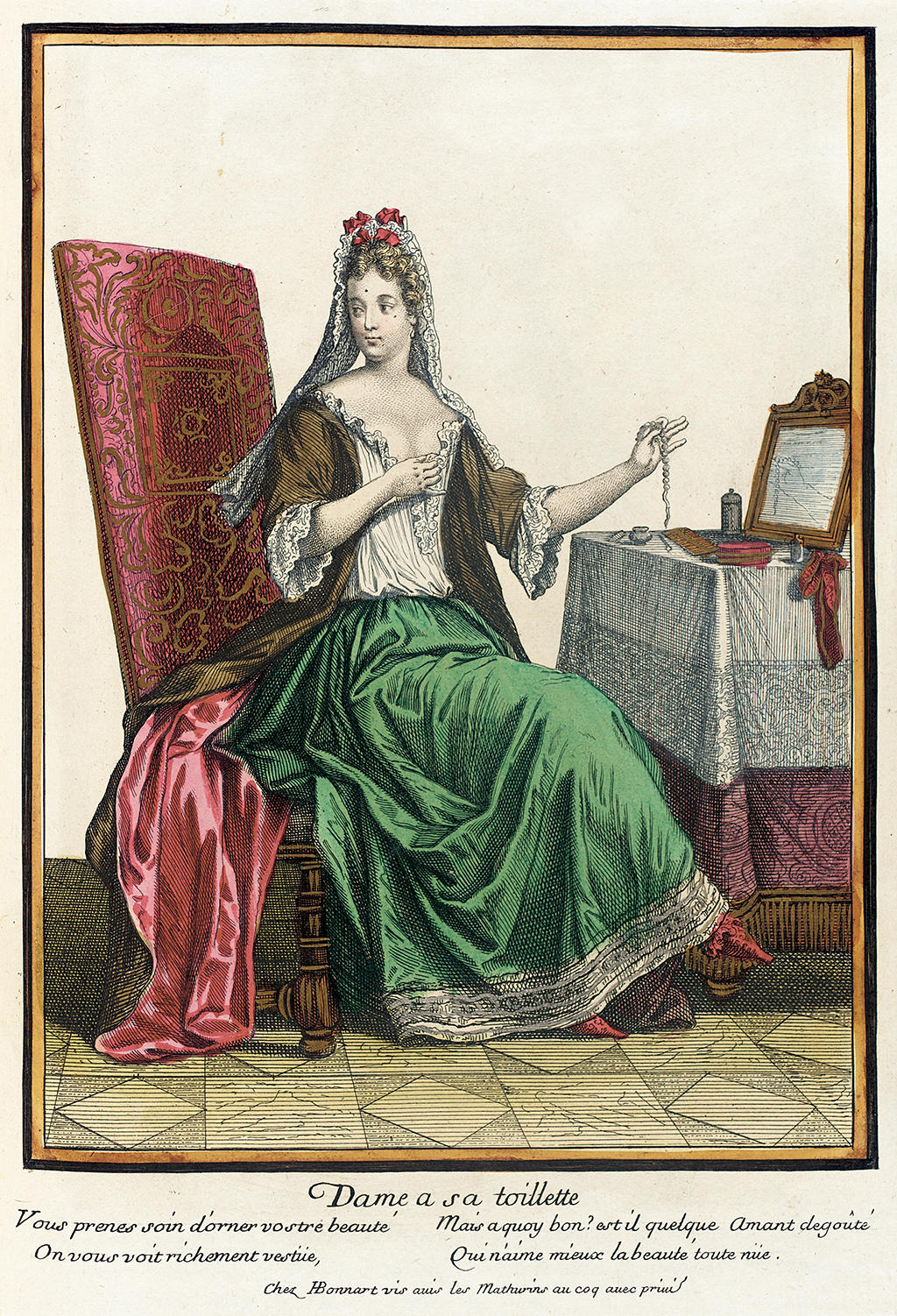
Despite the exactitude of the costumes, decorative objects, and everyday activities, De Troy’s tableaux de mode are ultimately selective in their realism.24Bailey et al., The Age of Watteau, 23. For example, the figures all look the same from painting to painting,25The similarity in the appearance of de Troy’s women was noted by at least one of his contemporaries, Antoine-Joseph Dézallier d’Argenville, who was prompted to explain that de Troy was so smitten with his young wife that he painted her head (always in profile to hide a cataract) in all his gallant paintings; d’Argenville, Abrégé de la vie des plus fameux peintres, 4:368. and with their emphasis on the latest fashions they resemble the printed fashion plates that circulated widely in France beginning in the seventeenth century. The morning toilette was a popular setting in these prints and may have inspired De Troy in his selection of subjects (Fig. 3).26Goodman-Soellner, “Boucher’s Madame de Pompadour,” 47–48; and Baxter, “Fashions of Sociability,” 31. The term tableaux de mode, in fact, suggests his contemporaries’ awareness of this connection and of the elements of fantasy found in this kind of image. As Leribault has argued, these illustrations of social interactions fall perfectly in line with the narratives of sentimental novels of the period. Their appeal and power reside precisely in the fact that they reflect an idealized world of beauty, refinement, and chivalry among the privileged classes.27Leribault, Jean-François de Troy, 72.
The circumstances behind the creation of the
Nelson-Atkins pendants remain elusive, as there is no
record of these copies’ existence before the museum
purchased them in 1982. Moreover, nearly nothing is
known about De Troy’s studio practice and whether he
employed assistants in the making of the few
high-quality replicas currently attributed to him,
such as the replicas of
The Declaration of Love and
The Garter at the Williams College Museum of
Art in Williamstown, Massachusetts.28Of de Troy’s tableaux de mode, the Nelson-Atkins
pictures are the only other known copies. For the
Williams College versions, see
https://egallery
Unlike the replicas in Williamstown, the Nelson-Atkins pictures are smaller than the originals and exhibit slight alterations in their compositions. Perhaps to compensate for the narrower proportions of the copies, both compositions were enlarged on all four sides (most noticeably at the top and bottom), which sets the figures farther back from the picture plane. A noticeable discrepancy can be seen in the appearance of the figures’ faces, particularly the two female figures in A Lady Attaching a Bow to a Gentleman’s Sword and the chambermaid in A Lady Showing a Bracelet Miniature to Her Suitor. They do not display the highly stylized, homogenous facial features that usually characterize De Troy’s subjects. This, however, is the result of past abrasion: A loss of surface material due to rubbing, scraping, frequent touching, or inexpert solvent cleaning. and subsequent restoration.29See technical notes by Mary Schafer, NAMA paintings conservator, April 1, 2011 (82-36/1) and April 6, 2011 (82-36/2), NAMA conservation files. Pre-treatment photographs of the abraded areas reveal that what is left of the original paint surface closely resembles the faces in the original versions. Thus, with a few exceptions, the Nelson-Atkins pendants are rather faithful transcriptions of the originals.30The skirt of the lady’s pink sack dress in A Lady Attaching a Bow is missing the central seam; otherwise, there are no significant changes beyond the enlarged composition; see Leribault, Jean-François de Troy, 335. So exact are their details and matching palettes that, in the absence of other known, high-quality copies that could have served as models, it is not unreasonable to speculate the Nelson-Atkins copies were made directly from the originals.
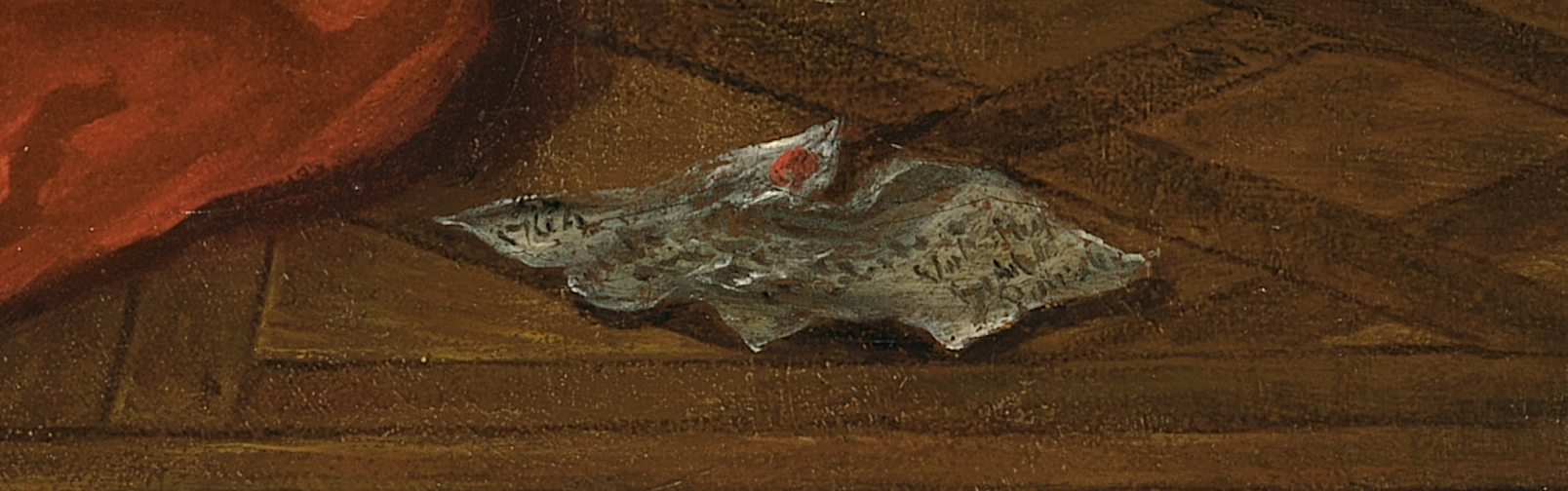
Leribault posits that the Nelson-Atkins paintings could be autograph copies, and he attributes them to Jean François de Troy despite a certain “dryness” in their surface treatment and lesser quality.31Due to the virtual inaccessibility of the original versions, which are now housed in a private collection, assessments of their quality and comparisons to the Nelson-Atkins paintings have relied exclusively upon reproductions, including Leribault’s entries in the de Troy catalogue raisonné. Nevertheless, an attribution to De Troy remains problematic. While the issue of quality has remained central to many scholars and connoisseurs, it is in fact a discrepancy in the inscriptions that builds the strongest case against an attribution to De Troy. In the original pair, A Lady at Her Toilette is signed “De Troy” on the letter at the lower right, and the box in the center foreground of A Lady Attaching a Bow is inscribed “DETROY 1734.” Neither of the Nelson-Atkins copies is signed; however, the copy of A Lady Showing a Bracelet presents a date on the crumpled letter of “17[6?]4” (Fig. 4).32The Williamstown copies omit altogether the inscriptions on the Wrightsman paintings. Painted wet-into-wet: An oil painting technique which involves blending of colors on the picture surface., this inscription appears to date to the time of the copy’s creation and remains in good condition.33See Schafer, technical notes, April 6, 2011 (82–36/2), NAMA conservation files. The third digit is difficult to decipher, even when viewed with a microscope. Nevertheless, its curved shape rules out the number 3 (and thus a date of 1734); it most closely resembles a 6.34The number’s curved shape also rules out a 4 (for 1744), the only other number that would have indicated a possible date for the painting’s execution within de Troy’s lifetime. If the inscription indeed reads 1764, it dates the copy, and presumably its pendant, to twelve years after De Troy’s death in 1752.
The original pendants were sold in 1762 following the death of Chauvelin, their first owner, who had kept the paintings for nearly thirty years. Unlike many of De Troy’s tableaux de mode, the original versions were never engraved and thus probably remained largely unknown until they resurfaced on the market. One can easily imagine that this rediscovery in 1762 prompted a new appreciation for these elegant paintings, resulting in the production of copies around that time. The smaller, narrower dimensions of the copies now at the Nelson-Atkins could in fact reflect the proportions of a space for which they were specifically commissioned.
Despite our inability to attribute these pictures definitively, they are nonetheless high-quality copies that reflect De Troy’s great skill, innovation, and creativity. And although Mariette predicted that the tableaux de mode would not, in the end, form the basis of the artist’s reputation, it is precisely for these sophisticated depictions of upper-class gallantry that De Troy is best remembered and admired today.35“Il a beaucoup plu [sic] à Paris par ses petits tableaux de modes, qui sont en effet plus soignés que ses grands tableaux d’histoire; mais je ne pense pas que ce soit sur ces ouvrages qu’il fonde sa réputation” (He greatly pleased Paris with his small fashion paintings, which are in fact more careful than his large historical paintings; but I don’t think it’s on these works that he bases his reputation). P[ierre] J[ean] Mariette, Abécédario de P. J. Mariette et autres notes inédites de cet amateur sur les arts et les artistes, ed. Ph. De Chennevières and A. de Montaiglon (Paris: J.-B. Dumoulin, 1853–54), 2:101.
Notes
-
“On voyait de M. de Troye, le fils, déjà connu par de plus grands ouvrages, un Tableau qui fait beaucoup d’honneur à son pinceau, par l’entente et le goût galant et vrai dont il est composé. C’est un jeune Cavalier en habit de velours, dont l’étoffe est véritablement moëlleuse, auprès d’une Dame assise sur un canapé.” “Extraits de diverses Lettres,” Mercure de France (June 1724): 1391; repr. Mercure de France, Tome VI, Janvier–Juin 1724 (Geneva: Slatkine Reprints, 1968), 370. Translated in Colin Bailey, Philip Conisbee, and Thomas W. Gaehtgens, The Age of Watteau, Chardin, and Fragonard: Masterpieces of French Genre Painting, exh. cat. (New Haven: Yale University, 2003), 10.
-
The term tableaux de mode appears in texts by Jean Pierre Mariette and in the Mercure de France. Christophe Leribault, Jean-François de Troy (1679–1752) (Paris: Arthena, 2002), 72.
-
Colin B. Bailey, “Surveying Genre in Eighteenth-Century French Painting,” in Bailey et al., Age of Watteau, 18–19; and Leribault, Jean-François de Troy, 60.
-
Michael Levey, Painting and Sculpture in France, 1700–1789 (New Haven: Yale University Press, 1993), 21.
-
Richard Rand, Intimate Encounters: Love and Domesticity in Eighteenth-Century France, exh. cat (Hanover, NH: Hood Museum of Art, Dartmouth College, 1997), 5.
-
Leribault, Jean-François de Troy, 62; Bailey et al., Age of Watteau, 166, no. 24.
-
Barbara Anderman, “La notion de peinture de genre à l’époque de Watteau,” in Patrick Ramade and Martin P. Eidelberg, Watteau et la fête galante, exh. cat. (Paris: Réunion des musées nationaux, 2004), 35. See also Jörg Ebeling, “Upwardly Mobile: Genre Painting and the Conflict between Landed and Moneyed Interests,” in Philip Conisbee, ed., French Genre Painting in the Eighteenth Century (Washington, DC: National Gallery of Art, 2007), 73–89.
-
Thomas W. Gaehtgens, “Genre Painting in Eighteenth-Century Collections,” in Bailey et al., Age of Watteau, 81; Joan DeJean, “A New Interiority: The Architecture of Privacy in Eighteenth-Century Paris,” in Charissa Bremer-David, ed., Paris: Life and Luxury in the Eighteenth Century, exh. cat. (Los Angeles: J. Paul Getty Museum, 2011), 34; and Penelope Hunter-Stiebel, “French Painting in the Age of Madame de Pompadour,” in Penelope Hunter-Stiebel et al., La Volupté du Gout: French Painting in the Age of Madame de Pompadour, exh. cat. (Paris: Somogy éditions d’art, 2008), 20.
-
De Troy was also a member of the social elite, having married a wealthy woman whose fortune allowed him to purchase the rank of secrétaire du roi du grand collège (secretary to the king of the grand college) in 1737. Many of De Troy’s contemporaries remarked on his elevated social position and the worldly milieu with which he associated. See Ebeling, “Upwardly Mobile,” 73; A[ntoine]-J[oseph] Dézallier d’Argenville, Abrégé de la vie des plus fameux peintres (1762; repr. Geneva: Minkoff Reprint, 1972), 4:368; and Chevalier de Valory, “Jean-François de Troy,” in L. Dussieux et al., Mémoires Inédits sur la Vie et les Ouvrages des Membres de l’Académie Royale de Peinture et de Sculpture (1854; Paris: F. de Nobele, 1968), 2:260–61.
-
Germain Louis Chauvelin, a financier, belonged to the class of nouveaux riches and haute bourgeois that made up part of De Troy’s clientele. Denise Amy Baxter, “Parvenu or honnête homme: The Collecting Practices of Germain-Louis de Chauvelin,” Journal of the History of Collections 20, no. 2 (2008): 273–89.
-
Monika Kopplin, European Lacquer: Selected Works from the Museum für Lackkunst Münster (Munich: Hirmer, 2010), 110. Few complete toilette sets have survived intact; this is a rare illustration of French Regency silver that closely resembles a toilette set in the Gilbert Collection of Gold and Silver at the Los Angeles County Museum of Art. See Denise Amy Baxter, “Fashions of Sociability in Jean-François de Troy’s Tableaux de Mode, 1725–1738: Defining a Fashionable Genre in Early Eighteenth-Century France,” in Alden Cavanaugh, ed., Performing the “Everyday”: The Culture of Genre in the Eighteenth Century (Newark: University of Delaware Press, 2007), 31.
-
Peter Thornton, Authentic Decor: The Domestic Interior 1620–1929 (London: Weidenfeld and Nicolson, 1984), 109; and Kimberly Chrisman-Campbell, “Dressing to Impress: The Morning Toilette and the Fabrication of Femininity,” in Bremer-David, ed., Paris: Life and Luxury in the Eighteenth Century, 55–56.
-
My sincere thanks go to Katelyn Bennett, Nelson-Atkins French paintings catalogue intern, for her research and identification of this previously undocumented object. This pot with a lid and no handles may have had a functional use as a perfume burner. French collectors appreciated monochrome Chinese porcelains for their brilliant shine and reflective quality, which in the De Troy painting resembles that of glass. These luxury porcelains were very costly due to the difficulty of achieving an even glaze as well as their relative scarcity, since they were exported from China in small quantities. See Kristel Smentek, Rococo Exotic: French Mounted Porcelains and the Allure of the East (New York: Frick Collection, 2007), 13–14.
-
D. F. Lunsingh Scheurleer, Chinese Export Porcelain: “Chine de Commande” (London: Faber and Faber, 1974), 50–51.
-
Chrisman-Campbell, “Dressing to Impress,” 56.
-
Pierre Verlet, La Maison du XVIIIe Siècle en France: Société Décoration Mobilier (Paris: Baschet, 1966), 134–36.
-
Kopplin, European Lacquer, 90, 93.
-
Everett Fahy, ed., Wrightsman Pictures (New York: Metropolitan Museum of Art, 2005), 163, 166; and Baxter, “Fashions of Sociability,” 31. De Troy included this same clock in The Garter (1724; Metropolitan Museum of Art, New York), and The Reading of Molière (ca. 1728; private collection).
-
Maurice Leloir, Histoire du Costume de l’Antiquité à 1914 (Paris: Henri Ernst, 1938), 11:26, 28–29; and Aileen Ribeiro, Dress in Eighteenth-Century Europe 1715–1789 (New Haven: Yale University Press, 2002), 29.
-
For an excellent discussion of the practice of the toilette and its visual representation in the eighteenth century, see Chrisman-Campbell, “Dressing to Impress,” esp. 53, 71; and Elise Goodman-Soellner, “Boucher’s Madame de Pompadour at her Toilette,” Simiolus 17, no. 1 (1987): 41–58.
-
Although modern scholars assume that the woman in A Lady Showing a Bracelet Miniature to Her Suitor is showing her lover a portrait miniature of his likeness, descriptions of this object penned in the eighteenth century are varied. One author noted that the lady is giving her own portrait to the suitor: “Deux autres tableaux aussi de mode, l’un une dame qui donne son portrait à un jeune homme, et l’autre une dame qui attache une nœud d’épée à un cavalier” (Two other tableaux de mode, in one a lady giving her portrait to a young man, and in the other a lady tying a sword knot to for knight); “Extrait de la vie de M. De Troy, peintre du roi et directeur de son Académie à Rome,” in Mémoires inédits, 275. The catalogue accompanying Chauvelin’s sale in 1762, however, described the object as a watch: “Dans l’un, une Dame attache un ruban à l’épée d’un Cavalier; dans l’autre, une Dame fait voir à un Monsieur, qui est assis proche à sa toilette, l’heure qu’il est” (In one, a lady ties a ribbon to a knight’s sword; in the other, a lady shows a gentleman, who is sitting nearby at her toilette, what time it is); Catalogue des Tableaux, Estampes en livres et en feuilles, Cartes manuscrites et gravées, montées à gorges et rouleaux, du Cabinet de feu Messire Germain-Louis Chauvelin, Ministre d’Etat, Commandeur des Ordres du Roi, et Ancien Garde des Sceaux (Paris: Lottin et Musier, 1762), 9–10. This and subsequent translations by the author.
-
Rand, Intimate Encounters, 105.
-
Rand, Intimate Encounters, 105.
-
Bailey et al., Age of Watteau, 23.
-
The similarity in the appearance of De Troy’s women was noted by at least one of his contemporaries, Antoine-Joseph Dézallier d’Argenville, who was prompted to explain that De Troy was so smitten with his young wife that he painted her head (always in profile to hide a cataract) in all his gallant paintings; D’Argenville, Abrégé de la vie des plus fameux peintres, 4:368.
-
Goodman-Soellner, “Boucher’s Madame de Pompadour,” 47–48; and Baxter, “Fashions of Sociability,” 31.
-
Leribault, Jean-François de Troy, 72.
-
Of De Troy’s tableaux de mode, the Nelson-Atkins pictures are the only other known copies. For the Williams College versions, see https://egallery.williams.edu/objects/10412/la-declaration-damour and https://egallery.williams.edu/objects/22393/la-conversation-galante.
-
See technical notes by Mary Schafer, NAMA paintings conservator, April 1, 2011 (82-36/1) and April 6, 2011 (82-36/2), NAMA conservation files.
-
The skirt of the lady’s pink sack dress in A Lady Attaching a Bow is missing the central seam; otherwise, there are no significant changes beyond the enlarged composition; see Leribault, Jean-François de Troy, 335.
-
Due to the virtual inaccessibility of the original versions, which are now housed in a private collection, assessments of their quality and comparisons to the Nelson-Atkins paintings have relied exclusively on reproductions, including Leribault’s entries in the De Troy catalogue raisonné.
-
The Williamstown copies omit altogether the inscriptions on the paintings at the Met.
-
See Schafer, technical notes, April 6, 2011 (82–36/2), NAMA conservation files.
-
The number’s curved shape also rules out a 4 (for 1744), the only other number that would have indicated a possible date for the painting’s execution within De Troy’s lifetime.
-
“Il a beaucoup plu [sic] à Paris par ses petits tableaux de modes, qui sont en effet plus soignés que ses grands tableaux d’histoire; mais je ne pense pas que ce soit sur ces ouvrages qu’il fonde sa réputation” (He greatly pleased Paris with his small fashion paintings, which are in fact more careful than his large historical paintings; but I do not think it is on these works that he bases his reputation). P[ierre] J[ean] Mariette, Abécédario de P. J. Mariette et autres notes inédites de cet amateur sur les arts et les artistes, ed. Ph. de Chennevières and A. de Montaiglon (Paris: J.-B. Dumoulin, 1853–54), 2:101.
Technical Entry
Technical entry forthcoming.
Documentation
Citation
Chicago:
Glynnis Napier Stevenson, “After Jean François de Troy, A Lady Attaching a Bow to a Gentleman’s Sword,” documentation in French Paintings and Pastels, 1600–1945: The Collections of the Nelson-Atkins Museum of Art, ed. Aimee Marcereau DeGalan (Kansas City: The Nelson-Atkins Museum of Art, 2024), https://doi.org/10.37764/78973.5.312.4033.
MLA:
Stevenson, Glynnis Napier. “After Jean François de Troy, A Lady Attaching a Bow to a Gentleman’s Sword,” documentation. French Paintings and Pastels, 1600–1945: The Collections of The Nelson-Atkins Museum of Art, edited by Aimee Marcereau DeGalan, Nelson-Atkins Museum of Art, 2024. doi: 10.37764/78973.5.312.4033.
Provenance
Possible sale, Versailles, ca. 1980 [1];
With Etablissement pour la diffusion et la connaissance des œuvres d’art (“D.C.”), Vaduz, Liechtenstein, by August 18–September 14, 1982;
Purchased from the latter, through David Carritt Limited, London, by The Nelson-Atkins Museum of Art, Kansas City, MO, 1982.
Notes
[1] Former Nelson-Atkins curator Roger Ward noted in a letter to Jessica Falvo, student at the Institute of Fine Arts, New York University, November 27, 1995, that the painting might have been auctioned at a Versailles sale in 1980. Extensive research has not produced any record of the paintings before 1982.
Exhibitions
Genre, The Nelson-Atkins Museum of Art, Kansas City, MO, April 5–May 15, 1983, no. 16A, as by Jean-François De Troy, Scenes Gallantes: A Lady Attaching a Bow to a Gentleman’s Sword.
References
Roger Ward, “New at the Nelson: Two Detroy [sic] Paintings Added to Collection,” Calendar of Events (The Nelson-Atkins Museum of Art) (April 1983): 2, (repro.), as by Jean François Detroy [sic], A Lady Attaching a Bow to a Gentleman’s Sword.
Donald Hoffmann, “Art journal: This preservation exhibit is better late,” Kansas City Star 103, no. 292 (August 28, 1983): 8E.
Ross E. Taggart and Laurence Sickman, Genre, exh. cat. (Kansas City, MO: Nelson-Atkins Museum of Art, 1983), 2, 12, (repro.), as by Jean François Detroy [sic], Scenes Gallantes: A Lady Attaching a Bow to a Gentleman’s Sword.
“Principales acquisitions des musées en 1983,” La Chronique des Arts: supplément à la Gazette des Beaux-Arts 103, no. 1382 (March 1984): S27, (repro.), as by J.-F. de Troy, Jeune femme attachant un ruban à l’épée d’un jeune homme.
Peter Thornton, Authentic Decor: The Domestic Interior 1620–1920 (London: Weidenfeld and Nicolson, 1984), 108–09, (repro.), as by Jean-François de Troy, Fixing the bow, France.
Peter Thornton, “Regards d’époque,” Connaissance des Arts, no. 405 (November 1985): 78, (repro.), as by J.-F. de Troye [sic], Le nœud.
GBL: 1986 Annual Report (Brussels: Groupe Bruxelles Lambert s.a., 1986), 8, (repro.), as by Jean-François de Troy, Scène galante.
Roger Ward, ed., A Bountiful Decade: Selected Acquisitions, 1977–1987, exh. cat. (Kansas City, MO: Nelson-Atkins Museum of Art, 1987), 124, as by Jean-François de Troy, A lady attaching a bow to a gentleman’s sword.
Elise Goodman-Soellner, “Boucher’s Madame de Pompadour at Her Toilette,” Simiolus 17, no. 1 (1987): 55n70, as by Jean-François de Troy, A lady attaching a bow to a gentleman’s sword.
Jean-Luc Bordeaux, “Jean-François de Troy, Still an Enigma: Some Observations on His Early Works,” Artibus et Historiae 10, no. 20 (1989): 169n28.
Jacques Anquetil, La Soie en Occident (Paris: Flammarion, 1995), 98–99, (repro.), as by Jean François de Troy, Une dame attachant un nœud à l’épée d’un gentilhomme.
Katharina Krause, “Genrebilder: Mode und Gesellschaft der Aristokraten bei Jean-François de Troy,” Festschrift für Johannes Langner zum 65. Geburtstag am 1. Februar 1997, ed. Klaus Gereon Beuckers and Annemarie Jaeggi (Munich: Lit, 1997), 146–48, 156n41, 160, (repro.), as by Jean François de Troy, Une dame attachant un nœud à l’épée d’un cavalier.
Richard Rand, Intimate Encounters: Love and Domesticity in Eighteenth-Century France, exh. cat. (Hanover, NH: Hood Museum of Art, Dartmouth College, 1997), 108n2.
Christophe Leribault, Jean-François de Troy (1679–1752) (Paris: Arthena, 2002), no. P. 222 b, p. 335, (repro.), as Dame attachant un nœud à l’épée d’un cavalier.
Colin B. Bailey, Philip Conisbee, and Thomas W Gaehtgens, The Age of Watteau, Chardin, and Fragonard: Masterpieces of French Genre Painting, ed. Colin Bailey, exh. cat. (New Haven: Yale University Press, 2003), 39n243.
Denise Amy Baxter, “Fashions of Sociability in Jean-François de Troy’s tableaux de mode, 1725–1738” (PhD diss., University of California, Santa Barbara, 2003), 267–68, as by Jean François de Troy, Dame attachant un nœud à l’épée d’un cavalier.
Alden Cavanaugh, ed., Performing the “Everyday”: The Culture of Genre in the Eighteenth Century (Newark: University of Delaware, 2007), 31, 35, 40, 43n16, (repro.), as by Jean François de Troy, Lady Attaching a Bow to a Gentleman’s Sword.
Denise Amy Baxter, “Parvenu or honnête homme: The Collecting Practices of Germain-Louis de Chauvelin,” Journal of the History of Collections 20, no. 2 (2008): 280, (repro.), as by Jean François de Troy, Lady Attaching a Bow to a Gentleman’s Sword.
Charissa Bremer-David, ed., Paris: Life and Luxury in the Eighteenth Century, exh. cat. (Los Angeles: Getty Publications, 2011), 25, as by Jean François de Troy, A Lady Fastening a Ribbon on a Sword.
Een leven in Mode: Vrouwenkleding 1750–1950, Uit de collective Jacoba de Jonge/ Living Fashion: Women’s Daily Wear, 1750–1950, From the Jacoba de Jonge Collection, exh. cat. (Tielt, Belgium: Lannoo, 2012), 60, 62, (repro.), as by Jean François de Troy, The Ribbon.
Ewa Lajer-Burcharth, The Painter’s Touch: Boucher, Chardin, Fragonard (Princeton, NJ: Princeton University Press, 2017), 66, (repro.), as after Jean François de Troy, Lady Attaching a Bow to a Gentleman’s Sword.