Catalogue Entry
Read more about this painting at the associated catalogue entry.
Technical Entry
Citation
Chicago:
Diana M. Jaskierny, “Jean-Baptiste Pater, The Bathers, 1728–30,” technical entry in French Paintings and Pastels, 1600–1945: The Collections of the Nelson-Atkins Museum of Art, ed. Aimee Marcereau DeGalan (Kansas City: The Nelson-Atkins Museum of Art, 2025), https://doi.org/10.37764/78973.5.327.2088.
MLA:
Jaskierny, Diana M. “Jean-Baptiste Pater, The Bathers, 1728–30,” technical entry. French Paintings and Pastels, 1600–1945: The Collections of The Nelson-Atkins Museum of Art, edited by Aimee Marcereau DeGalan, Nelson-Atkins Museum of Art, 2025. doi: 10.37764/78973.5.327.2088.
The Bathers, by Jean-Baptiste Pater, reveals much of the artist’s planning process through an elaborate underdrawing: A drawn or painted sketch beneath the paint layer. The underdrawing can be made from dry materials, such as graphite or charcoal, or wet materials, such as ink or paint. that he modified as he worked through wash: An application of thin paint that has been diluted with solvent.-like layers and lively brushwork. The painting was executed on a plain weave: A basic textile weave in which one weft thread alternates over and under the warp threads. Often this structure consists of one thread in each direction, but threads can be doubled (basket weave) or tripled to create more complex plain weave. Plain weave is sometimes called tabby weave. canvas and is attached to a five-member stretcher: A wooden structure to which the painting’s canvas is attached. Unlike strainers, stretchers can be expanded slightly at the joints to improve canvas tension and avoid sagging due to humidity changes or aging.. Though the tacking margins: The outer edges of canvas that wrap around and are attached to the stretcher or strainer with tacks or staples. See also tacking edge. were removed, likely during an early lining: A procedure used to reinforce a weakened canvas that involves adhering a second fabric support using adhesive, most often a glue-paste mixture, wax, or synthetic adhesive. process, pronounced cusping: A scalloped pattern along the canvas edges that relates to how the canvas was stretched. Primary cusping reveals where tacks secured the canvas to the support while the ground layer was applied. Secondary cusping can form when a pre-primed canvas is re-stretched by the artist prior to painting. is visible throughout the perimeter of the picture plane: The two-dimensional surface where the artist applies paint., indicating that the painting was not significantly altered in format or dimensions.1Former conservator Forrest Bailey speculated that portions of the original tacking margins may now extend onto the picture plane due to the slight increase in size; however, this is difficult to confirm due to the extensive fill material and retouching around the edges. In the radiograph, there are no clear tack holes visible to indicate that the tacking margins are present. Forrest R. Bailey, August 25, 1982, examination report, NAMA conservation file, no. F82-35/2.
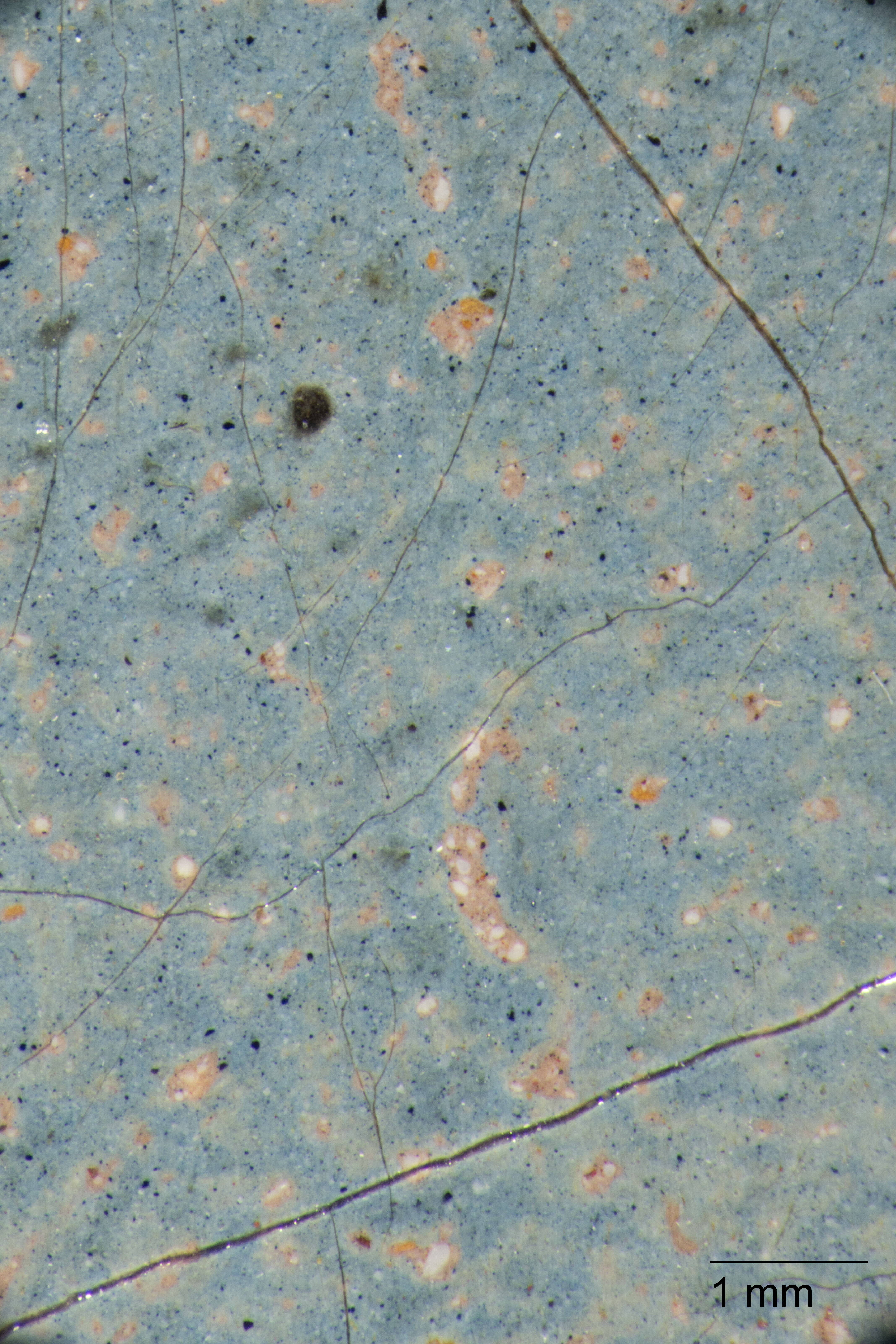
It is not entirely clear how the ground layer: An opaque preparatory layer applied to the support, either commercially or by the artist, to prevent absorption of the paint into the canvas or panel. See also priming layer. was applied or what the layer structure is. In many areas where the ground is visible, throughout much of the sky and some of the foreground, it appears to be a pale red-earth tone (Fig. 19). However, in the architecture and in many figures, there appears to be an off-white layer on top of the red-earth ground. It is possible that Pater applied a red-earth ground across the entirety of the canvas, while the off-white layer was used to block in the active parts of the composition.
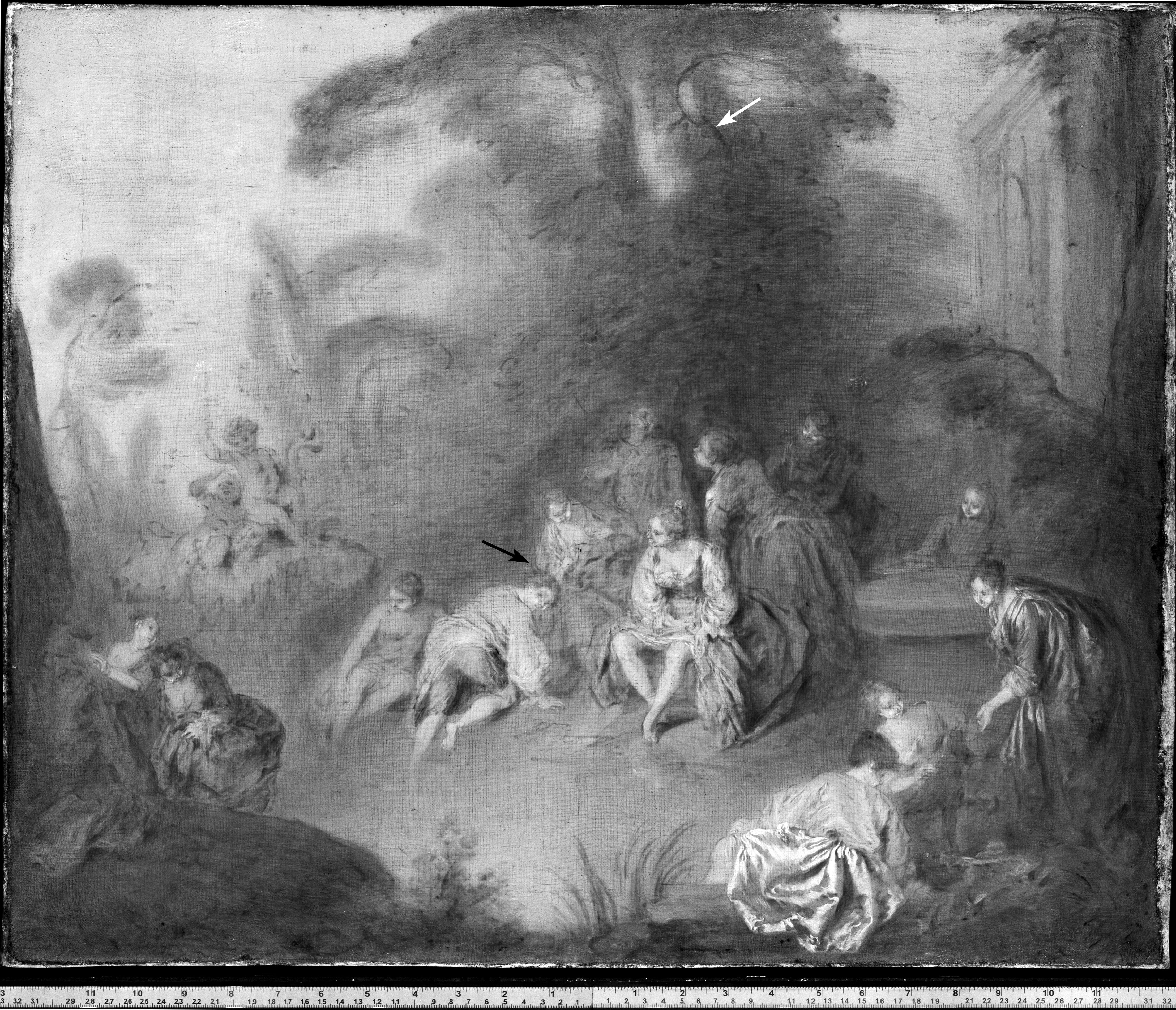
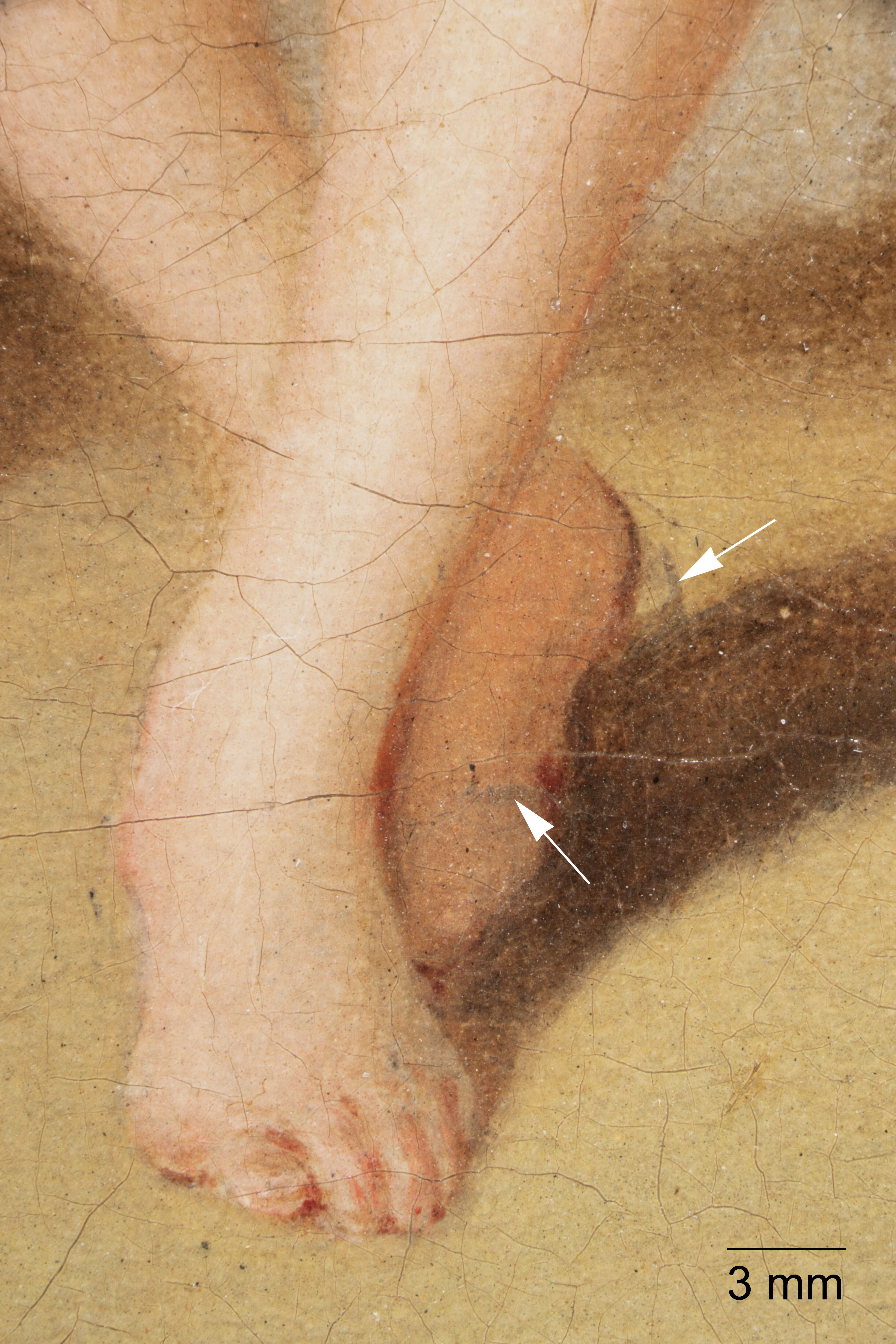
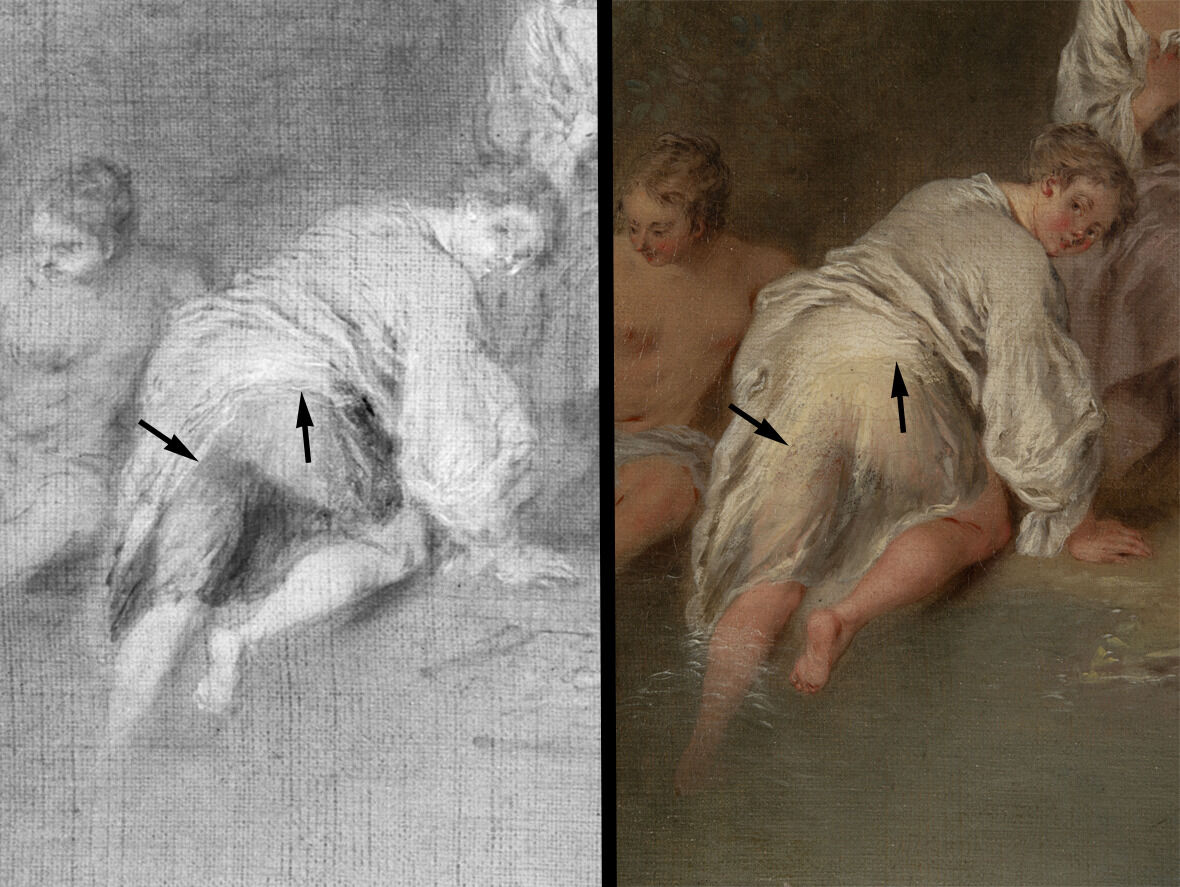
infrared reflectography (IRR): A form of infrared imaging that exploits the behavior of painting materials at wavelengths beyond those accessible to infrared photography. These advantages sometimes include a continuing increase in the transparency of pigments beyond wavelengths accessible to infrared photography (i.e, beyond 1,000 nanometers), rendering underdrawing more clearly. The resulting image is called an infrared reflectogram. Devices that came into common use in the 1980s such as the infrared vidicon effectively revealed these features but suffered from lack of sharpness and uneven response. Vidicons continue to be used out to 2,200 nanometers but several newer pixelated detectors including indium gallium arsenide and indium antimonide array detectors offer improvements. All of these devices are optimally used with filters constraining their response to those parts of the infrared spectrum that reveal the most within the constraints of the palette used for a given painting. They can be used for transmitted light imaging as well as in reflection. reveals that two methods were used when developing the underlying drawing. Within the background, both the trees and the tall arch were sketched using a fluid medium, likely applied by brush based on the variation of line thickness. In contrast, the drawing of the figures and much of the foreground was formed with fine lines of a dry medium such as charcoal (Fig. 20). Throughout the painting, due to the thin application of paint, some of these fine lines remain visible in standard light, such as around the central figure’s feet (Fig. 21).
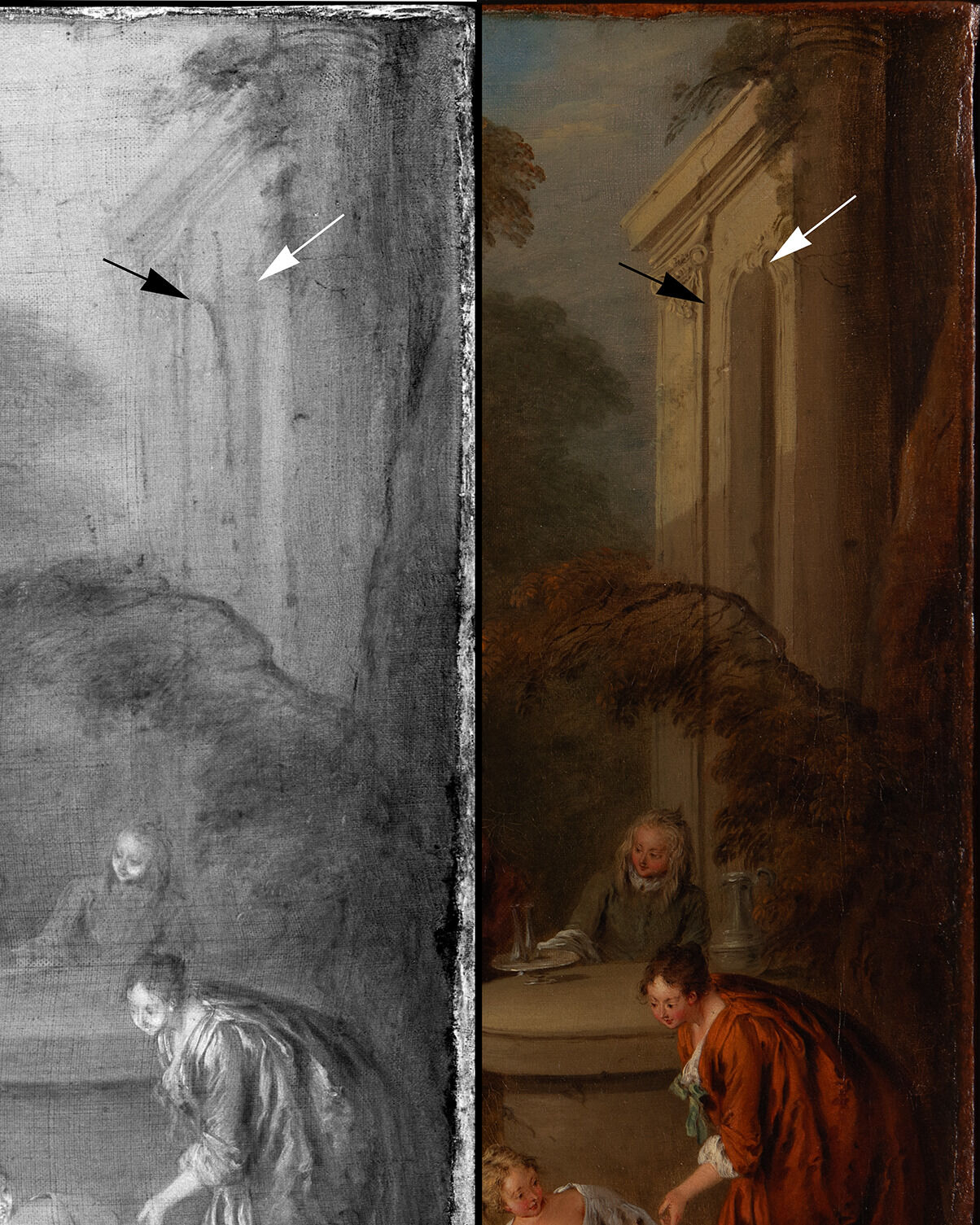
The underdrawing reveals that multiple changes were made by the artist using both types of media. The fluid underdrawing of the background confirms that the original location of the arch’s opening was shifted slightly to the left of where Pater ultimately painted it (Fig. 22). Within the figures, more adjustments were made, specifically with the orientation of some heads. The central figure who rises the tallest among the cluster of figures was shifted, as indicated by the oval that once marked the position of her head, with a horizontal line designating the brow placement. Additionally, the second figure from the left edge was also adjusted, with her head turning toward the water as opposed to the lower left corner (Fig. 23). It is possible that Pater made this latter modification to avoid repetitive poses in relation to the right-most figure and the seated central figure, each with their heads positioned in a similar manner.
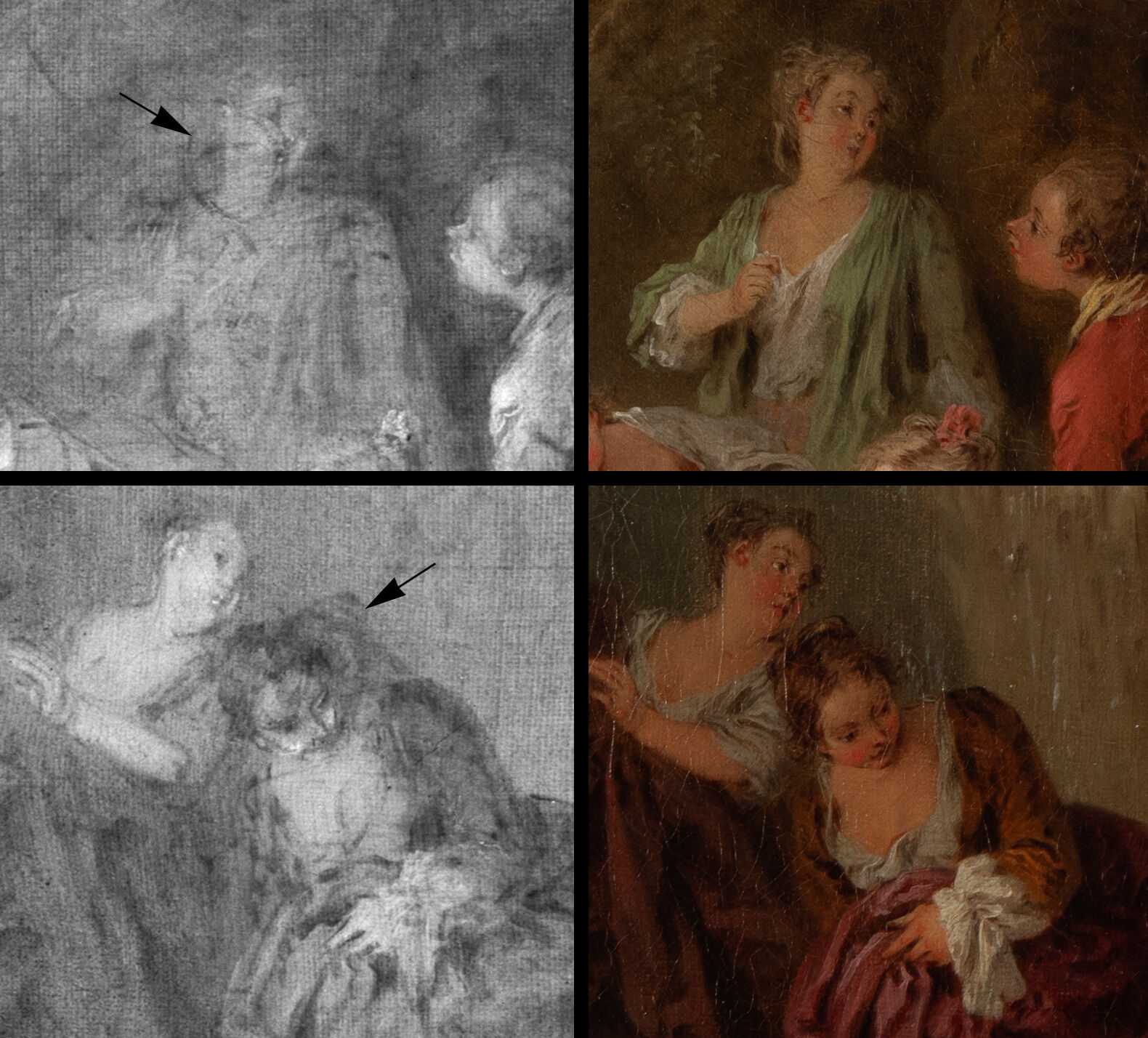
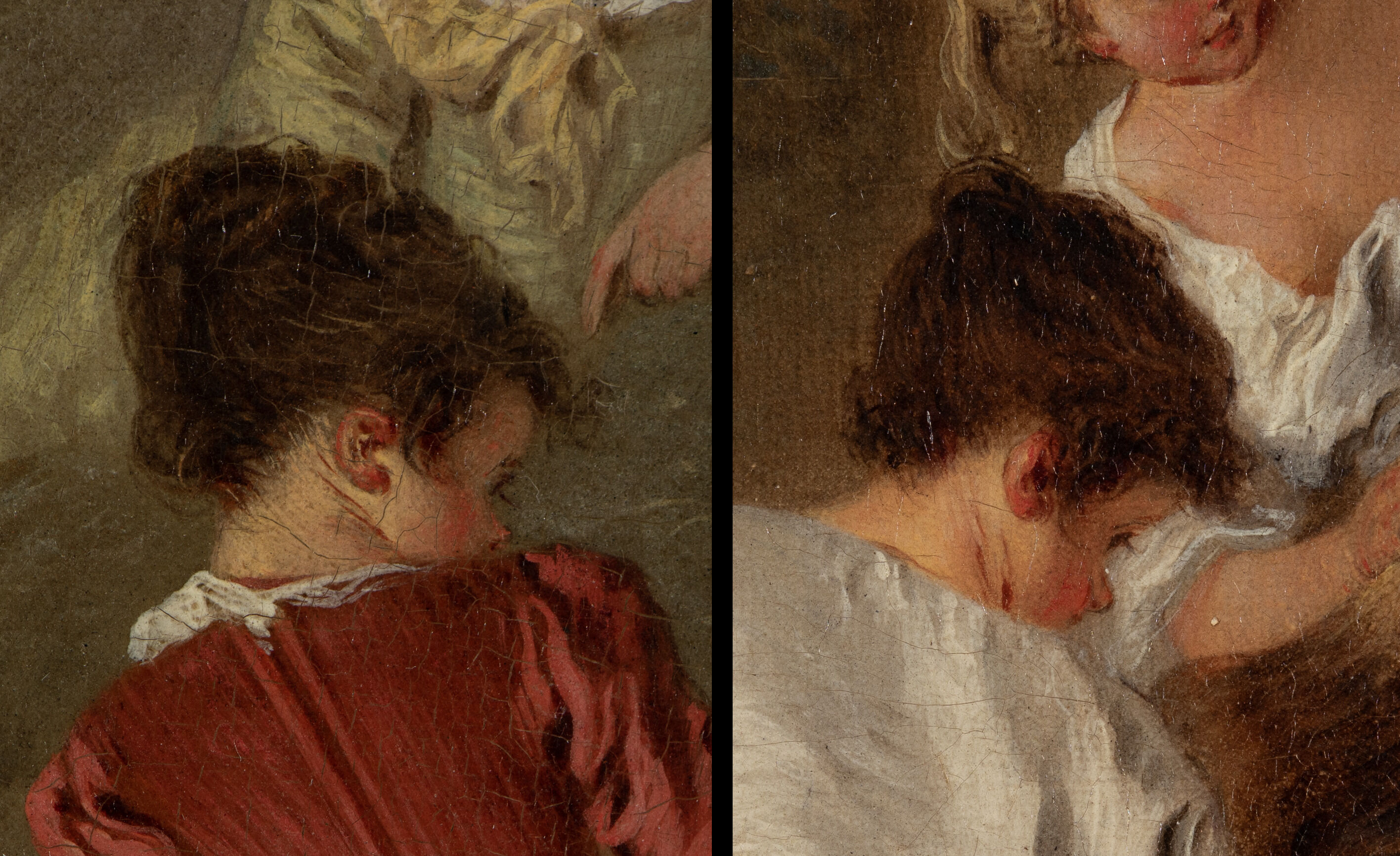
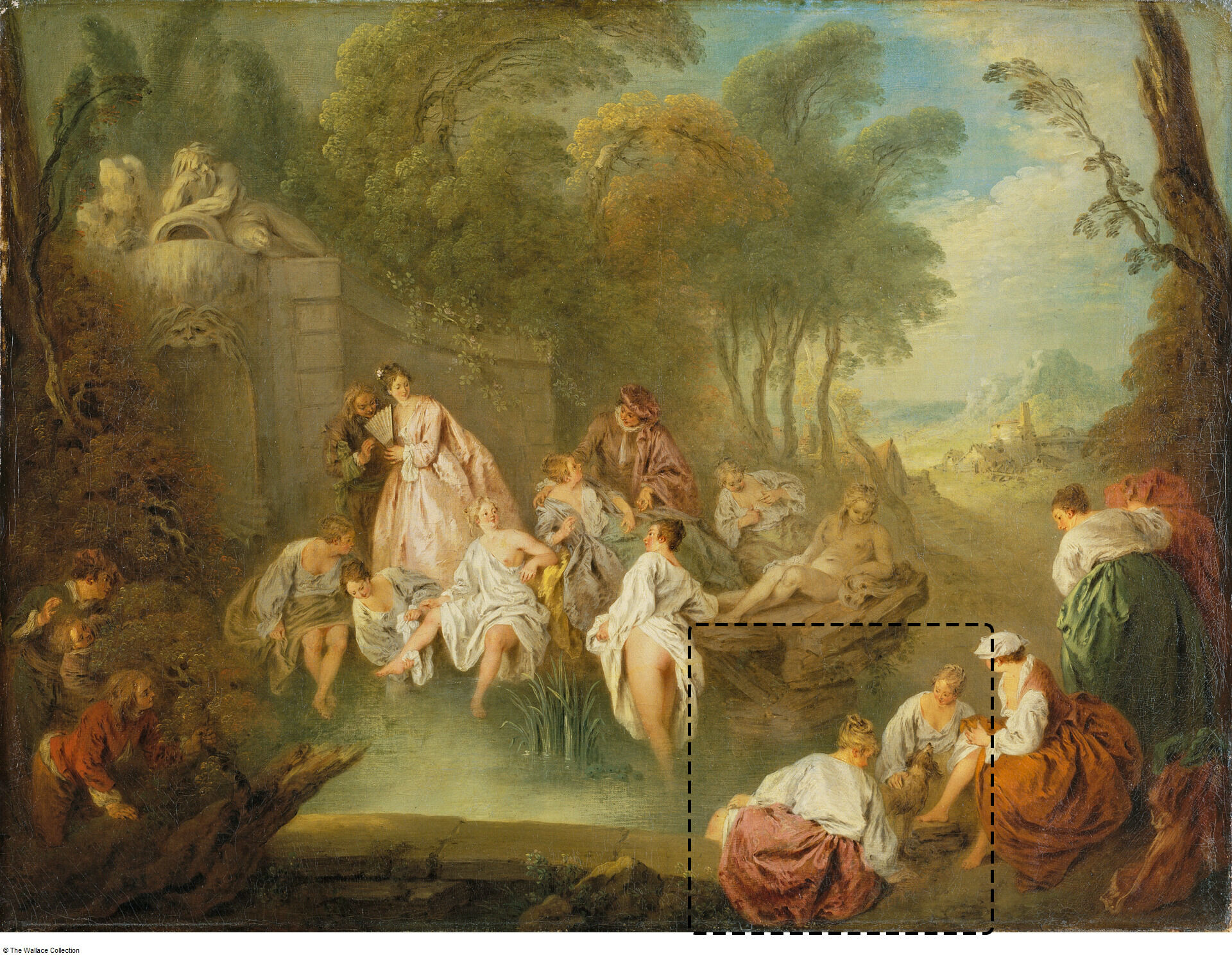
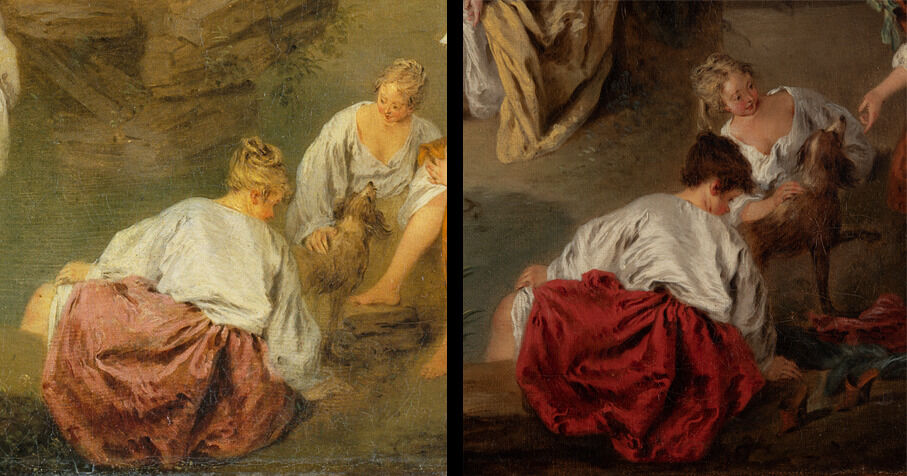
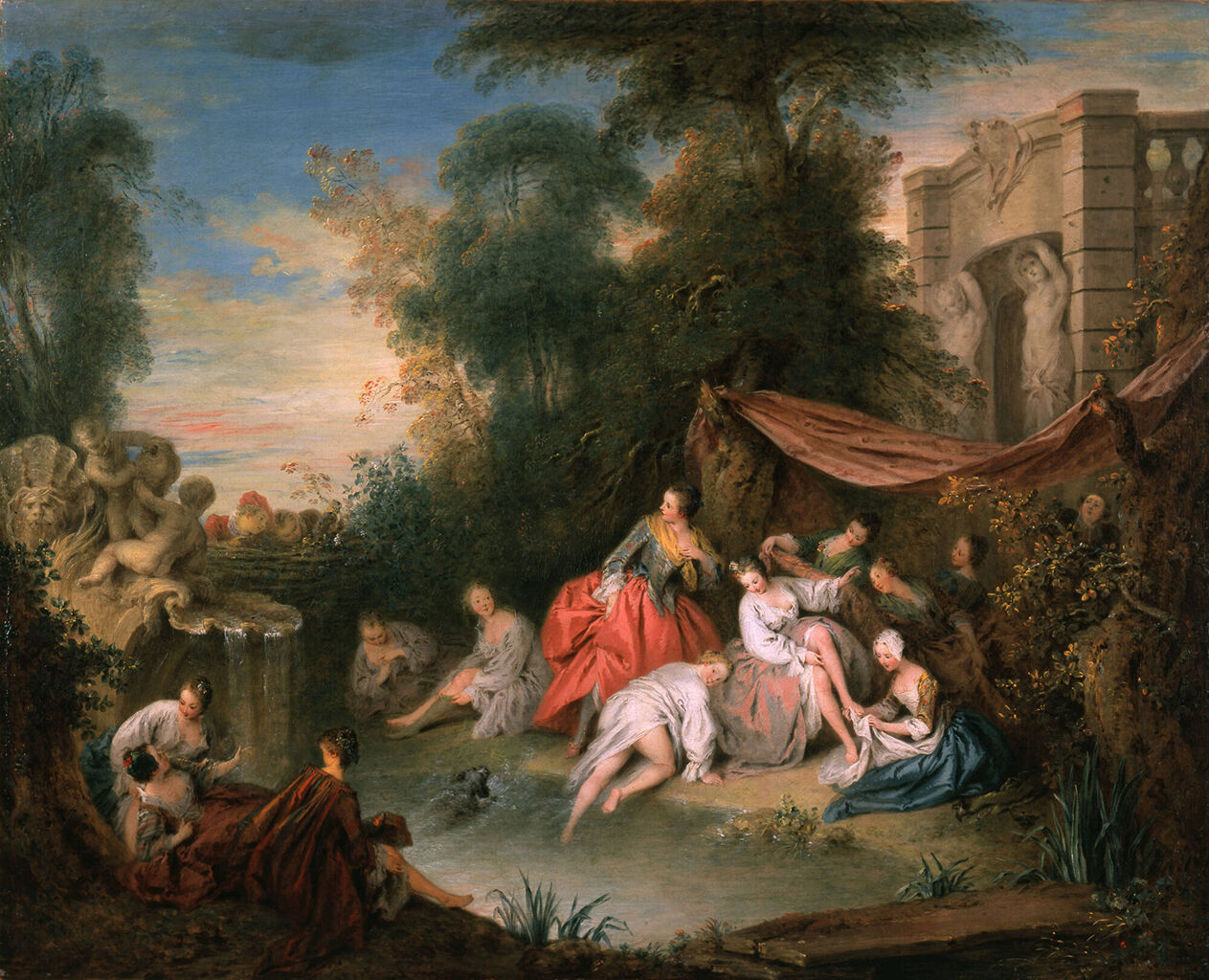
While these changes demonstrate that Pater continued to work out his composition into the painting stage, the artist was also known for his formulaic approach to figures and architecture. Frequently reusing figures between paintings, his work has been described as “a theme with few variations.”2David Wakefield, French Eighteenth-Century Painting (New York: Alpine Fine Arts Collection, 1984), 36. An example of this can be found in the Nelson-Atkins paintings. In The Bathers, the head of the figure closest to the foreground is also present in The Garden Party (1725–30), though in the latter, she is portrayed as a young girl, while in the former she appears to be an adult (Fig. 24). In the painting Bathing Party in a Park (Fig. 25), a similar group of figures in the lower right corner mimics the group found in the lower right corner of the Nelson-Atkins version, The Bathers. In this instance, however, the figure previously in question has light hair and a slightly different face (Fig. 26).
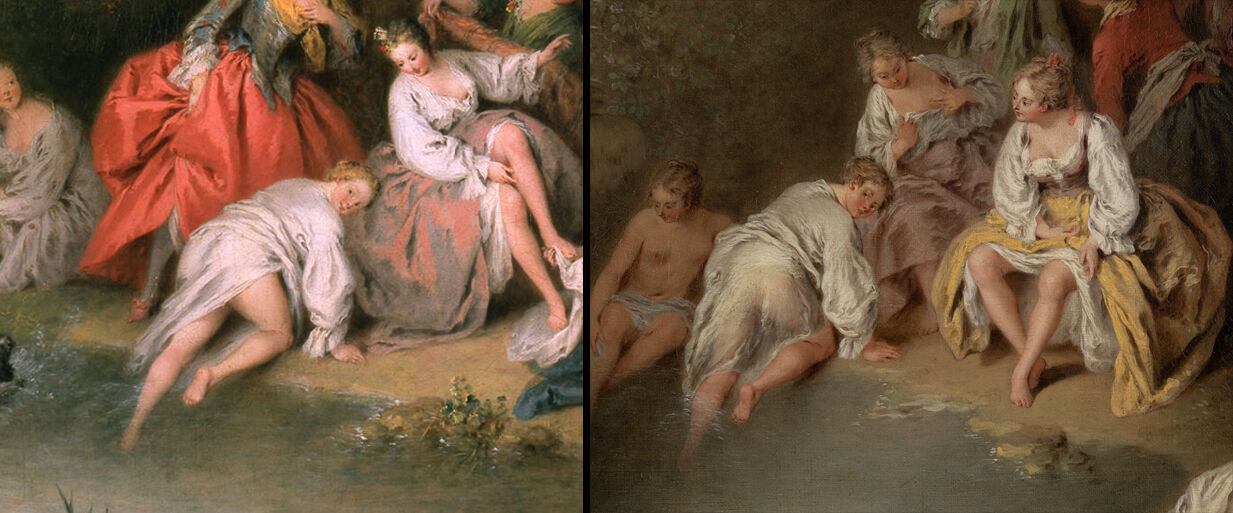
One change to the Nelson-Atkins composition that was
not made by the artist involves the central, kneeling
woman in white, who turns backwards to look toward the
viewer. As with other figures, she has also been
repeated in other paintings and can be found in
The Bathing Party (Fig. 27). However,
a notable difference exists in the depiction of the
lower portion of clothing, with the version in the
Toledo Museum of Art being slightly more revealing in
its length (Fig. 28).3Another similar variation of this figure more
closely resembling that of the Toledo Museum of
Art can be found in the collection of the
Birmingham Museum of Art:
Les Baigneuses (Female Bathers in a
Landscape), ca. 1735,
https://www.artsbma.org
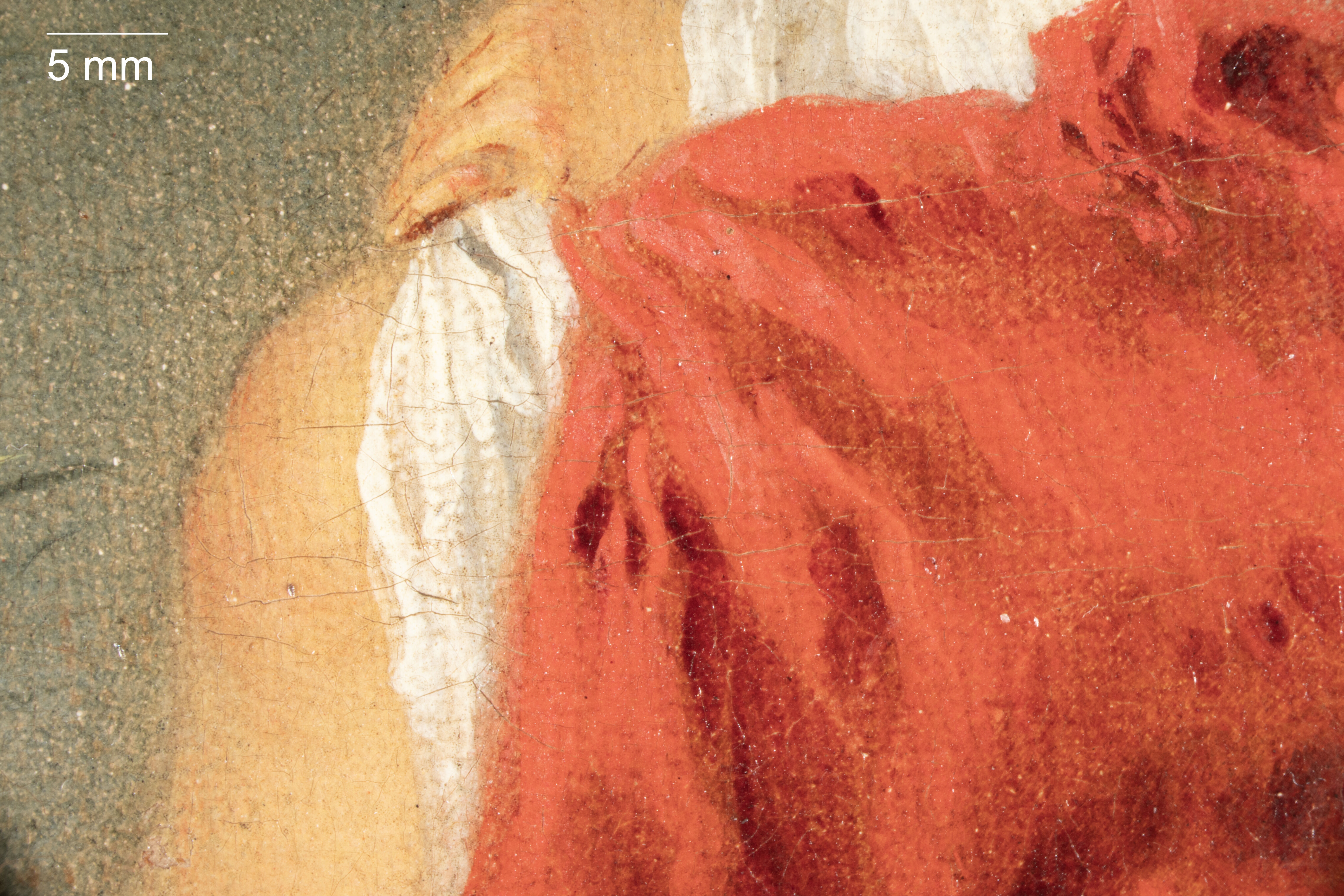
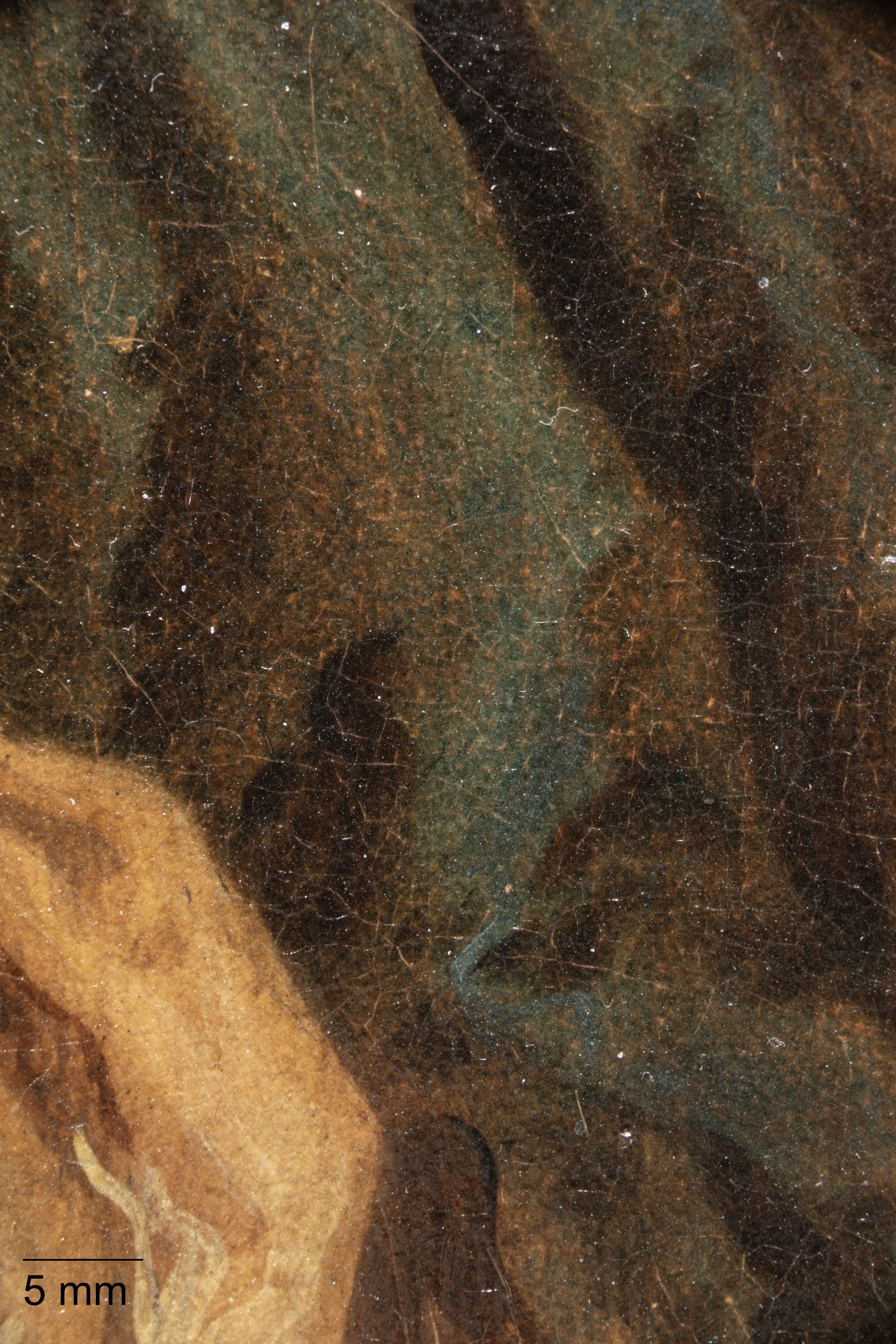
With active, loose brushwork and overall thin passages, the application of paint in The Bathers often resembles that of a painted sketch6Pater’s works are sometimes described as being “executed in the manner of a sketch,” partially because of the speed in which he was creating the repetitious imagery, as found in The Bathers. Patrick Ramade and Martin Eidelberg, Watteau et la fête galante, exh. cat. (Paris: Réunion des Musées Nationaux, 2004), 186. in comparison to the brushwork found on The Garden Party. The fabric, specifically that of the women’s skirts, was first blocked in with a thin wash, as is found in the figure nearest to the viewer. Here, the thin red wash remains clearly visible, and the texture of the canvas weave is prominent beneath it. Pater then added some deeper reds for shadows before adding an opaque red admixture to create folds and volume in the fabric (Fig. 30). To create the rich blue fabric for the skirt on the figure just right of center, a gray-brown wash was applied first, and then the folds were developed with black shadows and green-blue highlights (Fig. 31).
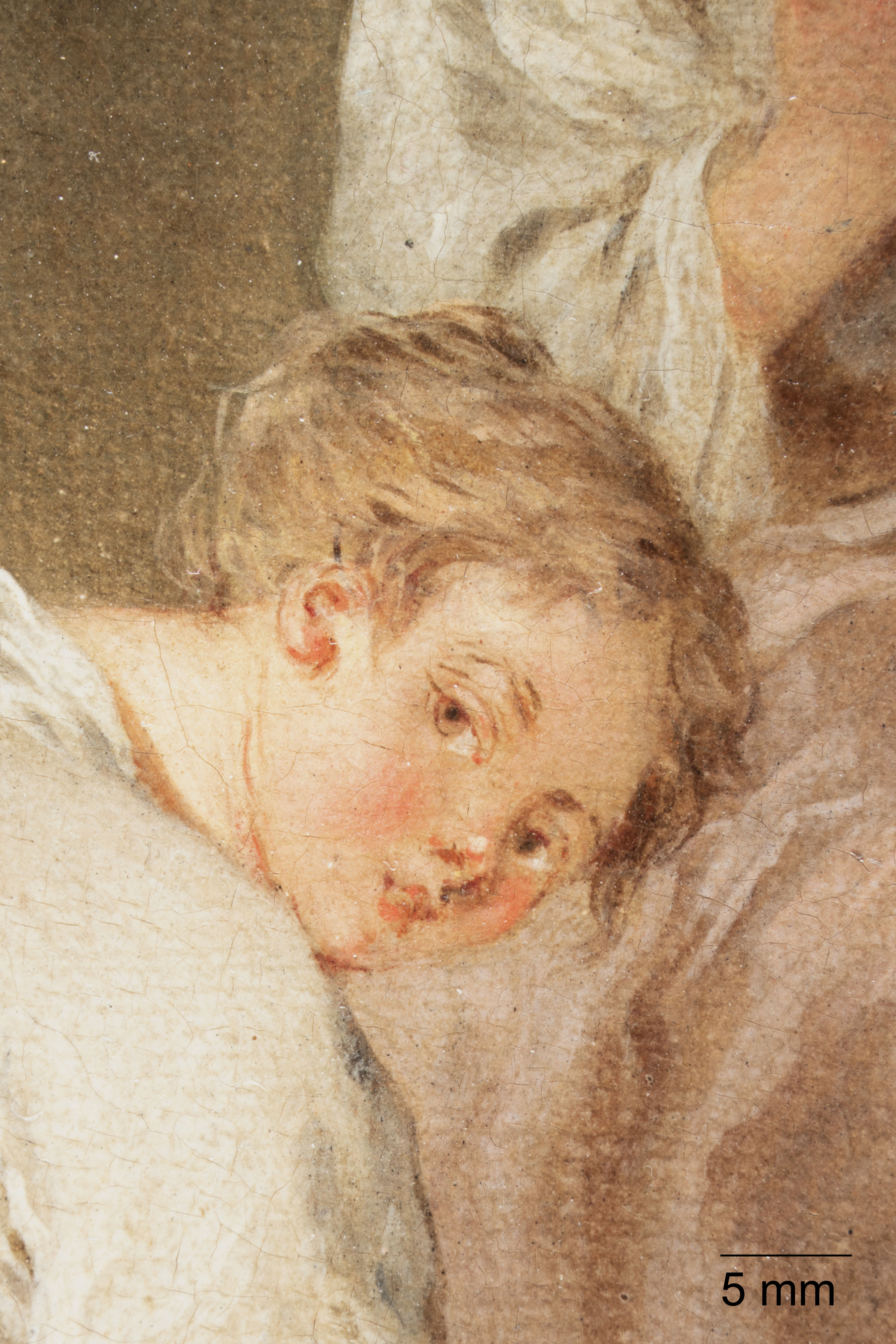
In contrast to the animated brushwork of the clothing, the figures’ heads were delicately painted with small brushes, sometimes producing lines as thin as one tenth of a millimeter. The features of the faces were formed with fine lines of brown and red paint, as is seen in the central kneeling figure (Fig. 32). Here the hair was constructed with short, thin brushstrokes, alternating highlights and shadows while allowing a lower brown wash to remain visible. Through the thinly painted hair, glimpses of underdrawing peek around the temple and ear, adding to the depth of the form.
The painting is in fair condition and has undergone multiple conservation campaigns. Likely early in its history, the painting was glue-paste lined, which appears to have extended the overall picture plane size by a few millimeters on each side. Though much of the translucency of the bathing scene is a result of the artist’s technique, abrasion: A loss of surface material due to rubbing, scraping, frequent touching, or inexpert solvent cleaning. is widespread across the painting. A few areas with small losses have been retouching: Paint application by a conservator or restorer to cover losses and unify the original composition. Retouching is an aspect of conservation treatment that is aesthetic in nature and that differs from more limited procedures undertaken solely to stabilize original material. Sometimes referred to as inpainting or retouch., with the majority of the restoration occurring along the edges and within the architecture in the proper left background.7Forrest R. Bailey, October 20, 1982, treatment report, NAMA conservation file, no. F82-35/2.
Notes
-
Former conservator Forrest Bailey speculated that portions of the original tacking margins may now extend onto the picture plane due to the slight increase in size; however, this is difficult to confirm due to the extensive fill material and retouching around the edges. In the radiograph, there are no clear tack holes visible to indicate that the tacking margins are present. Forrest R. Bailey, August 25, 1982, examination report, NAMA conservation file, no. F82-35/2.
-
David Wakefield, French Eighteenth-Century Painting (New York: Alpine Fine Arts Collection, 1984), 36.
-
Another similar variation of this figure more closely resembling that of the Toledo Museum of Art can be found in the collection of the Birmingham Museum of Art: Les Baigneuses (Female Bathers in a Landscape), ca. 1735, https://www.artsbma.org
/collection ./les-baigneuses-female-bathers-in-a-landscape/ -
Though the garment appears to be somewhat transparent, when comparing the painting today to the image reproduced in the 1928 catalogue raisonné, it appears this restoration has increased in transparency with age. Likely, it appeared more opaque and cohesive with the figure when it was first added. Florence Ingersoll-Smouse, Jean-Baptiste Joseph Pater: Biographie et catalogue critiques, l’œuvre complète de l’artiste (Paris: Les Beaux-arts, 1928), 121.
-
Pierre Schneider, The World of Watteau: 1684–1721 (New York: Time Incorporated, 1967), 76, 79–80.
-
Pater’s works are sometimes described as being “executed in the manner of a sketch,” partially because of the speed in which he was creating the repetitious imagery, as found in The Bathers. Patrick Ramade and Martin Eidelberg, Watteau et la fête galante, exh. cat. (Paris: Réunion des Musées Nationaux, 2004), 186.
-
Forrest R. Bailey, October 20, 1982, treatment report, NAMA conservation file, no. F82-35/2.
Documentation
Citation
Chicago:
Glynnis Napier Stevenson, “Jean-Baptiste Pater, The Bathers, 1728–30,” documentation in French Paintings and Pastels, 1600–1945: The Collections of the Nelson-Atkins Museum of Art, ed. Aimee Marcereau DeGalan (Kansas City: The Nelson-Atkins Museum of Art, 2025), https://doi.org/10.37764/78973.5.327.4033.
MLA:
Stevenson, Glynnis Napier. “Jean-Baptiste Pater, The Bathers, 1728–30,” documentation. French Paintings and Pastels, 1600–1945: The Collections of The Nelson-Atkins Museum of Art, edited by Aimee Marcereau DeGalan, Nelson-Atkins Museum of Art, 2025. doi: 10.37764/78973.5.327.4033.
Provenance
Eugène Secrétan (1836–1899), Paris, by March 1889–July 13, 1889 [1];
Purchased along with its pendant at his sale, Seventeen Ancient and Modern Pictures of the Highest Importance, Until Recently Forming Part of the Celebrated Secrétan Collection, Christie, Manson, and Woods, London, July 13, 1889, no. 4, erroneously as A Fete Champetre [sic], by Boussod, Valadon, et Cie., Paris, stock no. 19985 or 19986, as Fête champêtre, July 15–December 3, 1889 [2];
Purchased from Boussod, Valadon, et Cie., by Lacroix, Paris, December 3, 1889 [3];
Marcel Bernstein (1840–1896), Paris, by June 8, 1892–1896;
Inherited by his wife Ida Bernstein (née Seligman, 1854–1921), or by descent to his son, Henry Bernstein (1876–1953), Paris, 1896–1899;
Purchased from Ida Bernstein or Henry Bernstein by Ernest Gimpel, Paris, January 27, 1899–1901 [4];
Purchased from Gimpel by François “Ernest” Cronier (ca. 1840–1905), Paris, March 22, 1901–before August 27, 1905 [5];
Returned by Cronier to Ernest Gimpel and Wildenstein, as The Bath, before August 27, 1905–March 1906 [6];
Purchased from Ernest Gimpel and Wildenstein by John Woodruff (1850–1920) and Kate (née Seney, 1868–1943) Simpson, New York, March 1906–May 16, 1920 [7];
Purchased from the estate of John Woodruff Simpson by Wildenstein and Co., New York, stock no. 1007, 1921–September 14, 1982 [8];
Purchased from Wildenstein by The Nelson-Atkins Museum of Art, Kansas City, MO, 1982.
Notes
[1] Secrétan’s copper syndicate collapsed in March 1889. See email from Dr. Diana Kostyrko, Australian National University, to Meghan Gray, NAMA, April 6, 2017, NAMA curatorial files. Secrétan made his first acquisitions around 1876 but only began collecting old master paintings in 1880. Due to the generalized painting titles (like Fête champêtre) used in auction catalogues at the time, it is impossible to identify the museum’s painting prior to 1889. See email from Pamella Guerdat, PhD candidate at University of Neuchâtel, Switzerland, to Glynnis Stevenson, NAMA, August 11, 2021, NAMA curatorial files.
[2] The paintings were both titled A Fete Champetre in the 1889 Secrétan sales catalogue. See “Goupil et Cie/Boussod, Valadon, and Co. Stock Books, Series II. Galerie Boussod, Valadon Stock Books, 1875–1919, Livre no. 12, 1887–1891,” p. 115, stock no. 19985 or 19986, The Getty Research Institute, Los Angeles. The pair was purchased together, and it is not clear from the stock books which painting was assigned which stock number. They were reserved for the July 13, 1889, London sale of the collection by Secrétan’s English creditors. See email from Kostyrko to Gray, April 6, 2017, NAMA curatorial files.
[3] Several possibilities for “Lacroix” are French painter Tristán Lacroix (1849–1914), active in Argentina from the end of the nineteenth century [See María Isabel Baldasarre, “Buenos Aires: An Art Metropolis in the Late Nineteenth Century,” Nineteenth-Century Art Worldwide 16, no. 1 (Spring 2017): https://doi.org/10.29411/ncaw.2017.16.1.2]; Gaston Lacroix (1862–1909), an industrialist who lived at 104, avenue des Champs Elysées; or Gaston Lacroix, who earned his law degree in Toulouse in 1895. All three bought pictures from Boussod, Valadon, et Cie.
[4] Henry Bernstein’s biographers note that on January 27, 1899, either Henry or his mother Ida sold the Pater pendants to Gimpel. By this time, Henry and Ida were selling of parts of the collection created by Marcel Bernstein. Georges Bernstein Gruber and Gilbert Maurin, Bernstein, le magnifique: cinquante ans de théâtre, de passions et de vie parisienne (Paris: J. C. Lattès, 1988), 18.
[5] See René Gimpel, Diary of an Art Dealer (New York: Farrar, Straus, and Giroux, 1966), 305–06. Cronier returned the Pater pendants to Gimpel sometime before his suicide and estate sale in 1905. See email from Kostyrko to Gray, April 6, 2017, NAMA curatorial files.
[6] Gimpel went into business with Nathan and Ernest Wildenstein, and they opened their New York branch in 1902. See email from Kostyrko to Gray, April 6, 2017, NAMA curatorial files.
[7] See email from Joseph Baillio, Senior Vice President, Wildenstein and Company, to Meghan Gray, NAMA, November 9, 2016, NAMA curatorial files.
[8] See email from Baillio to Gray, November 9, 2016, NAMA curatorial files. In the Pater catalogue raisonné by Ingersoll-Smouse, the paintings are listed as in the collection Mrs. John Woodruff Simpson (née Katherine “Kate” Seney, 1868–1943), New York. See Florence Ingersoll-Smouse, Pater (Paris: Les beaux-arts, Édition d’études et de documents, 1928), no. 51, pp. 42, 120. Simpson often lent the paintings to exhibitions in New York, including in 1915 at the Benjamin Altman Gallery. Katherine Seney Simpson and her daughter, Jean Walker Simpson (1897–1980), inherited the bulk of the Woodruff estate and likely facilitated the sale of art to Wildenstein.
Exhibitions
Cents Chefs-d’œuvre des collections françaises et étrangères, Galerie Georges Petit, Paris, June 8–July 29, 1892, no. 32, as Le Bain.
Loan Exhibition of Fifty-nine Masterpieces of Ancient and Modern Schools, Benjamin Altman Gallery, New York, March 24–April 4, 1915, no. 39, as Le Bain.
Exposition Rococo: poésie et rêve de la peinture française au XVIIIe siècle, Otani Museum, Nishinomiya, Japan, January 14–February 12, 1978, no. 4, as Les Baigneuses.
Intimate Encounters: Love and Domesticity in Eighteenth-Century France, Hood Museum of Art, Dartmouth College, Hanover, NH, October 4, 1997–January 4, 1998; The Toledo Museum of Art, OH, February 15–May 10, 1998; The Museum of Fine Arts, Houston, May 31–August 23, 1998, no. 8, as The Bathers.
References
Possibly Tableaux anciens et modernes. . . .: catalogue de la collection de feu M. le duc de B[ojano] (Paris: Hôtel Drouot, January 19–20, 1882), 24, as Les plaisirs champêtres or Conversation galante.
F. G., “Galerie Sécretan,” Le Gaulois, no. 2500 (July 3, 1889): 2, as Fête champêtre or seconde Fête champêtre.
“The Secretan [sic] Sale,” Times (London), no. 32,741 (July 3, 1889): 7.
“Seventeen Secrétan Pictures,” Times (London), no. 32,746 (July 9, 1889): 11.
Catalogue of Seventeen Ancient and Modern Pictures of the Highest Importance, Until Recently Forming Part of the Celebrated Secrétan Collection (London: Christie, Manson, and Woods, July 13, 1889), B2, as A Fete Champetre [sic].
Frederick Wedmore, “The London Group of Secretan [sic] Pictures,” Academy, no. 897 (July 13, 1889): 27.
F. G., “La Vente Secrétan a [sic] Londres,” Le Gaulois, no. 2503 (July 14, 1889): 2, as Fête champêtre près d’une pièce d’eau.
L. K., “At the Secretan [sic] Sale: Scenes and Incidents of the Great Occasion,” New York Times 38, no. 11,817 (July 14, 1889): 5.
“Fine Pictures and Big Prices: The Secretan [sic] Pictures,” British Architect 32 (July 19, 1889): 52, as Fêtes Champêtre.
“Sales,” Athenaeum, no. 3221 (July 20, 1889): 104, as Fête Champêtre.
Montezuma, “My Note Book,” Art Amateur 21, no. 4 (September 1889): 66, as Fête Champêtre.
George Lafenestre and Léon Roger-Milès, Cents Chefs-d’Œuvre des Collections Françaises et Étrangères (Paris: Georges Petit, 1892), 19, 65–66, 152, (repro.), as Le Bain.
Exposition de Peinture: Cent Chefs-d’œuvre des Écoles Françaises et Étrangères (Deuxième Exposition), exh. cat. (Paris: George Petit, 1892), 36, as Le Bain.
W. Roberts, Memorials of Christie’s: A Record of Art Sales from 1766 to 1896 (London: G. Bell and Sons, 1897), 2:140.
Georges Lafenestre, Artistes et Amateurs (Paris: Société d’Édition Artistique, 1900), 315, as le Bain.
Loan Exhibition of Fifty-nine Masterpieces of Ancient and Modern Schools, exh. cat. (New York: Benjamin Altman Gallery, 1915), unpaginated, as Le Bain.
“Year’s Best Show of Art for War Aid: Owners of More Than 50 Masterpieces Join Exhibition at Altman Gallery,” New York Times 64, no. 20,878 (March 24, 1915): 11.
“A Magnificent Loan Exhibition: Masterpieces of Eighteenth Century French Art on View at the Residence of the Late Benjamin Altman,” New York Times 64, no. 20,882 (March 28, 1915): SM22, as Le Bain.
Guy Pène du Bois, “Mistresses of Famous American Collectors: The Collection of Mrs. John W. Simpson,” Arts and Decoration (March 1917): 234, 236, as Les Baigneuses.
Florence Ingersoll-Smouse, Pater (Paris: Les beaux-arts, Édition d’études et de documents, 1928), no. 318, pp. 62, 121, (repro.), as Baigneuses.
Jean Robiquet, La femme dans la peinture française, XVe–XXe siècle (Paris: Les Éditions Nationales, 1938), (repro.), as Les Baigneuses.
René Gimpel, Diary of an Art Dealer (New York: Farrar, Straus, and Giroux, 1966), 301, 305–06, as The Bath.
Didier Romand, “La Cote des peintres: peintures,” Gazette de l’Hôtel Drouot, no. 42 (December 8, 1972): 19, as Baigneuses.
Exposition Rococo: poésie et rêve de la peinture française au XVIIIe siècle, exh. cat. (Nishinomiya, Japan: Otani Museum, 1978), unpaginated, as Les Baigneuses.
“New Acquisitions,” Gallery Events (The Nelson-Atkins Museum of Art) (November 1982): unpaginated, as Les Baigneuses or The Bathing Party.
Donald Hoffmann, “Pater oils grace museum collection,” Kansas City Star 103, no. 43 (November 7, 1982): 9-I, (repro.), as Les Baigneuses.
Bill Marvel, “How good is the Nelson?” STAR Magazine, supplement, Kansas City Star 103, no. 186 (April 24, 1983): S26.
John Russell, “Art View: A Panoramic View of A French Master of Still Lifes,” New York Times 132, no. 45,756 (July 31, 1983): H25.
Donald Hoffmann, “Art journal: More about Oudry,” Kansas City Star 103, no. 292 (August 28, 1983): 8E.
Roger Ward, ed., A Bountiful Decade: Selected Acquisitions, 1977–1987, exh. cat. (Kansas City, MO: Nelson-Atkins Museum of Art, 1987), 122, as Les Baigneuses.
Georges Bernstein Gruber and Gilbert Maurin, Bernstein, le magnifique: cinquante ans de théâtre, de passions et de vie parisienne (Paris: J. C. Lattès, 1988), 18.
Gloria Groom, Edouard Vuillard, Painter-decorator: Patrons and Projects, 1892–1912 (New Haven, CT: Yale University Press, 1993), 238n18.
Alice Thorson, “Traveling treasures: Some gallery favorites to go on tour as Nelson gears up for expansion,” Kansas City Star 118, no. 87 (December 13, 1997): E2.
Richard Rand, Intimate Encounters: Love and Domesticity in Eighteenth-Century France, exh. cat. (Hanover, NH: Hood Museum of Art, Dartmouth College, 1997), 101–03, (repro.), as The Bathers.
Emmanuel Bénézit, Dictionnaire critique et documentaire des peintres, sculpteurs, dessinateurs, et graveurs de tous les temps et de tous les pays (Paris: Gründ, 2006), 10:988, as Fêtes champêtres.
Deborah Emont Scott, ed., The Nelson-Atkins Museum of Art: A Handbook of the Collection, 7th ed. (Kansas City, MO: Nelson-Atkins Museum of Art, 2008), 89, (repro.), as Les Baigneuses.
Diana Kostyrko, The Journal of a Transatlantic Art Dealer: René Gimpel 1918–1939 (London: Harvey Miller, 2017), 153–54, as Les Baigneuses.
Christel H. Force, ed., Pioneers of the Global Art Market: Paris-Based Dealer Networks, 1850–1950 (London: Bloomsbury Visual Arts, 2020), 241n6, as Le Bain.