Catalogue Entry
Citation
Chicago:
Joseph Baillio, “Attributed to Rose Adélaïde Ducreux, Portrait of Marie Thérèse Diane Andrault (née Maignard de la Vaupalière, 1768–90), Comtesse de Langeron, ca. 1790,” catalogue entry in French Paintings and Pastels, 1600–1945: The Collections of the Nelson-Atkins Museum of Art, ed. Aimee Marcereau DeGalan (Kansas City: The Nelson-Atkins Museum of Art, 2024), https://doi.org/10.37764/78973.5.404.5407.
MLA:
Baillio, Joseph. “Attributed to Rose Adélaïde Ducreux, Portrait of Marie Thérèse Diane Andrault (née Maignard de la Vaupalière, 1768–90), Comtesse de Langeron, ca. 1790,” catalogue entry. French Paintings and Pastels, 1600–1945: The Collections of The Nelson-Atkins Museum of Art, edited by Aimee Marcereau DeGalan, Nelson-Atkins Museum of Art, 2024. doi: 10.37764/78973.5.404.5407.
The subject of this three-quarter-length portrait of a young woman is the comtesse de Langeron, born Marie Thérèse Diane Maignard de la Vaupalière on June 1, 1768. She was the elder of the two daughters of Charles Étienne Pierre Marie Maignard, marquis de la Vaupalière,1Early in his military career, Maignard (1731–1816) had been captain in the cavalry unit, the régiment de Piémont. He purchased the rank of cornet in the first company of royal musketeers upon the retirement of the comte du Roure. He progressively ascended in the ranks, becoming lieutenant of the company in 1767. That same year, he was made brigadier in the armies of the king as well as lieutenant of the mousquetaires gris (an élite cavalry company of two hundred noblemen created in 1622 by Louis XIII). a native of Rouen, and his wife, Diane Jacqueline Josèphe Henriette de Clermont d’Amboise.2Diane Jacqueline Josèphe Henriette was the widow of Marie François Auguste Goyon de Matignon, comte de Gacé (1731–63), with whom she had one son, Louis Charles Auguste Goyon de Matignon, comte de Gacé (1755–73). On the Gacé lineage and its relationship with the Vaupalière and Balleroy families, see “Gace,” Website of Mériadec de Goyon-Matignon, accessed August 2011, http://meriadecdegouyon.com/gace.html. Diane de Langeron was descended on her mother’s side from the Stuart kings of England, albeit through illegitimate issue. The grandparents of the comtesse de Langeron were the comte and comtesse Jean-Baptiste Louis Clermont d’Amboise; the comtesse, née Henriette de FitzJames, was the daughter of James FitzJames, duke of Berwick, by his second wife, Anne Bulkeley, and was the granddaughter of King James II and his mistress Arabella Churchill. The comtesse de Langeron’s younger sister Albertine lived from 1770–1800. Her father, who was seriously addicted to gambling,3The marquis’s uncontrollable gambling habit was becoming so injurious to his financial affairs that on New Year’s Day of 1777, his wife presented him with a beautiful box in which he could store his markers and chips. Inserted into the box were miniature portraits of herself and her two daughters, inscribed “Think of us.” In a book of annotated letters published in 1879, Maurice Tourneux wrote the following about her predicament: “Malgré cette heureuse idée et malgré les réflexions de M. Dusaulx sur le jeu, je croie qu’on a joué cet hiver avec plus de fureur que jamais” (Despite this happy idea and despite Mr. Dusaulx’s thoughts on the game, I believe that we played this winter with more fury than ever). Maurice Tourneux, ed., Correspondance littéraire, philosophique, et critique par Grimm, Diderot, Raynal, Meister, etc. (Paris: Garnier, 1879), 11:410. was a high-ranking officer in the cavalry brigade and the mousquetaires gris (gray musketeers) and was attached to the household of Louis Philippe I, duc d’Orléans. In 1784, Diane and her younger sister, Albertine, were presented at the court of Louis XVI (r. 1774–92).
The comely, blue-eyed young woman is dressed in a
long-sleeved white gown, with vertical stitching
around the bodice that creates a ribbed effect.4A dress of a similar style, belonging to Madame
Oberkampf, the co-founder of Musée de la Toile de
Jouy, is dated to 1785–89:
Chemise à la reine, Musée de la Toile de
Jouy, Jouy-en-Josas, France. To learn more about
these types of dresses, see Anne Bissonnette, “The
Chemise Dress,”
Dress and Historical Escapism: The Dress
Research Exhibition Series; Part 1 of 3
(June 30, 2020–June 30, 2021),
http://clothingtextiles
Behind the table stands the splendid, stave-back ebony wood harp with a richly ornamented and gilded head scroll (volute). The instrument may have been made by Georges Cousineau and his son Jacques Georges Cousineau (1760–1824), Parisian harp-makers (facteurs or luthiers) to Queen Marie Antoinette.7Marie Antoinette was an accomplished harpist. Her interest and proclivity on this instrument made it incredibly popular at court. The author is extremely grateful to Florence Gétreau, director of the Institut de Recherche sur le Patrimoine Musical at France’s Centre National de la Recherce Scientifique (CNRS), for her enlightening comments on the comtesse de Langeron’s harp, which she formulated in consultation with Joël Dugot, curator of the Musée de la Musique in Paris and director of the journal Musique ancienne, luthier d’art. Although not visible in the painting, a distinctive feature of this instrument is its pedal mechanism à béquilles (right-angled metal levers), which was perfected around 1780 by Georges Cousineau and his son Jacques Georges Cousineau. Pairs of béquilles were operated by seven pedals that leave the strings in plane; when a pedal was depressed, one lever would turn clockwise and the other counterclockwise, providing a firm grip on the strings and raising the pitch. This invention replaced the more cumbersome hook or crochet strumming mechanisms and expanded the chromatic capabilities of the instrument. This was the type of harp for which Amadeus Mozart wrote his Concerto for Flute, Harp, and Orchestra in C Major (K.299) (1778). The soundboard of the comtesse de Langeron’s harp is decorated with a bouquet of flowers and leaves, which were probably painted on the harp in tempera on a white ground rather than on the bare wood; this is an unusual feature in harps of the period. A sumptuous gilded pedal harp by Cousineau le père dating from ca. 1785 is in the Victoria and Albert Museum, London (Fig. 1), and a considerably less ornate example is in the Horniman Music Gallery, London (acc. no. 3979).8Like Madame de Langeron’s harp, its soundboard is painted with a cluster of flowers.
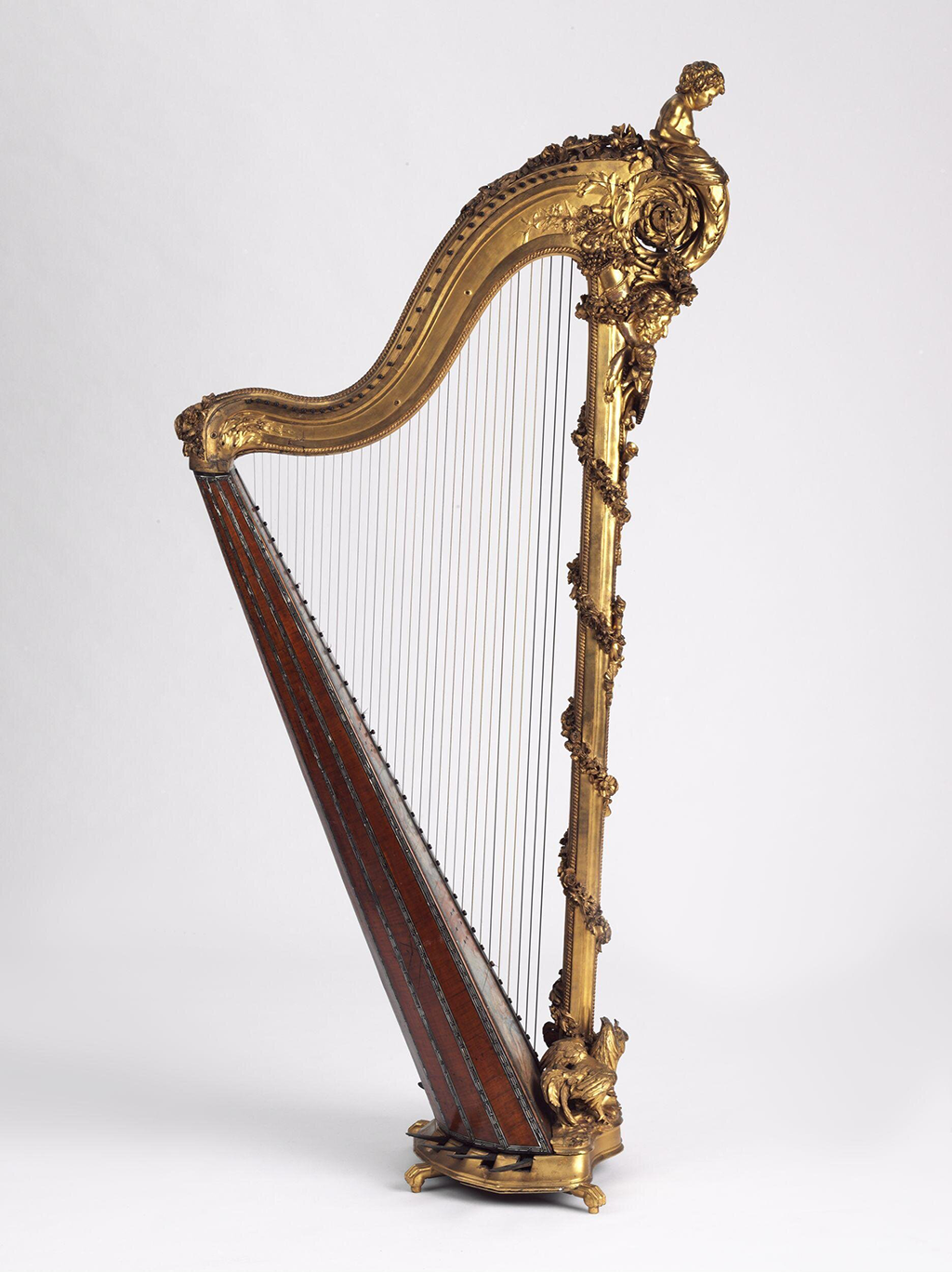
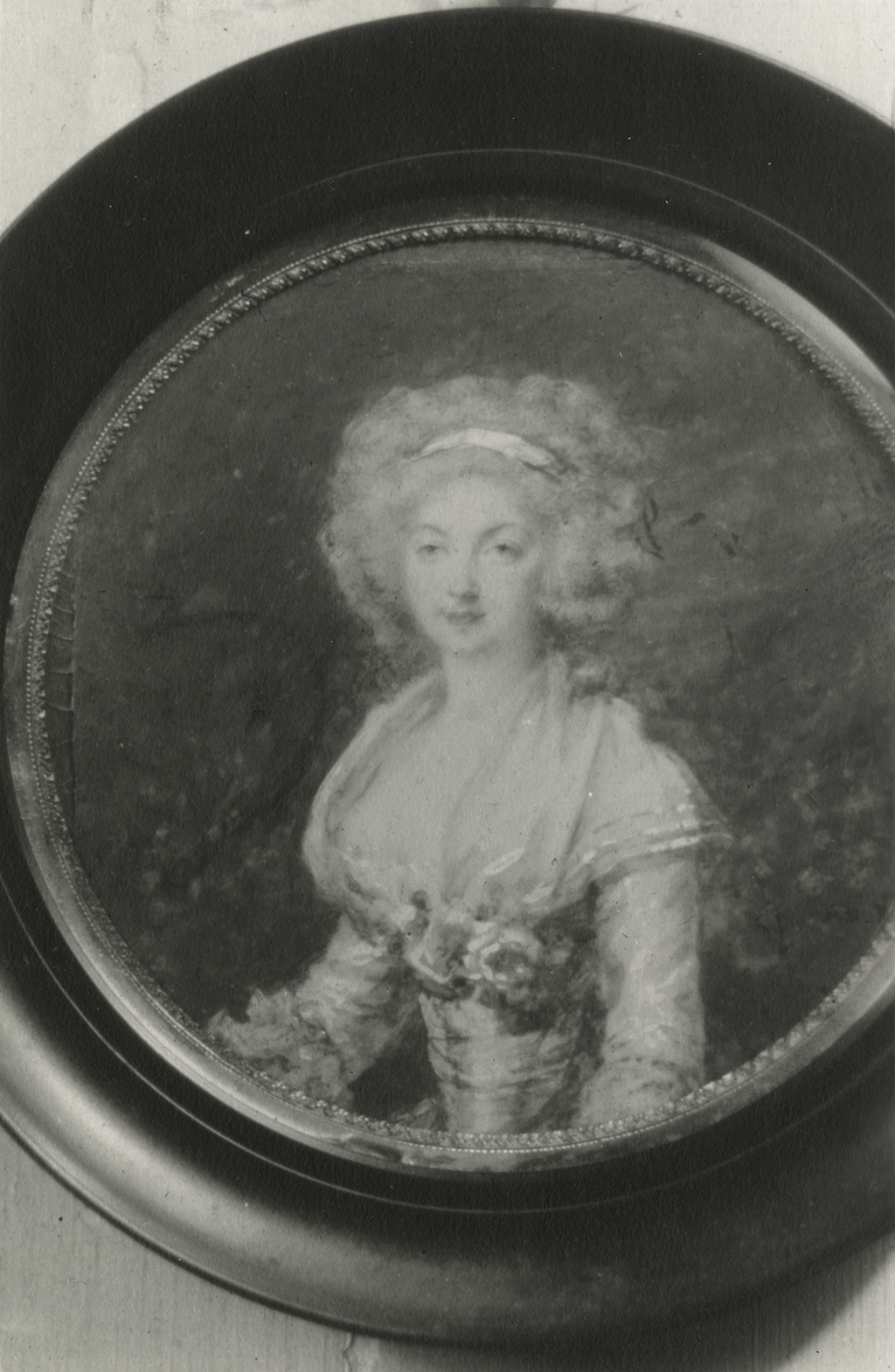
The iconography of the comtesse de Langeron includes
several anonymous copies (see list of related works
below) and a miniature portrait last recorded in the
collection of her great-great-nephew, the marquis de
Balleroy (Fig. 2). There also exist a bust-length
likeness of her in miniature9Reproduced in Joseph-Raymond Fournier-Sarlovèze,
Les Peintres de Stanislas-Auguste II, roi de
Pologne
(Paris: Librairie de l’art ancien et moderne,
1907), 103.
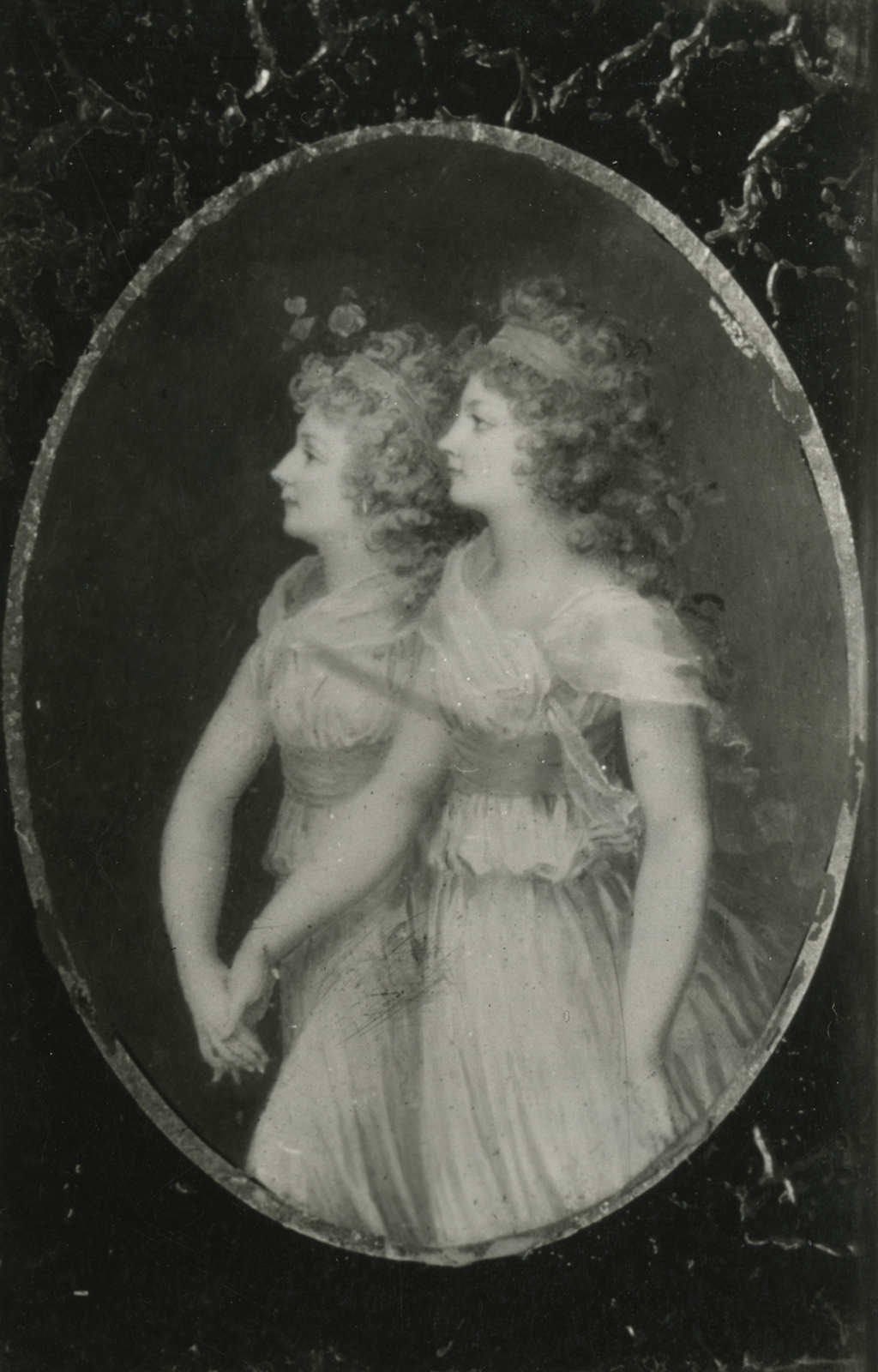
and an oval miniature in which she and her sister
Albertine, wearing diaphanous, neoclassical dresses,
are shown in profile as if they are walking (Fig.
3).10Fournier-Sarlovèze,
Les Peintres de Stanislas-Auguste II,
106–07. This may be the portrait that was engraved
by C. Pfeiffer (possibly Carl Hermann Pfeiffer
[1769–1829]); see Anatole-Louis-Théodore-Marie
Granges de Surgères and Gustave Bourcaud,
Les Françaises du XVIIIe siècle, portraits
gravés
(Paris: E. Dentu, 1887), 147–48, where the authors
state that the oval original on which the print is
based is in the Musée du Louvre. A very similar
double portrait in miniature depicts Georgiana
Cavendish, duchess of Devonshire, and her friend
Lady Elizabeth Foster, in profile and attired in
neoclassical dresses, which was painted in Paris
in November 1791 by one of David’s pupils, Jean
Urbain Guérin (1761–1836):
Georgiana, Duchess of Devonshire, and Lady
Elisabeth Foster, watercolor on ivory, oval: 3 3/4 x 2 3/4 in.
(9.5 x 7 cm), Wallace Collection, London, M177,
https://wallacelive
Diane and her sister, Albertine, were both born in Paris and spent most of their youth and early adulthood in the Hôtel de la Vaupalière, a townhouse built between 1767 and 1775 by the architect Louis-Marie Colignon (d. 1794), who in 1769 leased it to their parents. The three large buildings and the garden folie of this elegant residence, some of which has survived more or less unchanged, occupied a large, landscaped property that extended from the Grande rue du Faubourg Saint-Honoré to the Champs Elysées.11The original address of the Hôtel de la Vaupalière was 79, Faubourg Saint-Honoré; today the building bears the number 85 on the rue du Faubourg Saint-Honoré and 25 on the avenue Matignon. After 1789, when the hôtel was deserted by the De la Vaupalière family, Collignon allowed it to serve as a popular restaurant and café. In 1812, it was sold to comte Pierre Louis de Roederer. Its subsequent occupants were Comte Charles Lehon (1792–1868), who in 1831 was appointed Belgian ambassador to France. Today it serves as the headquarters of the AXA insurance group. See Valérie Bougault, “La Vaupalière, une demeure hors du temps,“ Connaissance des Arts, no. 663 (September 2008): 150–55.
On March 29, 1784, the marquis de Bombelles, France’s ambassador to Portugal, noted in his journal:
I ended the day at the home of Mme de La Vaupalière, where people had gathered to congratulate her for having arranged the two marriages. Her daughters will both be wed on the same day and at the same time, and the friends of La Vaupalière are all astonished to see how, without diminishing the splendor of the house, while even increasing his expenses (as he plans to take care of the newlywed couples there), he adds to those costs by giving thirty thousand livres in annual income divided between the two daughters. The older, who is marrying M. de Langeron, is tall and rather irreverent; the younger is short and pudgy; her husband, M. de Balleroy, is also not very tall, with a good complexion, and plump.12“Je suis venu finir la journée chez Mme de La Vaupalière, où l’on s’était assemblé pour la féliciter sur la conclusion de ses deux mariages. Ses filles seront mariées le même jour et à la même heure et les amis de La Vaupalière sont tous étonnés de voir que, sans rien diminuer de l’éclat de la maison, en augmentant même la dépense (puisqu’il va garder chez lui les deux nouveaux ménages), il puisse ajouter à ces charges celles de donner au même instant trente mille livres de rentes partagées entre ses deux filles. L’aînée, qui épouse M. de Langeron, est grande et assez leste; la cadette est petite et rondelette; son mari, M. de Balleroy, est aussi peu grand, frais et grassouillet.” Marc Marie, marquis de Bombelles, Journal, ed. Jean Grassion and Frans Durif (1780–84; repr. Geneva: Droz, 1977), 1:319–20.
On Sunday, June 6, of that same year, the two Maignard de la Vaupalière sisters said their wedding vows in a double ceremony at a church in the town of Versailles, possibly in Notre-Dame de Versailles. Sixteen-year-old Diane married Alexandre Louis Andrault, comte de Langeron13The 4th comte de Langeron (1763–1831) also bore the nobiliary titles of marquis de la Coste and baron de la Ferté, de Sassy, and de Coungy; moreover, he held feudal authority over the lands of Le Mont, Bazolle de l’Isle de Mars, and Alligny.—an officer in the 2nd infantry regiment of the Condé-dragons who had recently participated in the East Indies campaign in the Antilles near the end of the American Revolutionary War—while fourteen-year-old Albertine14With the outbreak of the Revolution, Albertine sought refuge in Germany, and her son was born in Frauenfeld in 1796. After the fall of Robespierre’s regime, she returned to France with her infant son. She died by drowning on February 10, 1800. wed Aimé Philippe Auguste Jacques de La Cour de Balleroy (1763–1840). Both couples took up residence in the Hôtel de la Vaupalière.15According to the État actuel de Paris, ou Le Provincial à Paris (Paris: Watin, 1788), 4:83, the Hôtel de la Vaupalière served as the residence in 1788 of “M. le mis. De Lavaupaliere & . . . , son épouse” (his wife), as well as “M. le comte de Langeron, & Dlle. Maignart de Lavaupaliere, son épouse . . .” (his wife), and “M. le mis. De Balleroi, & Dlle Magnart de Lavaupaliere, mariés tous les quatre le 6 juin 1784” (all four married on June 6, 1784). That same year, Diane and Albertine were formally presented at court, probably on August 10. Hungarian count Valentin Ladislas Esterházy de Galantha reported the event in a letter to his wife, Ursula: “Mmes de Langeron and de Balleroy were presented yesterday. The elder is rather attractive, the younger is more pleasant. They were both attired in the same way; their dresses were made in a style you would approve of; and they were a success.”16“Mmes de Langeron et de Balleroy ont été présentées hier. L’aînée a de la beauté, la cadette est plus agréable. Elles étaient mises toutes deux de même, leurs habits étaient dans le goût du vôtre; elles ont eu du succès.” Ernest Daudet, ed., Lettres du Cte Valentin Esterhazy à sa femme 1784–1792 (Paris: Plon-Nourrit, 1907), 3. The letter, written on August 1784, is dated “lundi 11 heures” (Monday 11 a.m.).
The two sisters belonged to the entourage of Marie Antoinette and the superintendent of her household, Marie-Louise Thérèse of Savoy, princesse de Lamballe. This group of young women also included the marquise de Laage de Volude,17The marquise de Laage de Volude was born Stéphanie Béatrix Étiennette Renart de Fuchsamberg d’Amblimont (1764–1842). who referred to them in her correspondence with her mother and in the memoirs of her years in exile during the French Revolution. For example, in a letter of April 17, 1789, only three months before the fall of the Bastille, Madame de Laage informed her mother that Diane’s royalist sentiments and her hotheaded temperament got the better of her, and De Laage compared her to the fierce ancient goddess of the hunt, Diana. Madame Langeron openly boasted that she would be willing to assassinate two prominent figures of the opposition to the crown’s policies at the time: Jacques Necker, Louis XVI’s former minister of finance, and Louis Philippe II, duc d’Orléans, the king’s disgruntled, politically ambitious, and morally challenged cousin.18Louis-Philippe-Joseph had assumed the title of duc d’Orléans in 1785 after the death of his father, Louis Philippe de Bourbon, and he became known by the nickname “Philippe Égalité,” which he adopted in 1792 in an act of pure demagoguery. In early 1793, as an elected member of the Convention Nationale, he voted for the death by guillotine of the dethroned and incarcerated king, his kinsman, and some ten months later Louis Philippe too was beheaded. Diane de Langeron derisively lumped the two together with such liberal politicians as the comte de Mirabeau, the abbé Sieyès, and the marquis de Lafayette:
Madame de Langeron is more like Diana than all the Dianas. Last evening, did she not want to kill Monsieur Necker and the duc d’Orléans by her very own hand? —But what can they do to me?— she said. I would tell the king: I did you a great service, whereas all those who surround you walk on eggshells and only want to placate the rabble. Her mother exclaimed: —Hold your tongue, Diane! —But mother, what can they do to me? And besides, just imagine what a service I would be rendering and how my name would go down in history! I would not tolerate those tightwads Mirabeau and Siéyès, or such numbskulls as Monsieur de La Fayette. Take away the fortune from the one and the names from the two others, and they would find themselves in the hands of the executioner.— I share her opinion. She wanted to show me how well she could handle a pistol; she went to get one in her husband’s study and enjoyed frightening me and her sister with it. I was anxious, because she was acting out her wildest whims, and [the guns] were loaded. She, who is afraid of nothing and who is really capable of doing what she says, was laughing at Albertine and me. We didn’t give up trying to stop her capricious behavior, in order to put an end once and for all to [such foolish talk about] the affairs of state.19“Mde de Langeron est la plus Diane de toutes les Dianes. Ne vouloit-elle pas hier au soir tuer elle-même Mr Necker et Mr le duc d’Orléans, ni plus ni moins que de ses propres mains! –Mais qu’est-ce qu’on me feroit? disoit-elle. Moi je dirois au Roi: je vous ay rendu le plus grand service, au lieu de tous ces gens qui vous entourent, qui marchent sur des œufs et ne font que ménager la canaille. Sa mère [the marquise de la Vaupalière] s’écria: —Diane, taisés-vous donc! —Mais, ma mère, qu’est-ce qu’on me feroit? Et d’ailleurs, calculés donc le service que je rendrois, et comme mon nom passeroit à la postérité! Je ne m’amuserois pas à des grippe-sols comme Mirabeau et Siéyès, et à des benêts comme Mr de la Fayette. Ôtés à la canaille l’or de l’un et le nom des deux autres, ils tomberoient dans la main du bourreau. Je suis de son avis. Elle voulut me montrer comme elle savoit bien manier un pistolet: elle fut en chercher un dans le cabinet de son mari, et s’amusa de ma frayeur et de celle de sa sœur [Albertine de Balleroy]. Je n’étois pas tranquille, car elle fit mille folies, et ils étoient chargés. Elle qui n’a peur de rien, et qui, en vérité, le feroit comme elle le dit, se moque d’Albertine et de moi. Nous l’avons laissée sur cette idée de se passer cette fantaisie, pour finir tout d’un coup et sans tant de façons les affaires de l’État.” Quoted in baron Léon Audebert de la Morinerie, ed., Souvenirs d’émigration de Madame la Marquise de Lage de Volude, dame de S.A.S. Madame la Princesse de Lamballe, 1792–1794; Lettres à Madame la Comtesse de Montijo (Évreux, France: L’Imprimerie d’Auguste Hérissey, 1869), LXXVIII–LXXIX.
Madame de Laage de Volude attributed this fearlessness of retribution to the fact that Diane was with child. Less than a month later, in May 1789, the two young women encountered the duc d’Orléans on the grounds of his Paris residence, the Palais-Royal, which at the time was seething with revolutionary activity. Diane was courageous and impertinent enough to allude to her foolhardy threats in his presence:
There’s no question that she is expecting. . . . For her own sake, I hope that this will distract her from murdering Monsieur Necker and Monsieur d’Orléans. . . . The other day in the Palais-Royal she gave me a terrible fright. That hideous creature—that’s how she refers to the duc d’Orléans—approached us to sneer his salutations at us. She then proceeded to tell me in front of him: —I would like to indulge in a whim; this would be just the right moment. And he then said while wrinkling his ugly nose: —What’s that? —Why, your lordship, it’s just a little whim of an expectant mother that has been on Madame de Langeron’s mind for some time. As soon as he had walked away, I let her know that I would no longer accompany her if she insisted on saying such crazy things; for, believe it or not, she was actually fantasizing about blowing out his brains.20“Elle est grosse décidément. . . . J’espère pour elle que cela la dégoûtera de tuer Mr Necker et Mr d’Orléans. . . . L’autre jour, au Palais-Royal, elle me fit une peur affreuse. Cette vilaine figure—elle désigne ainsi le duc d’Orléans—s’approcha de nous pour nous ricaner quelques politesses; elle se mit à me dire à sa barbe: —J’ai envie de m’en passer la fantaisie; ce seroit bien là le moment. Et lui de dire en ridant son vilain nez: —Qu’est-ce que c’est ? —Monseigneur, c’est une petite fantaisie de femme grosse, fort innocente, qui occupe Mde de Langeron depuis quelque tems [sic]. Quand il se fut éloigné, je lui signifiai que je ne me mettrois plus à côté d’elle si elle vouloit dire de telles folies; car, s’il vous plaît, c’étoit tout uniment la fantaisie de lui brûler la cervelle.” Letter from Madame de Lage de Volude to her mother dated May 13, 1789. Quoted in Audebert de la Morinerie, ed., Souvenirs d’émigration, LXXX.
Later that year, the comtesse de Langeron gave birth to a daughter, who, like her mother and maternal grandmother, was christened Diane.21According to one historian, the comte de Langeron’s only legitimate daughter bore that name and later married a Count Traczewski. Gustave Chaix d’Est-Ange, Dictionnaire des familles françaises anciennes ou notables à la fin du XIXe siècle (Évreux and Paris: Herissey, 1903), 1:196. The comtesse did not emigrate22Her parents did emigrate in 1789; her father was part of the general staff of the army of the prince de Condé during the French Revolutionary Wars. They returned to France from Bayreuth in Bavaria only under the Consulat, and their names were removed from the list of émigrés from the department of Paris only in early September 1801. when her husband, who was serving in the Armagnac regiment of the royal army, left France in May 1790 to join the army of the Bourbon princes, presumably at Coblenz.23Mémoires de la Société Éduenne (Autun: Imprimerie Dejussieu et Demasy, 1913), 41:128. The widowed comte de Langeron eventually entered the service of Catherine the Great, empress of Russia (r. 1762–96), whose court in Saint Petersburg he had previously visited. The expatriate French nobleman participated as an intrepid and much decorated mercenary in the Russian armed forces, fighting at various times against the armies of Sweden, Turkey, and revolutionary and Napoleonic France. He was present at the battles of Ismail and Sillistra, Austerlitz, and Brest-Litovsk. As he was not granted a marshal’s baton by the restored Bourbon monarchs, Louis XVIII and Charles X, he preferred to remain in Russia. Eventually appointed commander of the Cossacks of the Black Sea and military governor of New Russia with control over the district of Odessa, he died in that city during a cholera epidemic in 1831. He had married his second and third wives—the widow of Prince Kaschingstov, née Anastasia Troubetzkoya (d. 1816) and Louise Brummer—respectively in 1804 and 1819. Chaix d’Est-Ange, Dictionnaire des familles françaises, 1:196. Upon learning of a serious illness contracted by his wife in 1790, the comte de Langeron made haste for France. However, before he arrived, he received word that she had already died, and he turned back toward Russia. Diane died of unknown causes at the age of twenty-two on September 23, 1790,24See marquis de Bombelles, Journal, 1:320n32. a little more than a year after the taking of the Bastille marked the outbreak of the Revolution. That date provides a terminus ante quem if the Nelson-Atkins portrait of her was painted from life, although it may indeed be posthumous. The comtesse was apparently laid to rest in or near the château de Villers-Cotterets, the ancestral home of her husband’s family in the village of Langeron, in the old province of Nivernais. According to one source, however, her body was disinterred and desecrated by revolutionaries during the Reign of Terror: A period of the French Revolution that lasted from March 1793 until July 1794. The Revolutionary government, known as the Convention, executed the king, and then set about attacking and executing opponents and anyone else considered a threat to the regime. The Reign of Terror is associated with the Jacobin consolidation of power in the National Convention under their leader Maximilien Robespierre. It ended with his downfall and execution on 9-10 Thermidor (July 27) in the summer of 1794, although spurts of violence and executions continued throughout the Revolution..25Verax, “Général Comte de Langeron,” in L’Intermédiaire des chercheurs et curieux, no. 1761 (January 15, 1932): 171.
This portrait of Madame de Langeron was first proposed to the Nelson-Atkins Museum of Art on August 11, 1954, as an autograph work by Jacques Louis David, although it is unrecorded in the literature on that artist. This was done through the agency of a broker residing in Washington, DC, Mary Coggeshall Kuhn (1907–64), on behalf of the work’s owner at the time, Philippe-Charles-Henri de La Cour, marquis de Balleroy (1898–1957), a descendant of the sitter’s brother-in-law. Philippe de Balleroy was able to provide only attestations from the “expert” René Claude Catroux and an otherwise unknown individual, Maurice Thomas, neither of whom had any credentials as specialists of the work of David.26See Claude Catroux, Experts en Tableux, Paris, to Philippe de Balleroy, September 29, 1954, and attestation by Maurice Thomas, Expert des Tribunaux de la Seine, Paris, May 14, 1952, copies in NAMA curatorial files. For more on Catroux (1874–1964), see “René Claude Catroux,” in the Jewish Digital Cultural Recovery Project (JDCRP), https://pilot-demo.jdcrp.org/people/catroux_rene-claude/. Moreover, de Balleroy wrongly asserted that an oval, bust-length version of the portrait belonging to his sister Marguerite, princesse de Broglie, was a preparatory study for the knee-length portrait now in Kansas City.27See certificate prepared by notary Emile Choisnet, Balleroy, September 10, 1954, copy in NAMA curatorial files. Despite the fact that there existed no first-hand proof of the attribution to David, the Board of Trustees, in their meeting on September 10, 1954, agreed to submit an offer for the picture, which de Balleroy accepted five days later. By the end of January 1955, the portrait had been cleaned and restored, and it was classified as an original work by David.
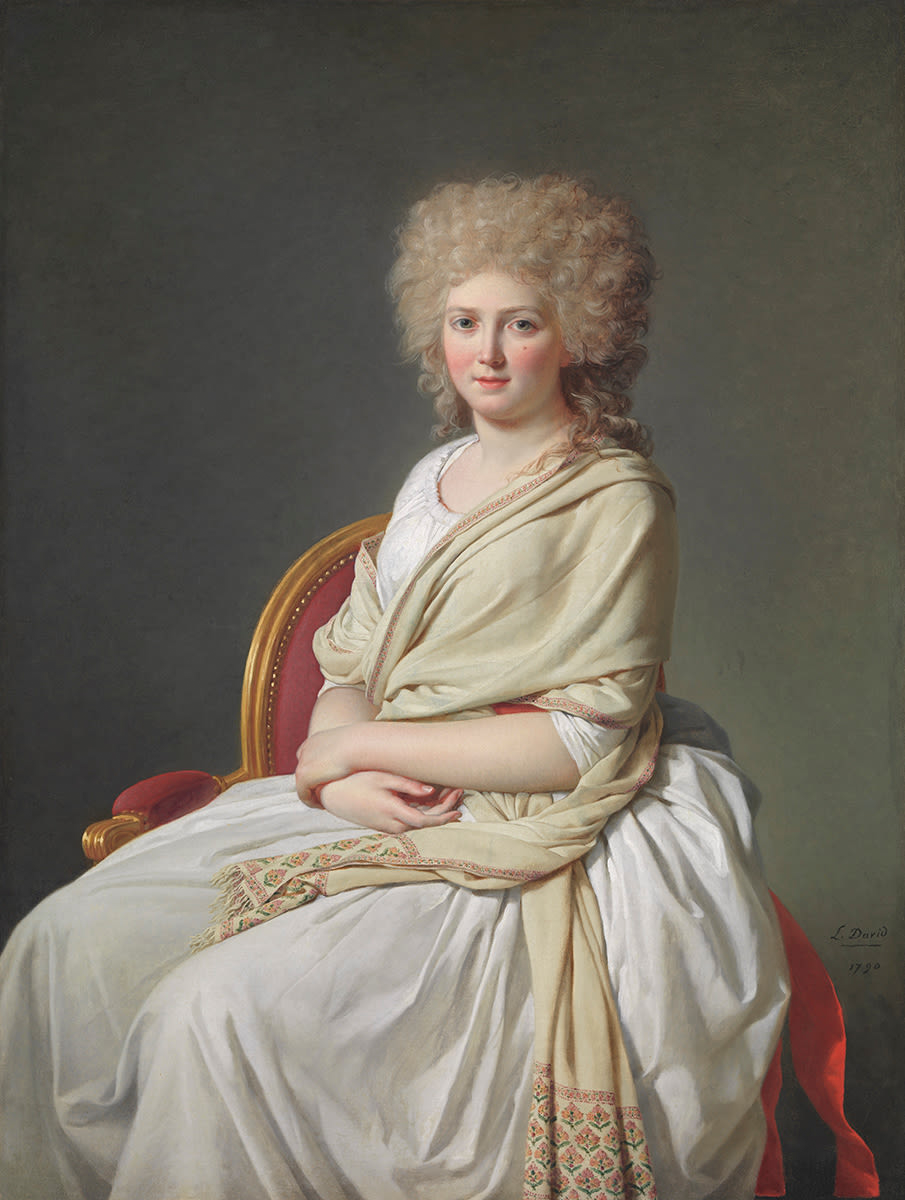
By 1969, the staff of the Nelson-Atkins were cognizant of the fact that the painting was not the work of David, and Ralph T. Coe, then the museum’s assistant director, had begun a campaign to identify its real author. He compared the head in the portrait to the hand of Jean-Baptiste Greuze (1725–1805), and he noted that the harp and table were “drawn in a thick, hard style that simply isn’t David.”28See letter from Ralph T. Coe, NAMA, to Mary Ann Harris, the Metropolitan Museum of Art, New York, October 3, 1975, NAMA curatorial files. While not by David, the Nelson-Atkins portrait is the work of an exceptionally gifted artist. Moreover, the painter’s familiarity with the technique of David is apparent, especially in the treatment of the hands and the fabrics. Additionally, Madame de Langeron’s neoclassical dress and shawl are similar to those depicted by David in his Portrait of the comtesse de Sorcy (Fig. 4) and by Jean Antoine Théodore Giroust (1753–1817) in his group portrait/conversation piece, Mademoiselle d’Orléans, the comtesse de Genlis, and “Mademoiselle Paméla” (1791; private collection),29See the entry for that painting in Guy Wildenstein and Joseph Baillio, The Arts of France from François Ier to Napoléon Ier: A Centennial Celebration of Wildenstein’s Presence in New York (New York: Wildenstein, 2006), 321–24, no. 144. both of which were shown at Salon, the: Exhibitions organized by the French Royal Academy of Painting and Sculpture (Académie Royale de Peinture et de Sculpture) and its successor the Academy of Fine Arts (Académie des Beaux Arts), which took place in Paris from 1667 onward. of 1791. These sartorial clues suggest a date for the Nelson-Atkins painting of circa 1790, the year of Madame de Langeron’s death. Over time, various attributions were made to a number of late-eighteenth-century women painters: Adélaïde Labille Guiard (1749–1803); the circle of Marguerite Gérard (1761–1837); and, most recently (and most plausibly by the present writer), Rose Adélaïde Ducreux (1761–1802), the daughter of the portraitist Joseph Ducreux (1735–1802).30A picture of a woman painting (1793; Musée de Rouen, 1842.4, https://www.pop.culture.gouv.fr/notice/joconde/07290022904) was formerly attributed to David but was published as a Ducreux self-portrait in Joseph Baillio, “Une artiste méconnue: Rose Adélaïde Ducreux,” L’Œil, no. 399 (October 1988): 20. The painting has also been plausibly attributed to Adèle Romany (1769–1846) in Margaret A. Oppenheimer, “Four ‘Davids,’ a ‘Regnault,’ and a ‘Girodet’ Reattributed: Female Artists at the Paris Salon,” Apollo 145, no. 424 (June 1997): 41.
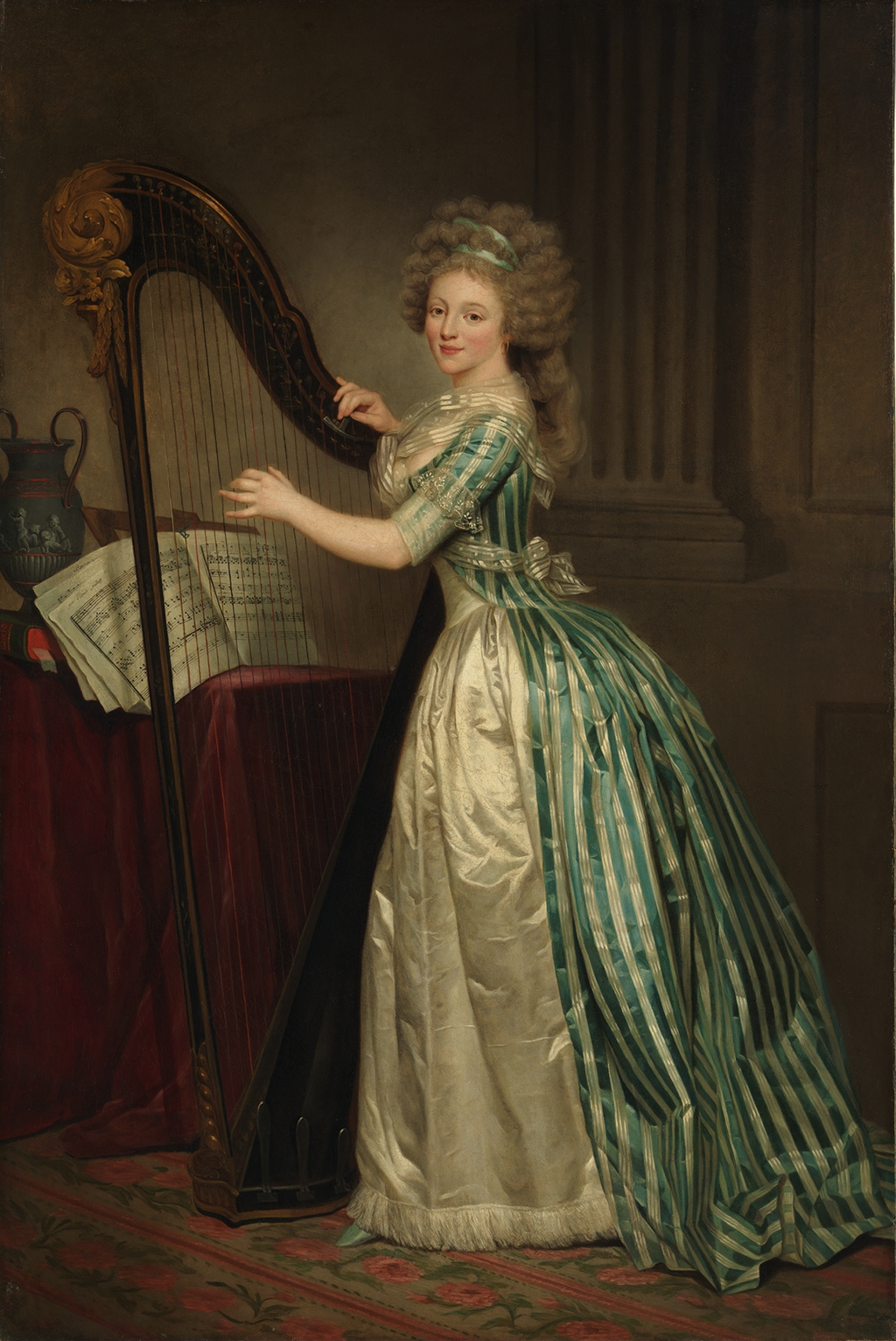
Works by Rose Adélaïde Ducreux, however, are difficult to assign. She never signed her work, and the few paintings now identified as by her have been confused with those by other artists, including Antoine Vestier (1740–1824) and Élisabeth Louise Vigée Le Brun (1755–1842). Notwithstanding these issues, many elements of her style and approach to the subject suggest she could have painted the Nelson-Atkins canvas. Among her outstanding achievements is the full-length Self-Portrait with a Harp (Fig. 5) that she sent to the Salon of 1791, an ambitious work in which she represented herself elegantly attired and playing an ebony harp featuring gilt-bronze fixtures similar to the one depicted in the Nelson-Atkins portrait of Madame de Langeron.31This hypothesis was first advanced by the present author as early as 1975, and the portrait was illustrated in Baillio, “Une artiste méconnue,” 22. Although harps were popular accessories for portraits of this era, Ducreux was a talented musician proficient on more than one instrument, and she often included musical instruments in her compositions, as can be seen in another self-portrait in which she is depicted seated at a piano made by Sébastian Érard playing a sonata by Czech composer Jan Ladislav Dussek (private collection).32Formerly in the collection of Baron Frédéric d’Erlanger. See Léandre Vaillat, La Société du XVIIIe siècle et ses peintres (Paris: Perrin et Cie, 1912), 102n46 (attributed to Jacques Louis David); and Baillio, “Une artiste méconnue,” 22–23. Similarly, the artist’s attention to detail in her rendering of the sumptuous fabrics in both the Self-Portrait with a Harp and the Nelson-Atkins picture suggest a kinship with one another, as does the delicate way in which the artist posed and rendered both sets of sitters’ hands. Unfortunately, Ducreux’s career was cut short soon after her marriage to François Lequoy de Montgiraud, the maritime prefect of the French consular government on the island of Saint-Domingue in the Antilles, where she caught yellow fever and died soon after her arrival in 1802, leaving only a few paintings. This painting may be another, rare example.
Notes
-
Early in his military career, Maignard (1731–1816) had been captain in the cavalry unit, the régiment de Piémont. He purchased the rank of cornet in the first company of royal musketeers upon the retirement of the comte du Roure. He progressively ascended in the ranks, becoming lieutenant of the company in 1767. That same year, he was made brigadier in the armies of the king as well as lieutenant of the mousquetaires gris (an élite cavalry company of two hundred noblemen created in 1622 by Louis XIII).
-
Diane Jacqueline Josèphe Henriette d’Amboise (1733–1804) was the widow of Marie François Auguste Goyon de Matignon, comte de Gacé (1731–63), with whom she had one son, Louis Charles Auguste Goyon de Matignon, comte de Gacé (1755–73). On the Gacé lineage and its relationship with the Vaupalière and Balleroy families, see “Gace,” Website of Mériadec de Goyon-Matignon, accessed August 2011, http://meriadecdegouyon.com/gace.html. Diane de Langeron was descended on her mother’s side from the Stuart kings of England, albeit through illegitimate issue. The grandparents of the comtesse de Langeron were the comte and comtesse Jean-Baptiste Louis Clermont d’Amboise; the comtesse, née Henriette de FitzJames, was the daughter of James FitzJames, duke of Berwick, by his second wife, Anne Bulkeley, and was the granddaughter of King James II and his mistress Arabella Churchill. The comtesse de Langeron’s younger sister Albertine lived from 1770–1800.
-
The marquis’s uncontrollable gambling habit was becoming so injurious to his financial affairs that on New Year’s Day of 1777, his wife presented him with a beautiful box in which he could store his markers and chips. Inserted into the box were miniature portraits of herself and her two daughters, inscribed “Think of us.” In a book of annotated letters published in 1879, Maurice Tourneux wrote the following about her predicament: “Malgré cette heureuse idée et malgré les réflexions de M. Dusaulx sur le jeu, je croie qu’on a joué cet hiver avec plus de fureur que jamais” (Despite this happy idea and despite Mr. Dusaulx’s thoughts on the game, I believe that we played this winter with more fury than ever). Maurice Tourneux, ed., Correspondance littéraire, philosophique, et critique par Grimm, Diderot, Raynal, Meister, etc. (Paris: Garnier, 1879), 11:410.
-
A dress of a similar style, belonging to Madame Oberkampf, the co-founder of Musée de la Toile de Jouy, is dated to 1785–89: Chemise à la reine, Musée de la Toile de Jouy, Jouy-en-Josas, France. To learn more about these types of dresses, see Anne Bissonnette, “The Chemise Dress,” Dress and Historical Escapism: The Dress Research Exhibition Series; Part 1 of 3 (June 30, 2020–June 30, 2021), https://clothingtextiles.ualberta.ca/dhe_chemise-dress/.
-
See technical notes by Mary Schafer, Nelson-Atkins paintings conservator, February 10, 2010, NAMA conservation file.
-
For two examples of chairs with arms, see Attributed to Georges Jacob, Office Chair of Corvisart, 1789 or later, mahogany, copper, and leather, 38 x 16 1/2 in. (96.5 x 42 cm), Musée des Châteaux de Malmaison et de Bois-Préau, Rueil-Malmaison, M.M.50.6.1, https://art.rmngp.fr/fr/library/artworks/georges-jacob_fauteuil-de-bureau-de-corvisart_ajoure_menuiserie_incruste_acajou-bois_cuir-matiere_cuivre-metal; or Georges Jacob, Fauteuil, 1792, carved and openwork mahogany, with colored printed frieze, illustrated in Hector Lefuel, Georges Jacob, ébéniste du XVIIIe siècle (Paris: A. Morancé, 1923), pl. 23, https://gallica.bnf.fr/ark:/12148/bpt6k9762143w/f407.item.
-
Marie Antoinette was an accomplished harpist. Her interest and proclivity on this instrument made it incredibly popular at court. The author is extremely grateful to Florence Gétreau, director of the Institut de Recherche sur le Patrimoine Musical at France’s Centre National de la Recherce Scientifique (CNRS), for her enlightening comments on the comtesse de Langeron’s harp, which she formulated in consultation with Joël Dugot, curator of the Musée de la Musique in Paris and director of the journal Musique ancienne, luthier d’art. Although not visible in the painting, a distinctive feature of this instrument is its pedal mechanism à béquilles (right-angled metal levers), which was perfected around 1780 by Georges Cousineau and his son Jacques Georges Cousineau. Pairs of béquilles were operated by seven pedals that left the strings in plane; when a pedal was depressed, one lever would turn clockwise and the other counterclockwise, providing a firm grip on the strings and raising the pitch. This invention replaced the more cumbersome hook or crochet strumming mechanisms and expanded the chromatic capabilities of the instrument. This was the type of harp for which Amadeus Mozart wrote his Concerto for Flute, Harp, and Orchestra in C Major (K.299) (1778).
-
Like Madame de Langeron’s harp, its soundboard is painted with a cluster of flowers.
-
Reproduced in Joseph-Raymond Fournier-Sarlovèze, Les Peintres de Stanislas-Auguste II, roi de Pologne (Paris: Librairie de l’art ancien et moderne, 1907), 103.
-
Fournier-Sarlovèze, Les Peintres de Stanislas-Auguste II, 106–07. This may be the portrait that was engraved by C. Pfeiffer (possibly Carl Hermann Pfeiffer [1769–1829]); see Anatole-Louis-Théodore-Marie Granges de Surgères and Gustave Bourcaud, Les Françaises du XVIIIe siècle, portraits gravés (Paris: E. Dentu, 1887), 147–48, where the authors state that the oval original on which the print is based is in the Musée du Louvre. A very similar double portrait in miniature depicts Georgiana Cavendish, duchess of Devonshire, and her friend Lady Elizabeth Foster, in profile and attired in neoclassical dresses, which was painted in Paris in November 1791 by one of David’s pupils, Jean Urbain Guérin (1761–1836): Georgiana, Duchess of Devonshire, and Lady Elisabeth Foster, watercolor on ivory, oval: 3 3/4 x 2 3/4 in. (9.5 x 7 cm), Wallace Collection, London, M177.
-
The original address of the Hôtel de la Vaupalière was 79, Faubourg Saint-Honoré; today the building bears the number 85 on the rue du Faubourg Saint-Honoré and 25 on the avenue Matignon. After 1789, when the hôtel was deserted by the De la Vaupalière family, Collignon allowed it to serve as a popular restaurant and café. In 1812, it was sold to comte Pierre Louis de Roederer. Its subsequent occupants were Comte Charles Lehon (1792–1868), who in 1831 was appointed Belgian ambassador to France. Today it serves as the headquarters of the AXA insurance group. See Valérie Bougault, “La Vaupalière, une demeure hors du temps,” Connaissance des Arts, no. 663 (September 2008): 150–55.
-
“Je suis venu finir la journée chez Mme de La Vaupalière, où l’on s’était assemblé pour la féliciter sur la conclusion de ses deux mariages. Ses filles seront mariées le même jour et à la même heure et les amis de La Vaupalière sont tous étonnés de voir que, sans rien diminuer de l’éclat de la maison, en augmentant même la dépense (puisqu’il va garder chez lui les deux nouveaux ménages), il puisse ajouter à ces charges celles de donner au même instant trente mille livres de rentes partagées entre ses deux filles. L’aînée, qui épouse M. de Langeron, est grande et assez leste; la cadette est petite et rondelette; son mari, M. de Balleroy, est aussi peu grand, frais et grassouillet.” Marc Marie, marquis de Bombelles, Journal, ed. Jean Grassion and Frans Durif (1780–84; repr. Geneva: Droz, 1977), 1:319–20.
-
The 4th comte de Langeron (1763–1831) also bore the nobiliary titles of marquis de la Coste and baron de la Ferté, de Sassy, and de Coungy; moreover, he held feudal authority over the lands of Le Mont, Bazolle de l’Isle de Mars, and Alligny.
-
With the outbreak of the Revolution, Albertine sought refuge in Germany, and her son was born in Frauenfeld in 1796. After the fall of Robespierre’s regime, she returned to France with her infant son. She died by drowning on February 10, 1800.
-
According to the État actuel de Paris, ou Le Provincial à Paris (Paris: Watin, 1788), 4:83, the Hôtel de la Vaupalière served as the residence in 1788 of “M. le mis. De Lavaupaliere & . . . , son épouse” (his wife), as well as “M. le comte de Langeron, & Dlle. Maignart de Lavaupaliere, son épouse . . .” (his wife), and “M. le mis. De Balleroi, & Dlle Magnart de Lavaupaliere, mariés tous les quatre le 6 juin 1784” (all four married on June 6, 1784).
-
“Mmes de Langeron et de Balleroy ont été présentées hier. L’aînée a de la beauté, la cadette est plus agréable. Elles étaient mises toutes deux de même, leurs habits étaient dans le goût du vôtre; elles ont eu du succès.” Ernest Daudet, ed., Lettres du Cte Valentin Esterhazy à sa femme 1784–1792 (Paris: Plon-Nourrit, 1907), 3. The letter, written on August 1784, is dated “lundi 11 heures” (Monday 11 a.m.).
-
The marquise de Laage de Volude was born Stéphanie Béatrix Étiennette Renart de Fuchsamberg d’Amblimont (1764–1842).
-
Louis-Philippe-Joseph had assumed the title of duc d’Orléans in 1785 after the death of his father, Louis Philippe de Bourbon, and he became known by the nickname “Philippe Égalité,” which he adopted in 1792 in an act of pure demagoguery. In early 1793, as an elected member of the Convention Nationale, he voted for the death by guillotine of the dethroned and incarcerated king, his kinsman, and some ten months later Louis Philippe too was beheaded.
-
“Mde de Langeron est la plus Diane de toutes les Dianes. Ne vouloit-elle pas hier au soir tuer elle-même Mr Necker et Mr le duc d’Orléans, ni plus ni moins que de ses propres mains! –Mais qu’est-ce qu’on me feroit? disoit-elle. Moi je dirois au Roi: je vous ay rendu le plus grand service, au lieu de tous ces gens qui vous entourent, qui marchent sur des œufs et ne font que ménager la canaille. Sa mère [the marquise de la Vaupalière] s’écria: —Diane, taisés-vous donc! —Mais, ma mère, qu’est-ce qu’on me feroit? Et d’ailleurs, calculés donc le service que je rendrois, et comme mon nom passeroit à la postérité! Je ne m’amuserois pas à des grippe-sols comme Mirabeau et Siéyès, et à des benêts comme Mr de la Fayette. Ôtés à la canaille l’or de l’un et le nom des deux autres, ils tomberoient dans la main du bourreau. Je suis de son avis. Elle voulut me montrer comme elle savoit bien manier un pistolet: elle fut en chercher un dans le cabinet de son mari, et s’amusa de ma frayeur et de celle de sa sœur [Albertine de Balleroy]. Je n’étois pas tranquille, car elle fit mille folies, et ils étoient chargés. Elle qui n’a peur de rien, et qui, en vérité, le feroit comme elle le dit, se moque d’Albertine et de moi. Nous l’avons laissée sur cette idée de se passer cette fantaisie, pour finir tout d’un coup et sans tant de façons les affaires de l’État.” Quoted in baron Léon Audebert de la Morinerie, ed., Souvenirs d’émigration de Madame la Marquise de Lage de Volude, dame de S.A.S. Madame la Princesse de Lamballe, 1792–1794; Lettres à Madame la Comtesse de Montijo (Évreux, France: L’Imprimerie d’Auguste Hérissey, 1869), LXXVIII–LXXIX.
-
“Elle est grosse décidément. . . . J’espère pour elle que cela la dégoûtera de tuer Mr Necker et Mr d’Orléans. . . . L’autre jour, au Palais-Royal, elle me fit une peur affreuse. Cette vilaine figure—elle désigne ainsi le duc d’Orléans—s’approcha de nous pour nous ricaner quelques politesses; elle se mit à me dire à sa barbe: —J’ai envie de m’en passer la fantaisie; ce seroit bien là le moment. Et lui de dire en ridant son vilain nez: —Qu’est-ce que c’est ? —Monseigneur, c’est une petite fantaisie de femme grosse, fort innocente, qui occupe Mde de Langeron depuis quelque tems [sic]. Quand il se fut éloigné, je lui signifiai que je ne me mettrois plus à côté d’elle si elle vouloit dire de telles folies; car, s’il vous plaît, c’étoit tout uniment la fantaisie de lui brûler la cervelle.” Letter from Madame de Lage de Volude to her mother dated May 13, 1789. Quoted in Audebert de la Morinerie, ed., Souvenirs d’émigration, LXXX.
-
According to one historian, the comte de Langeron’s only legitimate daughter bore that name and later married a Count Traczewski. Gustave Chaix d’Est-Ange, Dictionnaire des familles françaises anciennes ou notables à la fin du XIXe siècle (Évreux and Paris: Herissey, 1903), 1:196.
-
Her parents did emigrate in 1789; her father was part of the general staff of the army of the prince de Condé during the French Revolutionary Wars. They returned to France from Bayreuth in Bavaria only under the Consulat, and their names were removed from the list of émigrés from the department of Paris only in early September 1801.
-
Mémoires de la Société Éduenne (Autun: Imprimerie Dejussieu et Demasy, 1913), 41:128. The widowed comte de Langeron eventually entered the service of Catherine the Great, empress of Russia (r. 1762–96), whose court in Saint Petersburg he had previously visited. The expatriate French nobleman participated as an intrepid and much decorated mercenary in the Russian armed forces, fighting at various times against the armies of Sweden, Turkey, and revolutionary and Napoleonic France. He was present at the battles of Ismail and Sillistra, Austerlitz, and Brest-Litovsk. As he was not granted a marshal’s baton by the restored Bourbon monarchs, Louis XVIII and Charles X, he preferred to remain in Russia. Eventually appointed commander of the Cossacks of the Black Sea and military governor of New Russia with control over the district of Odessa, he died in that city during a cholera epidemic in 1831. He had married his second and third wives—the widow of Prince Kaschingstov, née Anastasia Troubetzkoya (d. 1816) and Louise Brummer—respectively in 1804 and 1819. Chaix d’Est-Ange, Dictionnaire des familles françaises, 1:196.
-
See marquis de Bombelles, Journal, 1:320n32.
-
Verax, “Général Comte de Langeron,” in L’Intermédiaire des chercheurs et curieux, no. 1761 (January 15, 1932): 171.
-
See Claude Catroux, Experts en Tableux, Paris, to Philippe de Balleroy, September 29, 1954, and attestation by Maurice Thomas, Expert des Tribunaux de la Seine, Paris, May 14, 1952, copies in NAMA curatorial files. For more on Catroux (1874–1964), see “René Claude Catroux,” in the Jewish Digital Cultural Recovery Project (JDCRP), https://pilot-demo.jdcrp.org/people/catroux_rene-claude/.
-
See certificate prepared by notary Emile Choisnet, Balleroy, September 10, 1954, copy in NAMA curatorial files.
-
See letter from Ralph T. Coe, NAMA, to Mary Ann Harris, the Metropolitan Museum of Art, New York, October 3, 1975, NAMA curatorial files.
-
See the entry for that painting in Guy Wildenstein and Joseph Baillio, The Arts of France from François Ier to Napoléon Ier: A Centennial Celebration of Wildenstein’s Presence in New York (New York: Wildenstein, 2006), 321–24, no. 144.
-
A picture of a woman painting (1793; Musée de Rouen, 1842.4, https://www.pop.culture.gouv.fr/notice/joconde/07290022904) was formerly attributed to David but was published as a Ducreux self-portrait in Joseph Baillio, “Une artiste méconnue: Rose Adélaïde Ducreux,” L’Œil, no. 399 (October 1988): 20. The painting has also been plausibly attributed to Adèle Romany (1769–1846) in Margaret A. Oppenheimer, “Four ‘Davids,’ a ‘Regnault,’ and a ‘Girodet’ Reattributed: Female Artists at the Paris Salon,” Apollo 145, no. 424 (June 1997): 41.
-
This hypothesis was first advanced by the present author as early as 1975, and the portrait was illustrated in Baillio, “Une artiste méconnue,” 22.
-
Formerly in the collection of Baron Frédéric d’Erlanger. See Léandre Vaillat, La Société du XVIIIe siècle et ses peintres (Paris: Perrin et Cie, 1912), 102n46 (attributed to Jacques Louis David); and Baillio, “Une artiste méconnue,” 22–23.
Technical Entry
Citation
Chicago:
Becca Goodman, “Attributed to Rose Adélaïde Ducreux, Portrait of Marie Thérèse Diane Andrault (née Maignard de la Vaupalière, 1768–90), Comtesse de Langeron, ca. 1790,” technical entry in French Paintings and Pastels, 1600–1945: The Collections of the Nelson-Atkins Museum of Art, ed. Aimee Marcereau DeGalan (Kansas City: The Nelson-Atkins Museum of Art, 2026), https://doi.org/10.37764/78973.5.404.2088.
MLA:
Goodman, Becca. “Attributed to Rose Adélaïde Ducreux, Portrait of Marie Thérèse Diane Andrault (née Maignard de la Vaupalière, 1768–90), Comtesse de Langeron, ca. 1790,” technical entry. French Paintings and Pastels, 1600–1945: The Collections of The Nelson-Atkins Museum of Art, edited by Aimee Marcereau DeGalan, Nelson-Atkins Museum of Art, 2026. doi: 10.37764/78973.5.404.2088.
Marie Thérèse Diane Andrault sits among a carefully crafted collection of objects—a harp, a buillotte table,1Joseph Baillio describes the table as a guéridon, meaning a small end table (see the accompanying catalogue entry). More specifically, it is characteristic of a bouillotte table, a small, circular table with a marble top, bronze or brass gallery, at least one drawer, and four legs. While used for more than just cards, the table gets its name from a card game. Roger de Félice, French Furniture under Louis XVI and the Empire, trans. F. M. Atkinson (London: William Heinemann, 1920), 63, pl. 22. books, and a cashmere shawl. Recent examination and technical imaging illuminated the extent to which the artist changed these compositional elements. The arrangement of objects was drastically altered during the execution of the work.
The canvas is secured to a six-membered wooden stretcher: A wooden structure to which the painting’s canvas is attached. Unlike strainers, stretchers can be expanded slightly at the joints to improve canvas tension and avoid sagging due to humidity changes or aging. that cannot be original as it is too large for the painting. When the painting was attached to the current stretcher, the tacking margins: The outer edges of canvas that wrap around and are attached to the stretcher or strainer with tacks or staples. See also tacking edge. shifted to the picture plane: The two-dimensional surface where the artist applies paint. to accommodate the larger dimensions. Approximately 0.6 to 1.3 centimeters of the tacking margins are now present at all edges of the picture plane. The original dimensions of the painted canvas are roughly 128.3 x 96.0 centimeters.
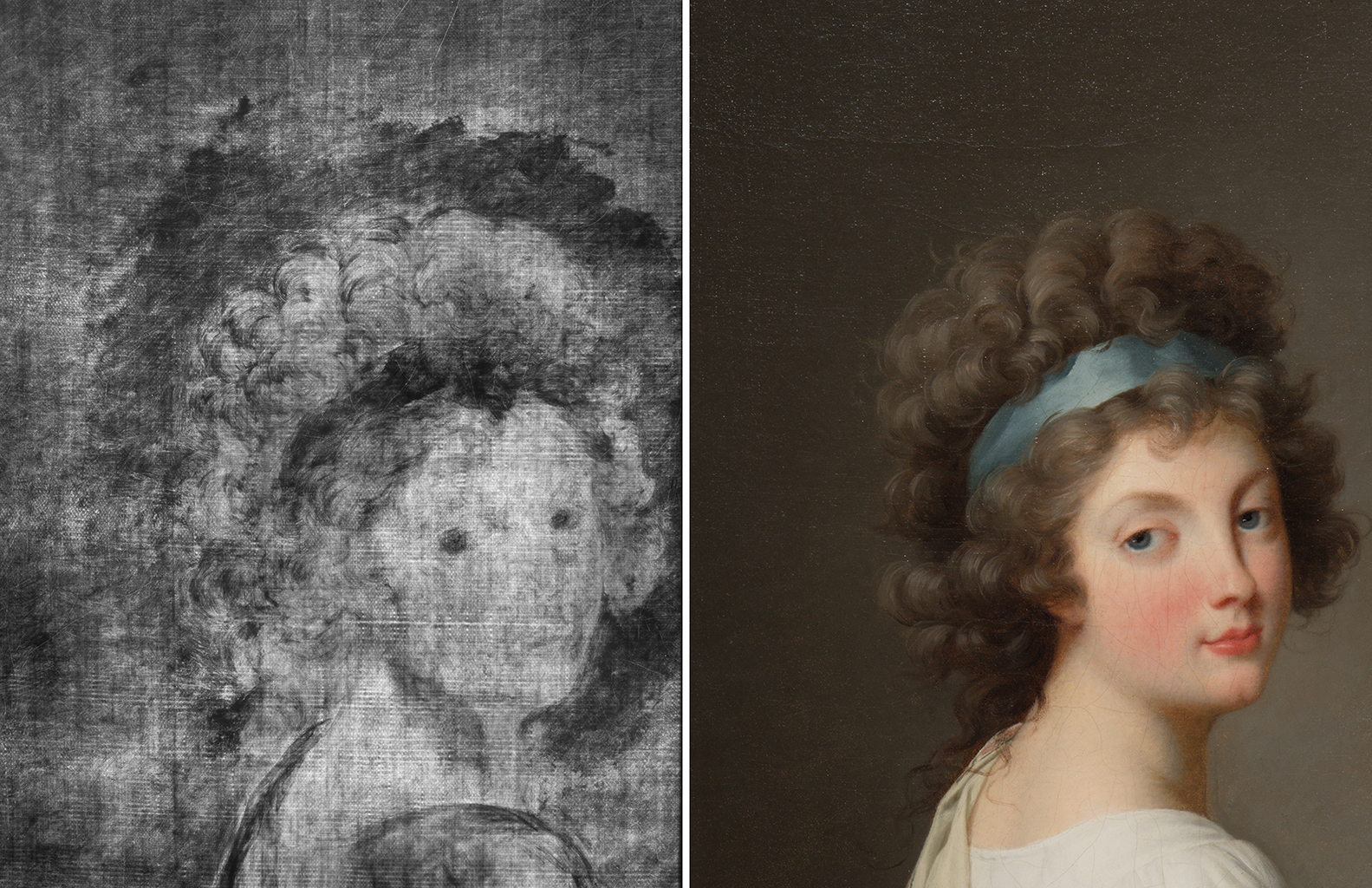
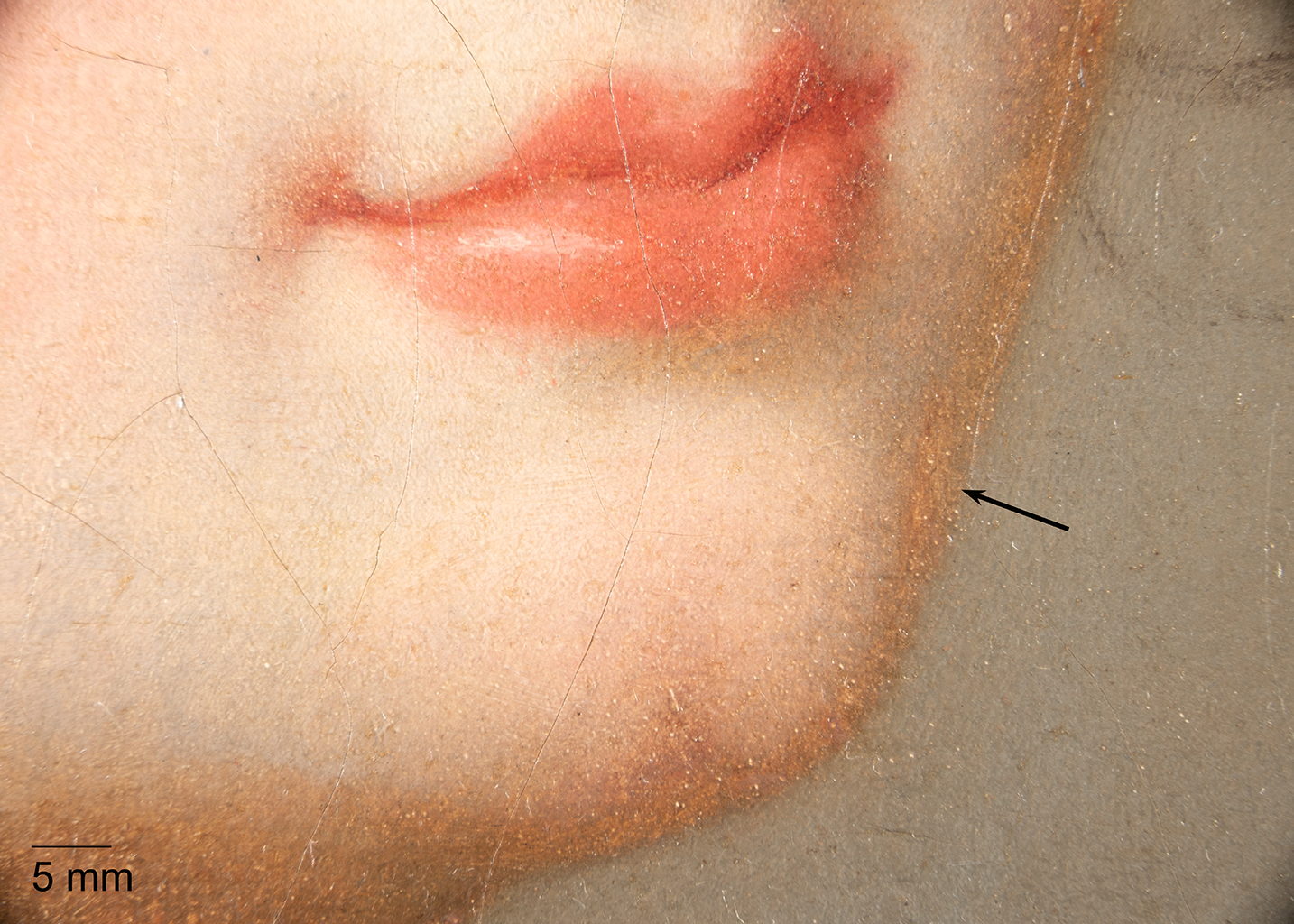
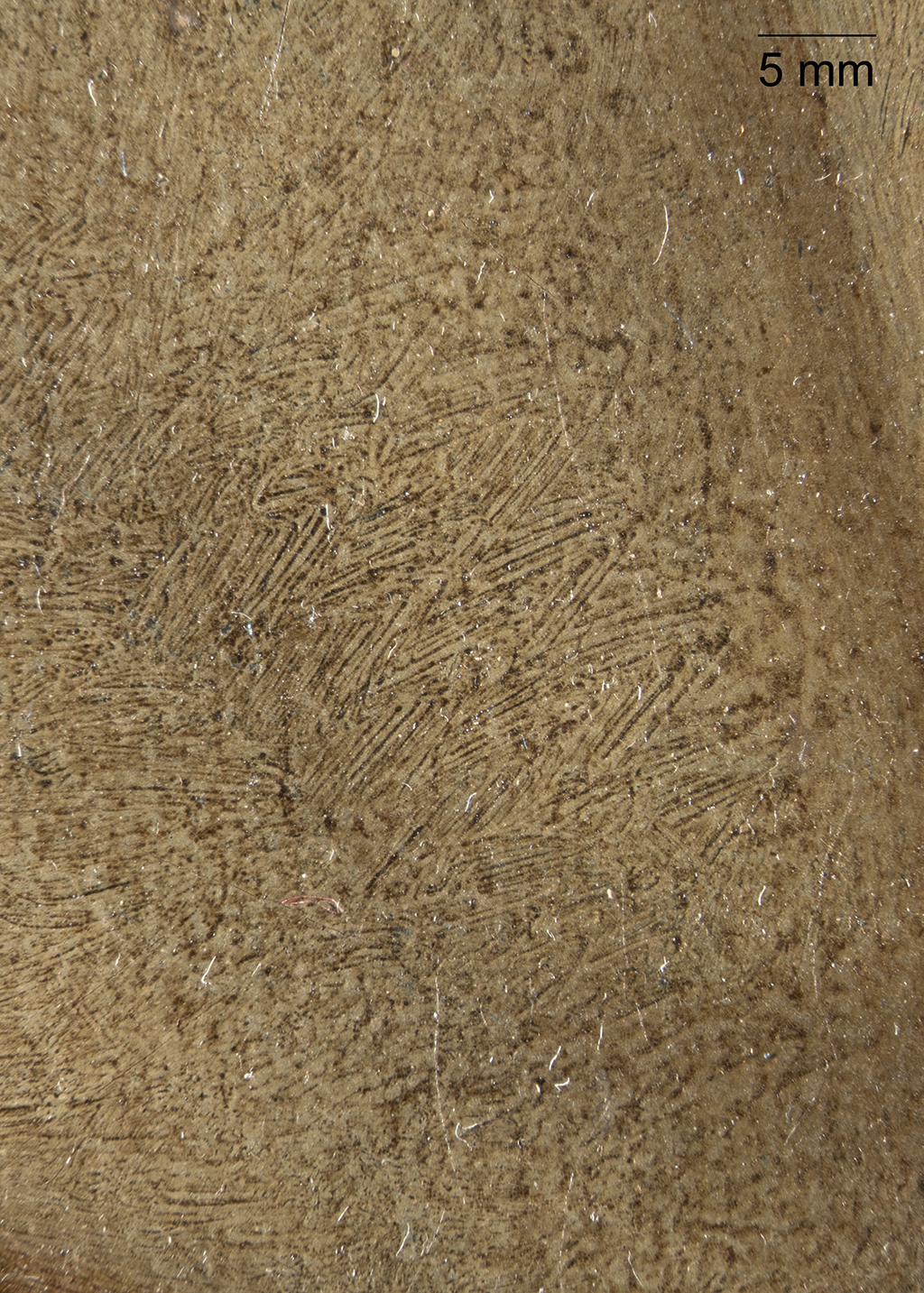
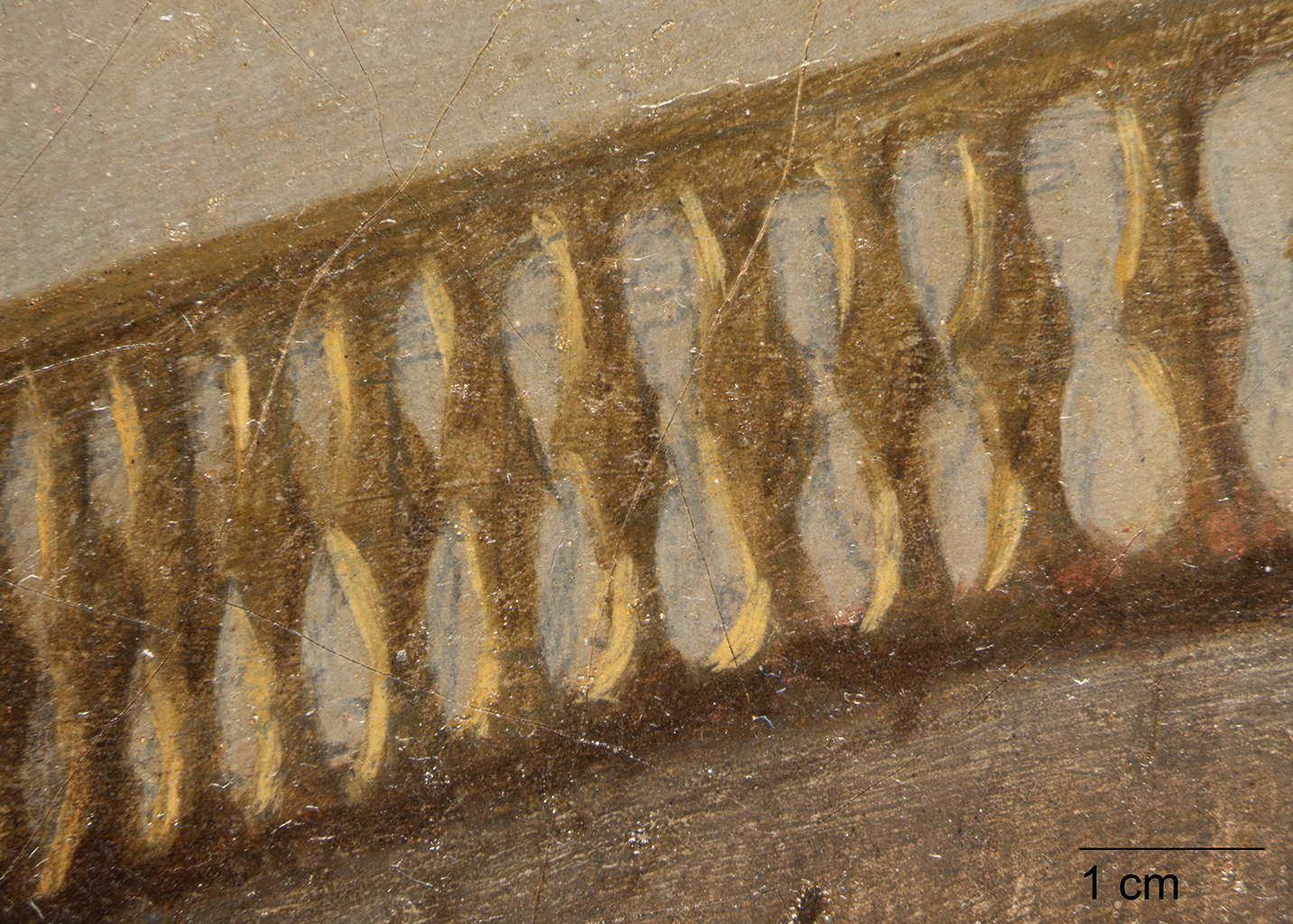
The portrait was executed on canvas with a plain weave: A basic textile weave in which one weft thread alternates over and under the warp threads. Often this structure consists of one thread in each direction, but threads can be doubled (basket weave) or tripled to create more complex plain weave. Plain weave is sometimes called tabby weave. composed of irregular threads. It was initially prepared with a white or cream-colored ground layer: An opaque preparatory layer applied to the support, either commercially or by the artist, to prevent absorption of the paint into the canvas or panel. See also priming layer. layer. infrared reflectography (IRR): A form of infrared imaging that exploits the behavior of painting materials at wavelengths beyond those accessible to infrared photography. These advantages sometimes include a continuing increase in the transparency of pigments beyond wavelengths accessible to infrared photography (i.e, beyond 1,000 nanometers), rendering underdrawing more clearly. The resulting image is called an infrared reflectogram. Devices that came into common use in the 1980s such as the infrared vidicon effectively revealed these features but suffered from lack of sharpness and uneven response. Vidicons continue to be used out to 2,200 nanometers but several newer pixelated detectors including indium gallium arsenide and indium antimonide array detectors offer improvements. All of these devices are optimally used with filters constraining their response to those parts of the infrared spectrum that reveal the most within the constraints of the palette used for a given painting. They can be used for transmitted light imaging as well as in reflection. revealed preparatory sketching in the face, chair, table, and harp. The underdrawing: A drawn or painted sketch beneath the paint layer. The underdrawing can be made from dry materials, such as graphite or charcoal, or wet materials, such as ink or paint. appears visually consistent with graphite. Warm, brown paint was selectively applied where the figure would be painted. This preparatory layer forms a halo around the sitter’s head that is apparent with transmitted transmitted infrared (IR) photography: An examination technique whereby the light source is placed on one side of the artwork while an electronic infrared imager or IR-modified digital camera placed on the opposite side captures the IR that is transmitted. This form of IR photography can be used to detect characteristics of the artist’s paint application, underlying compositions, artist changes, or inscriptions now covered by a lining canvas. (Fig. 6). Widespread lead soap aggregates in the background are nearly absent in the halo, suggesting the selective toning is suppressing or blocking degradation product from migrating toward the paint surface. The warm tone is intentionally visible through the final paint layers of the sitter’s hair and at the contour of her cheek and neck (Fig. 7). Thin paint layers were applied to gradually modulate the face. The shadows associated with the bridge of the sitter’s nose, nostril and eyebrows are defined with warm brown paint that deepens the color of the toning. Softer shadows that describe her eye sockets, jawline, and curves of her cheeks were painted with a cool gray color. Bright highlights were blended with the shadowed areas, and red was feathered into the cheeks to create her smooth, luminous skin. Elsewhere in the painting, the paint has a paste-like, buttery consistency capable of holding low impasto: A thick application of paint, often creating texture such as peaks and ridges. and distinctive zigzag brushwork, which is especially apparent in her skirt (Fig. 8).
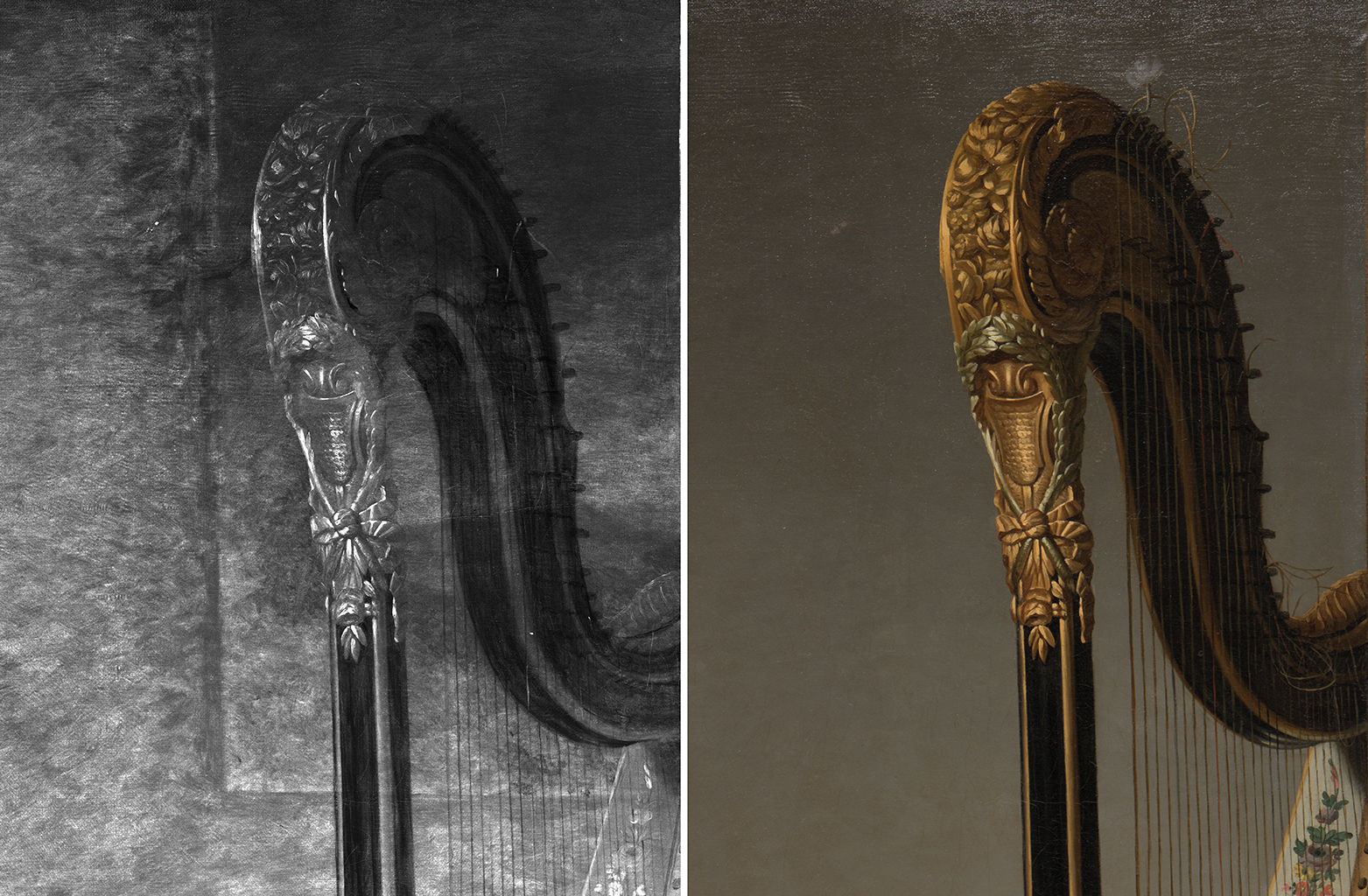
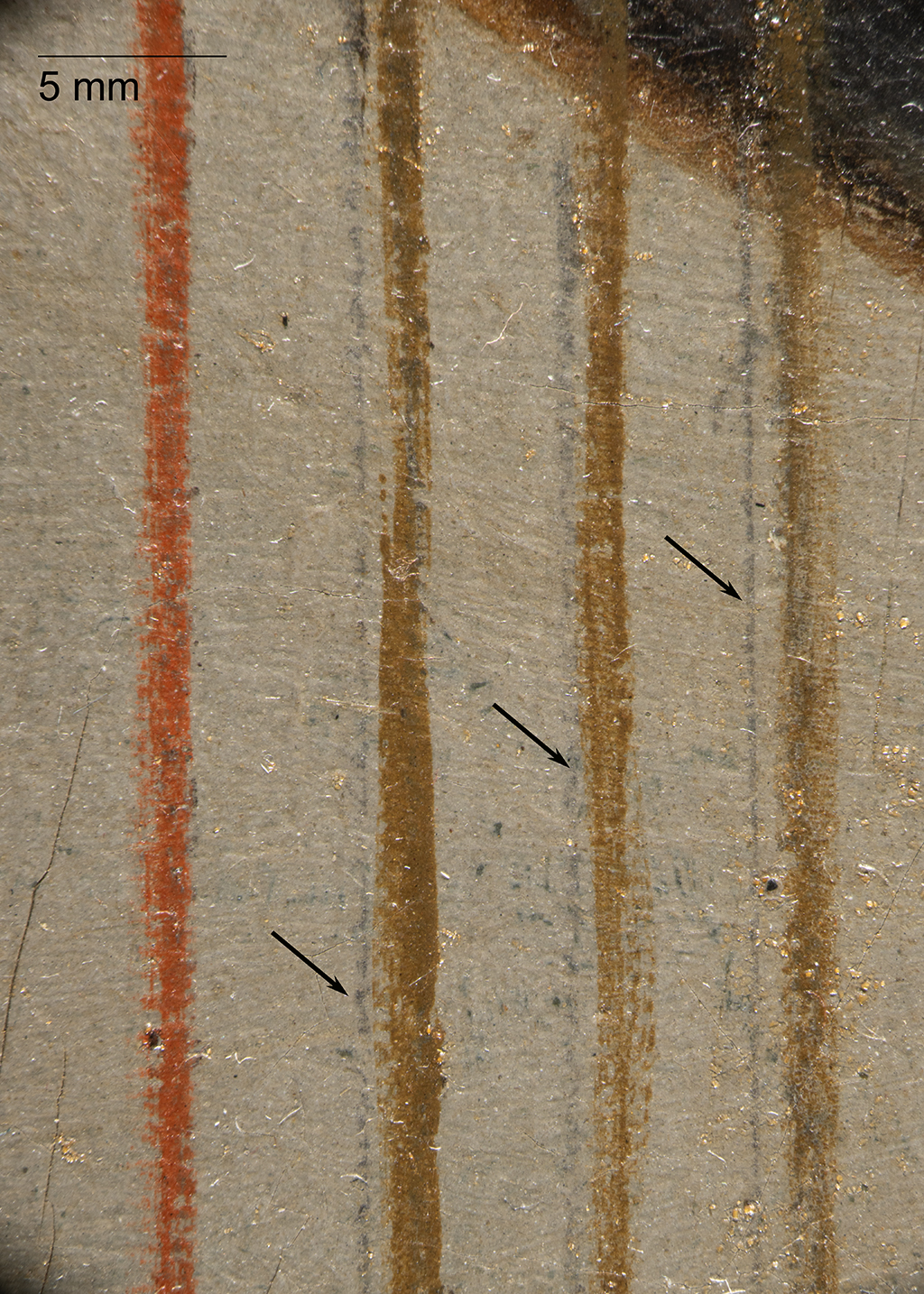
The underdrawing in the face and chair was applied directly on top of the ground layer, whereas that of the table and harp was sketched on top of dry paint layers. In the upper right corner, a window or framed landscape was realized and subsequently painted out with the gray background color (Fig. 9).2Under magnification, tiny areas of blue and green are visible, leading to the theory that the window or painting shows a landscape. The border around it—either a window casing or picture frame—seems to have been brown or yellow. The harp, which would have intersected the window or painting, was not left in reserve. Careful mapping of the harp strings is clearly visible on top of the background paint when viewed under magnification (Fig. 10). Thus, the harp was underdrawn and painted directly over the background (that covers the landscape), suggesting it was not part of the original composition.
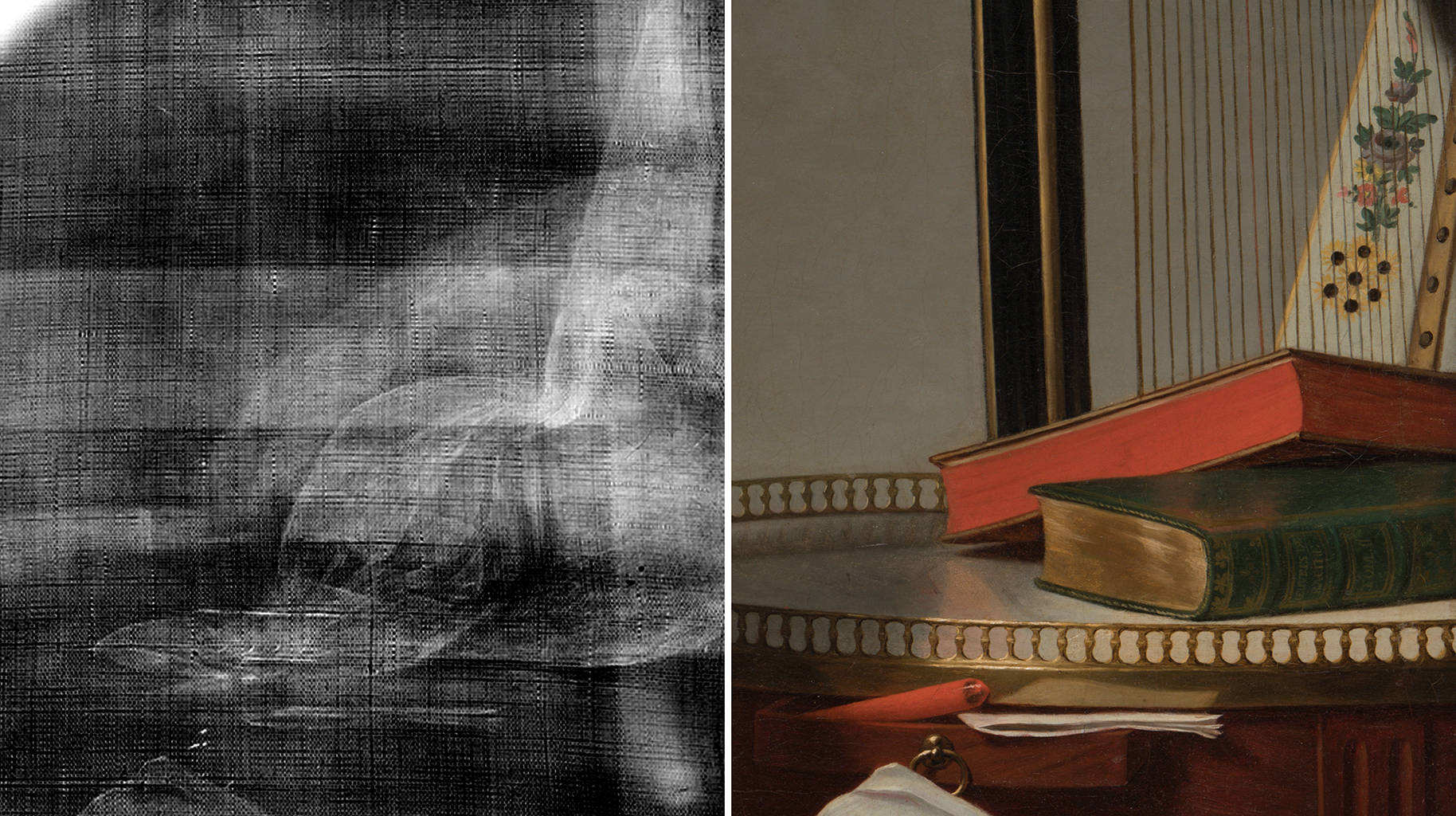
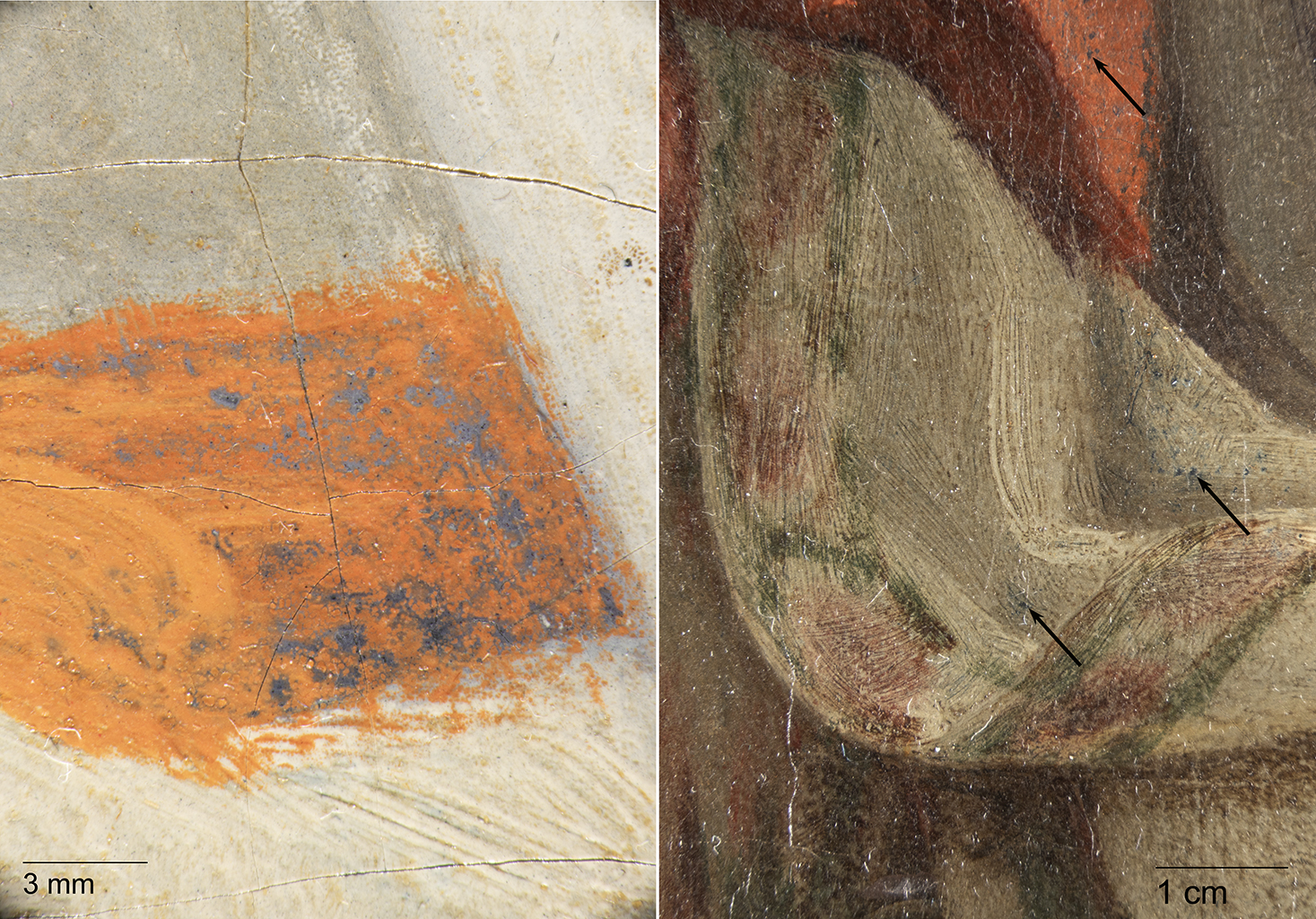
The bottom of the harp as well as the table and book
in the sitter’s hand were painted on top of bright red
and orange paint (Fig. 11). While
X-ray radiography (also referred to as
x-radiography or radiography): Radiography is an examination tool analogous to
the use of X-rays in medicine whereby denser
components of a painted composition can be
recorded as an inverted shadow image cast on film
or a digital X-ray imaging plate from a source
such as an X-ray tube. The method has been used
for more than a century and is most effective with
dense pigments incorporating metallic elements
such as lead or zinc. It can reveal artist
changes, underlying compositions, and information
concerning the artwork’s construction and
condition. The resulting image is called an
x-radiograph or radiograph. It differs from the
uses of X-ray spectrometry in being dependent on
the density of the paint to absorb X-rays before
they reach the film or image plate and being
non-specific as to which elements are responsible
for the resulting shadow image.
reveals a dome-like shape and a mound of fabric
seemingly gathered on the table (Fig. 12), it is
extremely difficult to interpret the earlier
compositional elements at the center and lower right
side of the work. Contemporary portraits of women
occasionally depict sofas with sumptuous pillows,
presenting a plausible interpretation of the
underlying colors and shapes in the Nelson-Atkins
painting.3See Caroline Delestres,
Portrait of a Woman Playing a Harp (1801;
location unknown,
https://www.debaecque.fr
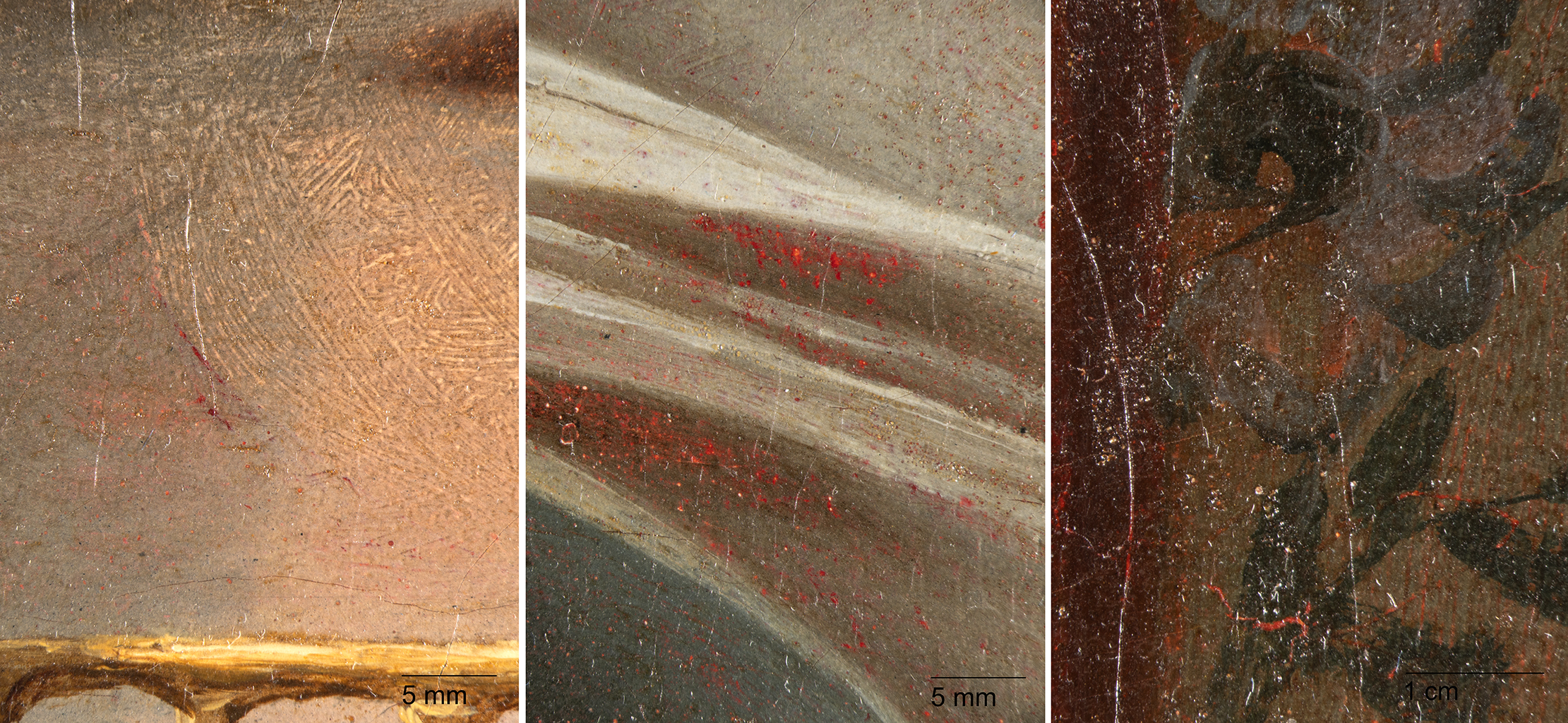
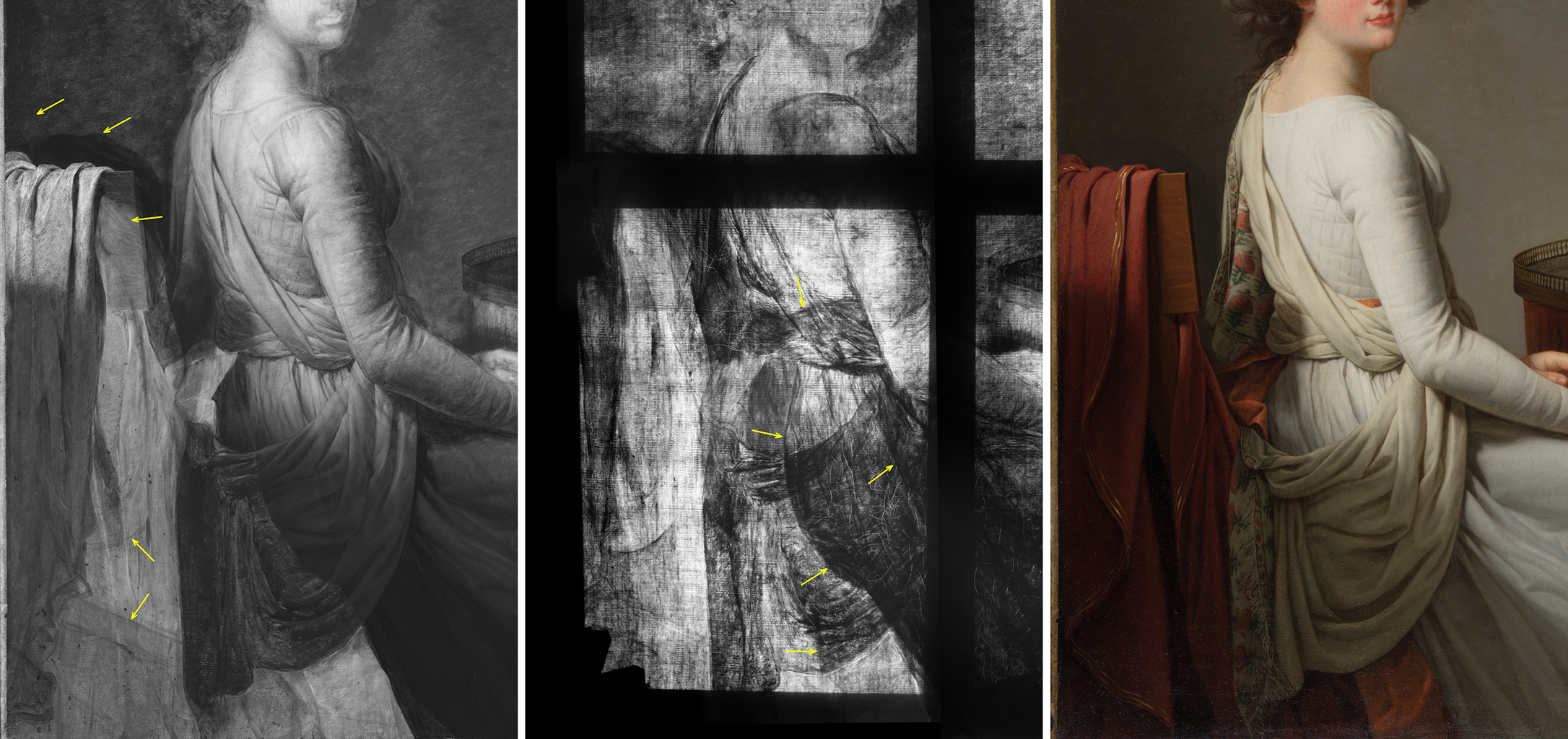
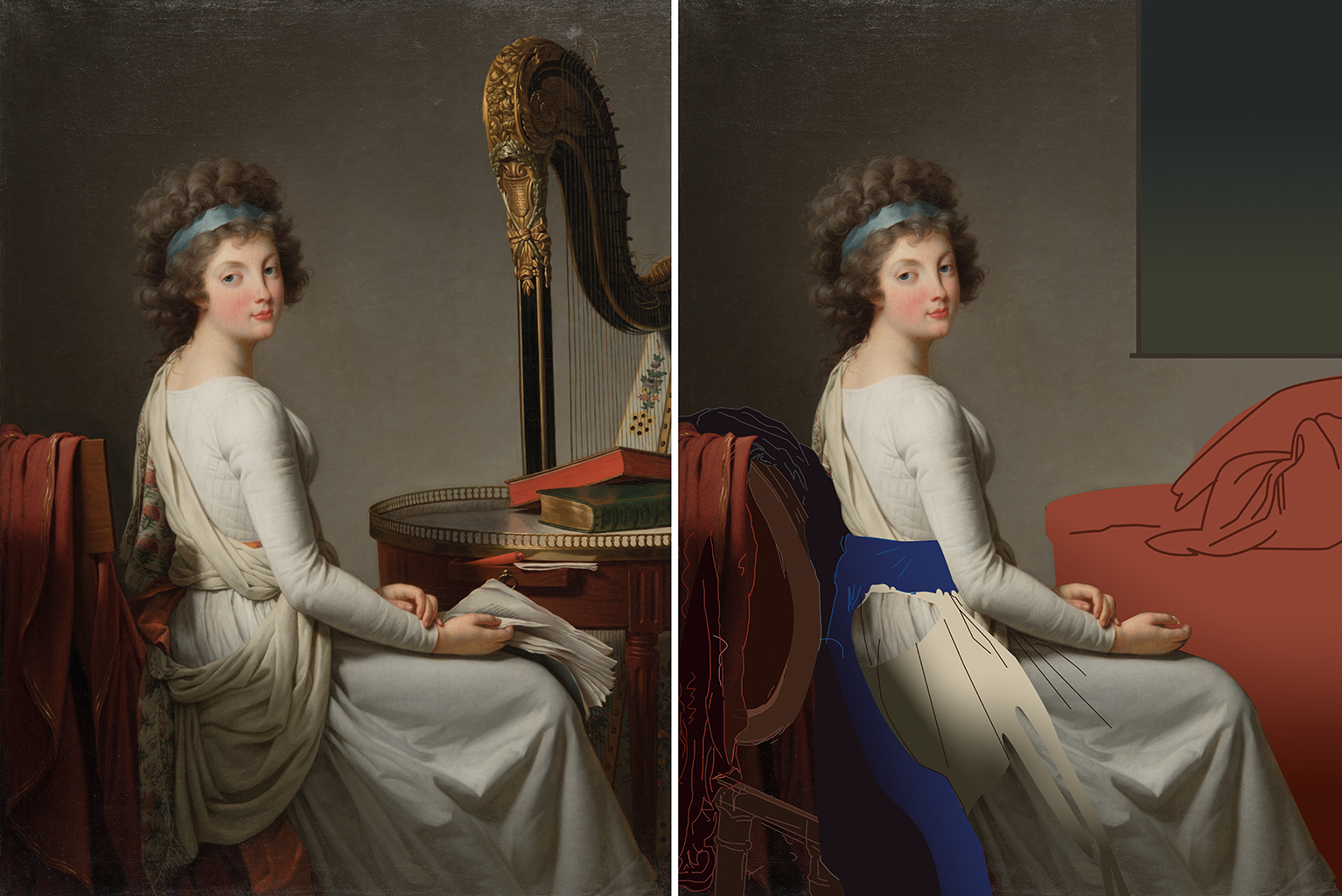
It has been noted that the orange ribbon across the sitter’s waist was once blue.4Mary Schafer, technical notes, February 10, 2010, NAMA conservation file, 54-66. By plotting each area in which deep blue or gray peeks through her white garment, it became clear that blue fabric extended past her waist and cascaded down to the floor (Fig. 14). Infrared imaging techniques provided further clarification of the significant changes to her skirt and ribbon (Fig. 15). The sitter’s chair back was originally oval rather than rectangular, and the red fabric draped over the chair was underpainted in black, suggesting it may have been darker in color. The fabric was configured differently and was piled notably higher above the chair back, which is perceptible in visible light as a pentimento (pl: pentimenti): A change to the composition made by the artist that is visible on the paint surface. Often with time, pentimenti become more visible as the upper layers of paint become more transparent with age. Italian for "repentance" or "a change of mind.". In the upper left corner, underlying paint strokes that do not appear relevant to the current composition may correspond to more fabric, a sculpture, or another decorative element that has been painted out. It is not possible to determine with certainty the appearance of the original composition, but because the changes are so extensive and were revealed through multiple techniques, a rudimentary digital approximation was made to help visualize them in a single image (Fig. 16).
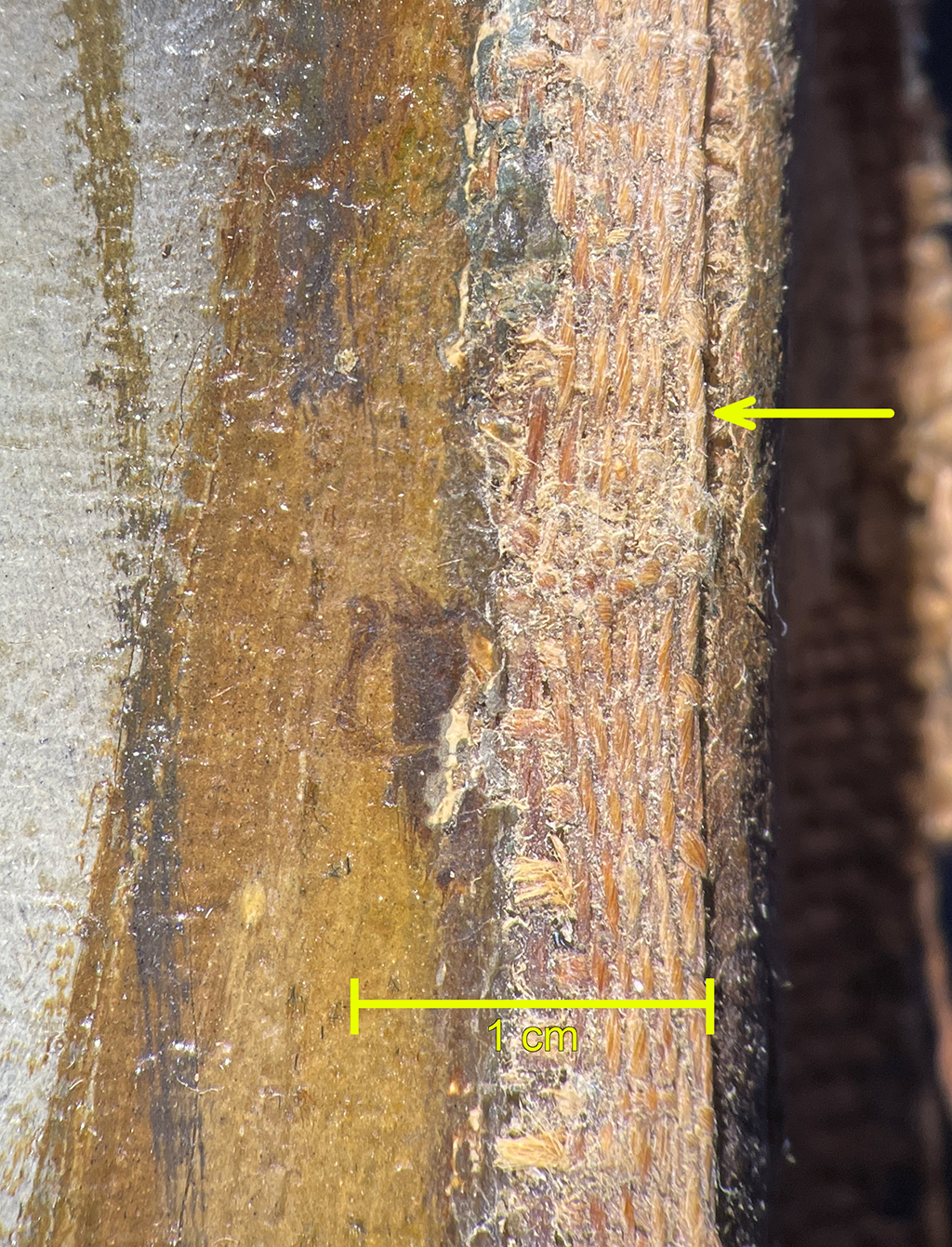
The painting has undergone treatment at least twice. The stretcher was replaced, and the canvas was lining: A procedure used to reinforce a weakened canvas that involves adhering a second fabric support using adhesive, most often a glue-paste mixture, wax, or synthetic adhesive. to a fine, tightly woven secondary support with a glue-paste adhesive. As a result of the lining, the canvas weave occasionally appears pronounced. When a small section of tape was removed from the proper left edge of the canvas, there appeared to be selvedge: The original woven edge of fabric formed by the weft threads looping over the warp during the loom weaving process. The selvedge runs the length of the fabric bolt, parallel to the warp threads, and forms a finished edge. present. However, the space between the original turnover edge (denoted by a barbe of paint) and the potential selvedge is only about 0.5 cm, which would have formed an extremely thin and impractical original tacking margin (Fig. 17). Instead, the cut edge of the canvas may have been folded under itself during lining, giving the illusion of a finished edge. Although customs stamps are not evident on the stretcher or lining canvas, the stretcher replacement and structural work were performed overseas prior to the painting’s arrival in the United States.5The painting was already lined when James Roth examined it on September 2, 1954, just after it arrived in the United States. See Roth, September 2, 1954, “Technical Report on Condition,” NAMA conservation file, 54-66.
The painting may have undergone cleaning during this intervention (or prior to it), but there are no records to confirm this. Upon its arrival in the United States in 1954, the painting was cleaned, varnished, and retouched. The synthetic varnish was brush-applied and appears streaky under ultraviolet (UV) radiation: A segment of the electromagnetic spectrum, just beyond the sensitivity of the human eye, with wavelengths ranging from 100–400 nanometers. For a description of its use in the study of art objects, see ultraviolet (UV) fluorescence or UV-induced visible fluorescence.. The painting may have been varnished while framed, as there is a perimeter of unvarnished paint that was likely protected by the frame rabbet: A recessed inner channel or groove on the back of a picture frame that secures artwork and/or glazing within the frame. Frame rabbets are typically padded with a soft material to prevent frame abrasion or indentations where it comes into contact with the artwork. Referred to as “rebate” in British English. Medium-rich colors appear chemically abraded from overcleaning, especially in the pattern on the cashmere shawl, the shadows in the table, and the modelling in the red fabric. Minimal retouching: Paint application by a conservator or restorer to cover losses and unify the original composition. Retouching is an aspect of conservation treatment that is aesthetic in nature and that differs from more limited procedures undertaken solely to stabilize original material. Sometimes referred to as inpainting or retouch. is apparent under UV.
Notes
-
Joseph Baillio describes the table as a guéridon, meaning a small end table (see the accompanying catalogue entry). More specifically, it is characteristic of a bouillotte table, a small, circular table with a marble top, bronze or brass gallery, at least one drawer, and four legs. While used for more than just cards, the table gets its name from a card game. Roger de Félice, French Furniture under Louis XVI and the Empire, trans. F. M. Atkinson (London: William Heinemann, 1920), 63, pl. 22.
-
Under magnification, tiny areas of blue and green paint are visible, leading to the theory that the window or painting shows a landscape. The border around it—either a window casing or picture frame—seems to have been brown or yellow.
-
See Caroline Delestres, Portrait of a Woman Playing a Harp (1801; location unknown, https://www.debaecque.fr
/lot ); Elisabeth Louise Vigée Le Brun, Comtesse de la Châtre (Marie Charlotte Louise Perrette Aglaé Bontemps, 1762–1848) (1789; Metropolitan Museum of Art, New York, https://www.metmuseum.org/91119 /9108166 /art ); and Marguerite Gérard, Prelude to a Concert (ca. 1810; National Museum of Women in the Arts, Washington, DC, https://nmwa.org/collection /search /437900 /art )./collection /prelude -concert/ -
Mary Schafer, technical notes, February 10, 2010, NAMA conservation file, 54-66.
-
The painting was already lined when James Roth examined it on September 2, 1954, just after it arrived in the United States. See Roth, September 2, 1954, “Technical Report on Condition,” NAMA conservation file, 54-66.
Documentation
Citation
Chicago:
Glynnis Napier Stevenson, “Attributed to Rose Adélaïde Ducreux, Portrait of Marie Thérèse Diane Andrault (née Maignard de la Vaupalière, 1768–90), Comtesse de Langeron, ca. 1790,” documentation in French Paintings and Pastels, 1600–1945: The Collections of the Nelson-Atkins Museum of Art, ed. Aimee Marcereau DeGalan (Kansas City: The Nelson-Atkins Museum of Art, 2024), https://doi.org/10.37764/78973.5.404.4033.
MLA:
Stevenson, Glynnis Napier. “Attributed to Rose Adélaïde Ducreux, Portrait of Marie Thérèse Diane Andrault (née Maignard de la Vaupalière, 1768–90), Comtesse de Langeron, ca. 1790,” documentation. French Paintings and Pastels, 1600–1945: The Collections of The Nelson-Atkins Museum of Art, edited by Aimee Marcereau DeGalan, Nelson-Atkins Museum of Art, 2024. doi: 10.37764/78973.5.404.4033.
Provenance
The sitter’s husband, Alexandre Louis Andrault, comte de Langeron (1763–1831), Paris, Saint Petersburg, and Odessa, 1790–1831 [1];
Probably inherited by his brother-in-law, Aimé Philippe Auguste Jacques de La Cour, marquis de Balleroy (1763–1840), Château de Balleroy, Calvados, France, 1831–40 [2];
Presumably by descent to his son, Auguste-François-Joseph de La Cour, marquis de Balleroy (1796–1875), Paris, April 3, 1840–75;
Presumably by descent to his grandson, Marie-Honoré-Jacques de La Cour, marquis de Balleroy, (1870–1948), Château de Balleroy, Calvados, France, and Paris, 1875–June 26, 1948 [3];
By descent to his son, Philippe-Charles-Henri de La Cour, marquis de Balleroy (1898–1957), Paris and Château de Balleroy, Calvados, France, 1948–September 28, 1954;
Purchased from Philippe-Charles-Henri de La Cour, marquis de Balleroy, through Mary Coggeshall Kuhn, by The Nelson-Atkins Museum of Art, Kansas City, MO, 1954.
Notes
[1] The sitter, Marie Thérèse Diane Andrault, Comtesse de Langeron (née Maignard de la Vaupalière, 1768–90), died around the time of the painting, and the portrait may have been posthumous. It is not clear who commissioned it, possibly her parents, Charles Étienne Pierre Marie Maignard, marquis de la Vaupalière (1731–1816), and Diane Jacqueline Josèphe Henriette de Clermont d’Amboise (1733–1804), or it may have been commissioned by her husband, the comte de Langeron. He was fighting in the Russo-Turkish War (1787–91) beginning in May 1790, around the time of the portrait and his wife’s death. He never returned to France. The portrait, on the other hand, undoubtedly remained in France, and after the death of the Comte de Langeron in 1831, it was inherited by the sitter’s brother-in-law. See letter from Philippe-Charles-Henri de La Cour, Marquis de Balleroy, translated by Mary Coggeshall Kuhn, to Patrick Kelleher, NAMA, September 18, 1954, NAMA curatorial files.
[2] See note 1.
[3] The son of Auguste François Joseph de La Cour, Albert Felix Justin de la Cour de Balleroy, died on August 10, 1872, before his father was deceased. Therefore, the painting probably passed to Albert’s only son, Marie Honoré Jacques de la Cour, the next Marquis de Balleroy. The painting was kept at 35, avenue Montaigne, Paris, until 1940, when the Marquis de Balleroy transferred it to the Château de Balleroy for safekeeping during World War II. See De La Cour to Kelleher, NAMA, September 18, 1954, NAMA curatorial files.
Copies
French school, after Rose Adélaïde Ducreux, Portrait de Mme Langeron, 1799, oil on canvas, 31 7/8 x 25 1/4 in. (81 x 64 cm), cited in Description des Objets d’Arts qui composent le cabinet de Feu M. Le Baron V. Denon; Tableaux, Dessins, et Miniatures (Paris: A. N. Pérignon, May 1–19, 1826), lot 197, as by Jacques Louis David.
French school, after Rose Adélaïde Ducreux, Portrait de Diane de la Vaupalière (Comtesse de Langeron), oil on oval canvas, dimensions unknown, illustrated in Raymond Nacenta, Cent chefs-d’oeuvre de l’art franҫais, 1750–1950 (Paris: Galerie Charpentier, 1957), no. 20, as by Jacques Louis David.
French school, after Rose Adélaïde Ducreux, Madame la comtesse de Langeron, oil on canvas, 39 3/8 x 23 5/8 in. (100 x 60 cm), cited in Catalogue de l’Exposition des Portrait de Femmes et d’Enfants, exh. cat. (Paris: École des Beaux-Arts, 1897), no. 43, as by Jacques Louis David.
After Rose Adélaïde Ducreux, Portrait of the Countess de Langeron, née Diane de la Vaupalière, oil on canvas, 16 1/8 x 13 1/8 in. (41 x 33.3 cm), sold at Collection Hubert Guerrand-Hermès, L’hôtel de Lannion, Sotheby’s, December 14, 2023, lot 282.
Exhibitions
The Century of Mozart, The Nelson-Atkins Museum of Art, Kansas City, MO, January 15–March 4, 1956, no. 21, erroneously as by Jacques Louis David, Diane de la Vaupalière, Cômtesse [sic] de Langeron.
A Beethoven Festival: Art in the Time of Beethoven, The Nelson-Atkins Museum of Art, Kansas City, MO, April 29–June 4, 1978, no. 1, as by Circle of Jacques Louis David, Diane de la Vaupaliere [sic], Comtesse de Langeron.
Those Beguiling Women, The Nelson-Atkins Museum of Art, Kansas City, MO, September 27–October 30, 1983, no. 24, as by Rose Ducreux, Diane de la Vaupalière, Cômtesse [sic] de Langeron.
References
“Accessions of American and Canadian Museums: October–December 1954,” Art Quarterly 18, no. 2 (Summer 1955): 200, 203, (repro.), erroneously as by Jacques Louis David, Diane de la Vaupalière, Comtesse de Langeron.
“New Acquisition,” Gallery News (The William Rockhill Nelson Gallery of Art and Mary Atkins Museum of Fine Arts) 22, no. 7 (April 1955): unpaginated, (repro.), as by Jacques Louis David, Diane de la Vaupaliere [sic], Comtesse de Langeron.
Winifred Shields, “Glamour of an Earlier France Caught in a Gallery Portrait: The Beautiful Diane de la Vaupaliere [sic], Countess de Langeron, Was the Wife of a Noted Soldier, Who Later Helped Defeat Napoleon,” Kansas City Star 75, no. 196 (April 1, 1955): 28, (repro.), erroneously as by Jacques Louis David, Diane de la Vaupaliere [sic], Countess de Langeron.
Winifred Shields, “Among the New Acquisitions of the Nelson Gallery of Art,” Kansas City Star 75, no. 226 (May 1, 1955): erroneously as by Jacques Louis David, Diane de la Vaupaliere [sic], Comtesse de Langeron.
Laurence Sickman, “Beauty of Beauties,” Nihon Keizai Shimbun (Financial and Business Journal of Japan) (June 21, 1955): 10 (repro.), erroneously as by Jacques-Louis David, Comtesse de Langeron.
“A U.S. Gallery Enters Its Third Decade: Anniversary Acquisitions,” Illustrated London News 227, no. 6073 (September 10, 1955): 451, (repro.), erroneously as by Jacques Louis David, Diane de la Vaupaliere [sic], Comtesse de Langeron.
“Paintings in Mozart Exhibition To Reflect Spirit of an Era: Show of Eighteenth Century Works, Also Including Sculptures and Decorative Items, Will Be Part of the City’s Celebration of Composer’s Birth,” Kansas City Star 76, no. 104 (December 30, 1955): 16.
“Special Exhibition: The Century of Mozart,” Gallery News (The William Rockhill Nelson Gallery of Art and Mary Atkins Museum of Fine Arts) 23, no. 6 (March 1956): unpaginated, erroneously as by Jacques Louis David, Countess de Langeron.
“The Century of Mozart: January 15 through March 4, 1956,” Bulletin (The Nelson Gallery and Atkins Museum) 1, no. 1, exh. cat. (January 1956): 10, 26, 53, 88–89, (repro.), erroneously as by Jacques Louis David, Diane de la Vaupalière, Cômtesse de Langeron.
Jan Dickerson, “Rare Gifts by Kansas Citians, New Purchases and Loans in Nelson Gallery Exhibit,” Kansas City Star 79, no. 81 (December 7, 1958): F[1], erroneously as by Jacques Louis David, Diane de la Vaupaliere [sic], Comtesse de Langeron.
Ross E. Taggart, ed., Handbook of the Collections in the William Rockhill Nelson Gallery of Art and Mary Atkins Museum of Fine Arts, 4th ed. (Kansas City, MO: William Rockhill Nelson Gallery of Art and Mary Atkins Museum of Fine Arts, 1959), 116, 260, (repro.), erroneously as by Jacques Louis David, Diane de la Vaupalière, Comtesse de Langeron.
Erwin Ottomar Christensen, A Guide to Art Museums in the United States (New York: Dodd, Mead, 1968), 210, erroneously as by Jacques-Louis David, Diana de la Vaupalière, Comtesse de Langeron.
Ross E. Taggart and George L. McKenna, eds., Handbook of the Collections in The William Rockhill Nelson Gallery of Art and Mary Atkins Museum of Fine Arts, Kansas City, Missouri, vol. 1, Art of the Occident, 5th ed. (Kansas City, MO: William Rockhill Nelson Gallery of Art and Mary Atkins Museum of Fine Arts, 1973), 152, 258, (repro.), as by Circle of Jacques Louis David, Diane de la Vaupalière, Comtesse de Langeron.
A Beethoven Festival: Art in the Time of Beethoven, exh. cat. (Kansas City, MO: Nelson-Atkins Museum of Art, 1978), 11, as by Circle of Jacques Louis David, Diane de la Vaupaliere [sic], Comtesse de Langeron.
Ross E. Taggart, Those Beguiling Women, exh. cat. (Kansas City, MO: Nelson-Atkins Museum of Art, 1983), 8, as by Rose Ducreux, Diane de la Vaupalière, Comtesse de Langeron.
Joseph Baillio, “Une artiste méconnue: Rose Adélaïde Ducreux,” L’Œil, no. 399 (October 1988): 22, (repro.), as by Rose Adélaïde Ducreux, Comtesse de Langeron, née Diane de La Vaupalière.
Christopher Wright, The World’s Master Paintings: From the Early Renaissance to the Present Day (London: Routledge, 1992), 2:600, erroneously as by Jacques-Louis David, Portrait of Diane de Vaupalière, comtesse de Langeron.
Michael Churchman and Scott Erbes, High Ideals and Aspirations: The Nelson-Atkins Museum of Art, 1933–1993 (Kansas City, MO: Nelson-Atkins Museum of Art, 1993), 73.
Patricia J. Fidler, “New at the Nelson: Painting by Noted 18th Century Artist Acquired,” Newsletter (The Nelson Atkins Museum of Art) (June 1995): 2, (repro.), as by Rose Ducreux, Portrait of Diane de la Vaupaliere [sic], Comtesse de Langeron.
Kristie C. Wolferman, The Nelson-Atkins Museum of Art: A History (Columbia, MO: University of Missouri Press, 2020), 196, erroneously as by Jacques-Louis David, Diane de la Vaupaliere [sic], Countess de Langeron.
Collection Hubert Guerrand-Hermès, L’Hôtel de Lannion (Paris: Sotheby’s, December 14, 2023), under lot 282, https://www.sothebys.com/en/buy/auction/2023/collection-hubert-guerrand-hermes-lhotel-de-lannion/portrait-of-the-countess-de-langeron-nee-diane-de?locale=en.