Catalogue Entry
Citation
Chicago:
Glynnis Napier Stevenson, “Christian Adolf Schreyer, Algerian Horsemen near an Oasis (possibly Biskra), ca. 1863,” catalogue entry in French Paintings and Pastels, 1600–1945: The Collections of The Nelson-Atkins Museum of Art, ed. Aimee Marcereau DeGalan (Kansas City: The Nelson-Atkins Museum of Art, 2022), https://doi.org/10.37764/78973.5.418.5407.
MLA:
Stevenson, Glynnis Napier. “Christian Adolf Schreyer, Algerian Horsemen near an Oasis (possibly Biskra), ca. 1863,” catalogue entry. French Paintings and Pastels, 1600–1945: The Collections of The Nelson-Atkins Museum of Art, edited by Aimee Marcereau DeGalan, Nelson-Atkins Museum of Art, 2022. doi: 10.37764/78973.5.418.5407.
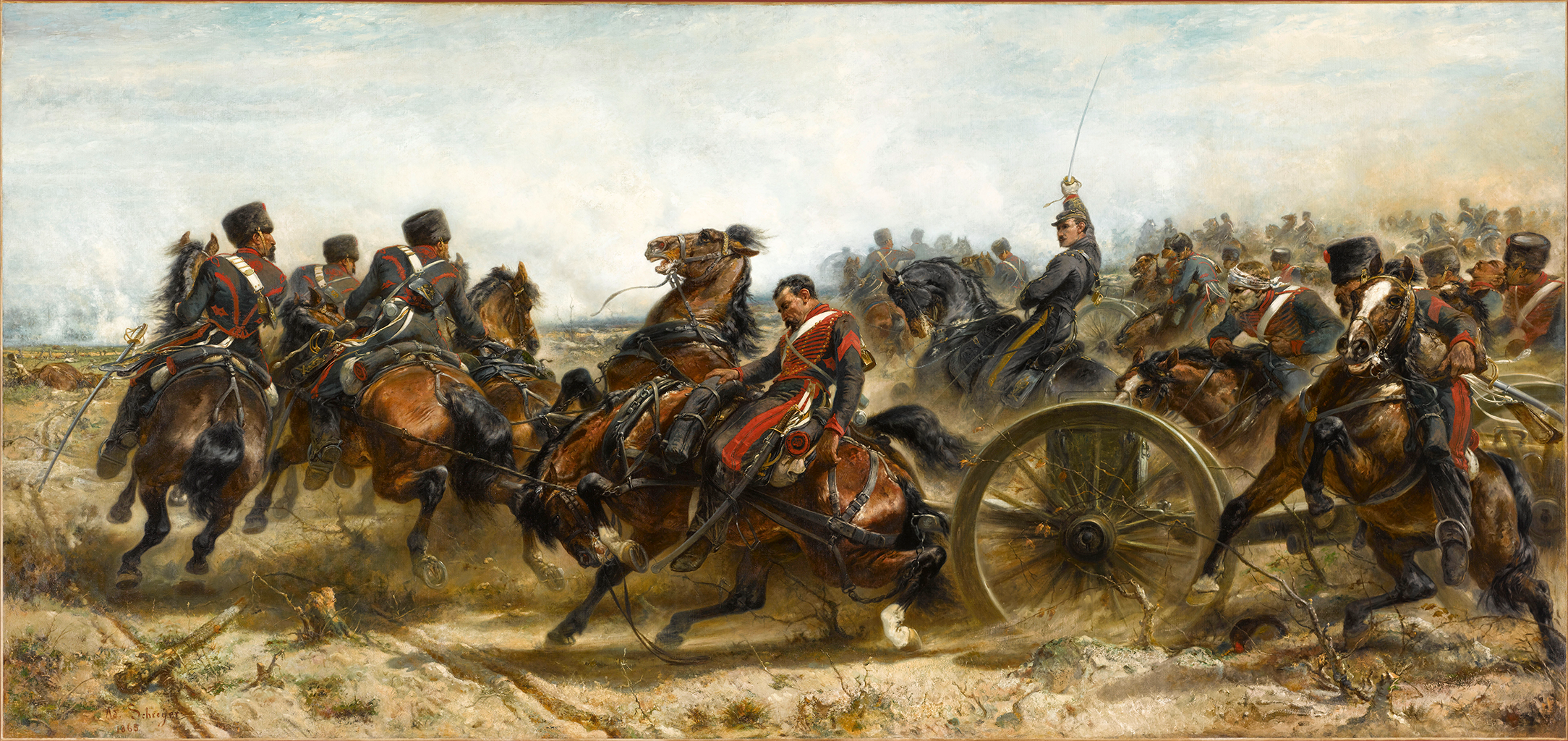
Born in Frankfurt-am-Main in 1828, Christian Adolf Schreyer traveled widely in search of exotic locales to paint. His canvases, inspired by the snowy plains of Eastern Europe and the deserts of North Africa, won medals at three Salon, the: Exhibitions organized by the French Royal Academy of Painting and Sculpture (Académie Royale de Peinture et de Sculpture) and its successor the Academy of Fine Arts (Académie des Beaux Arts), which took place in Paris from 1667 onward., and wealthy American collectors sought them out.1Chauncey Mitchell Depew Jr. (1879–1931), the son of a senator from New York, probably owned the Nelson-Atkins picture just before the museum purchased it in 1932. After studying at Frankfurt’s Städel Institut, Schreyer served as a painter-reporter for the German regiment of Maximilian Karl (1802–71), 6th Prince of Thurn und Taxis, during the Crimean War (1854–57). A decade after his wartime experience, Schreyer enthralled Parisian audiences with immersive battle scenes hailed as “the work of a master.”2Le Salon de 1865 (Lyon, France: L. Perrin, 1865), 17. Translations are by the author unless otherwise noted. At the Salon of 1865, Schreyer earned a medal for The Charge of the Artillery of the Imperial Guard, Traktir, Crimea, 16 August 1855 (Fig. 1), purchased by the French State after the Salon and now in the collection of the Musée d’Orsay. This painting displays all the trademarks of Schreyer’s work: proximity to the action, attention to the details of uniforms and anatomy, and empathy for the trauma experienced by warhorses. Schreyer’s depiction of horse anatomy is so precise that the Nelson-Atkins picture, which is contemporaneous to The Charge of the Artillery, was recently used as an illustration in a study on horse genetics.3William M. Hudson Jr., Matrilines of the Egyptian Arabian Horse, 2 vols. (Cumming, GA: Hudson Cardiology, 2018).
Schreyer made detailed studies during his many travels
through the Balkans, the Middle East, and North Africa
and used them to create finished paintings throughout
his career. Since Schreyer recycled motifs and there
is no existing archive of his correspondence, it is
difficult to date his finished paintings.4The Metropolitan Museum of Art holds a letter
from Schreyer to the New York dealer Samuel P.
Avery dated to 1879. The only painting referenced
in it is one of Schreyer’s Eastern European
scenes, Wallachwagen, Sonneneffect, April
1874, 37 13/16 x 22 in. (96 x 56 cm), which sold
for six thousand francs. Christian Adolf Schreyer
to Samuel P. Avery, June 20, 1879, “European
Letters: Samuel Putnam Avery Papers,” Thomas J.
Watson Library, The Metropolitan Museum of Art,
New York,
https://libmma
The specific group that Schreyer painted in many of
his pictures, including the Nelson-Aktins painting,
was the Arab Berber corps of mercenaries known as
spahis, a critical component of French
imperial rule.6Berbers are one of the Indigenous groups of the
Maghreb (North Africa). The more apt description
of the men depicted in Schreyer’s picture is “Arab
Berbers,” since there was significant
intermarriage between Berbers and Arabs following
the spread of Islam via the armies of the Prophet
Muhammad to North Africa beginning in 652 ᴄᴇ. In
modern-day Algeria, 99 percent of the population
identifies as Arab Berbers, and the majority
language is Arabic. “Algeria”
CIAWorldFactbook.gov (accessed November
5, 2019),
https://web.archive.org
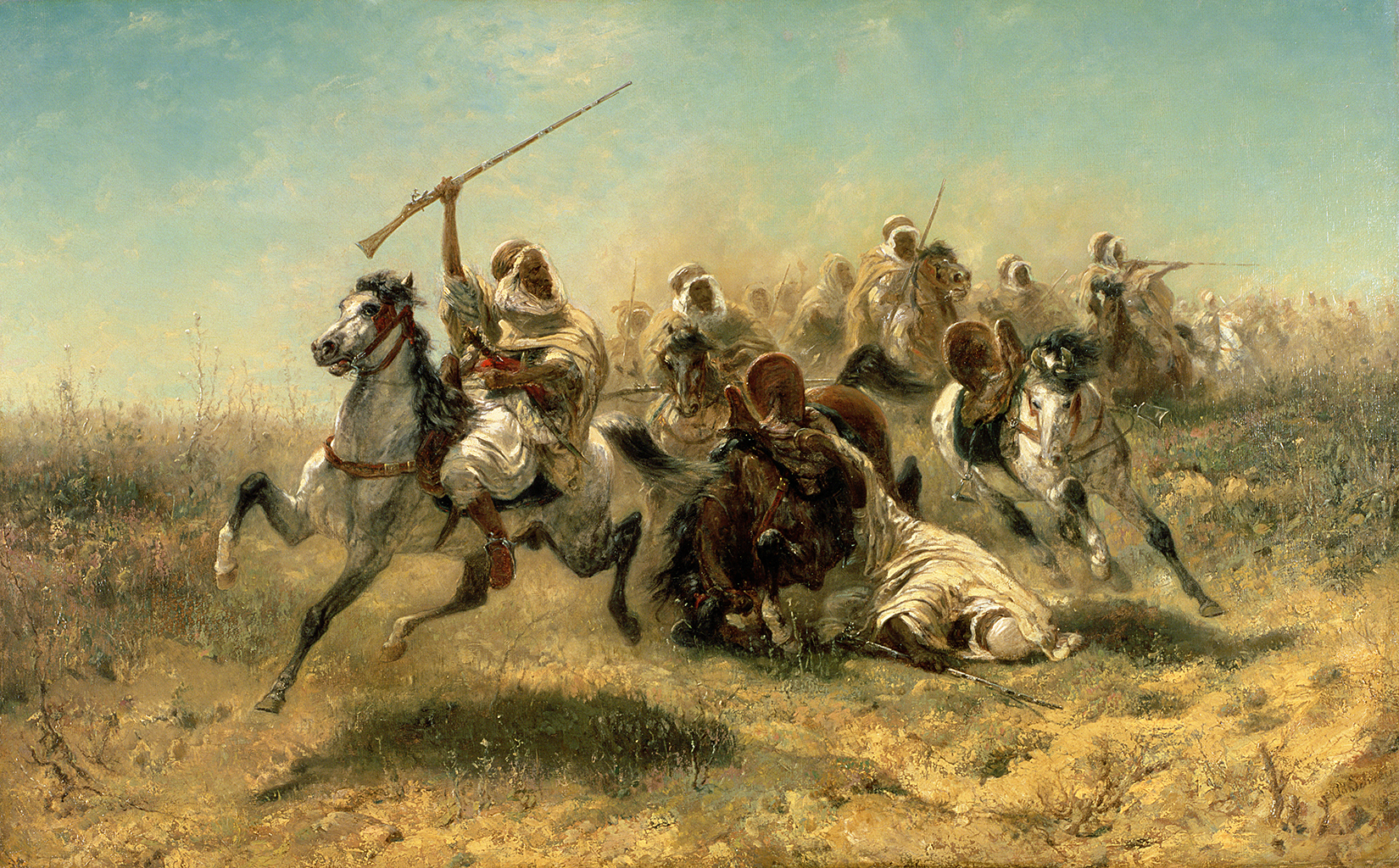
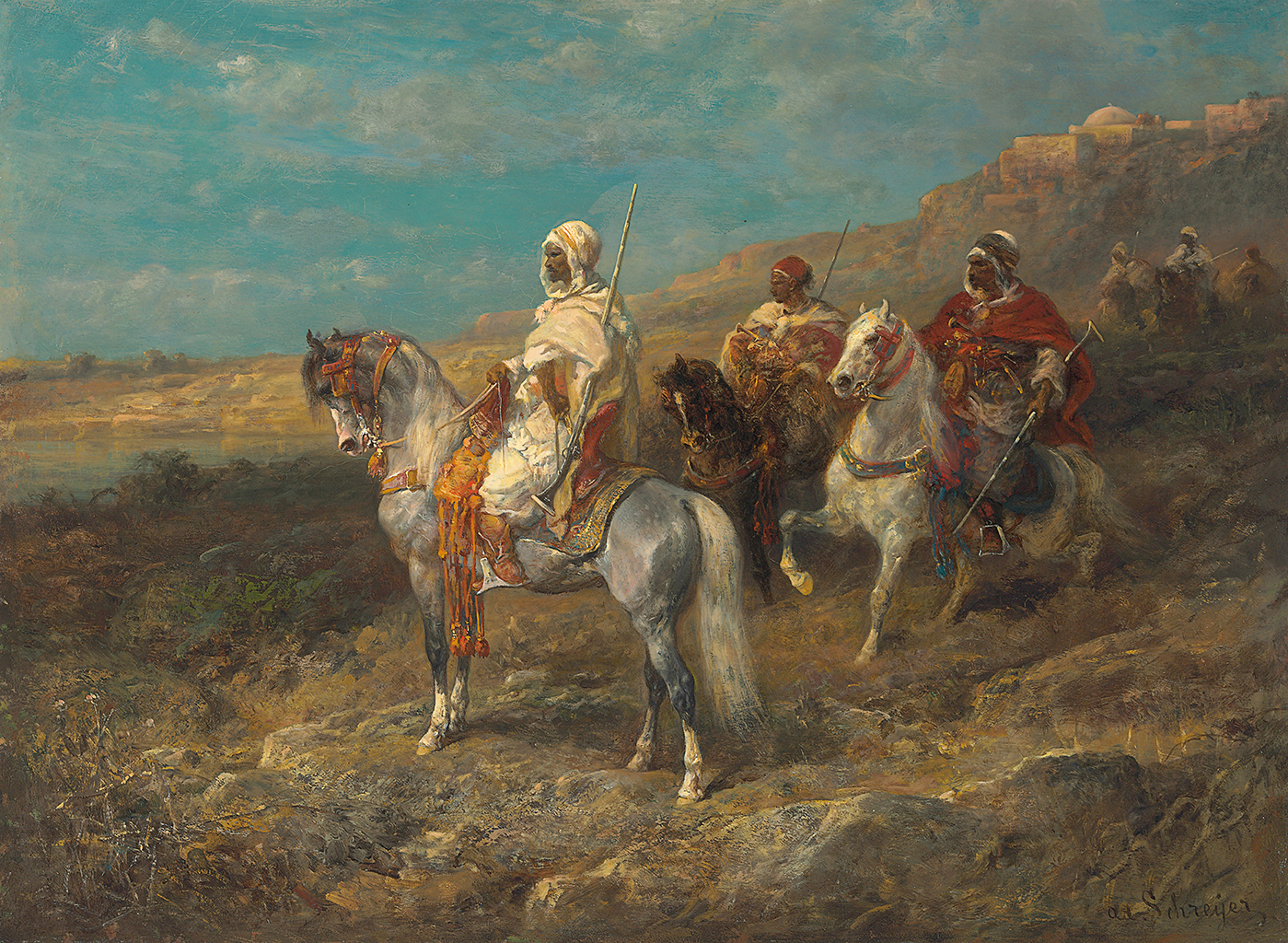
As mentioned, Schreyer’s works are difficult to date, but he developed the motif of the Nelson-Atkins and Christie’s pictures around 1863, when he was living in Paris. Further historical context supports the assertion that the Nelson-Atkins painting, Algerian Horsemen near an Oasis (possibly Biskra), is a depiction of Algerian spahis policing a critical French military outpost. The term spahi, used to describe Indigenous Arab Berbers recruited by the French to assist in maintaining imperial control in the Maghreb (North Africa), derives from the Turkish sipahi. The French utilized a system of native mercenaries that had been effective for their Ottoman predecessors in North Africa. Unlike artists who traveled to Algeria later in the century, when it had become a popular tourist destination, Schreyer observed the military phase of the French conquest of Algeria. In Schreyer’s painting The Charge (Fig. 3), Indigenous men brandishing muskets gallop into the foreground. They emblematize the “anarchic tribal society” that the French perceived in North Africa; the French argued that they “saved” North Africa by imposing European order.9Driss Maghraoui, “From ‘Tribal Anarchy’ to ‘Military Order’: The Moroccan Troops in the Context of Colonial Morocco,” Oriente Moderno (2004): 230. The empty saddles and the figure who has slumped to the ground are evidence that these men are engaged in battle, though their enemies are beyond the picture’s frame. In comparison, the Nelson-Atkins picture depicts five horsemen arrayed against a mountainous backdrop, clad in red and white burnous (a long, loose, hooded garment traditionally worn by Arabs).10Derived from the Berber word abernus, the burnous is the traditional dress in the Maghreb. Made of heavy wool, a burnous is usually white. Wolfgang Bruhn and Maurice Cottaz, Encyclopédie du costume: Des peuples de l’Antiquité à nos jours ainsi que (Paris: Nouvelles editions latines, 1990), 80. In colonial Morocco, the Berber spahis were readily identifiable by their blue burnous. The French Resident-General in Morocco from 1912 to 1925, Marshal Hubert Lyautey, wrote of the spahis, “My thoughts go to the men in blue burnous, who gave their lives to French peace.”11Maghraoui, “From ‘Tribal Anarchy’ to ‘Military Order,’” 228. Their Algerian counterparts, as seen in Schreyer’s paintings, wore red sashes and cloaks.
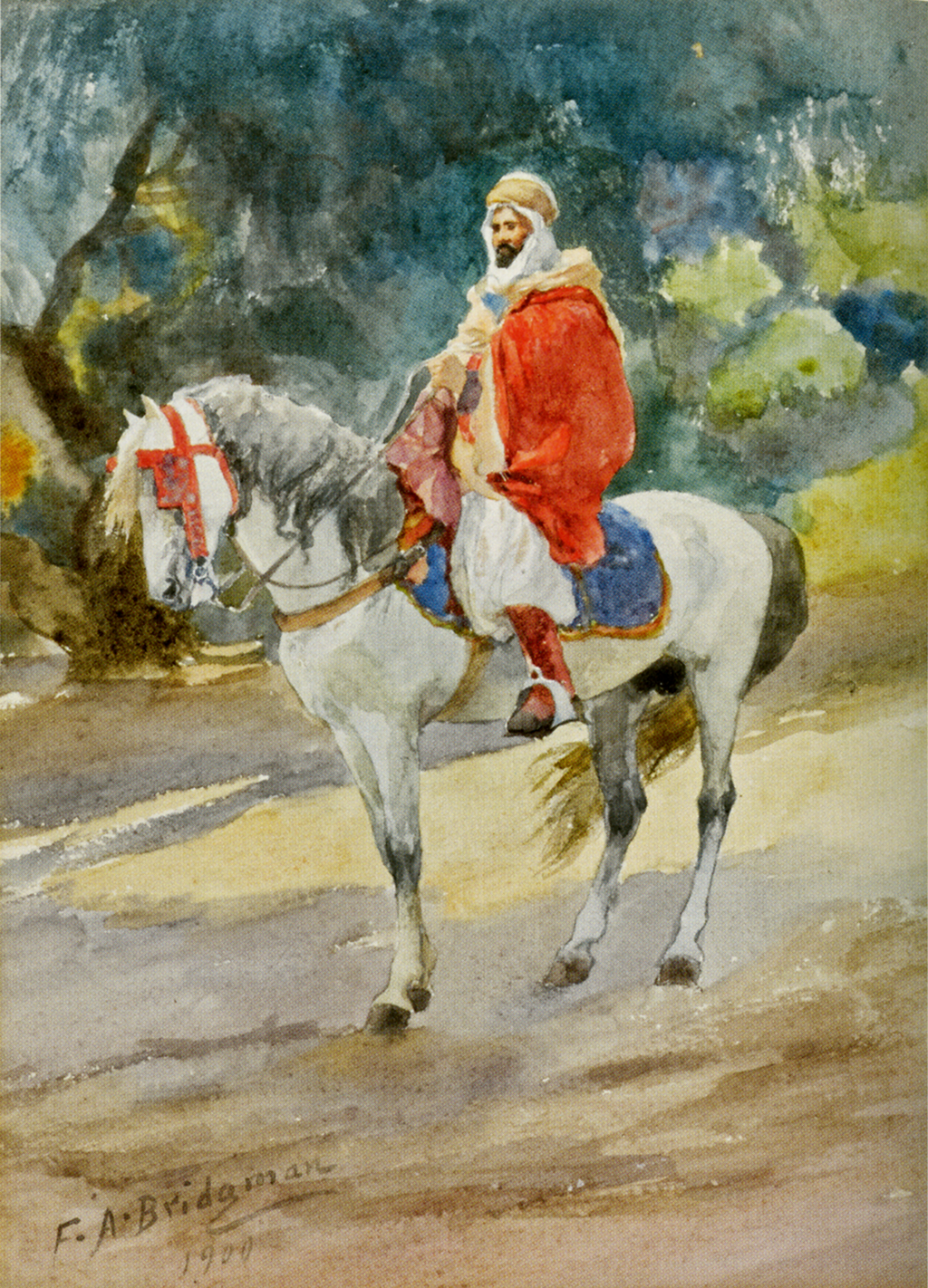
The red burnous was a recognizable motif in Orientalist art (Fig. 4) and literature and a hated symbol among Algerians fighting against French imperialism. In her 1922 short story Le manteau de spahi, the writer Colette depicts a French mother’s obsession with “the cloak of a spahi, red, and of fine cloth, [which] slept folded in a used sheet.”12Colette, Le maison de Claudine (Paris: Ferenczi, 1922), 125. The protagonist’s husband, a wounded French soldier, had brought the red burnous home as a trophy from the Algerian campaign. Despite the mother’s efforts at preservation, mites chew holes in the cloak, which devastates her. In Sage Goellner’s analysis of the story, the burnous stands for the amputated soldier, French nostalgia for days of empire gone by, and the tattered state of France’s colonial government in Algeria.13Colette’s own father, Captain Jules-Joseph Colette, served in the Zouave regiment in North Africa. She noted that his military journals were eerily blank. She surmised that he was ambivalent about his military service and, in her short story, he is the model for the amputated father figure. Sage Goellner, “Algeria in France: Colette’s ‘Le manteaux de spahi,’” French Review 65, no. 3 (February 2012): 483, 486. At the end of the story, the father turns the ruined garment into a pen cleaner, transforming the exotic into the quotidian, which speaks to how colonialism infiltrated the everyday in mainland France.
The historical title of the Nelson-Atkins picture, The Oasis, is the first clue to determining where Schreyer traveled.14See Important Paintings by Schreyer, Heuner, Daubigny, Dessar, Murphy, Van Goyen, Gainsborough, Lobley, Van Huysam and Artists of Like Distinction from Several Collections together with an Atheneum Portrait of Washington, by Stuart, and a Portrait of Judge Robert Johnson, by Waldo from the Estate of the Late Chauncey M. Depew, Jr., O’Reilly’s Plaza Art Galleries, New York, December 4, 1931, lot 11, as The Oasis. One of his other pictures, Arab at a Fountain in Bouchagroune (Algérie) (location of painting unknown), includes the name of a town in Biskra Province, a region encircling the oasis of Biskra.15Schreyer gave this painting to the artist François Bonvin, who then lost his livelihood when he became blind and paralyzed. Bonvin sold his collection at Hôtel Drouot on May 9–10, 1887, to support himself. Catalogue de tableaux, aquarelles, dessins, sculptures, etc.; Offerts par les artistes a [sic] F. Bonvin, leur confrère frappe de cécité et de paralysie (Paris: Hôtel Drouot, May 9–10, 1887). The quickest route to Biskra at the time was a steamer ship from Marseille to the Algerian port of Skikda (renamed Philippeville in 1838 by the French colonial administration, in honor of King Louis-Philippe). From Skikda to Biskra was an additional two-hundred-mile overland journey, for a total of approximately three days’ travel from Paris.16In Alfred E. Pease’s travel guide of 1893, he writes that European travelers in the Maghreb should take the train to reach Biskra from a variety of places, including Algiers and El Kantara. Alfred E. Pease, Biskra and the Oases and Desert of the Zibans with Information for Travellers (London: Edward Stanford, 1893), 9. When Schreyer traveled there in 1861, Algeria was not yet fully under French control, and it is unclear if his journey would have been smooth. For the first forty years of French occupation, French Algeria was a military state.17Patricia M. E. Lorcin, “Imperialism, Colonial Identity, and Race in Algeria, 1830–70: The Role of the French Medical Corps,” Isis 90, no. 4 (December 1999): 655. On March 14, 1844, Henri d’Orléans (1822–97), Duke of Aumale and King Louis-Philippe’s son, besieged Biskra with three thousand French troops and installed the Ben Ganah family as leaders of the city in return for their assistance to the French Army.18Benjamin Claude Brower, A Desert Named Peace: The Violence of France’s Empire in the Algerian Sahara, 1844–1902 (New York: Columbia University Press, 2009), 29. While the French boasted that they had captured Biskra without firing a shot, there was a mutiny among the Indigenous mercenaries less than two months later.19Brower, A Desert Named Peace, 40. Resistance to French rule was persistent, and the garrison at Biskra required five hundred permanent French soldiers just to maintain their foothold in the North African desert.20Brower, A Desert Named Peace, 41.
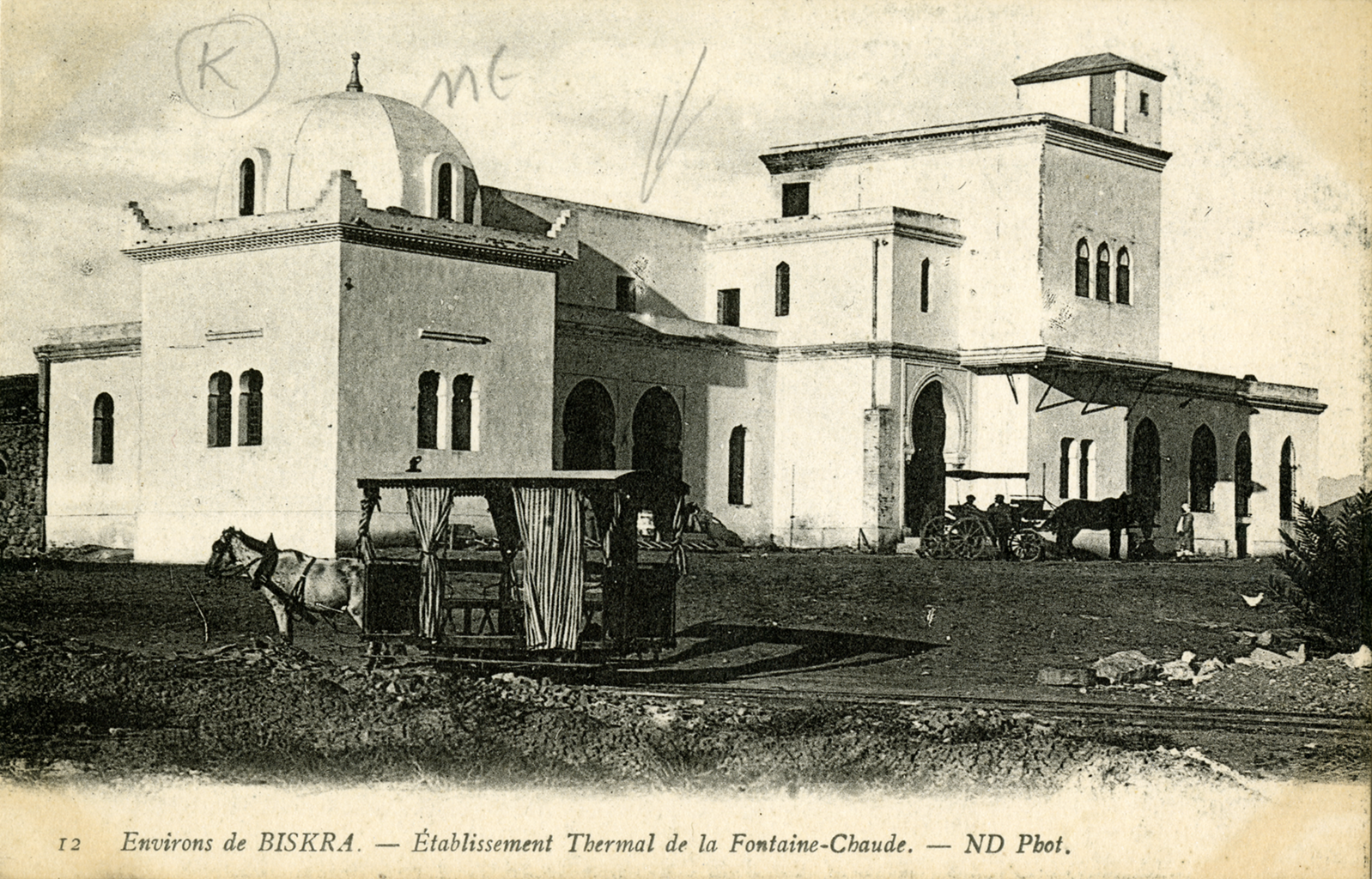
A further clue that the backdrop in both the Nelson-Atkins and Christie’s pictures is a Biskra vista is the similarity of the white adobe structure atop the hill to Biskra’s local baths, the Hammam Salihine (Fig. 5), located in Vieux-Biskra at a higher elevation than the core of the city. Biskra has regular access to water due to its several intermittently watered riverbeds, one of which is visible from the Hammam Salihine and also appears in the left middle ground of the Christie’s picture. Water was such a crucial resource to the French that they ranked the 360 Saharan oases under their control by each one’s quantity of date palm trees, which indicated the strength of its water supply.21Pease, Biskra and the Oases and Desert of the Zibans, 35. Biskra’s prevalence of water and date palms earned it the moniker “Queen of the Sahara.”22Major F. W. Begbie, “A Holiday Trip in Algeria,” Journal of the Royal Army Medical Corps 7 (January 1906): 291. As early as the Middle Ages, Biskra was described as a “place of palm date trees and flowing water” by the Arab geographer Muhammed Al-Muqaddasī (945/6–991 ᴄᴇ).23Al-Muqaddasī cited and translated from Arabic to French in Mohamed Meouak, Les Ziban entre Aurès et Sahara: Une géographie historique de Biskra et des ses oasis du Moyen Âge à la fin de l’époque moderne (Helsinki: Academia Scientiarum Fennica, 2017), 154. Both European and Arabic sources speak to Biskra’s pivotal position at the mouth of the Sahara desert. Crowning the hillside behind the spahis, the baths were a critical piece of infrastructure for the French to control, which Schreyer highlighted by including them in the Nelson-Atkins and Christie’s pictures.
Once a darling of America’s most prominent collectors, Schreyer is scarcely mentioned in the vast body of modern scholarship on Orientalist painting. As the Nelson-Atkins picture shows, his depiction of Algerian spahis provides rare, early insight into the French colonial military state, whereas most other images of Biskra date from later in the century, when the city became a tourist destination. A recent exhibition at the Arab Institute in Paris highlighted Biskra’s burgeoning tourist industry beginning in the 1880s, assembling images of bazaars, fantasized harems, and photographs of other local sites as seen through European eyes.24Roger Benjamin, Biskra: Sortilèges d’une oasis, exh. cat. (Paris: l’Institut du monde arabe, 2016). Most famously, Henri Matisse’s Nu bleu (Souvenir de Biskra) / Blue Nude (Memory of Biskra) (1907; Baltimore Museum of Art) presented the Maghreb as a region that was easily accessible to Europeans in every sense. Schreyer’s paintings are a preamble to the development of Algeria as a tourist destination for Europeans. His depictions of spahis performing reconnaissance tasks at the mouth of the Sahara are crucial to a full understanding of the French imperial project in North Africa.
Notes
-
Chauncey Mitchell Depew Jr. (1879–1931), the son of a senator from New York, probably owned the Nelson-Atkins picture just before the museum purchased it in 1932.
-
Le Salon de 1865 (Lyon, France: L. Perrin, 1865), 17. Translations are by the author unless otherwise noted.
-
William M. Hudson Jr., Matrilines of the Egyptian Arabian Horse, 2 vols. (Cumming, GA: Hudson Cardiology, 2018).
-
The Metropolitan Museum of Art holds a letter from Schreyer to the New York dealer Samuel P. Avery dated to 1879. The only painting referenced in it is one of Schreyer’s Eastern European scenes, Wallachwagen, Sonneneffect, April 1874, 37 13/16 x 22 in. (96 x 56 cm), which sold for six thousand francs. Christian Adolf Schreyer to Samuel P. Avery, June 20, 1879, “European Letters: Samuel Putnam Avery Papers,” Thomas J. Watson Library, The Metropolitan Museum of Art, New York, https://libmma.contentdm.oclc.org
/digital . Beyond this letter, there are no existing records of Schreyer’s words./collection /p15324coll13 /id /14805 -
Schreyer has only received one retrospective in the United States, a 1972 exhibition at the Paine Art Center in Oshkosh, Wisconsin. Edmund B. Nielsen curated the exhibition and compiled a much-needed but incomplete catalogue raisonné of Schreyer’s paintings: Adolf Schreyer: An International Exhibition Presented by the Paine Art Center and Arboretum, exh. cat. (Oshkosh, WI: Paine Art Center and Arboretum, 1972). Even within Schreyer’s home country, there has been only one monographic exhibition, Adolf Schreyer (1828–1899), held in 1999 in Kronberg im Taunus, where Schreyer died in 1899.
-
Berbers are one of the Indigenous groups of the Maghreb (North Africa). The more apt description of the men depicted in Schreyer’s picture is “Arab Berbers,” since there was significant intermarriage between Berbers and Arabs following the spread of Islam via the armies of the Prophet Muhammad to North Africa beginning in 652 ᴄᴇ. In modern-day Algeria, 99 percent of the population identifies as Arab Berbers, and the majority language is Arabic. “Algeria,” CIAWorldFactbook.gov (accessed November 5, 2019), https://web.archive.org
/web ./20070612211925 /https://www.cia.gov /library /publications /the -world -factbook /geos /ag.html -
“Le poste avancé de spahis” (“The outpost of spahis”); “un spahis, monté sur un cheval gris ardoise” (“a spahi mounted on a slate-gray horse”); “monté sur un cheval al zan” (“mounted on a chestnut horse.”) “Salon de 1863,” Le Temps, no. 208 (July 12, 1863): 1.
-
19th Century European Art and Orientalist Art (New York: Christie’s, October 22, 2008), lot 4, as Arabischer Schimmelreiter. The painting was in the J. P. Schneider collection in Frankfurt as of 1984 and later with Galerie Bühler in Munich. In this essay, I make the first identification of the 1863 picture as the one sold at Christie’s in 2008.
-
Driss Maghraoui, “From ‘Tribal Anarchy’ to ‘Military Order’: The Moroccan Troops in the Context of Colonial Morocco,” Oriente Moderno (2004): 230.
-
Derived from the Berber word abernus, the burnous is the traditional dress in the Maghreb. Made of heavy wool, a burnous is usually white. Wolfgang Bruhn and Maurice Cottaz, Encyclopédie du costume: Des peuples de l’Antiquité à nos jours ainsi que (Paris: Nouvelles editions latines, 1990), 80.
-
Maghraoui, “From ‘Tribal Anarchy’ to ‘Military Order,’” 228.
-
Colette, Le maison de Claudine (Paris: Ferenczi, 1922), 125.
-
Colette’s own father, Captain Jules-Joseph Colette, served in the Zouave regiment in North Africa. She noted that his military journals were eerily blank. She surmised that he was ambivalent about his military service and, in her short story, he is the model for the amputated father figure. Sage Goellner, “Algeria in France: Colette’s ‘Le manteaux de spahi,’” French Review 65, no. 3 (February 2012): 483, 486.
-
See Important Paintings by Schreyer, Heuner, Daubigny, Dessar, Murphy, Van Goyen, Gainsborough, Lobley, Van Huysam and Artists of Like Distinction from Several Collections together with an Atheneum Portrait of Washington, by Stuart, and a Portrait of Judge Robert Johnson, by Waldo from the Estate of the Late Chauncey M. Depew, Jr., O’Reilly’s Plaza Art Galleries, New York, December 4, 1931, lot 11, as The Oasis.
-
Schreyer gave this painting to the artist François Bonvin, who then lost his livelihood when he became blind and paralyzed. Bonvin sold his collection at Hôtel Drouot on May 9–10, 1887, to support himself. Catalogue de tableaux, aquarelles, dessins, sculptures, etc.; Offerts par les artistes a [sic] F. Bonvin, leur confrère frappe de cécité et de paralysie (Paris: Hôtel Drouot, May 9–10, 1887).
-
In Alfred E. Pease’s travel guide of 1893, he writes that European travelers in the Maghreb could take the train to reach Biskra from a variety of places, including Algiers and El Kantara. Alfred E. Pease, Biskra and the Oases and Desert of the Zibans with Information for Travellers (London: Edward Stanford, 1893), 9.
-
Patricia M. E. Lorcin, “Imperialism, Colonial Identity, and Race in Algeria, 1830–1870: The Role of the French Medical Corps,” Isis 90, no. 4 (December 1999): 655.
-
Benjamin Claude Brower, A Desert Named Peace: The Violence of France’s Empire in the Algerian Sahara, 1844–1902 (New York: Columbia University Press, 2009), 29.
-
Brower, A Desert Named Peace, 40.
-
Brower, A Desert Named Peace, 41.
-
Pease, Biskra and the Oases and Desert of the Zibans, 35.
-
Major F. W. Begbie, “A Holiday Trip in Algeria,” Journal of the Royal Army Medical Corps 7 (January 1906): 291.
-
Al-Muqaddasī cited and translated from Arabic to French in Mohamed Meouak, Les Ziban entre Aurès et Sahara: Une géographie historique de Biskra et des ses oasis du Moyen Âge à la fin de l’époque moderne (Helsinki: Academia Scientiarum Fennica, 2017), 154.
-
Roger Benjamin, Biskra: Sortilèges d’une oasis, exh. cat. (Paris: l’Institut du monde arabe, 2016).
Technical Entry
Citation
Chicago:
Diana M. Jaskierny, “Christian Adolf Schreyer, Algerian Horsemen near an Oasis (possibly Biskra), ca. 1863,” technical entry in French Paintings and Pastels, 1600–1945: The Collections of the Nelson-Atkins Museum of Art, ed. Aimee Marcereau DeGalan (Kansas City: The Nelson-Atkins Museum of Art, 2026), https://doi.org/10.37764/78973.5.418.2088.
MLA:
Jaskierny, Diana M. “Christian Adolf Schreyer, Algerian Horsemen near an Oasis (possibly Biskra), ca. 1863,” technical entry. French Paintings and Pastels, 1600–1945: The Collections of The Nelson-Atkins Museum of Art, edited by Aimee Marcereau DeGalan, Nelson-Atkins Museum of Art, 2026. doi: 10.37764/78973.5.418.2088.
Algerian Horsemen near an Oasis (possibly
Biskra)
was executed on a
plain weave: A basic textile weave in
which one weft thread alternates over and under
the warp threads. Often this structure consists of
one thread in each direction, but threads can be
doubled (basket weave) or tripled to create more
complex plain weave. Plain weave is sometimes
called tabby weave.
canvas, corresponding closely in size to a
standard-format supports: Commercially
prepared supports available through art suppliers,
which gained popularity in the nineteenth century
during the industrialization of art materials.
Available in three formats
figure (portrait),
paysage (landscape), and
marine (marine), these were numbered 1
through 120 to indicate their size. For each
numbered size, marine and
paysage had two options available: a
larger format (haute) and smaller
(basse) format.
no. 20 figure canvas.1David Bomford, Jo Kirby, John Leighton, and Ashok
Roy, Art in the Making: Impressionism (London: Yale University Press, 1991), 46.
Early in the its history, the painting was glue-paste
lining: A procedure used to reinforce a
weakened canvas that involves adhering a second
fabric support using adhesive, most often a
glue-paste mixture, wax, or synthetic
adhesive., resulting in a slight expansion of the
picture plane: The two-dimensional surface
where the artist applies paint.
by a few millimeters on each side.2A French standard-format no. 20
figure measures 73 x 60 centimeters. This
painting’s current dimensions measure 73.5 x 61
centimeters; however, the approximate original
measurements are 72.5 x 59.5 centimeters, based on
creases indicating the original turnover
edges.
A branded
supplier mark: A mark (ink stamp, brand,
impression, etc.), often present on the reverse of
canvas, panel, or other support, signifying the
company that sold or prepared the support. As
these companies sometimes performed framing and
restorations, these marks could also reflect these
services. See also canvas stamp.
on the cross-member of the stretcher bears the name of
an
artist supplier(s): Also called colormen
and color merchants. Artist suppliers prepared
materials for artists. This tradition dates back
to the Medieval period, but the industrialization
of the nineteenth century increased their
commerce. It was during this time that ready-made
paints in tubes, commercially prepared canvases,
and standard-format supports were available to
artists for sale through these suppliers. It is
sometimes possible to identify the supplier from
stamps or labels found on the reverse of the
artwork. See also canvas stamp,
supplier mark, and
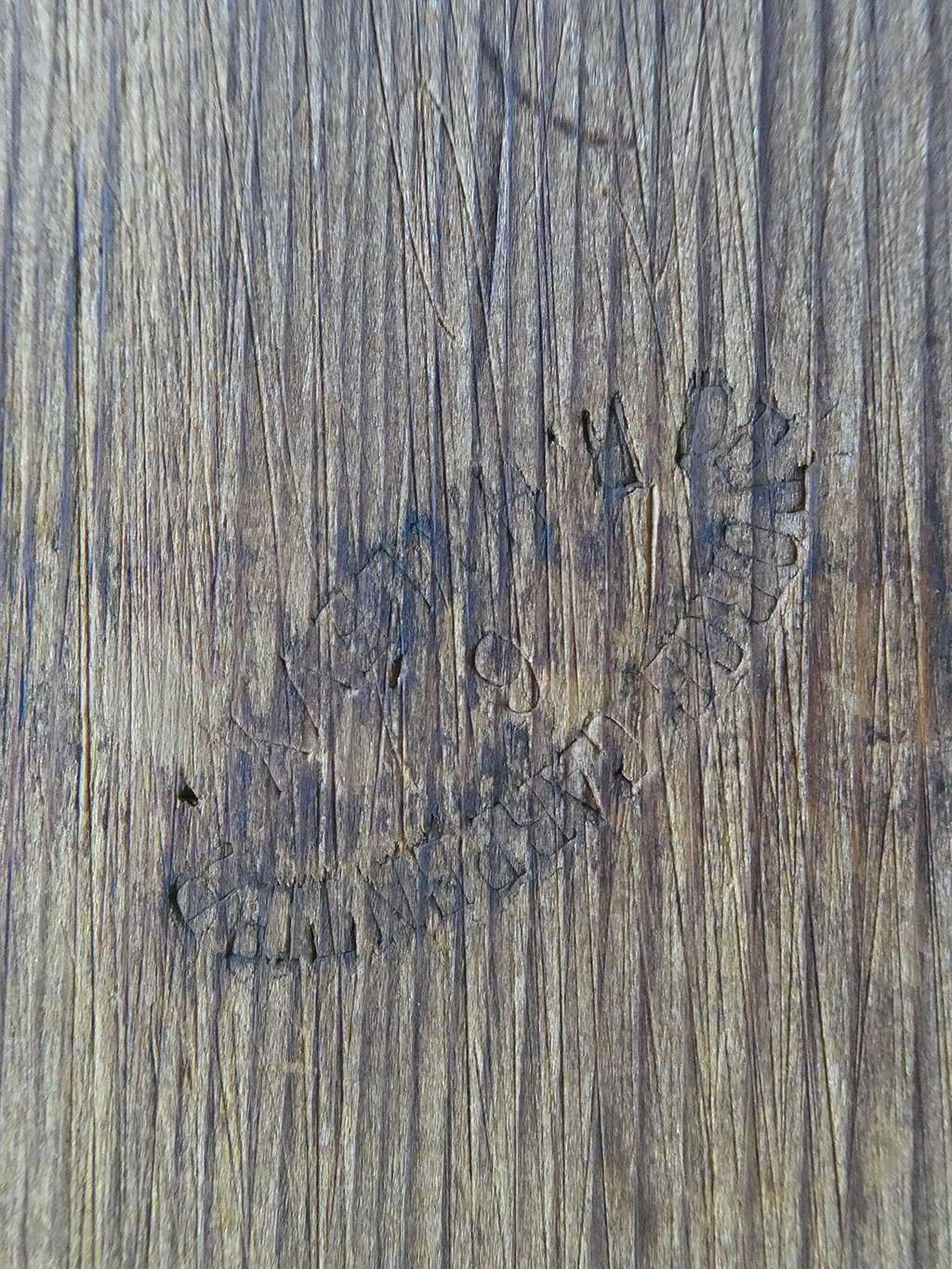
color merchant., Deforge-Carpentier (Fig. 6). However, documentation
on this company suggests that the address found on
this stamp, “6 R. Halévy,” dates to their operations
from August of 1870 to April of 1880, after the
painting’ completion. In addition to supplying
artists’ materials, this company also participated in
the sales of art and provided restorations, including
linings. The presence of this specific stamp indicates
that this stretcher is possibly non-original and
suggests that either a sale or restoration treatment
may have occurred by Deforge-Carpentier within the
first twenty years of this painting’s history.3While the stamp on the stretcher reads,
“Deforge-Carpentier,” the company was established
in 1830 as “Deforge” and changed its name and
address several times throughout its history,
including to “Deforge et Carpentier,”
“Carpentier-Deforge,” and finally “Carpentier”
before being sold and renamed “Bertrand et Cie” in
1880. This successor remained in operation at 6 R.
Halévy until 1883. Pascal Labreuche, “Carpentier
1869–1880,”
Guide Labreuche: Guide historique des
fournisseurs de matériel pour Artistes à Paris,
1790–1960, 2018,
https://www.guide
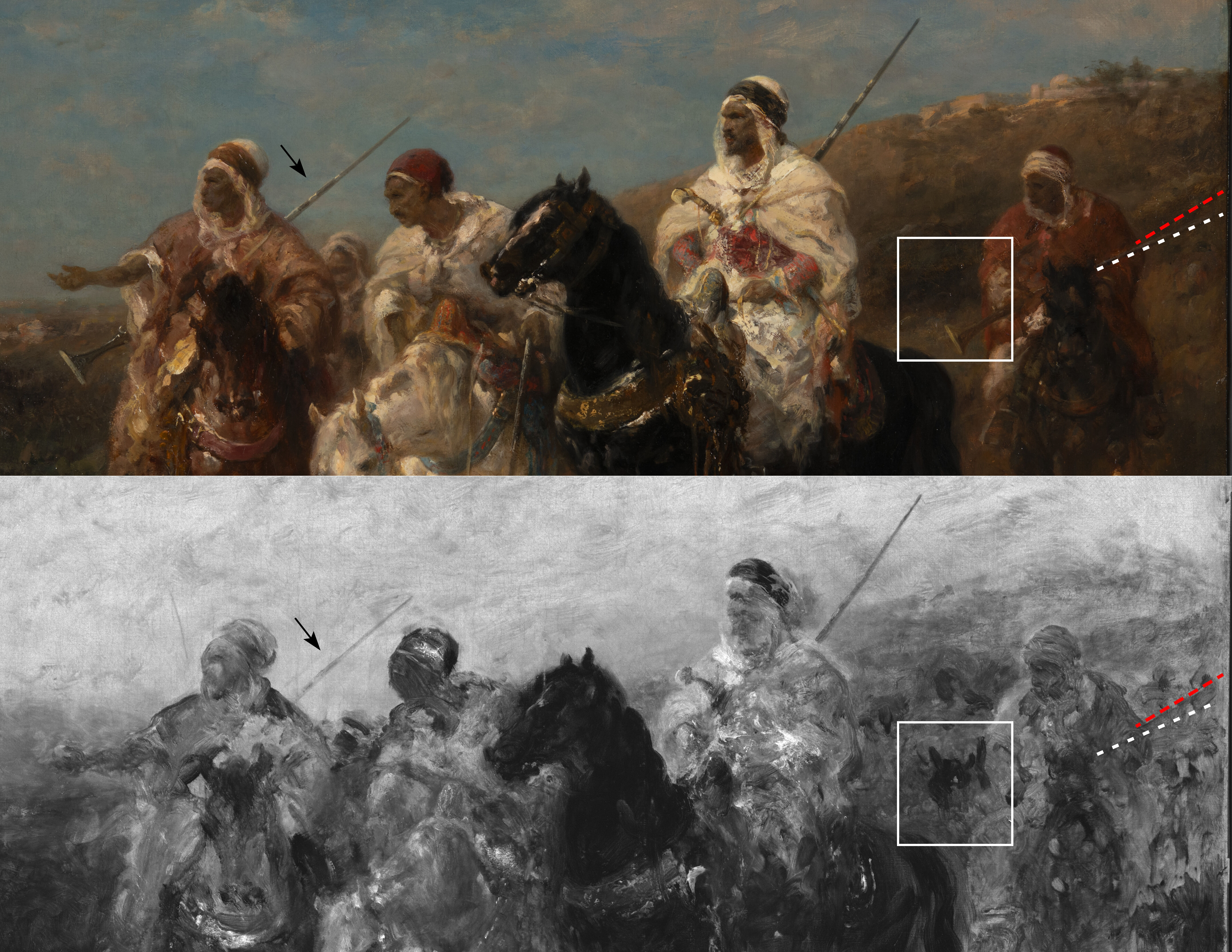
The canvas was prepared with a white or slightly off-white ground layer: An opaque preparatory layer applied to the support, either commercially or by the artist, to prevent absorption of the paint into the canvas or panel. See also priming layer..4Due to the lack of tacking margins, it is unclear if the ground layer was applied commercially or by the artist. No underdrawing was detected with infrared reflectography (IRR): A form of infrared imaging that exploits the behavior of painting materials at wavelengths beyond those accessible to infrared photography. These advantages sometimes include a continuing increase in the transparency of pigments beyond wavelengths accessible to infrared photography (i.e, beyond 1,000 nanometers), rendering underdrawing more clearly. The resulting image is called an infrared reflectogram. Devices that came into common use in the 1980s such as the infrared vidicon effectively revealed these features but suffered from lack of sharpness and uneven response. Vidicons continue to be used out to 2,200 nanometers but several newer pixelated detectors including indium gallium arsenide and indium antimonide array detectors offer improvements. All of these devices are optimally used with filters constraining their response to those parts of the infrared spectrum that reveal the most within the constraints of the palette used for a given painting. They can be used for transmitted light imaging as well as in reflection. or through microscopy. Schreyer frequently repeated the same or similar compositional motifs between his paintings, possibly reducing his reliance on underdrawings as he became more familiar with his compositions.5See the accompanying catalogue entry by Glynnis Napier Stevenson for comparative works. While minor artist changes are found throughout the composition, such as adjustments to the contours of the figures, three more notable changes were identified with infrared reflectography. As Schreyer finalized the image, he repositioned two of the gun barrels: the barrel for the leftmost figure was lowered approximately six millimeters to its current placement, and the angle of the barrel held by the rightmost figure was adjusted slightly, tipping it down. Infrared reflectography also reveals a dark shape between the two rightmost figures, resembling the head of a horse. This shape does not appear in the final composition and could possibly be the original placement of the horse on the right, or an additional horse that the artist chose not to include (Fig. 7).6In the infrared reflectograph, the nearly vertical line in the sky to the left of the leftmost figure does not appear to relate to an artist change but instead is retouching over a crack in the paint.
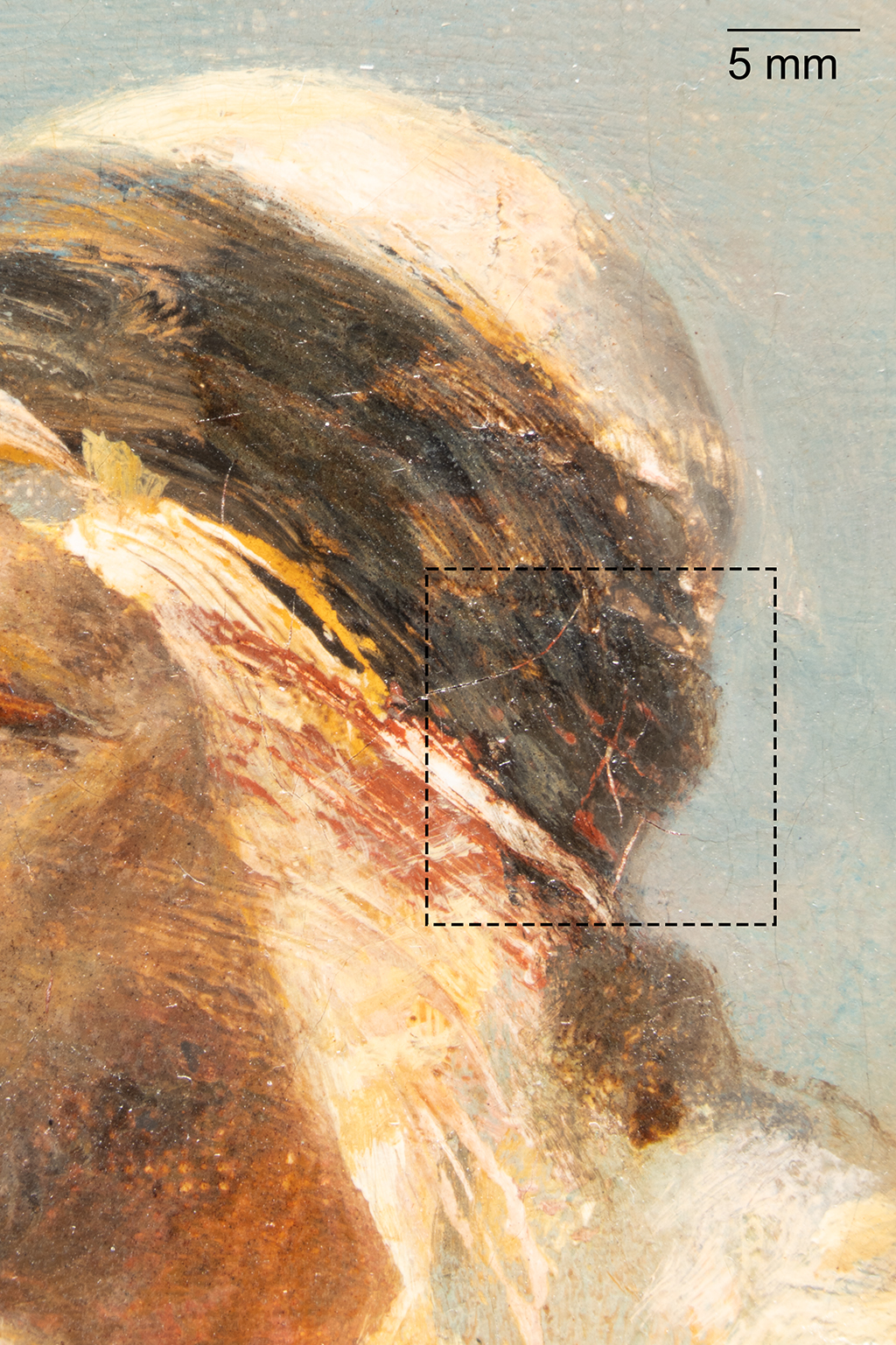
In place of a drawn preparation, it appears Schreyer laid in some components with an underpainting: The first applications of paint that begin to block in color and loosely define the compositional elements. Also called ébauche. to establish the scene. A thin, warm-toned wash: An application of thin paint that has been diluted with solvent. was applied beneath the landscape, ending shy of where the landscape meets the sky. This wash remains visible through much of the openly handled brushwork in the near foreground. Beneath some figures, such as in the head of the rider on the black horse, a red underlayer was painted, now visible through cracks in the paint (Fig. 8). Variations of warm and cool red underpaint are also found beneath the paint of the brown horses (Fig. 9), while the white horse does not appear to have been developed over a distinct underpainting.
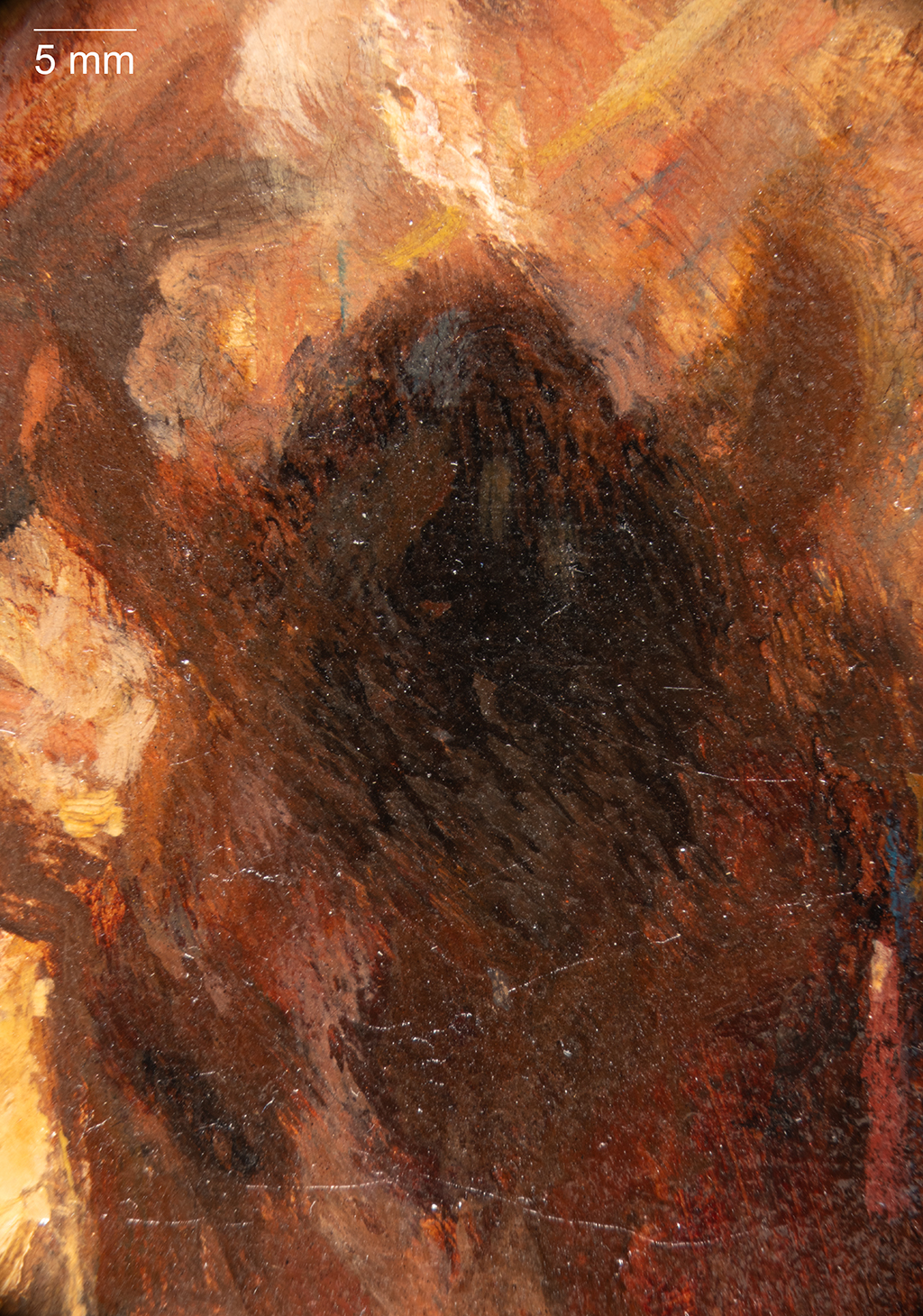
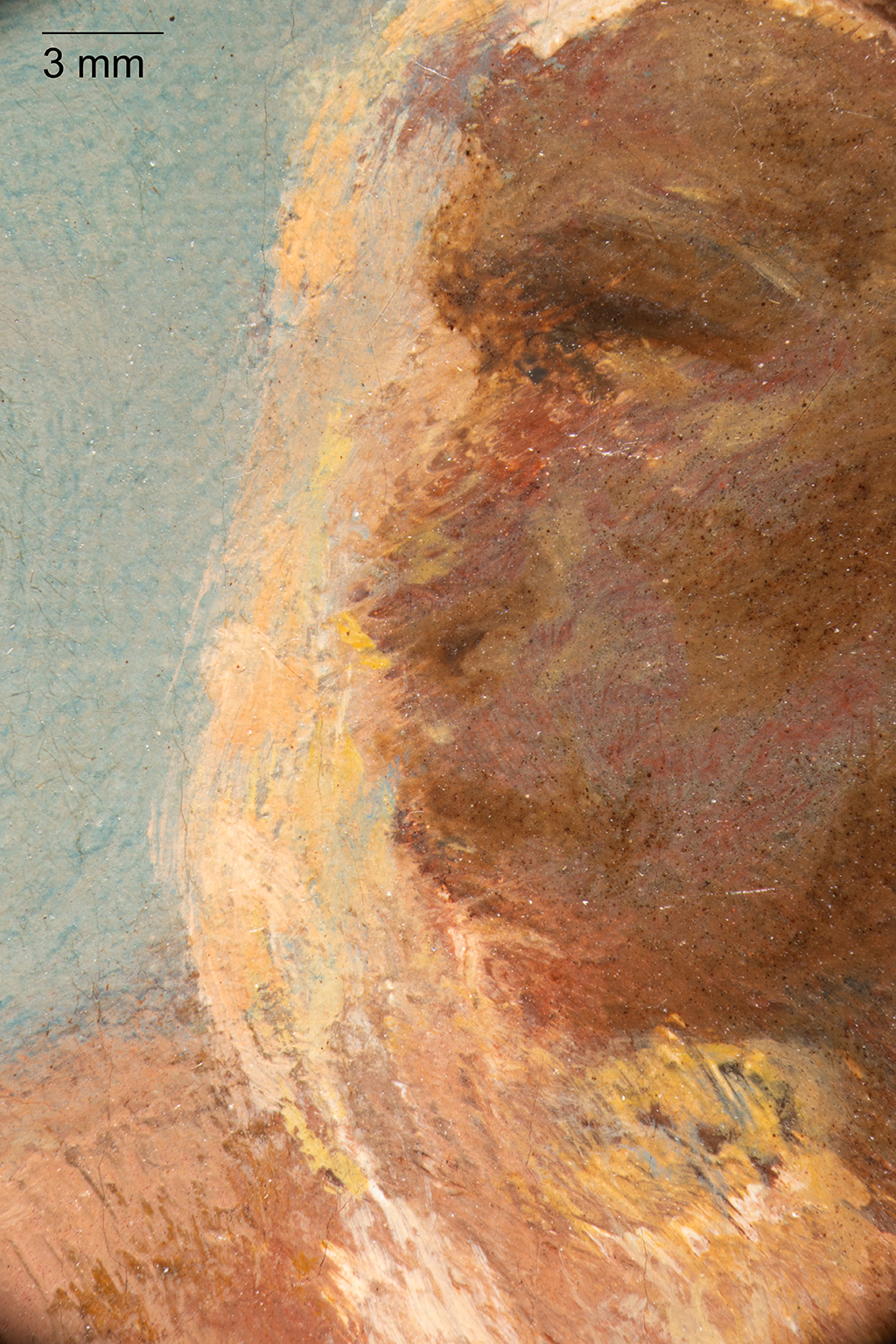
Constructed with loose brushwork, the composition is primarily composed of wet-over-wet: An oil painting technique which involves drawing a stroke of one color across the wet paint of another color. and wet-into-wet: An oil painting technique which involves blending of colors on the picture surface. paint application. Schreyer worked rapidly, often feathering adjacent passages of paint both within the compositional elements and between them and their surroundings, creating a softened, atmospheric effect.7Contemporaries of Schreyer commented on his ability to paint with accuracy while maintaining his rapid brushwork. James Thompson, The East, Imagined, Experienced, Remembered: Orientalist Nineteenth-Century Painting (Dublin: National Gallery of Ireland, 1988), 140. In the leftmost figure, for example, paint was pulled across the profile slightly, subtly obscuring features and softening the face (Fig. 10). As opposed to using a common technique of layering glazes over opaque paint, Schreyer alternated between opaque and translucent paints, creating depth and modulation where there is otherwise little form. This can be seen in the draped clothing of the leftmost figure where a translucent red-brown paint not dissimilar to that used for the landscape underpainting is found between opaque scumble: A thin layer of opaque or semi-opaque paint that partially covers and modifies the underlying paint. (Fig. 11).
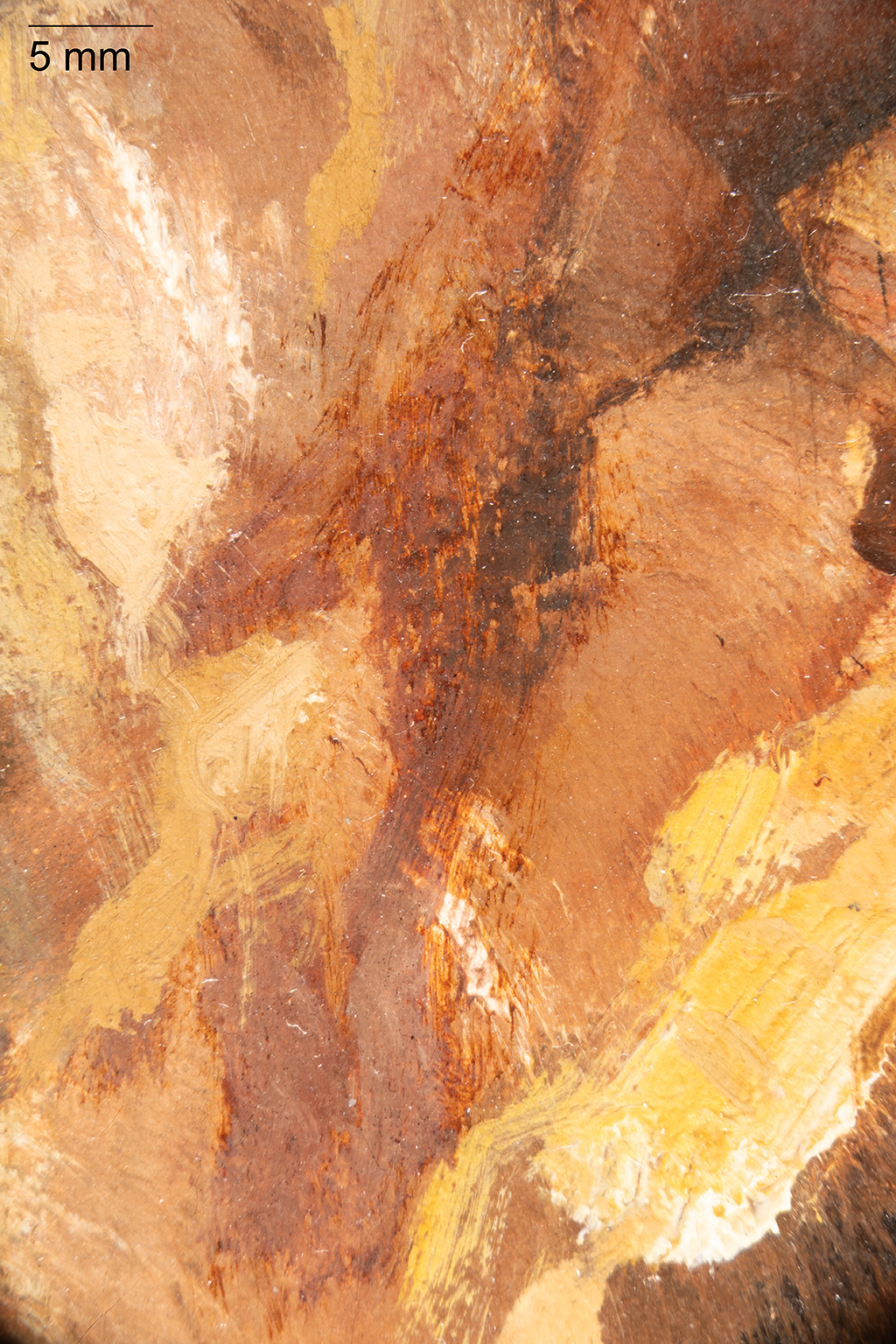
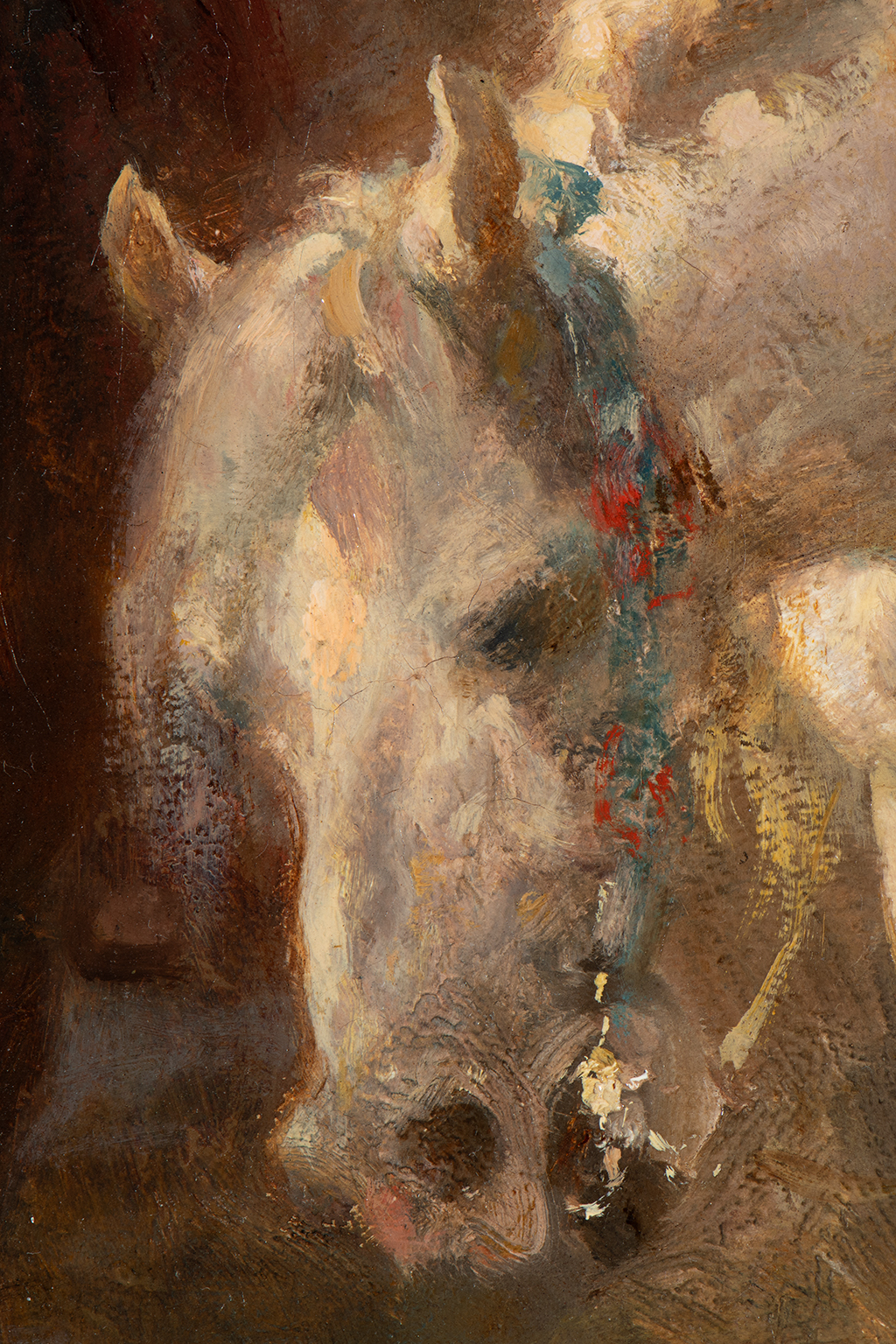
In comparison to his soft wet-into-wet blending, in other passages as the paint began to set, Schreyer continued to pull and manipulate the surface, often producing ripples and skips over the underlying paint, as is found in the face of the white horse (Fig. 12). Here, Schreyer’s knowledge of equine anatomy is evident, with the muzzle and nostrils developed through a few quickly placed brushstrokes.8Schreyer’s appreciation for horses began early, and he learned how to ride at a young age. As an adult, he frequently sketched and painted horses as he traveled across Europe and Africa. Inge Eichler, “Kosmopolit und Pferdenarr: Der Frankfurter Maler Adolf Schreyer,” Weltkunst 69, no. 4 (1999): 702–04. The artist also built the textures of the riders’ elaborate garments by allowing the top applications of paint to skip over the lower applications, likely once the lower paint was nearly dry to prevent blending. This is especially noticeable in the colorful fabric of the figure on the black horse, where vibrant reds skip over underlying blues (Fig. 13).9The only clearly identifiable wet-over-dry application is found in the left-side foliage, where green paint was applied over the already dried brown foreground. In this image, two fingerprints made from beige or pale pink paint are visible in the top of the center red region. These marks do not appear to be intentional to the composition and thus further reveal Schreyer’s rapid technique as the artist either was unaware of their presence or chose not to remove them.
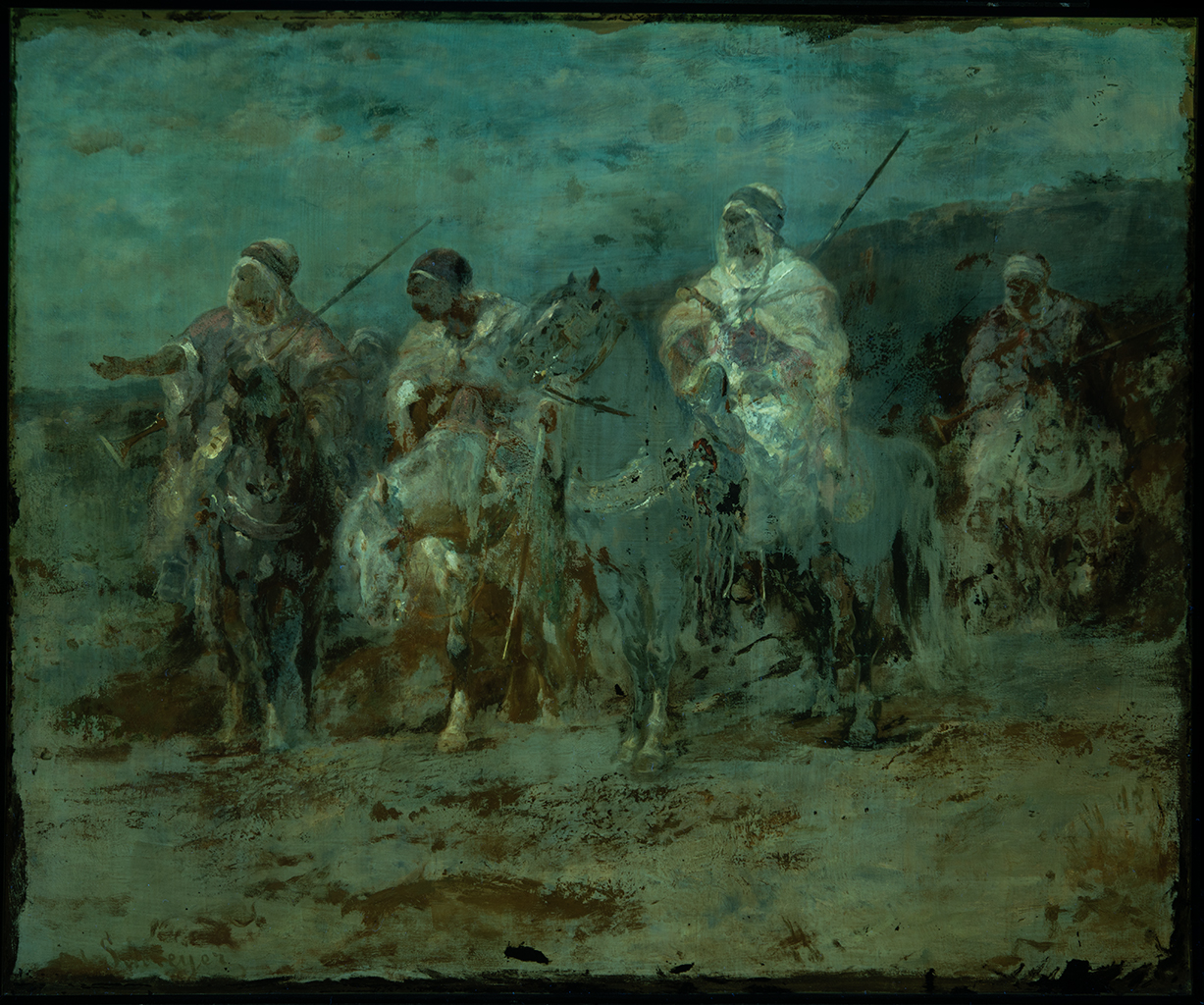
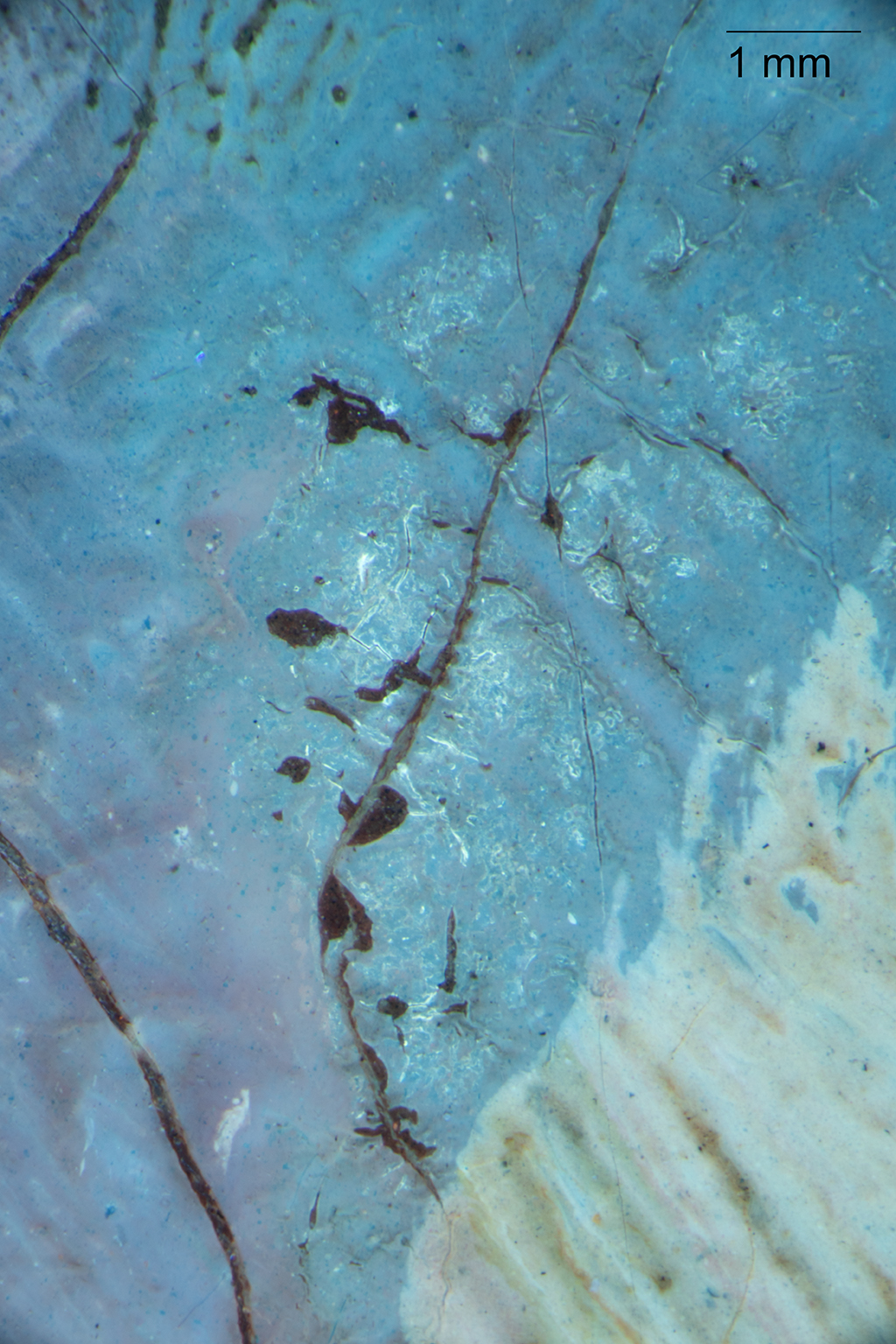
The painting is in good condition overall. Early in the painting’s history, it was glue-paste lined, during which time the tacking margins: The outer edges of canvas that wrap around and are attached to the stretcher or strainer with tacks or staples. See also tacking edge. were likely removed. The lining remains in good condition with adequate adhesion. The canvas is well tensioned and in plane except for one dent, found approximately 14.5 centimeters from the bottom edge and 13.5 centimeters from the left edge. In 1988, the first documented treatment was completed, including varnish removal and retouching: Paint application by a conservator or restorer to cover losses and unify the original composition. Retouching is an aspect of conservation treatment that is aesthetic in nature and that differs from more limited procedures undertaken solely to stabilize original material. Sometimes referred to as inpainting or retouch..10Scott Heffley, October 18, 1988, treatment report, NAMA conservation file, 32-10. During this treatment, it was noted that a “thick, badly discolored natural resin varnish” was removed, and it was replaced with a synthetic isolating varnish. Examination with ultraviolet (UV) radiation: A segment of the electromagnetic spectrum, just beyond the sensitivity of the human eye, with wavelengths ranging from 100–400 nanometers. For a description of its use in the study of art objects, see ultraviolet (UV) fluorescence or UV-induced visible fluorescence., however, indicates that an uneven surface coating, showing signs of abrasion: A loss of surface material due to rubbing, scraping, frequent touching, or inexpert solvent cleaning. and flaking, is currently present beneath the topmost layer (Figs. 14 and 15).11Discrepancies in color temperature are the result of differing ultraviolet radiation sources between images. This layer produces a milky blue fluorescence, which could indicate the presence of wax used as a matting agent. Scattered areas that do not fluoresce do not appear to always correlate with areas of retouching but instead may also be areas where the older surface coating was successfully removed. Retouching is found along all four edges and in small, isolated areas throughout the picture plane.12Due to the complicated response of the painting with ultraviolet radiation (Fig. 14), areas of retouching were quantified through microscopy.
Notes
-
David Bomford, Jo Kirby, John Leighton, and Ashok Roy, Art in the Making: Impressionism (London: Yale University Press, 1991), 46.
-
A French standard-format no. 20 figure measures 73 x 60 centimeters. This painting’s current dimensions measure 73.5 x 61 centimeters; however, the approximate original measurements are 72.5 x 59.5 centimeters, based on creases indicating the original turnover edges.
-
While the stamp on the stretcher reads, “Deforge-Carpentier,” the company was established in 1830 as “Deforge” and changed its name and address several times throughout its history, including to “Deforge et Carpentier,” “Carpentier-Deforge,” and finally “Carpentier” before being sold and renamed “Bertrand et Cie” in 1880. This successor remained in operation at 6 R. Halévy until 1883. Pascal Labreuche, “Carpentier 1869–1880,” Guide Labreuche: Guide historique des fournisseurs de matériel pour Artistes à Paris, 1790–1960, 2018, https://www.guide-labreuche.com
/en ./collection /businesses /carpentier -
Due to the lack of tacking margins, it is unclear if the ground layer was applied commercially or by the artist.
-
See the accompanying catalogue entry by Glynnis Napier Stevenson for comparative works.
-
In the infrared reflectograph, the nearly vertical line in the sky to the left of the leftmost figure does not appear to relate to an artist change but instead is retouching over a crack in the paint.
-
Contemporaries of Schreyer commented on his ability to paint with accuracy while maintaining his rapid brushwork. James Thompson, The East, Imagined, Experienced, Remembered: Orientalist Nineteenth-Century Painting (Dublin: National Gallery of Ireland, 1988), 140.
-
Schreyer’s appreciation for horses began early, and he learned how to ride at a young age. As an adult, he frequently sketched and painted horses as he traveled across Europe and Africa. Inge Eichler, “Kosmopolit und Pferdenarr: Der Frankfurter Maler Adolf Schreyer,” Weltkunst 69, no. 4 (1999): 702–04.
-
The only clearly identifiable wet-over-dry application is found in the left-side foliage, where green paint was applied over the already dried brown foreground.
-
Scott Heffley, October 18, 1988, treatment report, NAMA conservation file, 32-10.
-
Discrepancies in color temperature are the result of differing ultraviolet radiation sources between images.
-
Due to the complicated response of the painting with ultraviolet radiation (Fig. 14), areas of retouching were quantified through microscopy.
Documentation
Citation
Chicago:
Glynnis Napier Stevenson, “Christian Adolf Schreyer, Algerian Horsemen near an Oasis (possibly Biskra), ca. 1863,” documentation in French Paintings and Pastels, 1600–1945: The Collections of The Nelson-Atkins Museum of Art, ed. Aimee Marcereau DeGalan (Kansas City: The Nelson-Atkins Museum of Art, 2022), https://doi.org/10.37764/78973.5.418.4033.
MLA:
Stevenson, Glynnis Napier. “Christian Adolf Schreyer, Algerian Horsemen near an Oasis (possibly Biskra), ca. 1863,” documentation. French Paintings and Pastels, 1600–1945: The Collections of The Nelson-Atkins Museum of Art, edited by Aimee Marcereau DeGalan, Nelson-Atkins Museum of Art, 2022. doi: 10.37764/78973.5.418.4033.
Provenance
Possibly with Deforge-Carpentier, Paris, at the earliest by August 1870–no later than 1880 [1];
Probably Chauncey Mitchell Depew, Jr. (1879–1931), New York, by January 26, 1931;
Purchased from Important Paintings by Schreyer, Heuner, Daubigny, Dessar, Murphy, Van Goyen, Gainsborough, Lobley, Van Huysam and Artists of Like Distinction from Several Collections together with an Atheneum Portrait of Washington, by Stuart, and a Portrait of Judge Robert Johnson, by Waldo from the Estate of the Late Chauncey M. Depew, Jr., O’Reilly’s Plaza Art Galleries, New York, December 4, 1931, lot 11, as The Oasis, probably by Newhouse Galleries, New York, 1931–March 25, 1932 [2];
Purchased from Newhouse Galleries, through Harold Woodbury Parsons, by The Nelson-Atkins Museum of Art, Kansas City, MO, 1932 [3].
Notes
[1] A supplier mark on the stretcher verso reads,
“DEFORGE-CARPENTIER / 6 / R. HALEVY”.
Deforge-Carpentier supplied artists like Schreyer
and Pierre-Auguste Renoir with paints and
canvases, while also displaying their paintings in
the shop window. John House,
Pierre-Auguste Renoir: La Promenade (Los
Angeles: Getty Publications 1997), 20.
Deforge-Carpentier operated their shop at 6 rue
Halévy, Paris, from August 1870 to 1880, when
their shop was sold and renamed “Bertrand et Cie.”
See Pascal Labreuche, “Carpentier 1869–1880,”
Guide Labreuche: Guide historique des
fournisseurs de matériel pour Artistes à Paris,
1790–1960, 2018,
https://www.guide-labreuche.com
[2] It is likely that the picture belonged to Chauncey M. Depew Jr., but the sale had multiple consignors.
[3] The painting was placed on view at the Kansas City Art Institute from March 14 until May 20, 1932, since the museum was not yet built. See “Objects owned by the W. R. Nelson Trust on exhibit at the K.C. Art Institute as of March 14, 1932,” March 14, 1932, Nelson-Atkins Archives, William Rockhill Nelson Trust Office Records 1926–33, RG 80/05, Series I, box 02, folder 17, Exhibition at the Kansas City Art Institute, 1932, and was removed before May 20, 1932. See also, “Pictures remaining in the Art Institute after May 20, 1932,” May 20, 1932, Nelson-Atkins Archives, William Rockhill Nelson Trust Office Records 1926–33, RG 80/05, Series I, box 02, folder 17, Exhibition at the Kansas City Art Institute, 1932.
Exhibitions
Kansas State Teachers College, Emporia, KS, October–November 1941.
Objects from the Collection of the William Rockhill Nelson Gallery of Art and Mary Atkins Museum of Fine Arts, Winfield High School, KS, 1946.
Adolf Schreyer: An International Exhibition Presented by the Paine Art Center and Arboretum, Paine Art Center and Arboretum, Oshkosh, WI, June 8–July 30, 1972, unnumbered, as The Oasis.
References
“Recently Found Washington Portrait by Stuart to Be Sold,” Art News 30, no. 9 (November 28, 1931): 18.
“Hooper and Clarke Furniture on Sale; Large Collections With Many Rare Pieces to Be Dispersed at Auction This Week; Stuart Portrait Offered; Clarke Library Is Also Included—Ten Rooms of Old King Hooper House Cover Three Centuries,” New York Times 81, no. 26,972 (November 29, 1931): 6N.
Catalogue of Important Paintings by Schreyer, Heuner, Daubigny, Dessar, Murphy, Van Goyen, Gainsborough, Lobley, Van Huysam and Artists of Like Distinction from Several Collections together with an Atheneum Portrait of Washington, by Stuart, and a Portrait of Judge Robert Johnson, by Waldo from the Estate of the Late Chauncey M. Depew, Jr. (New York: Plaza Art Galleries, December 4, 1931), 9, as The Oasis.
M[inna] K. P[owell], “A New Nelson Group: Paintings and Drawings Are Added to Gallery; The Public May View the Recent Purchases From 2 Until 6 O’Clock This Afternoon at Epperson Room,” Kansas City Star 52, no. 206 (April 10, 1932): 11A.
M[inna] K. P[owell], “Art: Mr. Parsons Will Be Heard Thursday Night on ‘The Italian Renaissance’—What Is to Be Seen in the Group of Recently Acquired Paintings for the William Rockhill Nelson Gallery of Art Was Told the Hospitality Committee Yesterday by Him,” Kansas City Times 95, no. 88 (April 12, 1932): 10, erroneously as Tunisian Arabs on horseback.
“Kansas City Adds Important Works to its Holdings: Works Recently Bought for the William Rockhill Nelson Trust All Secured from Leading New York Dealers,” Art News 30, no. 30 (April 23, 1932): 8.
“Kansas City Art Museum Adds Important Pictures to Collection,” Art Digest 6, no. 15 (May 1, 1932): 4, as The Oasis.
Art News 30, no. 36 (June 4, 1932): 15, (repro.), as The Oasis.
“The Acquisitions,” in “The William Rockhill Nelson Gallery of Art, Kansas City Special Number,” Art Digest 8, no. 5 (December 1, 1933): 22, as The Oasis.
The William Rockhill Nelson Gallery of Art and Mary Atkins Museum of Fine Arts, Handbook of the William Rockhill Nelson Gallery of Art (Kansas City, MO: William Rockhill Nelson Gallery of Art and Mary Atkins Museum of Fine Arts, 1933), 52, as The Oasis.
A. J. Philpott, “Kansas City Now in Art Center Class: Nelson Gallery, Just Opened, Contains Remarkable Collection of Paintings, Both Foreign and American,” Boston Sunday Globe 125, no. 14 (January 14, 1934): 16.
“Art and Artists: ‘Masterpiece of Week’ On Display Next Sunday; Plan to Give a Single Work of Art a Spotlight and Special Setting Each Week at the Nelson Gallery to Be Inaugurated Sunday,” Kansas City Star 54, no. 173 (March 9, 1934): 15, as Arab Horsemen.
Hans Vollmer, ed., Allgemeines Lexikon der Bildenden Künstler von der antike bis zur Gegenwart (Leipzig: E.A. Seemann, 1936), 30:286.
The William Rockhill Nelson Gallery of Art and Mary Atkins Museum of Fine Arts, The William Rockhill Nelson Collection, 2nd ed. (Kansas City, MO: William Rockhill Nelson Gallery of Art and Mary Atkins Museum of Fine Arts, 1941), 168, as The Oasis.
Ross E. Taggart, ed., Handbook of the Collections in the William Rockhill Nelson Gallery of Art and Mary Atkins Museum of Fine Arts, 4th ed. (Kansas City, MO: William Rockhill Nelson Gallery of Art and Mary Atkins Museum of Fine Arts, 1959), 261, (repro.), as The Oasis.
John J. Doohan, “Forty Years Ago,” Kansas City Times 104, no. 185 (April 10, 1972): unpaginated.
Adolf Schreyer: An International Exhibition Presented by the Paine Art Center and Arboretum, exh. cat. (Oshkosh, WI: Paine Art Center and Arboretum, 1972), 42, (repro.), as The Oasis.
Ross E. Taggart and George L. McKenna, eds., Handbook of the Collections in The William Rockhill Nelson Gallery of Art and Mary Atkins Museum of Fine Arts, Kansas City, Missouri, vol. 1, Art of the Occident, 5th ed. (Kansas City, MO: William Rockhill Nelson Gallery of Art and Mary Atkins Museum of Fine Arts, 1973), 259, as The Oasis.