Catalogue Entry
Citation
Chicago:
Daniel Sobrino Ralston, “Unknown artist, View of the Cartoixa of Valldemossa, ca. 1875,” catalogue entry in French Paintings and Pastels, 1600–1945: The Collections of the Nelson-Atkins Museum of Art, ed. Aimee Marcereau DeGalan (Kansas City: The Nelson-Atkins Museum of Art, 2026), https://doi.org/10.37764/78973.5.536.5407.
MLA:
Ralston, Daniel Sobrino. “Unknown artist, View of the Cartoixa of Valldemossa, ca. 1875,” catalogue entry. French Paintings and Pastels, 1600–1945: The Collections of The Nelson-Atkins Museum of Art, edited by Aimee Marcereau DeGalan, Nelson-Atkins Museum of Art, 2026. doi: 10.37764/78973.5.536.5407.
When this small, luminous painting, long thought to be a view of Italy, was acquired for the Nelson-Atkins Museum of Art in 1932, it was attributed to the French painter Jean-Baptiste-Camille Corot on the basis of what was presumed to be the artist’s signature in the lower right corner. In 1960, the signature was recognized as a fraudulent later addition, having been applied over the varnish, and was removed during a conservation treatment.1See the accompanying technical entry by Becca Goodman. Doubts about the attribution to Corot arose as early as 1934. Paul Jamot, honorary curator of the Musée du Louvre, Paris, and director of the Musée des Beaux-Arts, Reims, called the attribution into question. See Richard Owen, art dealer, to Paul Gardner, NAMA director, November 15, 1934, NAMA curatorial files. In the absence of obvious alternatives, the painting was still held to represent an Italian town, perhaps Subiaco, possibly due to Corot’s known visits to that area.2The town of Subiaco was associated with the painting at some point before 1960, perhaps on the grounds that Corot was known to have visited the area in the 1820s. Nicole R. Myers to Patrick Matthiesen, December 14, 2012, NAMA curatorial files. Conservator Becca Goodman’s 2024 research has revealed, however, that this intriguing canvas depicts, in considerable and unequivocal detail, the view looking north along the road that leads to the former charterhouse, or Carthusian monastery, in Valldemossa on the Balearic island of Majorca (“Mallorca” in Spanish) off the eastern coast of Spain.3This essay builds on the groundbreaking identification of the charterhouse by Becca Goodman and her research to narrow down the painting’s execution date. See the accompanying technical entry.
The Torre dels Hostes, the prominent defensive tower on the left, was constructed in the sixteenth century. It looms over a sun-dappled dirt thoroughfare, bounded on each side by distinctive stone walls that fall and then rise as they recede into the distance. On the right, a stone post marks the wall’s lowest point. Tall cypress trees frame the long expanse of unpaved road, casting shadows whose orientation suggests the light of early morning. The road terminates abruptly at the center of the composition, where a rough brown stone wall, half in shadow, cuts off access to an elevated area above: the Miranda dels Lledoners (Lookout Point of the Hackberry Trees), which is distinguished by a large tree of the species. Bright light, indicated with pink and white highlights, catches a protruding section of wall below, indicating the opening through which the road continues out of sight to the right. Behind the hackberry (or oak) tree, an arched entrance is visible; one of the gates stands ajar. There is a recessed niche on the second story of the gatehouse, in which an indistinct object is represented with minute touches of red, blue, and yellow paint. Rising up in the far distance are the mountains of the Serra de Tramuntana, whose contours and ridges are represented with care.
Little is known about this mysterious painting’s
provenance before it was bought in late 1931 by the
agent Harold Woodbury Parsons (1882–1967) on behalf of
the museum through an English dealer in Paris, Richard
Owen (1873–1946).4Harold Woodbury Parsons to J. C. Nichols,
November 11, 1931, NAMA curatorial files.
Owen, who maintained premises across the Seine from
the Musée du Louvre at 15 Quai Voltaire, sold Parsons
a number of works from the Parisian collection of a
certain [Paul?] Jungers, including this painting and
the museum’s
Exit from the Theatre, which was purchased by Parsons as an Honoré
Daumier.5Although this attribution has been questioned,
recent research, as well as an extensive technical
study, place the painting on firmer grounds of
attribution. See Aimee Marcereau DeGalan,
“Attributed to Honoré Daumier, Exit from the Theater, after 1863,” catalogue entry, in DeGalan, French Paintings and Pastels, https://doi.org
In 1941, long before the falsified signature had been detected, Parsons himself conceded that the painting was probably not by Corot—who was among the most forged artists of the nineteenth century—instead suggesting an attribution to the painter’s lesser-known friend, Théodore Caruelle d’Aligny (1798–1871).10Harold Woodbury Parsons to Paul Gardner, May 14, 1941, NAMA curatorial files. For Corot and falsifications, see Vincent Pomarède, “Corot Forgeries: Is the Artist Responsible?” in Corot, ed. Gary Tinterow, Michael Pantazzi, and Vincent Pomarède (New York: Metropolitan Museum of Art, 1996), 383–96. Over the following decades, especially after the signature was removed in 1960, scholars and curators proposed, on stylistic grounds, numerous and varied French, British, American, and Italian artists as the authors of this painting without questioning whether the work indeed represented a town in Italy.11Among the disparate contenders proposed down the years were François Marius Granet (1775–1849), Frederick, Lord Leighton (English, 1830–1896), Alfred de Curzon (1820–1895), Elihu Vedder (American, 1836–1923), the obscure Federico Palazzini (life dates unknown), Paul Flandrin (1811–1902), and Achille Benouville (1815–1891). See correspondence in NAMA curatorial files. In 2012, the dealer Patrick Matthiesen was the first to hazard the tentative but prescient guess that the landscape represented might be Spanish, rather than Italian.12Patrick Matthiesen to Nicole R. Myers, November 26, 2012, NAMA curatorial files.
Very probably begun out of doors and, to judge from its facture, completed over more than one session, this small canvas depicts a view of the picturesque hamlet of Valldemossa, one that began to appear in prints around 1840.13For discussion of the brushwork and duration of the painting process, as well as further examples of print images of the scene, see the accompanying technical entry by Becca Goodman. The village is located in the hills about fifteen miles north of Majorca’s most populous town, Palma, to which it is connected by the road represented in the painting, the old highway up from the island’s southern coast. The straight, walled segment of the road that appears in the painting, which once ascended to the main gate of the town’s imposing charterhouse, was completed as a stepped ramp in 1673.14Concepció Bauçà de Mirabò Gralla, La Real Cartuja de Jesús de Nazaret de Valldemossa: formación y evolución de su patrimonio histórico-artístico (Palma de Mallorca: Ediciones Universitat de les Illes Balears, 2008), 193. See also Jaume Llabrés Mulet’s brief report on the charterhouse, NAMA curatorial files. The charterhouse itself, which lies mostly out of view to the left, was established in 1399 under Martin of Aragon (1356–1410), whose domains included southern France, eastern Spain, and several Mediterranean islands. The monastery incorporated elements of older fortifications that, though known to this day as the Palau dei Rei Sancho (Palace of King Sancho), were in fact ordered constructed by Sancho’s (r. 1311–1324) father, Jaume II of Majorca (1243–1311).15For the early history of the Valldemossa charterhouse, see Concepció Bauçà de Mirabò Gralla, “Viatges i intercanvis artístics a l’inici del renaixement: De València a Mallorca,” in La cartoixa de Portaceli (1272–2022): Vuit segles de testimoni, ed. Albert Ferrer Orts, Francisco Fuster Serra, and Josep-Marí Gómez Lozano (Universitat de València, 2024), 289–312. The complex was enlarged and altered on numerous occasions throughout its history, with construction beginning on the Torre dels Hostes at its southeastern edge in 1555.16For the building of the Torre dels Hostes and its counterpart, the Torre dels Armes, located at the southwestern edge of the monastery, see Bauçà de Mirabò Gralla, Real Cartuja de Jesús de Nazaret de Valldemossa, 160–63. The low building with a peaked roof in front of the tower, projecting toward the picture plane, was known as the infern. Constructed and renovated during the seventeenth century, the infern was intended to accommodate female guests—who were not permitted to enter the charterhouse itself—at a suitable remove from the cloistered monks, though it also served an occasional kitchen and infirmary.17Bauçà de Mirabò Gralla, Real Cartuja de Jesús de Nazaret de Valldemossa, 194–96. The original gatehouse that adjoined the Torre dels Hostes was likely erected in the 1680s, following the completion of the new stepped road up to the charterhouse.18Bauçà de Mirabò Gralla, Real Cartuja de Jesús de Nazaret de Valldemossa, 193–94.
By the time the artist painted this canvas, the charterhouse had been divided up and sold to various private owners in the wake of the Spanish government’s sweeping confiscation of ecclesiastical properties in 1835, known as the desamortización de Mendizábal. Not long after, the writer George Sand and composer Frédéric Chopin rented rooms in the former charterhouse, where they resided, along with her two children, from late 1838 until February of the following year. Sand wrote about their stay in the monastery—which she called “la plus poétique résidence” (the most poetic residence) in a letter to a friend—for the Revue des deux mondes; these articles were subsequently published as the travelogue Un hiver à Majorque, which appeared in 1842.19George Sand to Charlotte Marliani, December 14, 1838, in Lettres de Chopin et de George Sand (1836–1839), ed. Ronislas-Edouard Sydow, Denise Colfs-Chainaye, and Suzanne Chainaye (Palma de Mallorca: Edicions La Cartoixa, 1975), 65. This and all subsequent translations are by Daniel Sobrino Ralston. Sand’s articles appeared in the Revue des deux mondes between January 15 and March 15, 1841, under the title “Un hiver au midi de l’Europe.” They were published under that title in Oeuvres de George Sand (Brussels: Société belge de librairie, Hauman, 1842), 2:3–56 and then, separately, as George Sand, Un hiver à Majorque (Paris: H. Souverain, 1842).
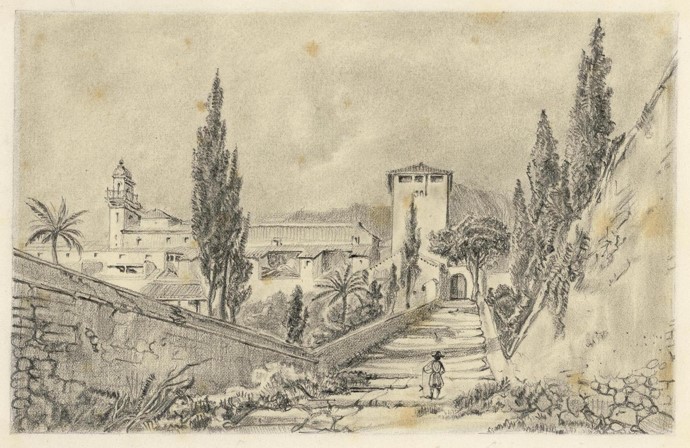
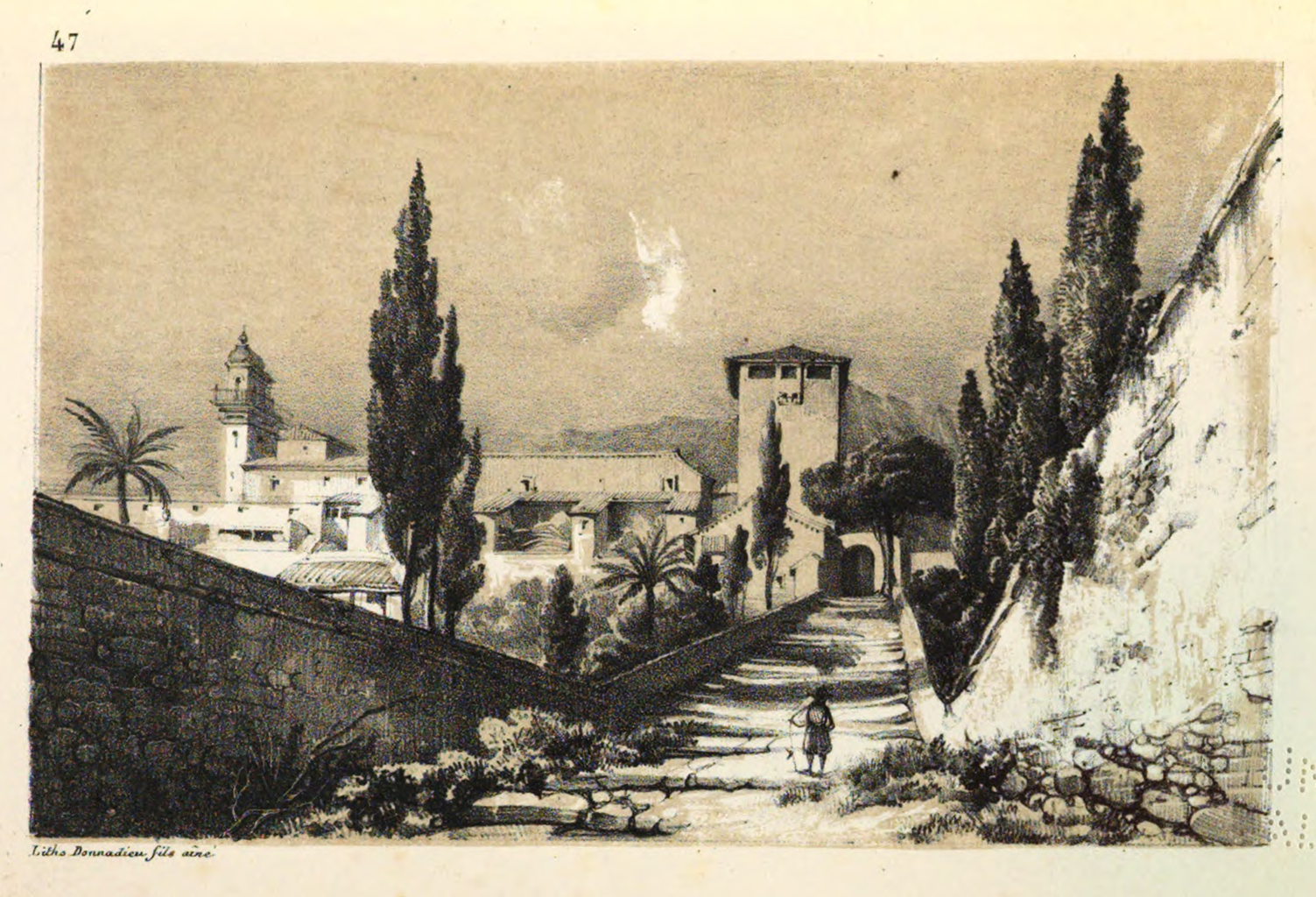
The French writer and artist Jean-Joseph Bonaventure Laurens (1801–1890) also visited Valldemossa in 1839 and published an illustrated account the following year, Souvenirs d’un voyage d’art, à l’île de Majorque. His fine pencil sketch of the road leading up to the charterhouse, annotated on its reverse by Aurore Sand, granddaughter of the famed writer, is the first to take up the viewpoint later used by the painter of the work in NAMA’s collection (Figs. 1–2). With some small differences, the same vista was represented by Francisco Javier Parcerisa y Boada (Spanish, 1803–1875) in a lithograph for a contemporaneous Spanish publication, Recuerdos y bellezas de España (Fig. 6a). Parcerisa’s view appeared in the volume dedicated to Majorca, brought out in 1842, where it was accompanied by Pablo Piferrer y Fábregas’s (1818–1848) rich description of the scene.
Thus, anyone contemplating the monastery from halfway up the long slope that leads to it, like an easy, rustic stairway, cannot help but open their soul to such a harmonious and varied landscape, which seems more like a landscape study than a natural scene. The rough walls that line the slope rise in two striking, curved lines, behind which cypress trees peek out with their pyramidal tops and palm trees show their graceful crowns, guiding the gaze to the object that stands out above the rest. This is a tall, wide, square tower, from which some ladroneras still protrude, and whose platform is covered by a hipped roof, which does not detract from its prominence and beauty or from the picturesqueness of the whole. At its foot, pieces of an ancient barbican with battlements delimit the atrium of the building and the solid gate of the portcullis; and as if to attest to the age of the building and enhance its effect, a venerable oak tree shades it with its leafy crown.20“Así el que contemple el monasterio desde la mitad de la larga cuesta que á manera de escalinata fácil y rústica á él conduce, mal podrá no abrir el alma á tal conjunto armoniosa y variamente accidentado, que mas que cuadro natural parece estudio de paisage. Las groseras paredes que orlan la cuesta suben trazando dos líneas vistosas y curvas, detras de las cuales los cipreses asoman sus piramidales cabezas y las palmas muestran sus gentiles copas, al paso que guian la vista al objeto que sobre los demas descuella. Es este una alta y ancha torre cuadrada, en que aun sobresalen algunas ladroneras, y cuya plataforma lleva una cubierta de tejado á cuatro aguas, no inoportuna para su resalto y belleza ni para lo pintoresco del todo. A su pié, trozos de una antigua barbacana defienden con sus almenas el atrio del edificio y la puerta maciza del rastrillo; y como si intentára acreditar la ancianidad de la fábrica y acrecer su buen efecto, un roble venerable la sombrea con su frondosa copa.” Pablo Piferrer y Fábregas, Recuerdos y bellezas de España: Mallorca (Barcelona: Joaquín Verdaguer, 1842), 281–82. A ladronera is a small, projecting parapet with openings in the floor through which defenders could drop or shoot weapons upon attackers. The ladronera is most visible in the Nelson-Atkins painting in the center of the top of the tower; the ladronera has a corbelled base. See also Fig. 13.
The gatehouse has a different appearance in Parcerisa’s lithograph than it does in Laurens’s sketch and engraving, as Goodman has shown. In the French artist’s view, the gatehouse meets the Torre dels Hostes at a lower elevation and is taller than the wall to its right. In Parcerisa’s image, by contrast, the gatehouse is considerably taller and not differentiated in height from the structure to the right. It also seems to have been enlivened with an ornamental element above the portal, which is likely a relief by the sculptor Jaume Blanquer (ca. 1578–1636) that depicts the founder of the Carthusian Order, Saint Bruno.21I thank Concepció Bauçà de Mirabò Gralla for her identification of the relief. Concepció Bauçà de Mirabò Gralla to the author, January 14, 2026. The variations between the two images are best ascribed to the artists’ differing interests and concerns with accuracy, since there is no definitive record of any renovations to the building during this period. Still, it is worth remarking that Parcerisa’s depiction of the height and decoration of the gatehouse, if not its relationship to the structure to its right, is similar to the next known representation of the vista looking up the road toward the monastery from the south.22No changes to the gatehouse’s architecture are documented between the first third of the eighteenth century and the early 1880s. Concepció Bauçà de Mirabò Gralla to the author, January 14, 2026.
That view, crucial to dating the NAMA painting and first discussed in relation to this painting by Goodman, appears in the Archduke Ludwig Salvator (Austrian, 1847–1915)’s extensive study of the Balearic Islands, Die Balearen in Wort und Bild Geschildert (1869–91), in a volume dedicated to Majorca that was published in 1884 (Fig. 6a–c).23For the intriguing figure of Archduke Ludwig Salvator, see Onofre Rullán, “El archiduque Luis Salvador Habsburgo-Lorena (1847–1915), geógrafo,” in Paisaje, cultura territorial y vivencia de la geografía: Libro homenaje al profesor Alfredo Morales Gil, ed. J. Fernando Vera, Jorge Olcina, and María Hernández (San Vicente del Raspeig, Spain: Publicaciones de la Universidad de Alicante, 2016), 895–920. See also Helga Schwendinger, El archiduque Luis Salvador de Austria, príncipe, científico y viajero (Palma de Mallorca: Miquel Font, 1991); Jo l’arxiduc: El desig d’anar més lluny (Palma de Mallorca: Institut d’Estudis Baleàrics, 2015). In this illustration, the height and decoration of the gatehouse’s second story accords with Parcerisa’s lithograph, suggesting that renovations to the gatehouse, if any indeed did take place,24See the accompanying technical entry by Becca Goodman. occurred after Laurens’s visit in 1839 and before Parcerisa’s in 1842, during a period when the monastery was being adapted to private use.25This part of the former monastery was the property of Nicolás Ripoll in 1845. After his death, it was sold, in 1868, to the banker Joan Sureda y Villalonga. Bauçà de Mirabò Gralla, Real Cartuja de Jesús de Nazaret de Valldemossa, 346, 350. At an indeterminate time after 1842, the old stepped ramp appears to have been replaced by a cobbled road, which no longer ascends to the gatehouse, having been diverted around the easternmost buildings of the monastery. Just as in the NAMA painting, the road in the Die Balearen illustration ends at a rough stone wall before continuing to the right, and a niche—which perhaps represents the Blanquer relief—is present above the portal. Joan Sureda y Villalonga, the owner of this section of the building, made several alterations to the Torre dels Hostes and acquired an adjoining space to the north in the early 1880s, corresponding with an architect, Bartolomé Ferrà Perelló, about plans to remodel this part of the property.26Bauçà de Mirabò Gralla, Real Cartuja de Jesús de Nazaret de Valldemossa, 350. Ferrà’s detailed report seems to clarify that the second story of the gatehouse served as a modest residence.27For Ferrà’s description of the buildings and his proposals for their reform, dated September 9, 1880, see Bauçà de Mirabò Gralla, Real Cartuja de Jesús de Nazaret de Valldemossa, doc. 22, 479–80. The artist of the NAMA painting also included a tree in front of the gatehouse, not present in the Die Balearen image, though this may have been imagined or perhaps even inspired by Laurens’s earlier depiction, who, as Goodman noted, may have omitted the tree to give greater prominence to the architecture of the portal. In any case, as Goodman demonstrates in her technical essay, the illustration helps to establish an approximate terminus post quem for the NAMA work, which seems likely to have been painted after the early 1840s.
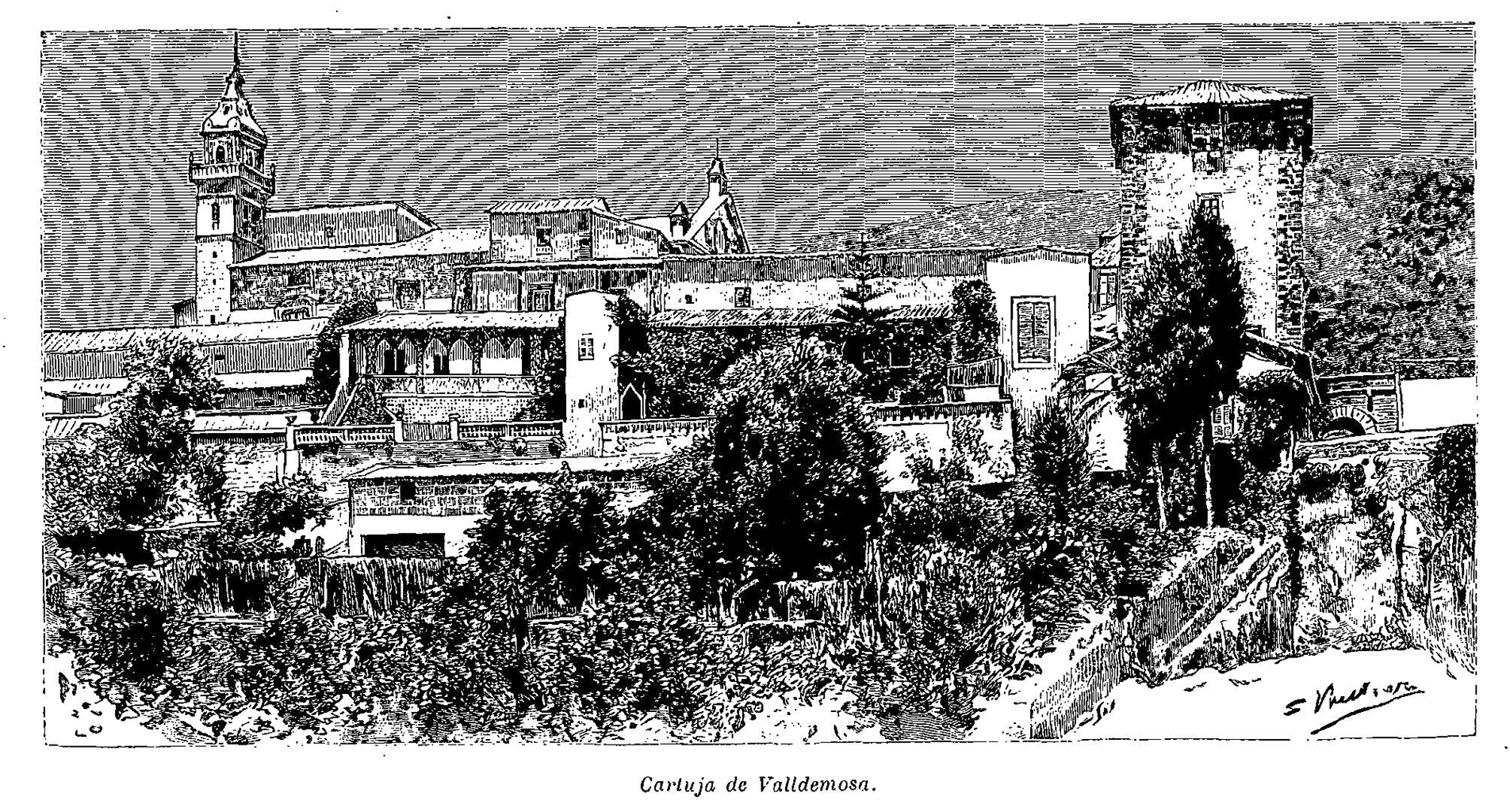
The painting must have been completed before autumn
1888, when the French artist and writer Gaston
Vuillier (1845–1915) visited Valldemossa. He reported
on his Majorcan journey in the French periodical
Le tour du monde, which included a small
illustration of the Torre dels Hostes and the
gatehouse, the next known image of this part of the
complex (Fig. 3).28Gaston Vuillier, “Voyage aux Iles Baleares :
Majorque,” Le tour du monde 2 (1889):
1–64. In the text, Vuiller notes that his travel
to Majorca began in Barcelona in October 1888. The
article was later published in a book, in which
the same illustration appears. Gaston Vuillier,
Les îles oubliées: Impressions de voyage
illustrées par l’auteur
(Paris: Hachette, 1893).
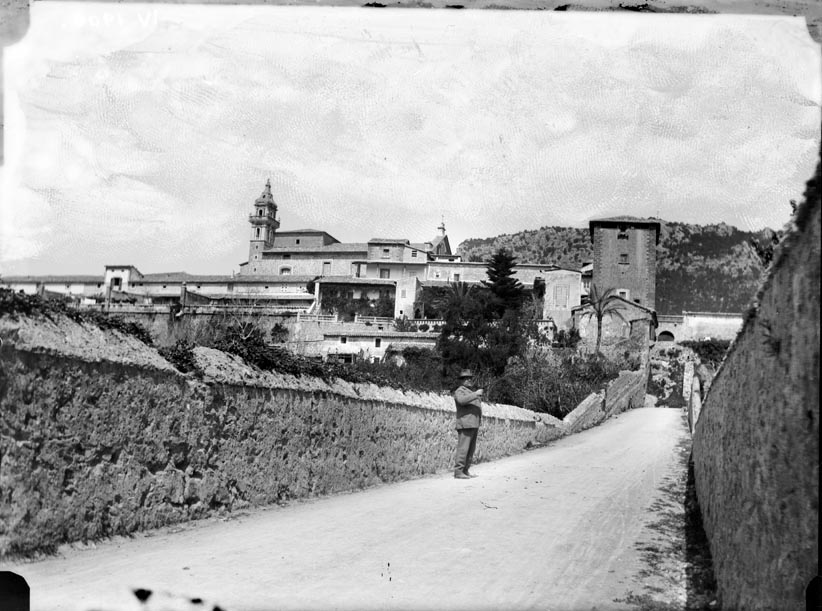
In Vuillier’s depiction, the second story of the
gatehouse, and the relief with it, have been removed,
rendering the building substantially different than in
the NAMA painting and similar to its appearance in
later photographs (Fig. 4).29See also Francesc Brunet i Recasens (Catalan,
1861–1939), View of Valldemossa, April
1900, gelatin silver negative on glass plate, 3
5/16 X 4 3/4 in. (8.5 x 12 cm), Arxiu Nacional de
Catalunya, Barcelona, ANC1-284-N-411,
https://calaix
For the time being, the authorship of the painting must remain an open question. The numerous Balearic travel accounts that appeared in the later nineteenth century, which include works by American, British, French, and Spanish writers, testify to the increasing appeal of Majorca as a destination for international travelers, and to the special allure of Valldemossa and its picturesque charterhouse in particular, which was visited by artists.31For Majorca as a tourist destination in the nineteenth century, see Concepció Bauçà de Mirabò Gralla, “Patrimoni i turisme cultural: Valldemossa com a focus d’una relació pionera a Mallorca,” in Turisme cultural: Anàlisi, diagnòstic i perspectives de futur, ed. S. Serra Busquets and G. Mayol Arbona (Palma de Mallorca: Agència d’Estratègia Turística Illes Balears, Conselleria model econòmic, turisme i treball, 2020), 465–73. The prominent Catalan painter Santiago Rusiñol (1861–1931) painted in and around the town on several occasions, but his first visit to Majorca came in 1893.32For Rusiñol’s paintings from Valldemossa, see Josep de C. Laplana and Mercedes Palau-Ribes O’Callaghan, La pintura de Santiago Rusiñol: Catàleg systematic (Barcelona: Editorial Mediterrània, 2004), 2:137–44. For the painter’s first visit to Majorca, see Damià Pons i Pons, “La primera estada de Rusiñol a Mallorca,” Lluc, no. 793 (July–August 1996): 158–63. For an extended discussion of his long relationship with Majorca, see Isabel Coll, “Rusiñol, la passió per Mallorca: Del luminisme i el simbolisme a l’estampa japonesa,” in Rusiñol, la passió per Mallorca: Del luminisme i el simbolisme a l’estampa japonesa (Palma de Mallorca: Fundació Es Baluard, Museu d’Art Modern i Contemporani de Palma, 2007), 17–52. John Singer Sargent (American, 1856–1925), some of whose light-filled landscapes bear a passing resemblance to the present painting, also visited Valldemossa, though only in 1908.33For the paintings Sargent made in Majorca, see Richard Ormond and Elaine Kilmurray, John Singer Sargent: Complete Paintings, vol. 8, Figures and Landscapes, 1908–1913 (New Haven, CT: Yale University Press, 2014), nos. 1451–1496, pp. 35–79. See also, for Sargent’s Majorcan sojourn, Meredith Martindale, John Singer Sargent a Mallorca (Palma de Mallorca: Ayuntament de Palma, 2009). While on Majorca, Sargent made a loose, sketch-like portrait of the mustachioed Argentinian artist Francisco Bernareggi (1878–1959), now in NAMA’s collection (F86-26), as well as many watercolors and oils. While neither Rusiñol nor Sargent could have painted the NAMA work, having visited Majorca well after the removal of the gatehouse’s second story, the names of other, less prominent artists have also been suggested.34I am most grateful to Isabel Coll i Mirabent, Richard Ormond, and Meredith Martindale for their generous assistance, as well as their confirmation that the Nelson-Atkins painting cannot be attributed to either Sargent or Rusiñol.
Some, such as the local painters Ricardo Anckermann
Riera (1842–1907) and Antoni Ribas Oliver (1845–1911)
can perhaps be discounted on stylistic grounds, as is
true of other artists from Majorca, like Antoni Fuster
Fortesa (1853–1902).35For Ribas and Fuster, see, respectively,
Antoni Ribas (1845–1911) (Palma de
Mallorca: Sa Nostra Caixa de Balears, 1991) and
José M. Pardo Falcón,
Antoni Fuster Fortesa (1853–1902) (Palma
de Mallorca: Fundació Sa Nostra, 2004). I thank
Isabell Coll i Mirabent for her suggestion that
the Nelson-Atkins painting was not painted by an
artist that hailed from any Spanish school. Isabel
Coll i Mirabent to the author, September 30,
2025.
Others, like the Catalan artists Francesc Gimeno i
Arasa (1858–1927) and Eliseo Meifrén Roig (1859–1940),
are not known to have had any connection to Majorca
until well after the NAMA painting must have been
completed. Among the most plausible candidates is the
Belgian-born Spanish landscape painter Carlos de Haes
(1829–1898), who visited Majorca in 1877 in the
company of his leading student, Aureliano de Beruete
(1845–1912), who had traveled to the island once
before, in 1874.36Ana Gutiérrez Márquez, “Carlos de Haes
(1826–1898): Biografía y trayectoria artística,”
in Carlos de Haes (1826–1898), ed. José
Luis Díez (Santander, Spain: Fundación Marcelino
Botín, 2002), 104–5. For Beruete, see
Aureliano de Beruete (1845–1912) (Madrid:
Caja de Pensiones, 1983).
Their trip, of uncertain duration, is documented by
only a few paintings, but Haes’s Realist style and his
predilection for small, thickly painted
en plein air (adjective: plein-air): French for “outdoors.” The term is used to
describe the act of painting quickly outside
rather than in a studio.
studies suggest that further research could possibly
link him—or an associated artist—with the NAMA
painting. Complicating this theory, other works known
to relate to Haes’s time in Majorca are on panel,
smaller in format, and looser in handling, such as
Un lazareto (Mallorca) (ca. 1877; Museo del
Prado, Madrid)37Carlos de Haes, Un lazareto (Mallorca),
ca. 1877, oil on panel, 5 1/2 x 8 11/16 in. (14 x
22 cm), Museo del Prado, Madrid, P004377,
https://www.museodelprado.es
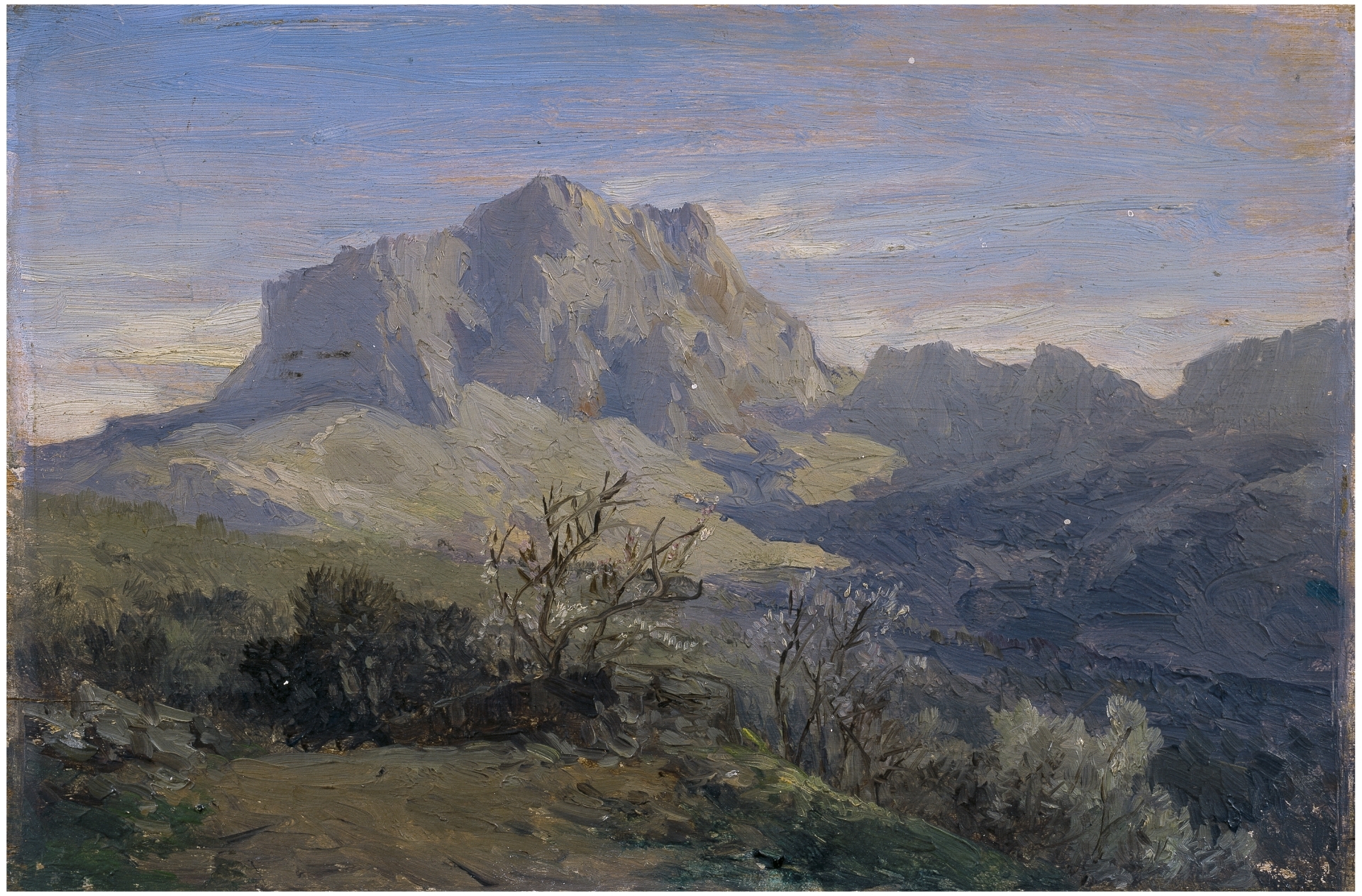
Whether the NAMA painting was made by an artist from the island, from Spain, or from further afield, it remains to be divined how it arrived in Paris as well as when—and by whom—it was christened a Corot. Whatever the answers to these questions may be, the canvas is nonetheless a considered essay in plein-air painting, as notable for its scrupulous attention to architectural detail as for its sensitive rendering of the warm light of a Mediterranean morning.
Notes
-
See the accompanying technical entry by Becca Goodman. Doubts about the attribution to Corot arose as early as 1934. Paul Jamot, honorary curator of the Musée du Louvre, Paris, and director of the Musée des Beaux-Arts, Reims, called the attribution into question. See Richard Owen, art dealer, to Paul Gardner, NAMA director, November 15, 1934, NAMA curatorial files.
-
The town of Subiaco was associated with the painting at some point before 1960, perhaps on the grounds that Corot was known to have visited the area in the 1820s. Nicole R. Myers to Patrick Matthiesen, December 14, 2012, NAMA curatorial files.
-
This essay builds on the groundbreaking identification of the charterhouse by Becca Goodman and her research to narrow down the painting’s execution date. See the accompanying technical entry.
-
Harold Woodbury Parsons to J. C. Nichols, November 11, 1931, NAMA curatorial files.
-
Although this attribution has been questioned, recent research, as well as an extensive technical study, place the painting on firmer grounds of attribution. See Aimee Marcereau DeGalan, “Attributed to Honoré Daumier, Exit from the Theater, after 1863,” catalogue entry, in DeGalan, French Paintings and Pastels, https://doi.org
/10 ..37764 /78973 .5 .512 .5407 -
Harold Woodbury Parsons to J. C. Nichols, January 19, 1932, NAMA curatorial files.
-
The painting (formerly 32-175), was deaccessioned by NAMA and sold at auction as a work by Lucas in 1989. See 19th-Century European Paintings, Drawings, Watercolors and Sculpture (New York: Christie’s, October 25, 1989), lot 167. Lucas’s paintings were often confused for Goya’s, as were those by Lucas’s son, Eugenio Lucas Villamil (1858–1918), who was also capable of emulating Goya’s manner. For a related problem of attribution, also involving a “Goya” painting sold in Paris in the 1920s, see Jonathan Brown, “The Bullfight,” in Jonathan Brown and Richard G. Mann, Spanish Paintings of the Fifteenth Through Nineteenth Centuries (Washington, DC: National Gallery of Art, 1990), 88–91.
-
Harold Woodbury Parsons to J. C. Nichols, September 26, 1932, NAMA curatorial files. He describes his purchases in some detail, writing that in addition to the “Goya” he “was able to secure for $5,000 six little paintings of the Nineteenth Century of rather better quality than those we purchased last Spring from Newhouse, and at prices even a little below. There is a study of fish by Ziem [D32-178] which ought to excite those who clamour for modern impressionism; ‘The Beach at Honfleur’ by Boudin [D32-177], one of the most exquisite landscape painters of the century; a tiny but important little panel by J. F. Millet, ‘The Sheep Shearer’ [D32-181]. This is the study for the famous big painting of the same subject owned in Boston. ‘A Canal in France’ by Jongkind [D32-179]; and ‘A Street at Montmartre’ [D32-176] and a sketch of cattle [D32-180], both by Lépine.” Parsons misremembered the painter of the sketch of cattle, which is in fact a work by Eugène Boudin. It is the only painting that the museum has not sold.
-
For further information on Owen, see Danielle Hampton Cullen, “The Elusive Mr. Richard Owen: A Dealer’s Rise and Fall in the Art Market in the United States,” Nineteenth-Century Art Worldwide 21, no. 2 (Summer 2022): https://doi.org
/10 ..29411 /ncaw .2022 .21 .2 .5 -
Harold Woodbury Parsons to Paul Gardner, May 14, 1941, NAMA curatorial files. For Corot and falsifications, see Vincent Pomarède, “Corot Forgeries: Is the Artist Responsible?” in Corot, ed. Gary Tinterow, Michael Pantazzi, and Vincent Pomarède (New York: Metropolitan Museum of Art, 1996), 383–96.
-
Among the disparate contenders proposed down the years were François Marius Granet (1775–1849), Frederick, Lord Leighton (English, 1830–1896), Alfred de Curzon (1820–1895), Elihu Vedder (American, 1836–1923), the obscure Federico Palazzini (life dates unknown), Paul Flandrin (1811–1902), and Achille Benouville (1815–1891). See correspondence in NAMA curatorial files.
-
Patrick Matthiesen to Nicole R. Myers, November 26, 2012, NAMA curatorial files.
-
For discussion of the brushwork and duration of the painting process, as well as further examples of print images of the scene, see the accompanying technical entry by Becca Goodman.
-
Concepció Bauçà de Mirabò Gralla, La Real Cartuja de Jesús de Nazaret de Valldemossa: formación y evolución de su patrimonio histórico-artístico (Palma de Mallorca: Ediciones Universitat de les Illes Balears, 2008), 193. See also Jaume Llabrés Mulet’s brief report on the charterhouse, NAMA curatorial files.
-
For the early history of the Valldemossa charterhouse, see Concepció Bauçà de Mirabò Gralla, “Viatges i intercanvis artístics a l’inici del renaixement: De València a Mallorca,” in La cartoixa de Portaceli (1272–2022): Vuit segles de testimoni, ed. Albert Ferrer Orts, Francisco Fuster Serra, and Josep-Marí Gómez Lozano (Valencia, Spain: Universitat de València, 2024), 289–312.
-
For the building of the Torre dels Hostes and its counterpart, the Torre dels Armes, located at the southwestern edge of the monastery, see Bauçà de Mirabò Gralla, Real Cartuja de Jesús de Nazaret de Valldemossa, 160–63.
-
Bauçà de Mirabò Gralla, Real Cartuja de Jesús de Nazaret de Valldemossa, 194–96.
-
Bauçà de Mirabò Gralla, Real Cartuja de Jesús de Nazaret de Valldemossa, 193–94.
-
George Sand to Charlotte Marliani, December 14, 1838, in Lettres de Chopin et de George Sand (1836–1839), ed. Ronislas-Edouard Sydow, Denise Colfs-Chainaye, and Suzanne Chainaye (Palma de Mallorca: Edicions La Cartoixa, 1975), 65. This and all subsequent translations are by Daniel Sobrino Ralston. Sand’s articles appeared in the Revue des deux mondes between January 15 and March 15, 1841, under the title “Un hiver au midi de l’Europe.” They were published under that title in Oeuvres de George Sand (Brussels: Société belge de librairie, Hauman, 1842), 2:3–56 and then, separately, as George Sand, Un hiver à Majorque (Paris: H. Souverain, 1842).
-
“Así el que contemple el monasterio desde la mitad de la larga cuesta que á manera de escalinata fácil y rústica á él conduce, mal podrá no abrir el alma á tal conjunto armoniosa y variamente accidentado, que mas que cuadro natural parece estudio de paisage. Las groseras paredes que orlan la cuesta suben trazando dos líneas vistosas y curvas, detras de las cuales los cipreses asoman sus piramidales cabezas y las palmas muestran sus gentiles copas, al paso que guian la vista al objeto que sobre los demas descuella. Es este una alta y ancha torre cuadrada, en que aun sobresalen algunas ladroneras, y cuya plataforma lleva una cubierta de tejado á cuatro aguas, no inoportuna para su resalto y belleza ni para lo pintoresco del todo. A su pié, trozos de una antigua barbacana defienden con sus almenas el atrio del edificio y la puerta maciza del rastrillo; y como si intentára acreditar la ancianidad de la fábrica y acrecer su buen efecto, un roble venerable la sombrea con su frondosa copa.” Pablo Piferrer y Fábregas, Recuerdos y bellezas de España: Mallorca (Barcelona: Joaquín Verdaguer, 1842), 281–82. A ladronera is a small, projecting parapet with openings in the floor through which defenders could drop or shoot weapons upon attackers. The ladronera is most visible in the Nelson-Atkins painting in the center of the top of the tower; the ladronera has a corbelled base. See also Fig. 13.
-
I thank Concepció Bauçà de Mirabò Gralla for her identification of the relief. Concepció Bauçà de Mirabò Gralla to the author, January 14, 2026.
-
No changes to the gatehouse’s architecture are documented between the first third of the eighteenth century and the early 1880s. Concepció Bauçà de Mirabò Gralla to the author, January 14, 2026.
-
For the intriguing figure of Archduke Ludwig Salvator, see Onofre Rullán, “El archiduque Luis Salvador Habsburgo-Lorena (1847–1915), geógrafo,” in Paisaje, cultura territorial y vivencia de la geografía: Libro homenaje al profesor Alfredo Morales Gil, ed. J. Fernando Vera, Jorge Olcina, and María Hernández (San Vicente del Raspeig, Spain: Publicaciones de la Universidad de Alicante, 2016), 895–920. See also Helga Schwendinger, El archiduque Luis Salvador de Austria, príncipe, científico y viajero (Palma de Mallorca: Miquel Font, 1991); Jo l’arxiduc: El desig d’anar més lluny (Palma de Mallorca: Institut d’Estudis Baleàrics, 2015).
-
See the accompanying technical entry by Becca Goodman.
-
This part of the former monastery was the property of Nicolás Ripoll in 1845. After his death, it was sold, in 1868, to the banker Joan Sureda y Villalonga. Bauçà de Mirabò Gralla, Real Cartuja de Jesús de Nazaret de Valldemossa, 346, 350.
-
Bauçà de Mirabò Gralla, Real Cartuja de Jesús de Nazaret de Valldemossa, 350.
-
For Ferrà’s description of the buildings and his proposals for their reform, dated September 9, 1880, see Bauçà de Mirabò Gralla, Real Cartuja de Jesús de Nazaret de Valldemossa, doc. 22, 479–80.
-
Gaston Vuillier, “Voyage aux Iles Baleares : Majorque,” Le tour du monde 2 (1889): 1–64. In the text, Vuiller notes that his travel to Majorca began in Barcelona in October 1888. The article was later published in a book, in which the same illustration appears. Gaston Vuillier, Les îles oubliées: Impressions de voyage illustrées par l’auteur (Paris: Hachette, 1893).
-
See also Francesc Brunet i Recasens (Catalan, 1861–1939), View of Valldemossa, April 1900, gelatin silver negative on glass plate, 3 5/16 X 4 3/4 in. (8.5 x 12 cm), Arxiu Nacional de Catalunya, Barcelona, ANC1-284-N-411, https://calaix
.gencat . When the second story was demolished, Blanquer’s relief of Saint Bruno was reinstalled above the main entrance to the charterhouse, where it remains to this day. Concepció Bauçà de Mirabò Gralla to the author, January 14, 2026. For an image of the relief in situ, see: José Luis Filpo Cabana, Defensive Tower, Palacio del Rey Sancho, Valldemossa, March 2012, photograph, https://en.wikipedia.org.cat /handle /10687 /400575 /wiki ./File :Palacio _del _Rey _Sancho ._Torre _defensiva ._Valldemossa .jpg -
For reference to their correspondence, see Bauçà de Mirabò Gralla, Real Cartuja de Jesús de Nazaret de Valldemossa, 351n2602.
-
For Majorca as a tourist destination in the nineteenth century, see Concepció Bauçà de Mirabò Gralla, “Patrimoni i turisme cultural: Valldemossa com a focus d’una relació pionera a Mallorca,” in Turisme cultural: Anàlisi, diagnòstic i perspectives de futur, ed. S. Serra Busquets and G. Mayol Arbona (Palma de Mallorca: Agència d’Estratègia Turística Illes Balears, Conselleria model econòmic, turisme i treball, 2020), 465–73.
-
For Rusiñol’s paintings from Valldemossa, see Josep de C. Laplana and Mercedes Palau-Ribes O’Callaghan, La pintura de Santiago Rusiñol: Catàleg systematic (Barcelona: Editorial Mediterrània, 2004), 2:137–44. For the painter’s first visit to Majorca, see Damià Pons i Pons, “La primera estada de Rusiñol a Mallorca,” Lluc, no. 793 (July–August 1996): 158–63. For an extended discussion of his long relationship with Majorca, see Isabel Coll, “Rusiñol, la passió per Mallorca: Del luminisme i el simbolisme a l’estampa japonesa,” in Rusiñol, la passió per Mallorca: Del luminisme i el simbolisme a l’estampa japonesa (Palma de Mallorca: Fundació Es Baluard, Museu d’Art Modern i Contemporani de Palma, 2007), 17–52.
-
For the paintings Sargent made in Majorca, see Richard Ormond and Elaine Kilmurray, John Singer Sargent: Complete Paintings, vol. 8, Figures and Landscapes, 1908–1913 (New Haven, CT: Yale University Press, 2014), nos. 1451–1496, pp. 35–79. See also, for Sargent’s Majorcan sojourn, Meredith Martindale, John Singer Sargent a Mallorca (Palma de Mallorca: Ayuntament de Palma, 2009).
-
I am most grateful to Isabel Coll i Mirabent, Richard Ormond, and Meredith Martindale for their generous assistance, as well as their confirmation that the Nelson-Atkins painting cannot be attributed to either Sargent or Rusiñol.
-
For Ribas and Fuster, see, respectively, Antoni Ribas (1845–1911) (Palma de Mallorca: Sa Nostra Caixa de Balears, 1991) and José M. Pardo Falcón, Antoni Fuster Fortesa (1853–1902) (Palma de Mallorca: Fundació Sa Nostra, 2004). I thank Isabell Coll i Mirabent for her suggestion that the Nelson-Atkins painting was not painted by an artist that hailed from any Spanish school. Isabel Coll i Mirabent to the author, September 30, 2025.
-
Ana Gutiérrez Márquez, “Carlos de Haes (1826–1898): Biografía y trayectoria artística,” in Carlos de Haes (1826–1898), ed. José Luis Díez (Santander, Spain: Fundación Marcelino Botín, 2002), 104–5. For Beruete, see Aureliano de Beruete (1845–1912) (Madrid: Caja de Pensiones, 1983).
-
Carlos de Haes, Un lazareto (Mallorca), ca. 1877, oil on panel, 5 1/2 x 8 11/16 in. (14 x 22 cm), Museo del Prado, Madrid, P004377, https://www.museodelprado.es
/coleccion ./obra -de -arte /un -lazareto -mallorca /d4c2ce44 -458d -45ac -86fe -770e54496b7b
Technical Entry
Citation
Chicago:
Becca Goodman, “Unknown artist, View of the Cartoixa of Valldemossa, ca. 1875,” technical entry in French Paintings and Pastels, 1600–1945: The Collections of the Nelson-Atkins Museum of Art, ed. Aimee Marcereau DeGalan (Kansas City: The Nelson-Atkins Museum of Art, 2026), https://doi.org/10.37764/78973.5.536.2088.
MLA:
Goodman, Becca. “Unknown artist, View of the Cartoixa of Valldemossa, ca. 1875,” technical entry. French Paintings and Pastels, 1600–1945: The Collections of The Nelson-Atkins Museum of Art, edited by Aimee Marcereau DeGalan, Nelson-Atkins Museum of Art, 2026. doi: 10.37764/78973.5.536.2088.
Acquired by the Nelson-Atkins Museum of Art in 1932 as a landscape by French painter Jean-Baptist-Camille Corot, the painting was reclassified as an Italian scene by an unknown artist when the signature was revealed to be fraudulent in 1960. During the 2024 examination of the painting, it was clear that the artist’s detailed rendering of distinct landmarks pointed to a specific location. Taking advantage of Google Lens and the ability to apply artificial intelligence as a visual search tool, the author successfully identified the location of this enigmatic painting. The walled road depicted in the painting leads to a defensive tower attached to the old Carthusian Monastery in Valldemossa, a village on the Balearic Island of Majorca (“Mallorca” in Spanish). The Serra de Tramuntana mountain range is visible in the distance.
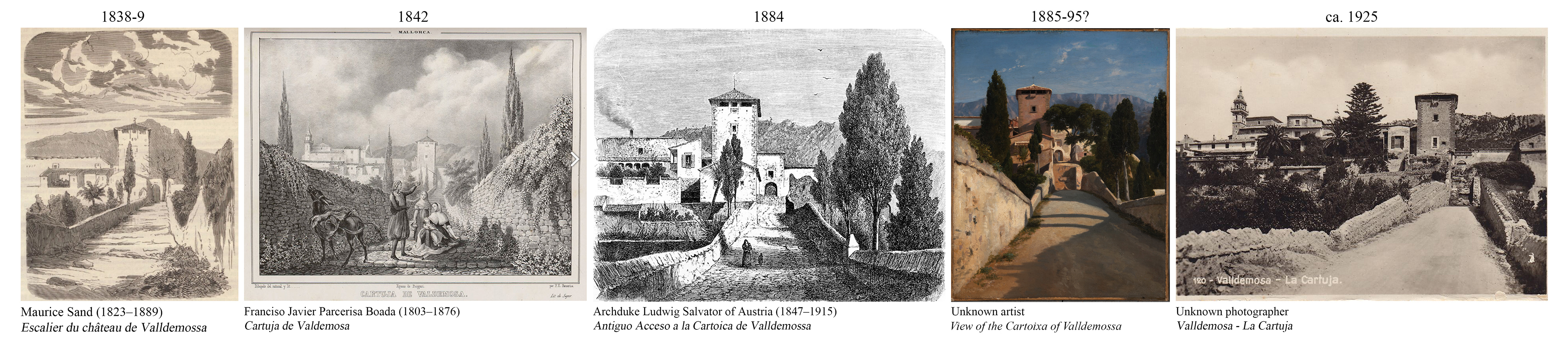
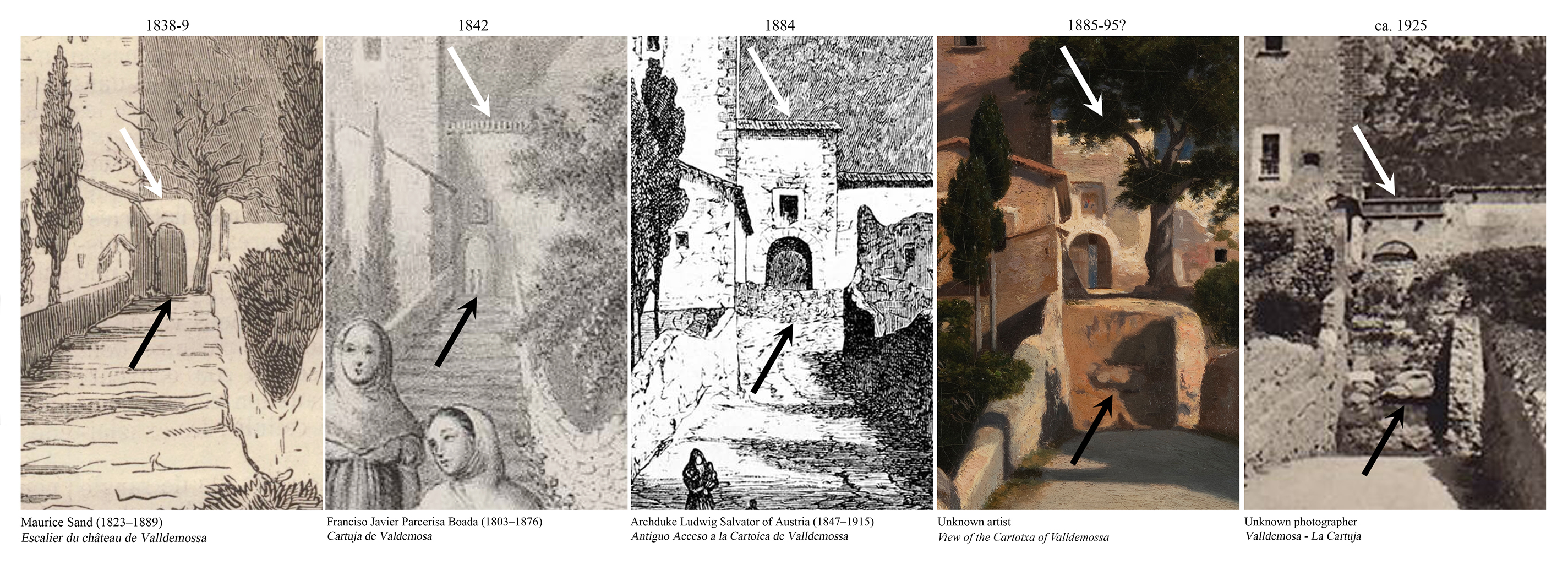
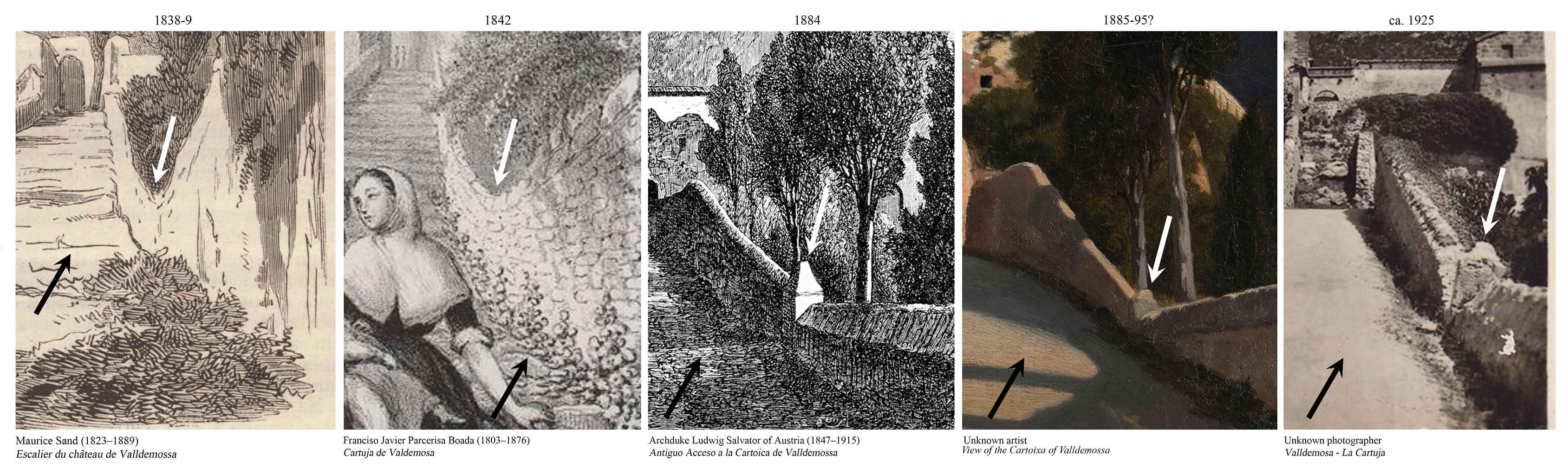
Majorca became a tourist destination in the nineteenth
century thanks to the rising popularity of
travelogues.1The monastery was described in such travelogues
as Jean-Joseph Bonaventure Laurens,
Souvenirs d’un voyage d’Art a l’île de
Majorque
(Paris: Arthur Bertrand et Gihaut Frères, 1840);
George Sand, Un hiver en Mallorca (Paris:
H. Souverain, 1842); Pablo Piferrer,
Recuerdas y Bellezas de Espana, vol. 2,
Mallorca (Barcelona: Joaquín Verdaguer,
1842–44); and Erzherzog Ludwig Salvator von
Österreich-Toskana,
Die Balearen geschildert in wort un bild
(Leipzig: Brockhaus, 1884).
The monastery and its attached tower were illustrated
in several of these books and in early
twentieth-century postcards. The depictions of the
southeast side of the tower (facing northwest) are
comparable to the painting, and by comparing details
and changes to the structure over time, this imagery
can be used to determine a rough execution date (Figs.
6a–c).2Complete image captions for Fig. 6, arranged in
chronological order, from left to right: (1)
Maurice Sand (1823–1889), engraved by Tony
Johannot (1803–1852),
Escalier du château de Valldemossa (Ascent of
the Chateau of Valldemossa), ca. 1838–39, published in George Sand,
Voyage à Majorque (Paris: J. Hetzel,
1868), 41; (2) Francisco Javier Parcerisa y Boada
(Spanish, 1803–1875),
Cartuja de Valdemosa (Valldemossa
Charterhouse), 1842, illustrated in Pablo Piferrer,
Recuerdos y bellezas de España: Majorca,
2:282–83. Photo: Biblioteca Nacional de España.
Public domain, copyright CC BY 4.0; (3) Archduke
Ludwig Salvator of Austria,
Antiguo Acceso a la Cartoica de Valldemossa
(Old Entrance to the Valldemossa
Charterhouse), ca. 1884, illustrated in Salvator,
Die Balearen geschildert in wort und bild, vol. 2, Mallorca (1884; repr.
Würzburg: Leo Woerl, 1897), 29. Public domain; (4)
View of the Cartoixa of Valldemossa, ca.
1875, oil on canvas, The Nelson-Atkins Museum of
Art; (5) “Valldemosa: La Cartuja,” photograph,
illustrated in Cartoixa de Valldemossa, “Hoy sí
que retrocedemos en el tiempo . . . ,” Facebook,
August 28, 2023,
https://www.facebook.com
At first, travelers to Majorca primarily came from
other parts of Spain, France, and Britain, but the
draw of the exotic island eventually reached artists
in the United States, the Netherlands, Russia, and
other parts of the world.5For example, John Singer Sargent (American,
1856–1925),
Wild Olive Tree Roots, Valldemosa, Majorca, 1908, 21 15/16 x 28 in. (55.8 x 71.1 cm),
National Gallery of Art, Washington, DC,
https://www.nga.gov
The painting is executed on canvas that has been lining: A procedure used to reinforce a weakened canvas that involves adhering a second fabric support using adhesive, most often a glue-paste mixture, wax, or synthetic adhesive. to a heavy fabric,6Transmitted light could not penetrate the fabric to determine if any stamps or inscriptions were present on the back of the original canvas. and a customs stamp on the back of the secondary canvas confirms that the lining was performed in Europe before the painting arrived in the United States.7A second, seemingly identical customs stamp is present on the proper right side of the upper member and appears clearer. Still, further imaging and rendering are necessary to decipher the text. The stamp is presumably French; however, improving the stamps’ legibility through further imaging could help uncover the provenance (Fig. 7). The lined canvas is tacked to a five-membered wooden stretcher: A wooden structure to which the painting’s canvas is attached. Unlike strainers, stretchers can be expanded slightly at the joints to improve canvas tension and avoid sagging due to humidity changes or aging. with a dovetailed horizontal crossbar. The color of the wood and design of the stretcher is consistent with late eighteenth- and nineteenth-century examples.8Many of the keys were replaced, and there is a stark difference in color between the aged wood and the replacements. The shape of the original keys is distinctive, but unfortunately, little substantial research has been conducted on key shapes. Nearly identical stretchers and keys have been noted on French, English, and American paintings. The dimensions are nearly identical to a LeFranc no. 8 figure standard-format supports: Commercially prepared supports available through art suppliers, which gained popularity in the nineteenth century during the industrialization of art materials. Available in three formats figure (portrait), paysage (landscape), and marine (marine), these were numbered 1 through 120 to indicate their size. For each numbered size, marine and paysage had two options available: a larger format (haute) and smaller (basse) format. canvas.9See the table from Lefranc et Cie’s 1899 catalogue of standard sizes for panels and millboards, reproduced in Anthea Callen, The Work of Art: Plein-Air Painting and Artistic Identity in Nineteenth-Century France (London: Reaktion Books, 2015), 89. During the lining, the original tacking margins: The outer edges of canvas that wrap around and are attached to the stretcher or strainer with tacks or staples. See also tacking edge. were removed, and the painting was cropped slightly.10Remnants of a black line, which delineated where the cut would be made, are present on top of the paint layer at the perimeter of the painted portion. Its granular appearance, with little or no binder, suggests that graphite, charcoal, or chalk was used. This material is most prominent 1 1/2 inches from the top right corner. The overall composition remains visually balanced, and cusping: A scalloped pattern along the canvas edges that relates to how the canvas was stretched. Primary cusping reveals where tacks secured the canvas to the support while the ground layer was applied. Secondary cusping can form when a pre-primed canvas is re-stretched by the artist prior to painting. visible in the X-ray radiography (also referred to as x-radiography or radiography): Radiography is an examination tool analogous to the use of X-rays in medicine whereby denser components of a painted composition can be recorded as an inverted shadow image cast on film or a digital X-ray imaging plate from a source such as an X-ray tube. The method has been used for more than a century and is most effective with dense pigments incorporating metallic elements such as lead or zinc. It can reveal artist changes, underlying compositions, and information concerning the artwork’s construction and condition. The resulting image is called an x-radiograph or radiograph. It differs from the uses of X-ray spectrometry in being dependent on the density of the paint to absorb X-rays before they reach the film or image plate and being non-specific as to which elements are responsible for the resulting shadow image. indicates that the painting is close to its original size.
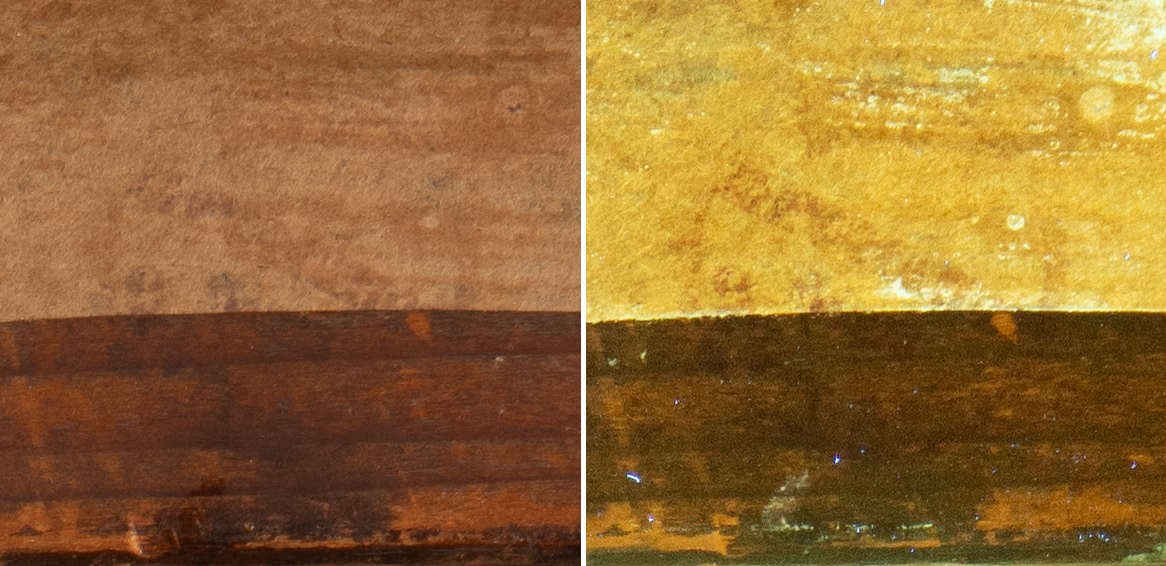
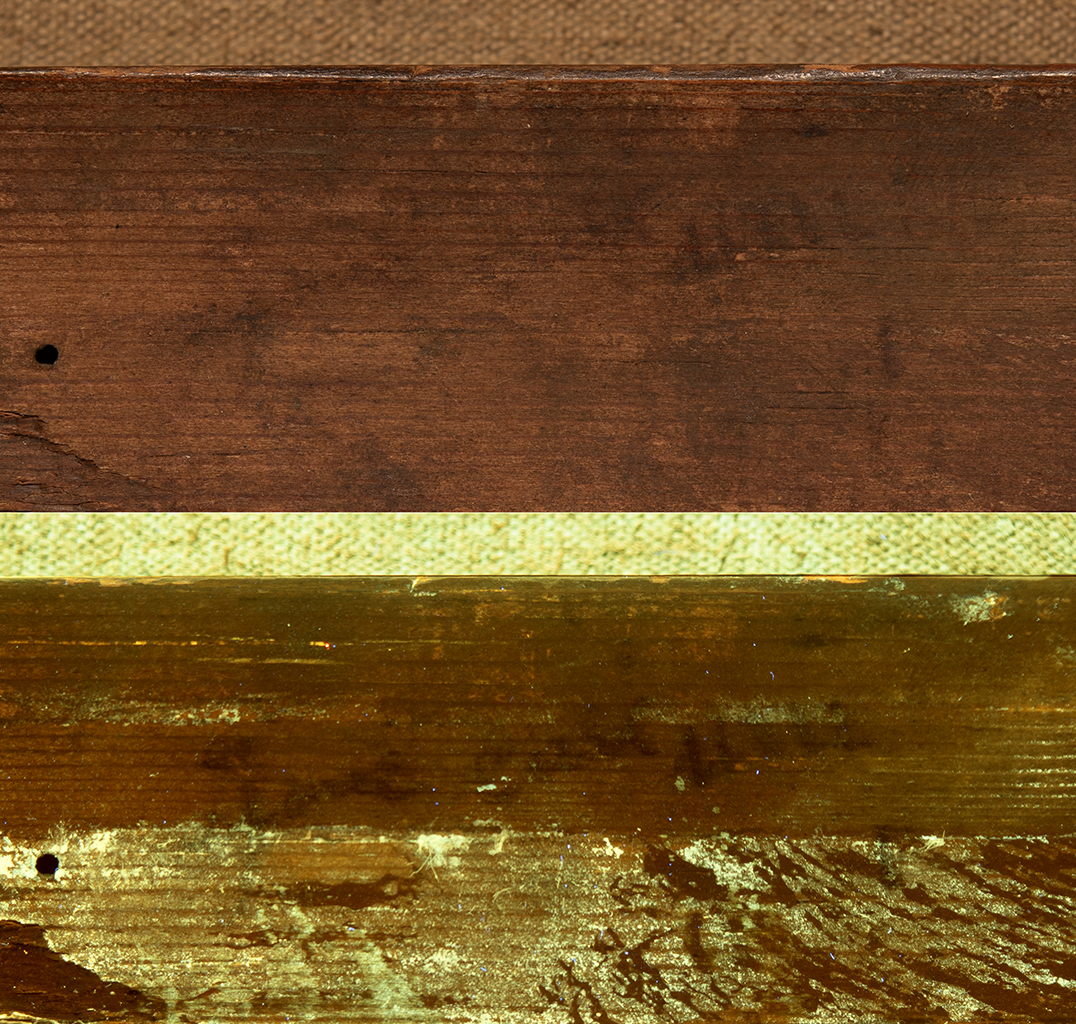
On the back of the stretcher is a small, aged, and frustratingly illegible inscription located on the lower half of the proper left member. The inscription was partially covered by brown paper tape applied to the tacking margins as part of the lining treatment. For access, the brown paper was carefully removed, and the area was imaged using a variety of techniques.11The following techniques were used: visible light, ultraviolet-induced visible fluorescence, reflected infrared digital photography, and infrared reflectography. The text appeared completely transparent under infrared radiation. Under ultraviolet (UV) radiation: A segment of the electromagnetic spectrum, just beyond the sensitivity of the human eye, with wavelengths ranging from 100–400 nanometers. For a description of its use in the study of art objects, see ultraviolet (UV) fluorescence or UV-induced visible fluorescence., the text appears nonfluorescent and slightly more legible, but the fluorescence of leftover adhesive obscures the lower portion of the words (Fig. 8). At present, the inscription has not been deciphered, and the language in which it was written remains unknown.12The images were altered in Adobe Camera Raw by adjusting the overall exposure, levels, and highlights as well as selecting similar pixels and digitally manipulating them separately to improve contrast. Highly speculative attempts were made to read the text from these images: the first word could be “foret” (French for forest), and the last word could be “Vall” (short for “Valldemossa”) or “Mall” (short for “Mallorca,” the Spanish spelling of Majorca). The presence of the inscription beneath the brown paper points to several possibilities: the restorer marked the stretcher before or during the lining process and partially covered it with the final layer of paper; the stretcher was poached from a different painting and the inscription is irrelevant; or the stretcher—and therefore the inscription—is original and was reused after the painting was lined. If the last scenario is correct, deciphering the inscription could be critical to identifying the artist.
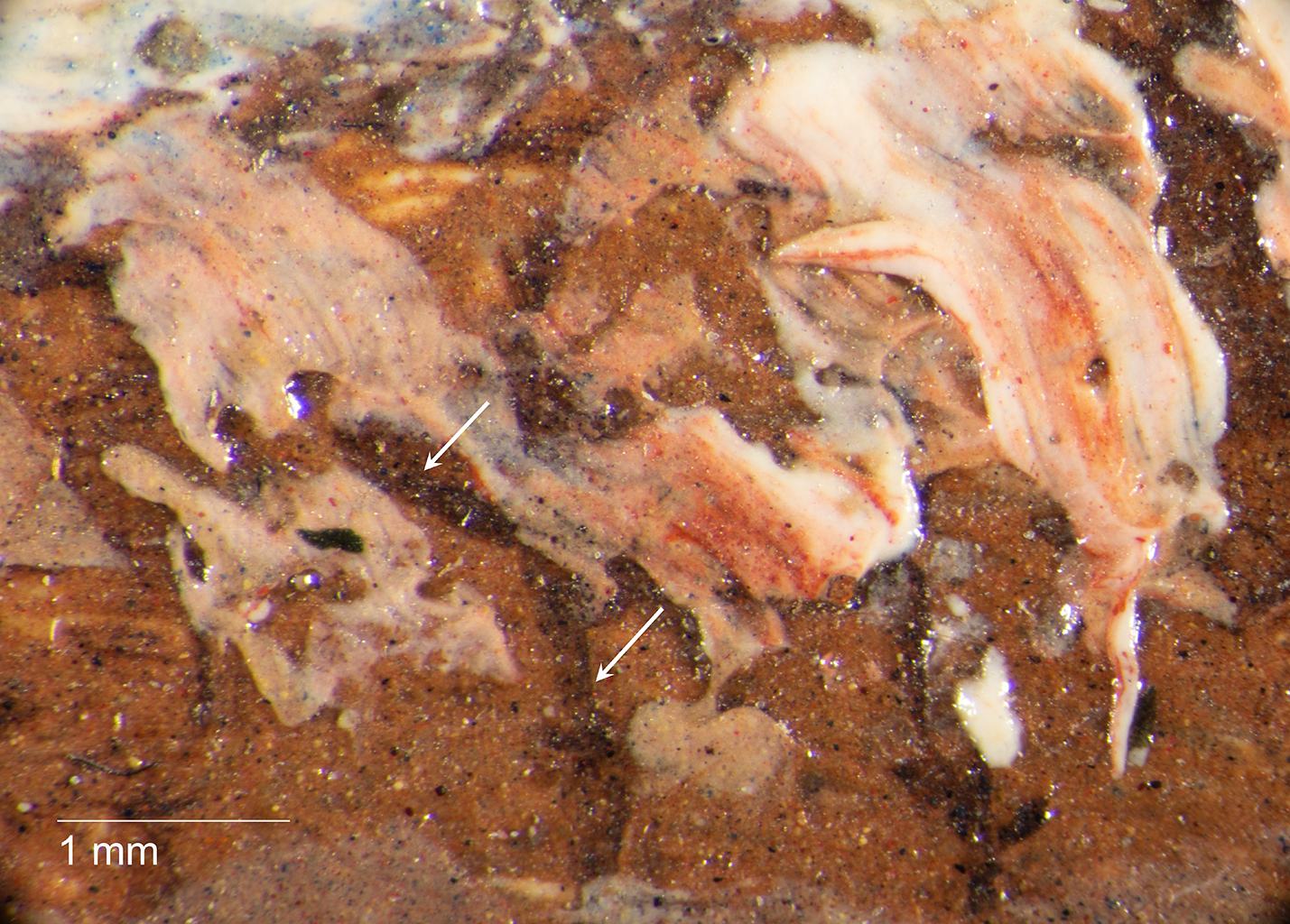
The canvas was prepared with a white or cream-colored ground layer: An opaque preparatory layer applied to the support, either commercially or by the artist, to prevent absorption of the paint into the canvas or panel. See also priming layer.. Without the original tacking margins, it is not clear if the canvas was commercially primed or prepared by the artist. There is no evidence of underdrawing: A drawn or painted sketch beneath the paint layer. The underdrawing can be made from dry materials, such as graphite or charcoal, or wet materials, such as ink or paint., but the artist may have used dilute brown paint to sketch the composition before fully rendering it. Some linear details in the tower’s roof peek through upper layers of paint and could belong to a detailed underpainting: The first applications of paint that begin to block in color and loosely define the compositional elements. Also called ébauche. (Fig. 9). Moreover, there are no significant artist-made changes noted in the x-radiograph or with infrared reflectography (IRR): A form of infrared imaging that exploits the behavior of painting materials at wavelengths beyond those accessible to infrared photography. These advantages sometimes include a continuing increase in the transparency of pigments beyond wavelengths accessible to infrared photography (i.e, beyond 1,000 nanometers), rendering underdrawing more clearly. The resulting image is called an infrared reflectogram. Devices that came into common use in the 1980s such as the infrared vidicon effectively revealed these features but suffered from lack of sharpness and uneven response. Vidicons continue to be used out to 2,200 nanometers but several newer pixelated detectors including indium gallium arsenide and indium antimonide array detectors offer improvements. All of these devices are optimally used with filters constraining their response to those parts of the infrared spectrum that reveal the most within the constraints of the palette used for a given painting. They can be used for transmitted light imaging as well as in reflection., suggesting the composition was considered and solidified before paint was applied.
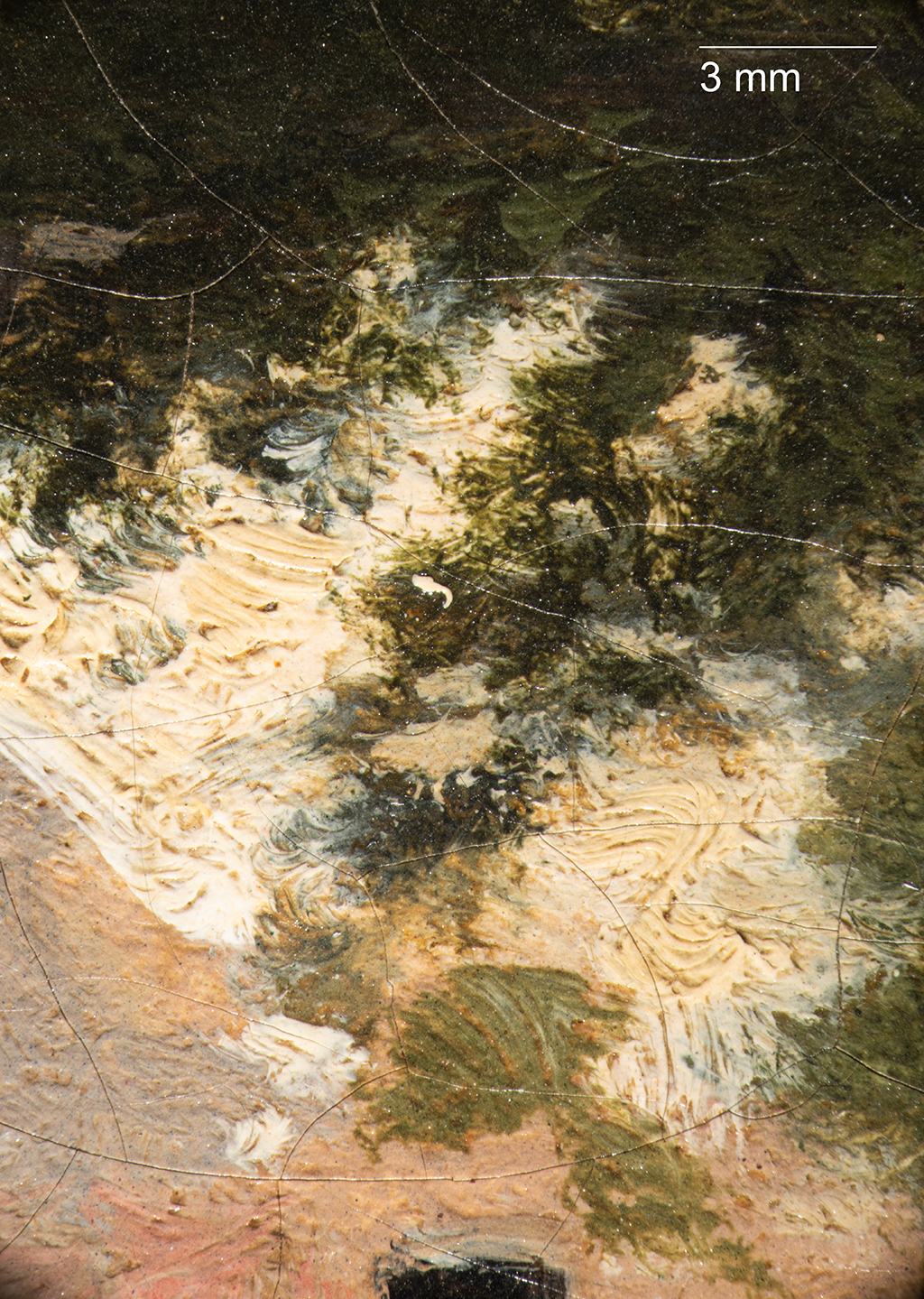
Using thick, buttery brushstrokes, the artist built up the painted surface. Some areas, such as the edges of the trees that overlap the building, were painted wet-into-wet: An oil painting technique which involves blending of colors on the picture surface. to produce mixed veins of color. Other areas, particularly the sandy, reddish walls of the road and tower, were painted wet-over-wet: An oil painting technique which involves drawing a stroke of one color across the wet paint of another color. with serpentine brushstrokes dragged through the lower layers of paint (Fig. 10). The artist formed the deep shadows in the street by applying light paint over the wet dark paint and then perfected the contours by switching between the colors. In order to prevent a muddy mixture, the artist likely used multiple brushes, each loaded with the appropriate color.
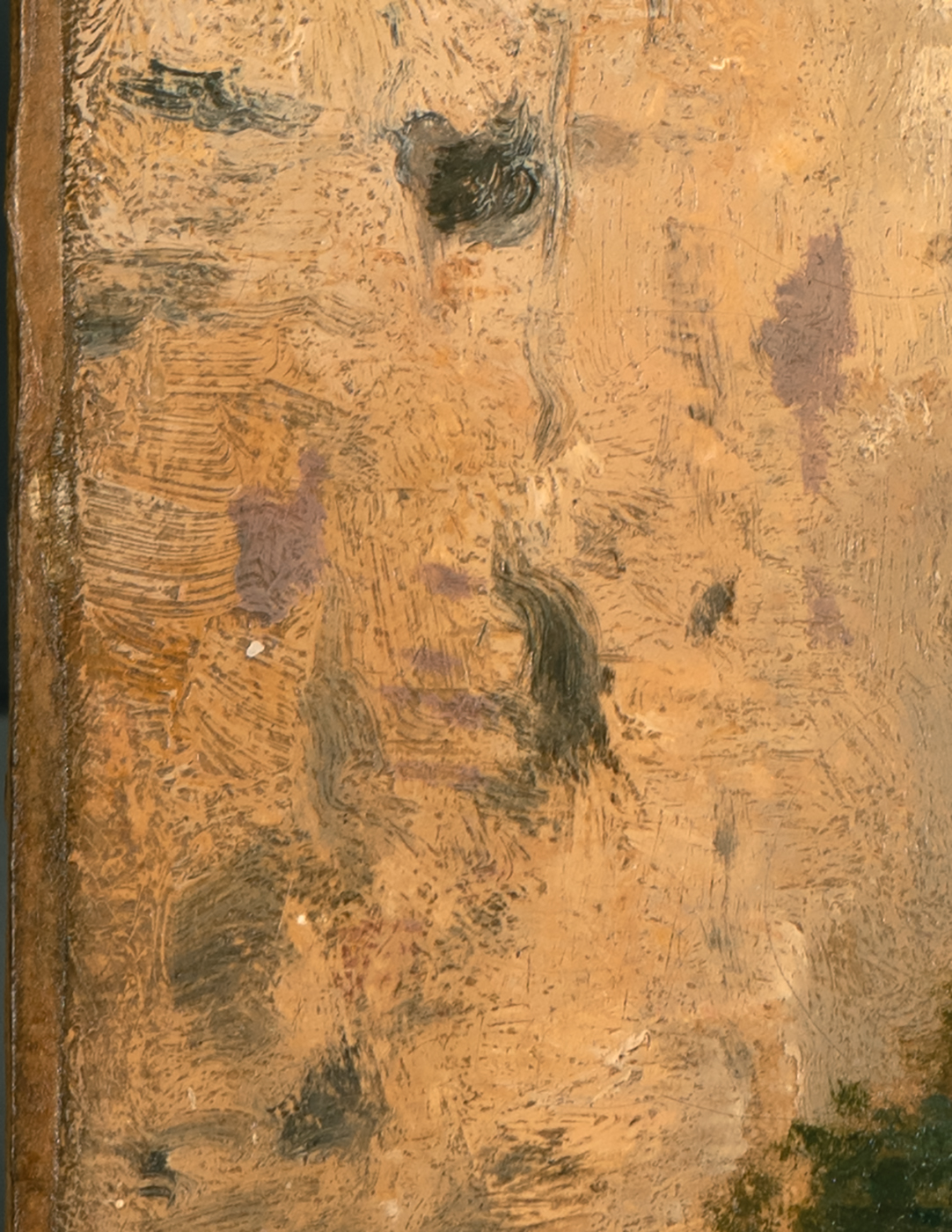
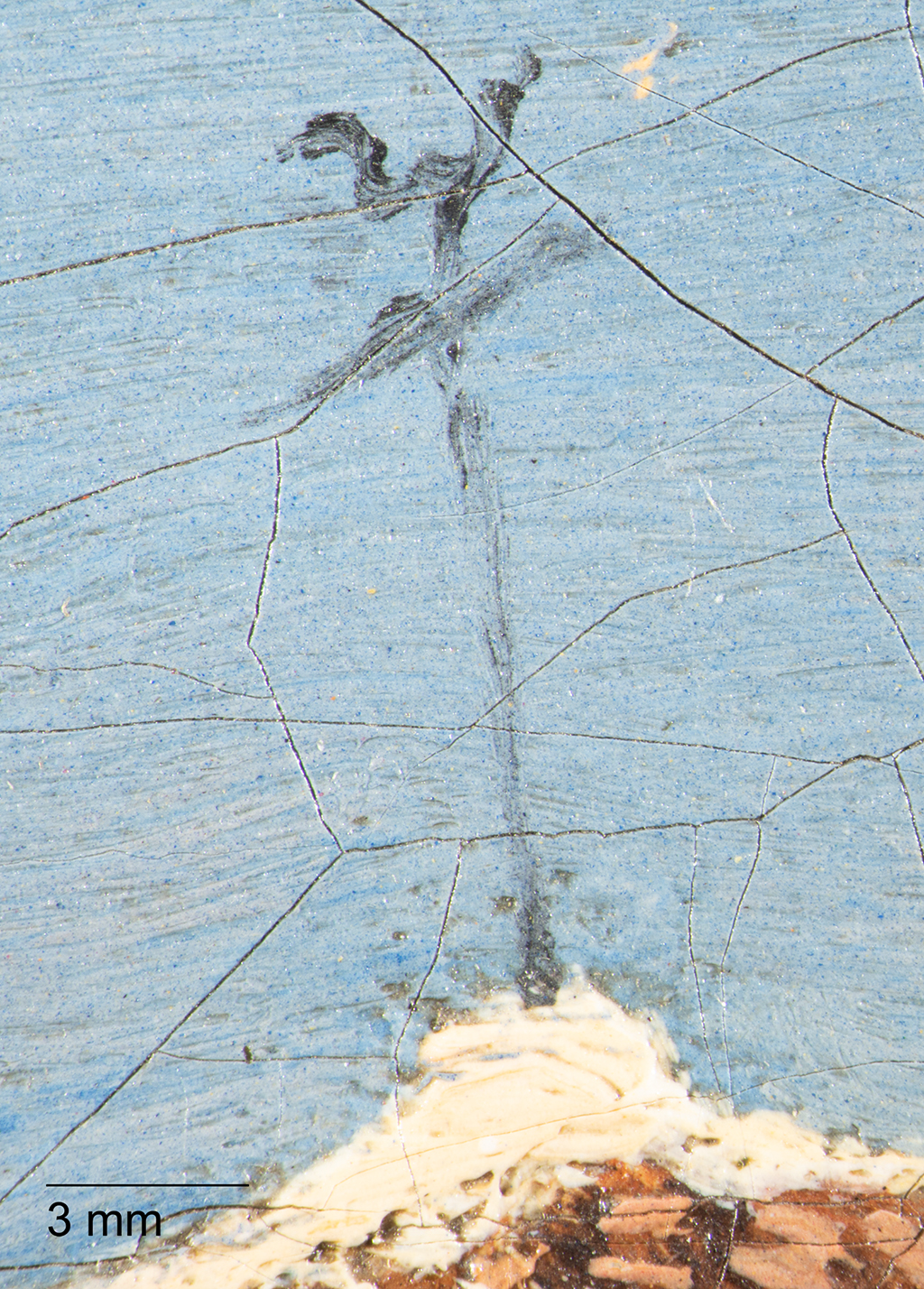
Although the painting successfully captures a fleeting glimpse of morning light, the presence of wet-over-dry: An oil painting technique that involves layering paint over an already dried layer, resulting in no intermixing of paint or disruption to the lower paint strokes. areas proves that the work was created in more than one sitting. The artist used this technique to heighten textures. The stony appearance of the walls is emphasized with thinly painted purple daubs that leave visible the topography of the underlying strokes (Fig. 11). Small touches of blue and violet were added over the tallest trees to create the impression of the sky and mountains showing through. Most of the highlights were rendered late in the painting process, using thick impasto: A thick application of paint, often creating texture such as peaks and ridges.. The bright white streak at the peak of the tower was painted on top of the building, sky, and base of the weathervane (Fig. 12).13Under magnification, the roof ornament is clearly a weathervane, not a cross. The curved, asymmetrical line indicates it is likely a weathercock, a weathervane in the shape of a rooster. However, sky blue paint slightly overlaps the extreme right tip of the same highlight, suggesting that a few modifications were made after the highlights were completed.
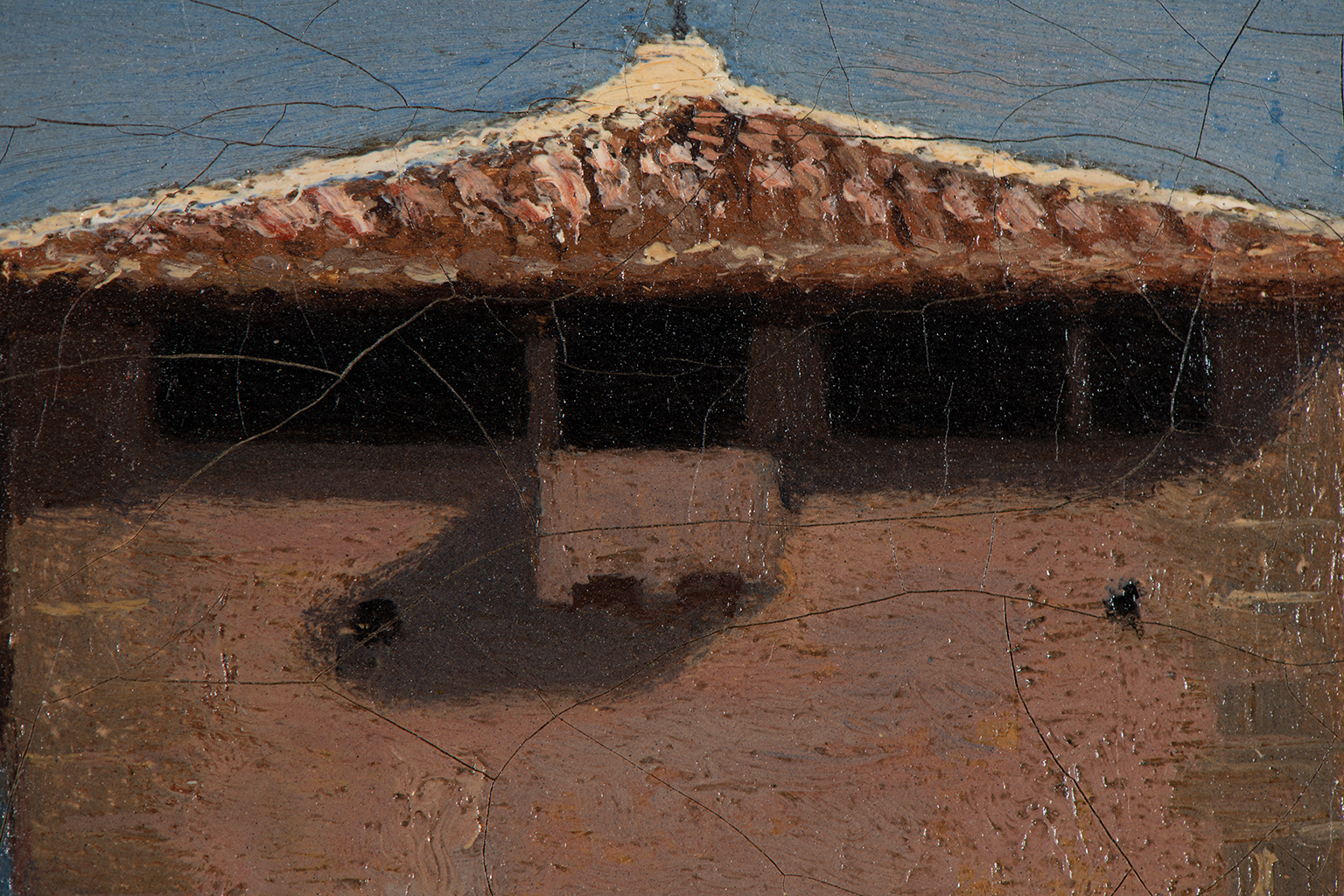
Other minor adjustments to the contours of the tower, trees, and mountains are evident. The blue paint of the sky encroaches onto the upper edges of the mountains. In turn, the blue and violet paint comprising the mountains occasionally overlaps and refines the shapes of the trees. The green beneath the violet is visible under high magnification, and these areas appear slightly darker under UV radiation. A pentimento (pl: pentimenti): A change to the composition made by the artist that is visible on the paint surface. Often with time, pentimenti become more visible as the upper layers of paint become more transparent with age. Italian for "repentance" or "a change of mind." is present at the left putlog (a small hole added in a brick building) near the top of the tower’s façade (Fig. 13). The shape was painted out and raised slightly to match the height of the putlog on the right side. Ironically, the earlier location was more accurate, as modern images show that the left putlog was lower than the right one. (According to photographs of the façade today, the putlogs have been filled, but their former positions are obvious because the newer mortar is much lighter than the naturally aged material.)
The artist used a range of brushes and pigments to create the painting. Occasional thick brush hairs from a larger brush are present throughout the expanses of color, including in the road and sky. Details like the aforementioned niche and the weathervane were accomplished using an extremely fine brush. The artist used a full palette, including at least two red pigments, blue, white, and true orange, green, and black (not mixtures of primary colors). High magnification reveals that a bright yellow pigment was used extensively, even throughout the sky (Fig. 14).
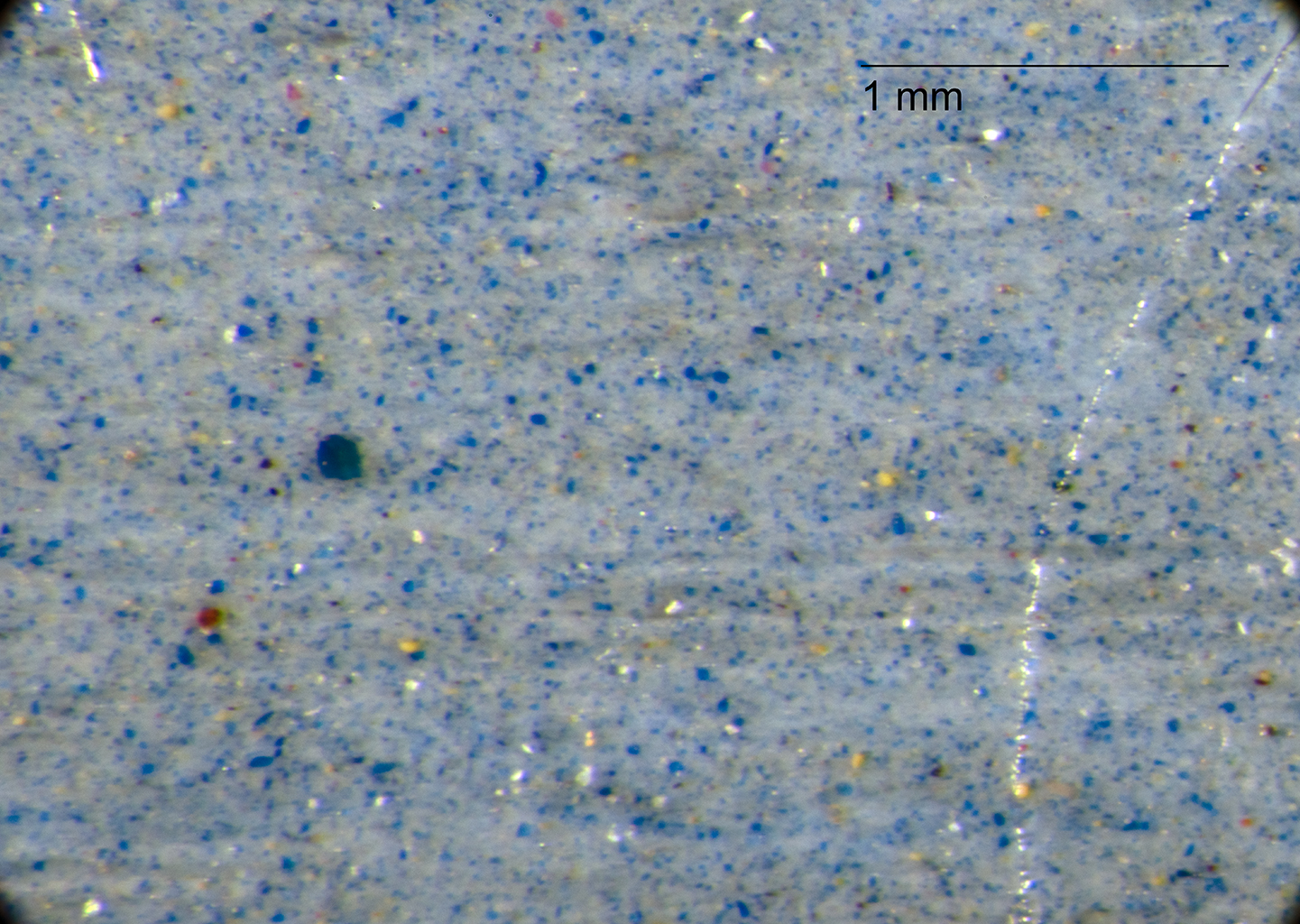
The painting is in fair condition overall, although the topography of the paint appears flat and slumped due to the heat and pressure used during the traditional glue-paste lining. At some point before the acquisition by the Nelson-Atkins, the painting was fraudulently signed “COROT” in the lower right corner.14A 1987 accessioning worksheet, located in the NAMA conservation file, 32-76, indicates that the signature was located at the bottom left corner, but it was actually at the bottom right; see reproduction in William Rockhill Nelson Gallery of Art and Mary Atkins Museum of Fine Arts, Handbook of the William Rockhill Nelson Gallery of Art (Kansas City, MO: William Rockhill Nelson Gallery of Art and Mary Atkins Museum of Fine Arts, 1933), 50. In 1960, it was determined the signature had been applied over an aged natural resin varnish layer, and both were removed. Remnants of discolored varnish are visible in the interstices of the paint. A network of widely spaced mechanical cracks: Cracks, either localized or overall, that form in response to movement or stress. exists across the surface, although the cracks are less apparent close to the perimeter of the work, where the stretcher bars have kept the canvas from flexing. A synthetic varnish was applied as part of the 1960 treatment, and occasional losses were fill material: A material added to a loss of paint and/or ground to create an area level with the surrounding original paint. and retouching: Paint application by a conservator or restorer to cover losses and unify the original composition. Retouching is an aspect of conservation treatment that is aesthetic in nature and that differs from more limited procedures undertaken solely to stabilize original material. Sometimes referred to as inpainting or retouch.. The retouching has discolored slightly since the last treatment campaign.
Notes
-
The monastery was described in such travelogues as Jean-Joseph Bonaventure Laurens, Souvenirs d’un voyage d’Art a l’île de Majorque (Paris: Arthur Bertrand et Gihaut Frères, 1840); George Sand, Un hiver en Mallorca (Paris: H. Souverain, 1842); Pablo Piferrer, Recuerdas y Bellezas de Espana, vol. 2, Mallorca (Barcelona: Joaquín Verdaguer, 1842–44); and Erzherzog Ludwig Salvator von Österreich-Toskana, Die Balearen geschildert in wort un bild (Leipzig: Brockhaus, 1884).
-
Complete image captions for Fig. 6, arranged in chronological order, from left to right: (1) Maurice Sand (1823–1889), engraved by Tony Johannot (1803–1852), Escalier du château de Valldemossa (Ascent of the Chateau of Valldemossa), ca. 1838–39, published in George Sand, Voyage à Majorque (Paris: J. Hetzel, 1868), 41; (2) Francisco Javier Parcerisa y Boada (Spanish, 1803–1875), Cartuja de Valdemosa (Valldemossa Charterhouse), 1842, illustrated in Pablo Piferrer, Recuerdos y bellezas de España: Majorca, 2:282–83. Photo: Biblioteca Nacional de España. Public domain, copyright CC BY 4.0; (3) Archduke Ludwig Salvator of Austria, Antiguo Acceso a la Cartoica de Valldemossa (Old Entrance to the Valldemossa Charterhouse), ca. 1884, illustrated in Salvator, Die Balearen geschildert in wort und bild, vol. 2, Mallorca (1884; repr. Würzburg: Leo Woerl, 1897), 29. Public domain; (4) View of the Cartoixa of Valldemossa, ca. 1875, oil on canvas, The Nelson-Atkins Museum of Art; (5) “Valldemosa: La Cartuja,” photograph, illustrated in Cartoixa de Valldemossa, “Hoy sí que retrocedemos en el tiempo . . . ,” Facebook, August 28, 2023, https://www.facebook.com
/cartoixavalldemossa /posts /pfbid02KBec FRtuveyLKDP zK18feMeMB1pr XL4AYSNFKkWNGx 4rqJu815P sDnCp96RnhEkml -
This niche or window has previously been referred to as a shrine (see conservation file for 32-76), but the painting was made after the property had been secularized.
-
The niche is not yet present in The Road to Valldemossa, illustrated in Laurens, Souvenirs, pl. 47. See also Fig. 2 in the accompanying catalogue entry.
-
For example, John Singer Sargent (American, 1856–1925), Wild Olive Tree Roots, Valldemosa, Majorca, 1908, 21 15/16 x 28 in. (55.8 x 71.1 cm), National Gallery of Art, Washington, DC, https://www.nga.gov
/collection ; Leo Gestel (Dutch, 1881–1941), Landschap Mallorca (Landscape of Mallorca), 1914, 15 3/4 x 18 7/8 in. (40 x 48 cm), Stedelijk Museum, Amsterdam, https://www.stedelijk.nl/art -object -page .73835 .html /en ; and Alexander Yakovlev (Russian, 1887–1938). For more on Yakovlev, see E. P. Yakovleva, “ЯКОВЛЕВ Александр Евгеньевич: Jacovleff Alexandre,” February 7, 2012, искусство и архитектура русского заруБЕЖЬЯ (Art and Architecture of the Russian Diaspora), https://artrz.ru/collection /2640 -leo -gestel -landschap -mallorca /articles ./1804787778 /index .html -
Transmitted light could not penetrate the fabric to determine if any stamps or inscriptions were present on the back of the original canvas.
-
A second, seemingly identical customs stamp is present on the proper right side of the upper member and appears clearer. Still, further imaging and rendering are necessary to decipher the text.
-
Many of the keys were replaced, and there is a stark difference in color between the aged wood and the replacements. The shape of the original keys is distinctive, but unfortunately, little substantial research has been conducted on key shapes. Nearly identical stretchers and keys have been noted on French, English, and American paintings.
-
See the table from Lefranc et Cie’s 1899 catalogue of standard sizes for panels and millboards, reproduced in Anthea Callen, The Work of Art: Plein-Air Painting and Artistic Identity in Nineteenth-Century France (London: Reaktion Books, 2015), 89.
-
Remnants of a black line, which delineated where the cut would be made, are present on top of the paint layer at the perimeter of the painted portion. Its granular appearance, with little or no binder, suggests that graphite, charcoal, or chalk was used. This material is most prominent 1 1/2 inches from the top right corner.
-
The following techniques were used: visible light, ultraviolet-induced visible fluorescence, reflected infrared digital photography, and infrared reflectography. The text appeared completely transparent under infrared radiation.
-
The images were altered in Adobe Camera Raw by adjusting the overall exposure, levels, and highlights as well as selecting similar pixels and digitally manipulating them separately to improve contrast. Highly speculative attempts were made to read the text from these images: the first word could be “foret” (French for forest), and the last word could be “Vall” (short for “Valldemossa”) or “Mall” (short for “Mallorca,” the Spanish spelling of Majorca).
-
Under magnification, the roof ornament is clearly a weathervane, not a cross. The curved, asymmetrical line indicates it is likely a weathercock, a weathervane in the shape of a rooster.
-
A 1987 accessioning worksheet, located in the NAMA conservation file for 32-76, indicates that the signature was located at the bottom left corner, but it was actually at the bottom right; see reproduction in William Rockhill Nelson Gallery of Art and Mary Atkins Museum of Fine Arts, Handbook of the William Rockhill Nelson Gallery of Art (Kansas City, MO: William Rockhill Nelson Gallery of Art and Mary Atkins Museum of Fine Arts, 1933), 50.
Documentation
Citation
Chicago:
Glynnis Stevenson, “Unknown artist, View of the Cartoixa of Valldemossa, ca. 1875,” technical entry in French Paintings and Pastels, 1600–1945: The Collections of the Nelson-Atkins Museum of Art, ed. Aimee Marcereau DeGalan (Kansas City: The Nelson-Atkins Museum of Art, 2026), https://doi.org/10.37764/78973.5.536.4033.
MLA:
Stevenson, Glynnis. “Unknown artist, View of the Cartoixa of Valldemossa, ca. 1875,” technical entry. French Paintings and Pastels, 1600–1945: The Collections of The Nelson-Atkins Museum of Art, edited by Aimee Marcereau DeGalan, Nelson-Atkins Museum of Art, 2026. doi: 10.37764/78973.5.536.4033.
Provenance
[Paul?] Jungers (d. ca. 1934), Paris, by November 11, 1931 [1];
With Richard Owen, Paris, by November 11, 1931–May 1, 1932 [2];
Purchased from Richard Owen, through Harold Woodbury Parsons, by The Nelson-Atkins Museum of Art, Kansas City, MO, 1932, erroneously as by Corot [3].
Notes
[1] The spelling of this constituent’s name varies but is most often found as Jungers. See K. E. Maison, Honoré Daumier Catalogue Raisonné of the Paintings, Watercolours, and Drawings (London: Thames and Hudson, 1968), nos. I-7, I-172, and I-194. For the possible first name Paul, see deaccession proposal for Felix Ziem, Still Life with Fish, 32-178, NAMA registrar files. In December 1931, Paris-based art dealer and specialist in eighteenth- and nineteenth-century drawings Richard Owen (1873–1946) was looking for buyers for four Honoré Daumier pictures he had recently purchased from a “well-known French collector” [Jungers]. See correspondence from Harold Woodbury Parsons, NAMA art agent, to J. C. Nichols, NAMA trustee, December 11, 1931, NAMA curatorial files. Through the assistance of Owen, NAMA acquired this painting, a Daumier, and several other works from this collector. See Harold Woodbury Parsons to William Mathewson Milliken, former director of the Cleveland Museum of Art, June 10, 1932, Cleveland Museum of Art Archives.
[2] For further information on Owen, see Danielle
Hampton Cullen, “The Elusive Mr. Richard Owen: A
Dealer’s Rise and Fall in the Art Market in the
United States,”
Nineteenth-Century Art Worldwide 21, no.
2 (Summer 2022):
https://doi.org
[3] Press reports show that the painting was in Kansas City by January 1932, although it was not officially accessioned until May. See “Italian Landscape by Corot for William Rockhill Nelson Gallery,” Kansas City Star 52, no. 120 (January 15, 1932): 17, (repro.), erroneously as by Jean-Baptiste-Camille Corot. The painting was placed on view at the Kansas City Art Institute as of February 8, 1932. See M[inna] K. P[owell], “Art: A Large Sunday Crowd at the Kansas City Art Institute Sees the Midwestern Show and Old Masters,” Kansas City Times 95, no. 33 (February 8, 1932): 6, erroneously as by Corot.
Exhibitions
Landscapes of the European War Theatre, The Nelson-Atkins Museum of Art, Kansas City, MO, January–February 13, 1944, no cat., erroneously as by Corot, View of Subiaco.
Exhibition in conjunction with the Consumers Cooperative Association’s 30th Annual Meeting, Municipal Auditorium, Kansas City, MO, December 2–5, 1958, no cat.
References
“Italian Landscape by Corot for William Rockhill Nelson Gallery,” Kansas City Star 52, no. 120 (January 15, 1932): 17, (repro.), erroneously as by Jean-Baptiste-Camille Corot.
“The Nelson Collection Grows,” Kansas City Star 52, no. 120 (January 15, 1932): D, erroneously as by Corot.
“Art News,” Kansas City Journal-Post 78, no. 224 (January 17, 1932): 2-C, erroneously as by Corot.
“Kansas City Museum Acquires Nine More Works from Nelson Fund,” Art Digest 6, no. 9 (February 1, 1932): 7, (repro.), erroneously as by Corot, Italian Scene.
M[inna] K. P[owell], “Art: A Large Sunday Crowd at the Kansas City Art Institute Sees the Midwestern Show and Old Masters, Including Five Lent by Maxwell Blake; George Ford Morris’s Paintings of Horses and Dogs are Shown at Lighton Studios,” Kansas City Times 95, no. 33 (February 8, 1932): 6, erroneously as by Corot.
“Art: Two Noted European Scholars Visit the William Rockhill Nelson Gallery of Art and Are Led to Comment Freely on the Comparative Value of the Paintings in the Collection,” Kansas City Star 52, no. 185 (March 20, 1932): 11A, erroneously as by Corot, Italian Scene.
“M. Claudel in Rich Land: A Desire to See Harvest Expressed by Ambassador; The Visitor Goes to View the Kansas City Art Collection and Sees Some Works of His Countrymen,” Kansas City Times 95, no. 70 (March 22, 1932): 11, erroneously as by Corot. As “the early Corot.”
“Books That Will Give Kansas Citians True Appreciation of Nelson Gallery,” Kansas City Star 53, no. 330 (August 13, 1933): 8-D, erroneously as by Corot.
“Nelson Gallery of Art Special Number,” Art Digest 8, no. 5 (December 1, 1933): 13, 20-21, (repro.), erroneously as by Corot, Italian Scene and View of Subiaco.
Minna K. Powell, “The First Exhibition of the Great Art Treasures: Paintings and Sculpture, Tapestries and Panels, Period Rooms and Beautiful Galleries are Revealed in the Collections Now Housed in the Nelson-Atkins Museum,” Kansas City Star 54, no. 84 (December 10, 1933): 4C, erroneously as by Corot.
“Set Aside Day for Kansas City Kansas at Gallery,” Kansas City Kansan (December 10, 1933).
“$15,000,000 Nelson Art Gallery Opens: Gift of Kansas City Star Publisher—Museum Has Many Innovations,” Boston Evening Transcript, no. 288 (December 11, 1933): 11, erroneously as by Corot.
“Art Critics View Nelson Gallery: Preview of Edifice, Costing $15,000,000 With Contents, Held at Kansas City; Filled with Treasures; Classical Structure on Landscaped Tract Provides All Comforts for Visitors,” New York Times 83, no. 27,715 (December 11, 1933): 24L, erroneously as by Corot.
“Nelson Gallery of Art Opened at Kansas City: $14,000,000 Gift of ‘Star’ Publisher and His Heirs Already Fully Furnished; Has Many Innovations; Oriental, Roman, Colonial Objects World Famous,” New York Herald Tribune 93, no. 31,802 (December 11, 1933): 12, erroneously as by Corot, Italian Scene.
J. S. B., “The Nelson Gallery of Art Seen Thru Eyes of a Novice,” Clay Center Dispatch, no. 2 (December 13, 1933): 2, erroneously as by Corot.
“Dreams of the Beauty of Art to Life in the Nelson Gallery,” Kansas City Star 54, no. 88 (December 14, 1933): 19, erroneously as by Corot.
Nan Sheets, “The Nelson Gallery of Art: Kansas City Presents A Treasury,” Daily Oklahoman 41, no. 341 (December 15, 1933): unpaginated.
“Nelson Gallery of Art Opens,” Editor and Publisher 66, no. 31 (December 16, 1933): 10, erroneously as by Corot.
Paul V. Beckley, “Art News,” Kansas City Journal-Post, no. 193 (December 17, 1933): 2C, erroneously as by Corot, View of Subiaco.
The William Rockhill Nelson Gallery of Art and Mary Atkins Museum of Fine Arts, Handbook of the William Rockhill Nelson Gallery of Art (Kansas City, MO: William Rockhill Nelson Gallery of Art and Mary Atkins Museum of Fine Arts, 1933), 41, 50, (repro.), erroneously as by Corot, View of Subiaco.
Ellen Josephine Green, “Among the Fine Arts,” Musical Bulletin 22, no. 4 (January 1934): 9, erroneously as by Corot.
A. J. Philpott, “Kansas City Now in Art Center Class: Nelson Gallery, Just Opened, Contains Remarkable Collection of Paintings, Both Foreign and American,” Boston Sunday Globe 125, no. 14 (January 14, 1934): 16, erroneously as by Corot.
“In Gallery and Studio: News and Views of the Week in Art,” Kansas City Star 54, no. 264 (June 8, 1934): 23, erroneously as by Corot.
Ellen Josephine Green, “The Fine Arts,” Musical Bulletin 23, no. 2 (November 1934): 8, erroneously as by Corot, Subiaco.
“Women’s Club Calendar: Wednesday,” Kansas City Star 55, no. 111 (January 6, 1935): 11C, erroneously as by Corot, View of Subiaco.
“Visitors as Well as the Art Interest a Gallery Observer: A Falling Dime, a Boy Copying a Corot Masterpiece, a Student of Great Pictures, Gum Chewing Girls, Boys Who Desire to Smoke, an Elderly Couple, in the Day’s Kaleidoscope,” Kansas City Star 56, no. 119 (January 14, 1936): 9, erroneously as by Corot, View of Subiaco.
“Club Women to Gallery: Art Collection Wins Praise of 745 Visitors; The American Wing and the Oak Hall Room Are Centers of Attraction for the Federation Delegates,” Kansas City Times 101, no. 116 (May 16, 1938): 8, erroneously as by Corot, View of Subiaco.
The William Rockhill Nelson Gallery of Art and Mary Atkins Museum of Fine Arts, The William Rockhill Nelson Collection, 2nd ed. (Kansas City, MO: William Rockhill Nelson Gallery of Art and Mary Atkins Museum of Fine Arts, 1941), 168, erroneously as by Corot, View of Subiaco.
“Temporary Exhibitions: Landscapes of the European War Theatre,” Gallery News (The William Rockhill Nelson Gallery of Art and Mary Atkins Museum of Fine Arts) 10, no. 5 (January 1944): 2, erroneously as by Corot, View of Subiaco.
H. C. H., “Scenes of Old Europe: Nelson Gallery Presents a Continent As It Was; Locales of Paintings Made Before Bombs Fell Are Designated on Map at Exhibit,” Kansas City Star 107, no. 6 (January 7, 1944): 4, erroneously as by Corot, View of Subiaco.
Landon Laird, “About Town,” Kansas City Times 115, no. 56 (March 5, 1952): 4, erroneously as by Corot, Subiaco.
Winifred Shields, “Art and Artists: Mild-Mannered Frenchman Had Success in Art, Even Financially; Poetic Quality Marks the Landscapes of Camille Corot, Who, Ignoring the Turbulence of His Era, Painted Only Beauty in the Woods of Fontainebleau,” Kansas City Star 74, no. 1 (September 18, 1953): 22, erroneously as by Corot, View of Subiaco.
Ross E. Taggart, ed., Handbook of the Collections in the William Rockhill Nelson Gallery of Art and Mary Atkins Museum of Fine Arts, 4th ed. (Kansas City, MO: William Rockhill Nelson Gallery of Art and Mary Atkins Museum of Fine Arts, 1959), 260, erroneously as by Corot, View of Subiaco.
Ross E. Taggart and George L. McKenna, eds., Handbook of the Collections in The William Rockhill Nelson Gallery of Art and Mary Atkins Museum of Fine Arts, Kansas City, Missouri, vol. 1, Art of the Occident, 5th ed. (Kansas City, MO: William Rockhill Nelson Gallery of Art and Mary Atkins Museum of Fine Arts, 1973), 257, erroneously as by Corot, View of Subiaco.
Donald Hoffmann, “A fresh look at the Nelson: Painting, rearranging give new perspective to exhibits,” Kansas City Star 104, no. 78 (December 18, 1983): 3-I, erroneously as by Corot.
Alice Thorson, “The Nelson Celebrates its 60th: Museum built its reputation virtually from ground zero,” Kansas City Star 113, no. 304 (July 18, 1993): J4, erroneously as by Corot.