Catalogue Entry
Citation
Chicago:
Brigid M. Boyle, “Eugène Boudin, The Port of Deauville, ca. 1884, and Boats Decorated with Flags in the Port of Deauville, 1895,” catalogue entry in French Paintings and Pastels, 1600–1945: The Collections of The Nelson-Atkins Museum of Art, ed. Aimee Marcereau DeGalan (Kansas City: The Nelson-Atkins Museum of Art, 2022), https://doi.org/10.37764/78973.5.606.5407.
MLA:
Boyle, Brigid M. “Eugène Boudin, The Port of Deauville, ca. 1884, and Boats Decorated with Flags in the Port of Deauville, 1895,” catalogue entry. French Paintings and Pastels, 1600–1945: The Collections of The Nelson-Atkins Museum of Art, edited by Aimee Marcereau DeGalan, Nelson-Atkins Museum of Art, 2022. doi: 10.37764/78973.5.606.5407.
This catalogue entry explores two paintings. For the catalogue documentation and technical entry for the associated painting, see Boats Decorated with Flags in the Port of Deauville, 2015.13.3.
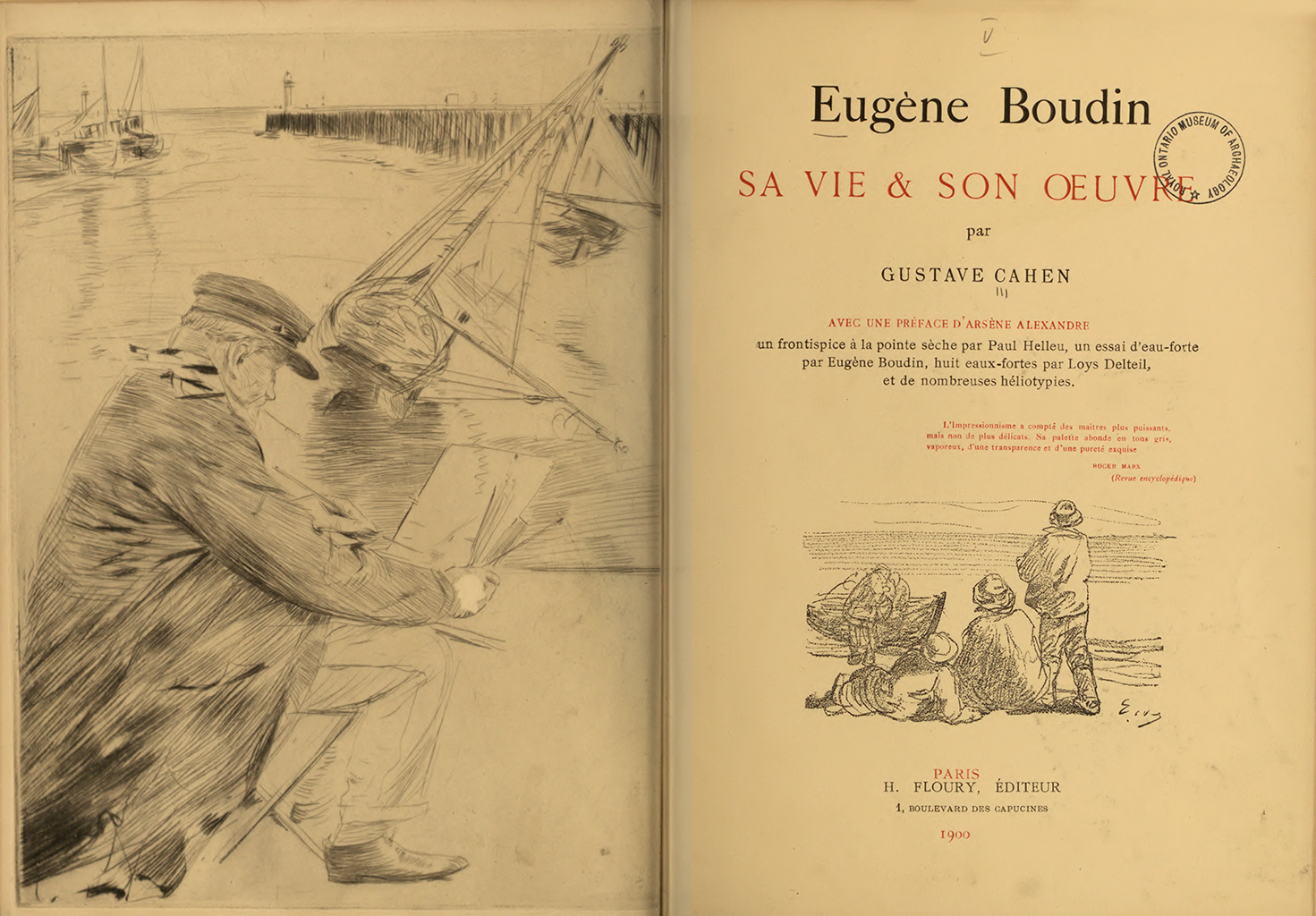
Eugène Boudin’s fabled attachment to the sea has long been part of his mythology as an artist. At Boudin’s funeral services, French bureaucrat Albert Kaempfen delivered a poetic eulogy about the artist’s experience growing up on the coast: “His childhood was cradled by the wave, by the gust of wind . . . and the sky and the sea were his first loves, to which he always remained faithful.”1Quoted in Gustave Cahen, Eugène Boudin: Sa vie et son œuvre (Paris: H. Flory, 1900), 148. “Son enfance fut bercée sur la vague, au souffle du vent . . . et le ciel et la mer furent ses premières amours, auxquelles il demeura toujours fidèle.” All translations are by Brigid M. Boyle. British art critic Frederick Wedmore echoed this sentiment, insisting that “the sea was in his blood,” while New York Times columnist Edward Alden Jewell declared Boudin and the sea “inseparable.”2See Frederick Wedmore, Whistler and Others (London: Sir Isaac Pitman and Sons, 1906), 51; and Edward Alden Jewell, “Boudin Paintings Are Put On View,” New York Times (November 1, 1933). Perhaps most telling, the frontispiece to Gustave Cahen’s early monograph on Boudin depicts the artist seated on a shore, intently sketching a sailboat run aground (Fig. 1). Dressed in a sailor’s cap and striped cravat, Boudin appears quite at home in this environment and oblivious to anything but the vessel before him. Such images contributed to Boudin’s reputation as “without doubt the greatest of French marine painters,” as famed art dealer Paul Durand-Ruel pronounced him at a posthumous retrospective.3Exposition of Paintings by the Late Louis Eugène Boudin, exh. cat. (New York: Durand-Ruel Galleries, 1898), unpaginated. Of course, Durand-Ruel had a vested interest in building Boudin’s renown.
It is certainly true that Boudin was surrounded by boats from a young age. His father, Léonard-Sébastien Boudin, came from a long line of seamen and oversaw the steamboat service between Le Havre and Honfleur for over two decades. His mother, Marie-Félicité Boudin (née Buffet), served as a chambermaid aboard various ships. Boudin himself worked as a mousse (sailor’s apprentice) beginning at age ten.4Georges Jean-Aubry, Eugène Boudin d’après des documents inédits: L’Homme et l’œuvre (Paris: Editions Bernheim-Jeune, 1922), 17–19. However, when Boudin took up painting in 1847, he did not immediately gravitate toward maritime subjects. Instead, he tried his hand at portraiture and still lifes, depicted Breton religious ceremonies known as pardons, and, above all, captured the bourgeois beachgoers at Trouville and Deauville.5Boudin later claimed to have abandoned portraiture because the vogue for daguerreotypes reduced the demand for painted portraits. See Paul Leroi, “Salon de 1887 (suite),” L’Art: Revue bimensuelle illustrée, no. 556 (July 15, 1887): 32. Boating scenes remained a marginal portion of Boudin’s production during the 1850s and 1860s. It was only in 1869, as Laurent Manœuvre has noted, when Belgian dealer Léon Gauchez commissioned Boudin to paint several maritime pictures, that the artist turned his attention in earnest to the sea in the hope of building an international clientele.6Laurent Manœuvre, “Eugène Boudin, Gustave Courbet et le développement de l’impressionnisme,” in Frédérique Thomas-Maurin, Julie Delmas, and Élise Boudon, eds., Courbet et l’impressionnisme, exh. cat. (Milan: Silvana, 2016), 44–45. According to a letter dated August 30, 1869, from Boudin to his friend Ferdinand Martin, Gauchez intended to market Boudin’s maritime scenes to collectors of Belgian seascapes, a strategy he had already employed for paintings by Johan Barthold Jongkind. As Boudin continued in this genre, his seascapes also attracted French tourists, who were vacationing at the shore in ever-greater numbers.
The Boudin harbor scenes at the Nelson-Atkins both portray Deauville, a fashionable resort town for the beau monde (high society) of Paris. Once a quiet hamlet known primarily for its fish market and thatched roofs, Deauville was redeveloped in the 1860s by Charles-Auguste-Louis-Joseph, duke de Morny, who built a racetrack, casino, and railway station to lure the upper classes.7See Anna Bowman Dodd, Up the Seine to the Battlefields (New York: Harper and Brothers, 1920), 34–36; and Suzanne Cassidy, “The Thoroughbred Called Deauville,” New York Times, July 23, 1989. Some scholars argue that the duke’s role in transforming Deauville has been overstated; see Frédérique Citéra, “Deauville,” in Un siècle de bains de mer dans l’estuaire de la Seine, 1830–1930, exh. cat. (Honfleur: Musée Eugene Boudin, 2003), 36–39. Boudin witnessed these changes firsthand, attending the inaugural horse races at the hippodrome and the opening concerts at the casino. A regular visitor to Deauville during July and August, he built himself a Neo-Norman–style summer residence on the rue Olliffe in 1884, when he had at last achieved some material success.8Carla Gottlieb, “Boudin’s Drawings,” Master Drawings 6, no. 4 (Winter 1968): 401. Boudin lived in relative poverty for much of his life. It was not until the early 1880s, when Durand-Ruel took notice of his work, that Boudin became financially secure. During Boudin’s final two decades, he painted Deauville’s busy harbor incessantly, determined to preserve “the appearance, riggings, and state of our ports in our age.”9Leroi, “Salon de 1887 (suite),” 33. “L’allure, les gréements et l’état de nos ports à notre époque.” Leroi quotes from a letter by Boudin to a mutual friend. After Boudin was diagnosed with stomach cancer in 1895, he moved to Deauville full time to live out his remaining years in his favorite seaside locale. He became so associated with the town that when Deauville celebrated its 150th anniversary in 2010, it designated August 8 “Eugène Boudin Day” in honor of its most famous former resident.10See “Normandy Impressionist Festival,” Times (London), April 24, 2010; and Seth Sherwood, “On the Cote Fleurie,” New York Times, August 8, 2010.
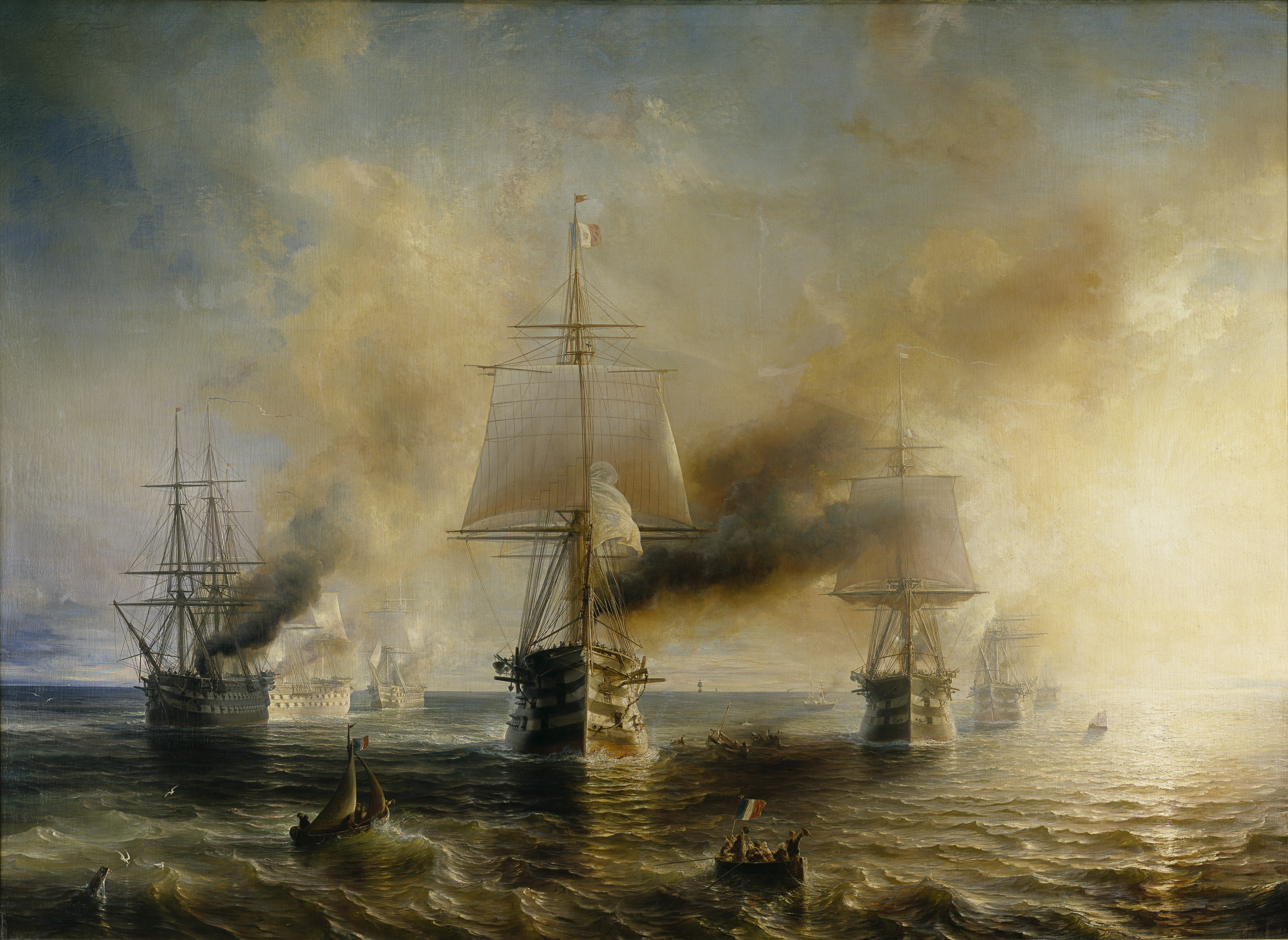
Port of Deauville, the earlier of the Kansas City boating scenes, was probably painted the same year that Boudin purchased a home in Deauville.11A Durand-Ruel label on the stretcher reads “Boudin No. 448 / Port de Deauville / 1884.” Durand-Ruel purchased Port of Deauville directly from Boudin in 1888. See Figure 9 in the technical entry. Moored beneath an overcast sky are several empty sailboats and dinghy: A small boat carried on board, or towed behind, a larger vessel.; the only sign of human activity is the rowboat carrying three figures in the foreground. The banality of this scene represented a radical departure from the Romantic maritime pictures of the previous generation.12For more on this subject, see Laurent Manœuvre, “Peinture de marines française, 1820–1905,” in Anne-Marie Bergeret-Gourbin and Dominique Lobstein, Honfleur entre tradition et modernité, 1820–1900, exh. cat. (Honfleur: Musée Eugène Boudin, 2010), 35–52. Artists like Théodore Gudin (1802–80) had specialized in tumultuous paintings of shipwrecks, naval battles, and stormy waters. Even less action-packed seascapes, like Gudin’s La flotte française se rendant de Cherbourg à Brest, 1858 (The French Fleet Heading from Cherbourg to Brest, 1858), were made theatrical by their lighting, composition, and monumentality (Fig. 2). In Gudin’s work, the sun sits low in the sky, casting strong shadows on the water, and the central ship’s mast forms the apex of a pyramidal arrangement. By contrast, Port of Deauville is deliberately undramatic. Its even illumination (consistent with being painted en plein air (adjective: plein-air): French for “outdoors.” The term is used to describe the act of painting quickly outside rather than in a studio.), loose structure, and absence of narrative are the antithesis of the Romantic style. Boudin sought to record daily life at the port, not to recreate grand nautical events.
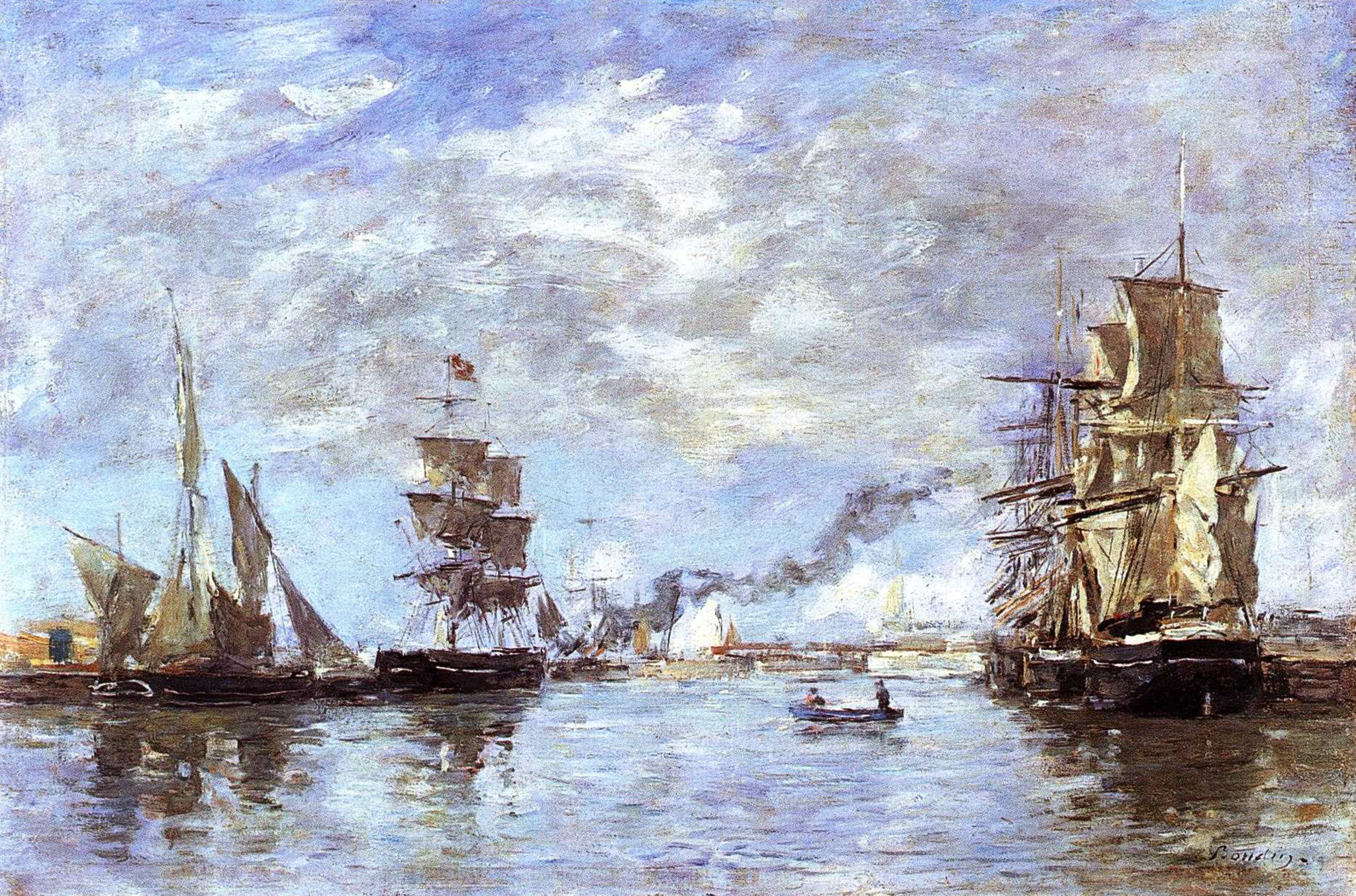
Many of the compositional elements in Port of Deauville reappear in other harbor scenes by Boudin. The canoe and smokestack were among his stock motifs, and he experimented ad infinitum with furled and unfurled sails. Some twentieth- and twenty-first century critics have accused Boudin of monotony or self-plagiarism, but his contemporary Philippe Burty assured the French public that the opposite was true.13For example, American journalist John Canaday acknowledged “assurance and finesse” in certain pictures by Boudin but claimed that he “could also be a rather monotonous painter.” John Canaday, “Boudin, Fantin-Latour and Newcomer,” New York Times (November 5, 1966). In his review of Boudin’s solo show at the Galerie Durand-Ruel in 1883, Burty praised the artist for approaching the same subjects with fresh eyes each time, such that his paintings “awaken specific, heightened memories of strolls we would have taken in these parts, on these varied coasts.”14Quoted in Jean-Aubry, Eugène Boudin, 183. Boudin’s works “éveillent les souvenirs précis, accentués, de promenades que nous aurions faites dans ces contrées, sur ces côtes diverses.” A comparison of the Nelson-Atkins panel to another rendering of Deauville’s harbor by Boudin from the early 1880s makes the artist’s originality manifest (Fig. 3). Both works have a low horizon line punctuated by sailboats, which dwarf the diminutive oarsmen in the foreground and increase in stature from left to right. Both paintings contain a diagonal trail of smoke that serves as a visual link between the ships.15Interestingly, Boudin painted the trail of smoke in the Nelson-Atkins picture before adding the sky. See technical notes by Mary Schafer, Nelson-Atkins paintings conservator, August 24, 2011, NAMA conservation files, 33-14/1. However, their atmospheric conditions and palettes are quite different. Shades of gray dominate the cloud-filled Kansas City seascape, while patches of blue enliven its counterpart, clearly painted on a sunnier day. One can understand how each work might stir recollections of separate outings in Deauville, as Burty suggested.
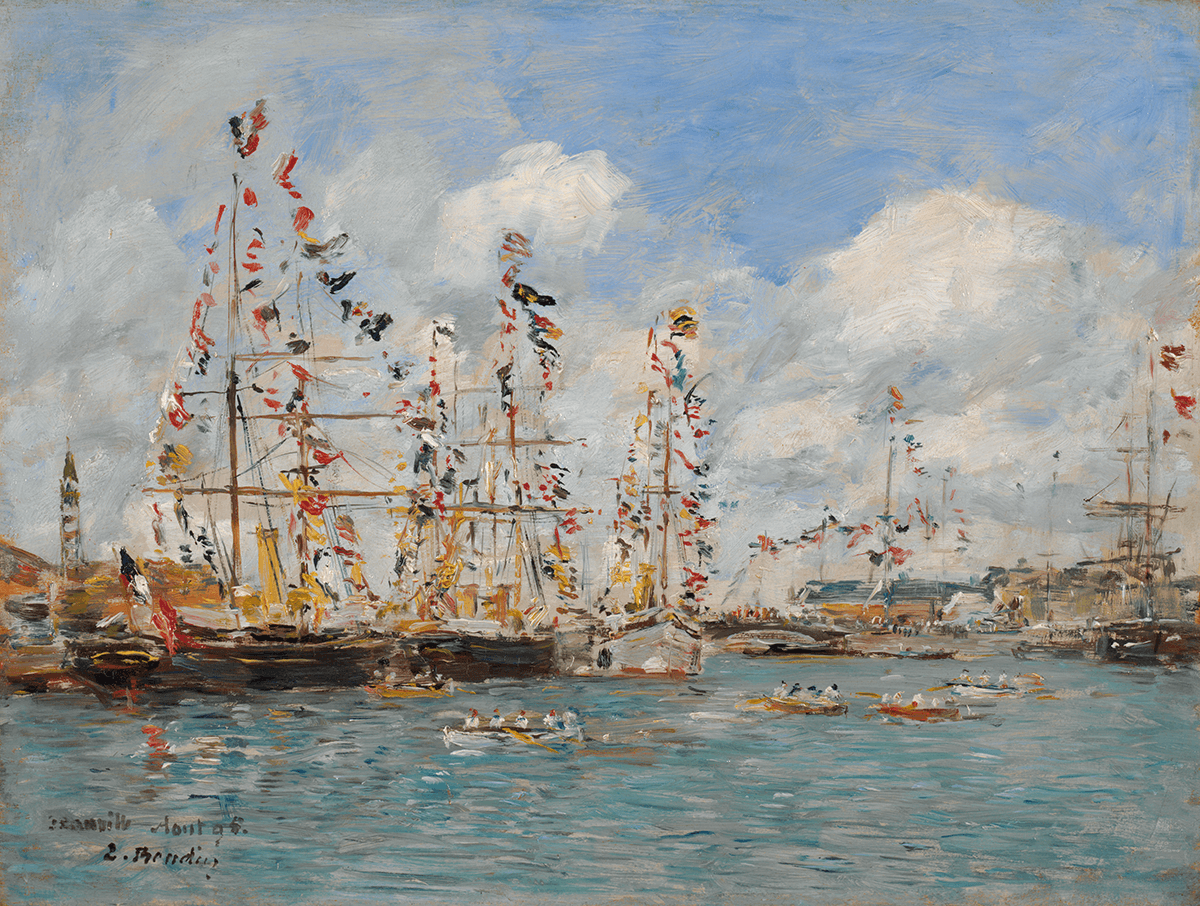
While the majority of Boudin’s Deauville harbor scenes document the routine comings and goings of sailboats, a few portray those crafts outfitted for special occasions. Boats Decorated with Flags in the Port of Deauville is one such picture. Painted in August 1895, most likely on the sixth day of a regatta (as discussed below), it features half a dozen vessels whose assorted pennants wave jauntily in the breeze. Yacht races were part of a burgeoning leisure culture for the European well-to-do. Beginning in the 1850s, French plaisanciers (pleasure boaters) participated in sailing contests at popular seaside resorts in imitation of their British peers, who already had a well-established tradition of regattas on the River Thames. Most did not pilot their vessels themselves, instead hiring professional sailors to staff them.16Jean-Louis Lenhof, “Régates et navigation de plaisance en baie de Seine au XIXe siècle,” in Dominique Barjot, Eric Anceau, and Nicolas Stoskopf, eds., Morny et l’invention de Deauville (Paris: Armand Colin, 2010), 381–406. As Lenhof explains, yachting took two forms in nineteenth-century France: yachting de croisière and yachting de course, or cruising and racing. When used as cruise ships, yachts were essentially “traveling private mansions” that allowed their owners to sightsee while still enjoying the comforts of home. They offered a novel place to entertain guests and conduct business. When used as racing vessels, yachts were equally luxurious but differently equipped: they did not rely on steam propulsion, and their sails could adapt more easily to variable winds. The Cercle de la Voile de Paris, a prominent yacht club founded in the French capital in 1858, collaborated with regional associations to organize annual events that became important fixtures on the summer social calendar.17For example, in 1892 the Cercle de la Voile de Paris joined forces with a company in Trouville to host a three-day regatta in late July. See Henri Philippe, “Yachting-Gazette: Revue des régates à la voile en 1892,” Le Sport, no. 18 (March 3, 1893): 284–85.
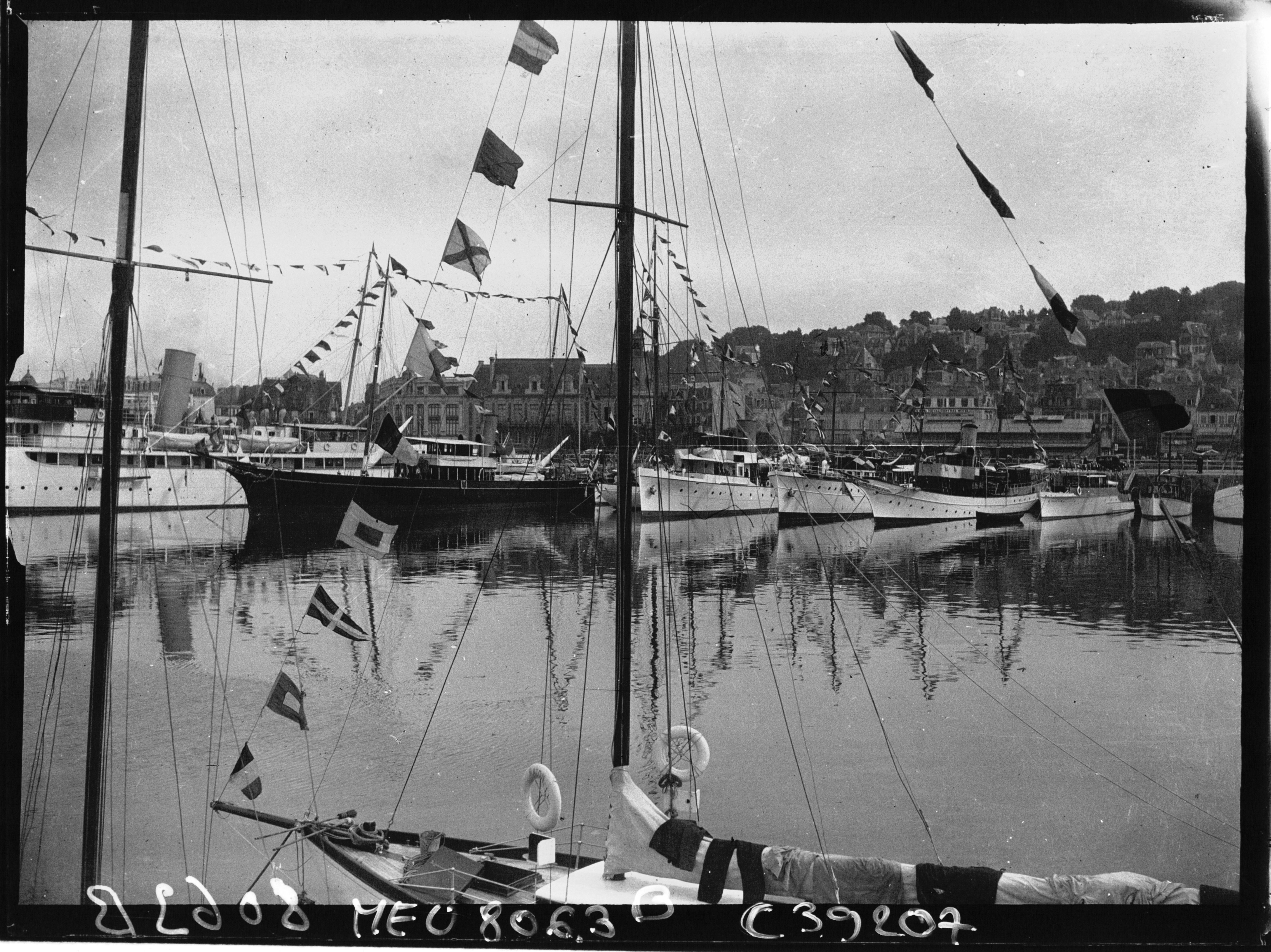
Deauville began welcoming yachts in 1866, when its wet dock—a special enclosure that maintains the level of high tide, allowing boats to remain afloat—was inaugurated. Yacht traffic increased during the Third Republic: The republic established in France in 1870, after the fall of Napoleon III, lasting until the German occupation of France in World War II., particularly after 1891, when a second dock tailored to racing vessels was constructed.18Lenhof, “Régates et navigation de plaisance,” 385–86. When in town for a regatta, yacht owners would often adorn their ships with signal flags, as seen in a twentieth-century photograph of Deauville’s harbor by the Agence Meurisse (Fig. 4). Normally used to communicate with other vessels during navigation, these flags could also serve more ornamental purposes. In the Agence Meurisse photo, the foremost sailboat is close enough to discern individual flags. The pennant with an X-shaped motif, for example, ordinarily indicates that the sailor requires assistance, while the white flag with a square at center usually warns that the boat will be moving astern. Here, however, they reveal only that a regatta is underway in Normandy.
Boudin’s interest in yachting and seaside galas dates to early in his career, as evidenced by Festival in the Harbor of Honfleur of 1858 (Fig. 5). Painted in the artist’s hometown, this seascape captures the joy of summertime and the excitement of a swimming competition. Men in bathing caps race to shore, watched by some nearby mallards and numerous spectators crammed into rowboats. Overhead, pennants flutter merrily in the wind and cast colorful shadows on the water. Though the subject is similar to that of Boats Decorated with Flags, the handling is much more meticulous. The intricate mesh of ropes required to operate the trois-mâts (three-masted ship) is painstakingly delineated, almost as if Boudin used a straightedge, and the rowboat passengers are distinguished from one another by their clothing and umbrellas. By contrast, the Nelson-Atkins panel is freer and more confident in its execution. Boudin painted most of the flags in three strokes or fewer, and he condensed the oarsmen to a few dots of pigment, imbuing the Kansas City picture with a greater sense of immediacy than its predecessor.
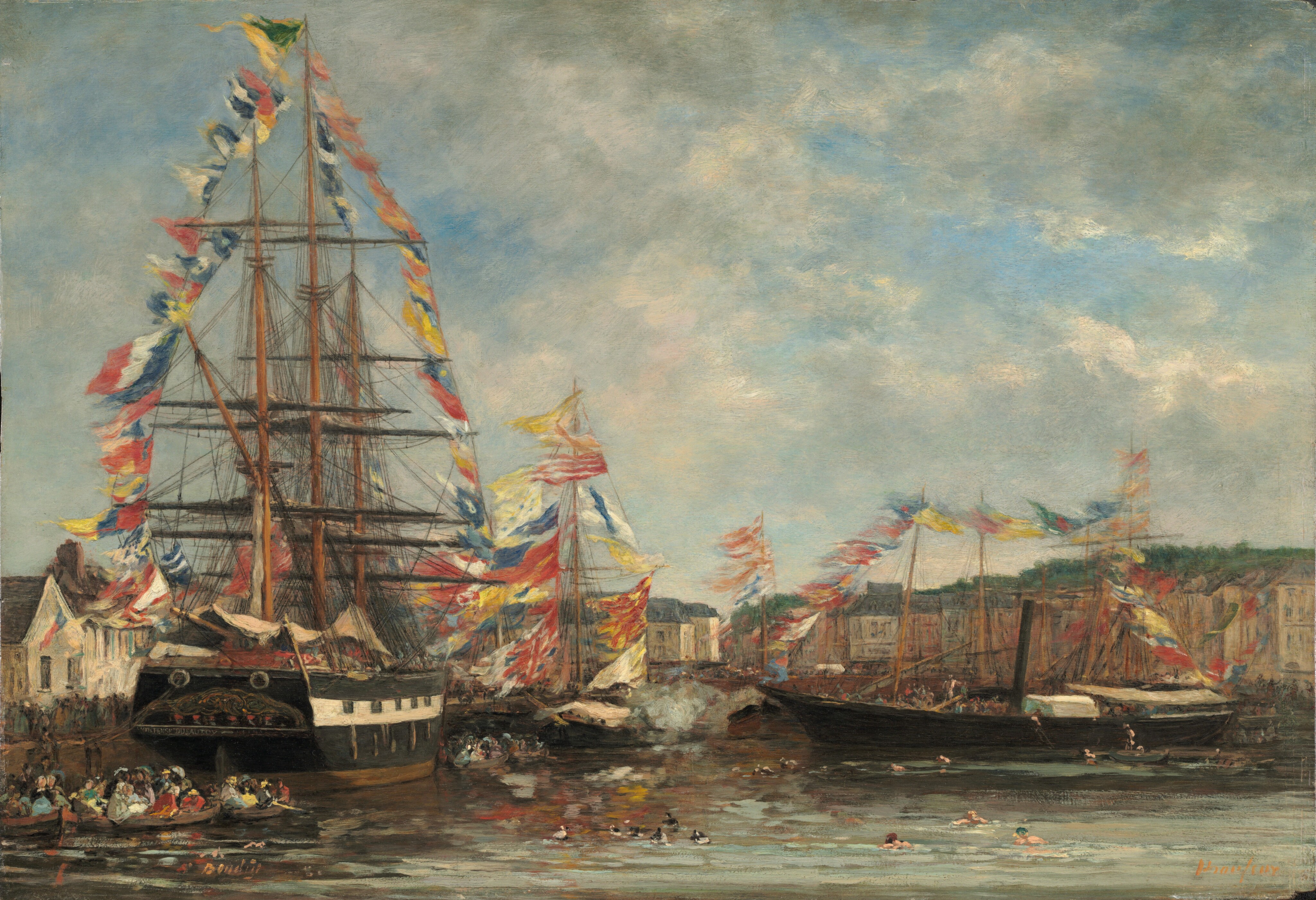

Despite their divergent brushwork, however, both paintings derive visual power and a sense of cohesion from the flags scattered across their picture space: The whole area of a painting, considered in relation to its parts.. Boudin made careful study of these pennants, as attested by three extant pastel drawings and a related oil painting at the Musée d’Orsay. One is a preparatory sketch for the 1858 painting; two others have close-ups of the Union Jack, the American flag, and several maritime signals; and a third, pictured here, features two masts with crisscrossing strings of pennants (Fig. 6).19See RF 16785, RF 16794, RF 3350, and RF 16793 at the Musée d’Orsay. Another pastel drawing of a boat with flags was sold at Tableaux modernes et contemporains, Rémy Le Fur et Associés, Paris, December 3, 2012, lot 21 (Bateau pavoisé). These works demonstrate Boudin’s fascination with the flags’ aesthetic and spatial properties. He sought to capture not only their vibrant hues and diverse shapes but also their behavior on blustery days and their relationship to neighboring pennants. We see these concerns play out in the Nelson-Atkins panel: the motley flags overlap, dance in the salty air, and draw the viewer’s eye across the scene.
Like other paintings in Boudin’s vast oeuvre, Boat Decorated with Flags is inscribed with the city, month, and year of its creation: “Deauville Aout 95.” Though this date is already quite precise, new information may allow us to pinpoint the exact day on which Boudin painted the seascape. On August 20, 1895, French journalist Jehan Soudan de Pierrefitte published a detailed account of a weeklong celebration in Deauville. On the fifth evening of the festival, yachts bedecked with Bengal lights: A firework or flare with a steady blue light, used, especially formerly, as a signal. paraded through the harbor, treating revelers to a stunning display that remained illuminated until daybreak. The following morning, August 19, people took strolls along the beachfront, admiring “the cheerful pennants and flags floating before the row of red parasols.”20Jehan Soudan [de Pierrefitte], “À Trouville,” Le Journal, no. 1057 (August 20, 1895): 2. “Les gais pavillons et drapeaux flottants devant les rangs de parasols rouges.” Some lunched al fresco on the casino’s terrace and then caught an opera matinee. That afternoon, large crowds enjoyed a regatta organized by Count Jean Alfred Octave de Chabannes la Palice, a French sailor and nobleman who later represented France at the 1900 Olympics in Paris. Many also amused themselves by watching the duck races, hog contests, and swimming competitions.
While those sporting events were taking place, Soudan de Pierrefitte happened upon “the master E. Boudin, painting this aquatic fair from the quay; the painter Jules Lefebvre, a habitué of Benerville-sur-Mer, [was] also there.”21Soudan [de Pierrefitte], “À Trouville,” 2. “Surpris le maître E. Boudin, peignant du quai cette kermesse aquatique; le peintre Jules Lefebvre, un fidèle de Bennerville, est là aussi.” During Boudin’s lifetime, he completed only five paintings of sailing vessels embellished with pennants in Deauville’s harbor. Three date to 1896 or 1897; one is undated; and one—the Nelson-Atkins panel—dates to 1895.22See Robert Schmit, Eugène Boudin, 1824–1898 (Paris: Galerie Schmit, 1973), nos. 3019, 3547, 3552, 3554, and 3621, pp. 3:165, 353, 356, and 382. The Nelson-Atkins panel, no. 3554, is erroneously dated to 1896 in the catalogue raisonné, even though it bears the aforementioned inscription “Deauville Aout 1895.” We can thus be fairly certain that Boats Decorated with Flags was on Boudin’s easel when Soudan de Pierrefitte bumped into him and Lefebvre on August 19, 1895. Like other festivalgoers, Boudin was taking in the sights, sounds, and smells of summer merriment: the pageantry of the yachts, the boom of salvos from the nearby Le Havre squadron, the aroma of fresh seafood served at the casino, and much more. The regatta and its associated diversions had a transformative effect on the port that Boudin knew so well, and he was determined to capture this annual spectacle for posterity.
Notes
-
Quoted in Gustave Cahen, Eugène Boudin: Sa vie et son œuvre (Paris: H. Flory, 1900), 148. “Son enfance fut bercée sur la vague, au souffle du vent . . . et le ciel et la mer furent ses premières amours, auxquelles il demeura toujours fidèle.” All translations are by Brigid M. Boyle.
-
See Frederick Wedmore, Whistler and Others (London: Sir Isaac Pitman and Sons, 1906), 51; and Edward Alden Jewell, “Boudin Paintings Are Put On View,” New York Times (November 1, 1933).
-
Exposition of Paintings by the Late Louis Eugène Boudin, exh. cat. (New York: Durand-Ruel Galleries, 1898), unpaginated. Of course, Durand-Ruel had a vested interest in building Boudin’s renown.
-
Georges Jean-Aubry, Eugène Boudin d’après des documents inédits: L’Homme et l’œuvre (Paris: Editions Bernheim-Jeune, 1922), 17–19.
-
Boudin later claimed to have abandoned portraiture because the vogue for daguerreotypes reduced the demand for painted portraits. See Paul Leroi, “Salon de 1887 (suite),” L’Art: Revue bimensuelle illustrée, no. 556 (July 15, 1887): 32.
-
Laurent Manœuvre, “Eugène Boudin, Gustave Courbet et le développement de l’impressionnisme,” in Frédérique Thomas-Maurin, Julie Delmas, and Élise Boudon, eds., Courbet et l’impressionnisme, exh. cat. (Milan: Silvana, 2016), 44–45. According to a letter dated August 30, 1869, from Boudin to his friend Ferdinand Martin, Gauchez intended to market Boudin’s maritime scenes to collectors of Belgian seascapes, a strategy he had already employed for paintings by Johan Barthold Jongkind.
-
See Anna Bowman Dodd, Up the Seine to the Battlefields (New York: Harper and Brothers, 1920), 34–36; and Suzanne Cassidy, “The Thoroughbred Called Deauville,” New York Times, July 23, 1989. Some scholars argue that the duke’s role in transforming Deauville has been overstated; see Frédérique Citéra, “Deauville,” in Un siècle de bains de mer dans l’estuaire de la Seine, 1830–1930, exh. cat. (Honfleur: Musée Eugene Boudin, 2003), 36–39.
-
Carla Gottlieb, “Boudin’s Drawings,” Master Drawings 6, no. 4 (Winter 1968): 401. Boudin lived in relative poverty for much of his life. It was not until the early 1880s, when Durand-Ruel took notice of his work, that Boudin became financially secure.
-
Leroi, “Salon de 1887 (suite),” 33. “L’allure, les gréements et l’état de nos ports à notre époque.” Leroi quotes from a letter by Boudin to a mutual friend.
-
See “Normandy Impressionist Festival,” Times (London), April 24, 2010; and Seth Sherwood, “On the Cote Fleurie,” New York Times, August 8, 2010.
-
A Durand-Ruel label on the stretcher reads “Boudin No. 448 / Port de Deauville / 1884.” Durand-Ruel purchased Port of Deauville directly from Boudin in 1888. See Figure 9 in the technical entry.
-
For more on this subject, see Laurent Manœuvre, “Peinture de marines française, 1820–1905,” in Anne-Marie Bergeret-Gourbin and Dominique Lobstein, Honfleur entre tradition et modernité, 1820–1900, exh. cat. (Honfleur: Musée Eugène Boudin, 2010), 35–52.
-
For example, American journalist John Canaday acknowledged “assurance and finesse” in certain pictures by Boudin but claimed that he “could also be a rather monotonous painter.” John Canaday, “Boudin, Fantin-Latour and Newcomer,” New York Times (November 5, 1966).
-
Quoted in Jean-Aubry, Eugène Boudin, 183. Boudin’s works “éveillent les souvenirs précis, accentués, de promenades que nous aurions faites dans ces contrées, sur ces côtes diverses.”
-
Interestingly, Boudin painted the trail of smoke in the Nelson-Atkins picture before adding the sky. See technical notes by Mary Schafer, Nelson-Atkins paintings conservator, August 24, 2011, NAMA conservation files, 33-14/1.
-
Jean-Louis Lenhof, “Régates et navigation de plaisance en baie de Seine au XIXe siècle,” in Dominique Barjot, Eric Anceau, and Nicolas Stoskopf, eds., Morny et l’invention de Deauville (Paris: Armand Colin, 2010), 381–406. As Lenhof explains, yachting took two forms in nineteenth-century France: yachting de croisière and yachting de course, or cruising and racing. When used as cruise ships, yachts were essentially “traveling private mansions” that allowed their owners to sightsee while still enjoying the comforts of home. They offered a novel place to entertain guests and conduct business. When used as racing vessels, yachts were equally luxurious but differently equipped: they did not rely on steam propulsion, and their sails could adapt more easily to variable winds.
-
For example, in 1892 the Cercle de la Voile de Paris joined forces with a company in Trouville to host a three-day regatta in late July. See Henri Philippe, “Yachting-Gazette: Revue des régates à la voile en 1892,” Le Sport, no. 18 (March 3, 1893): 284–85.
-
Lenhof, “Régates et navigation de plaisance,” 385–86.
-
See RF 16785, RF 16794, RF 3350, and RF 16793 at the Musée d’Orsay. Another pastel drawing of a boat with flags was sold at Tableaux modernes et contemporains, Rémy Le Fur et Associés, Paris, December 3, 2012, lot 21 (Bateau pavoisé).
-
Jehan Soudan [de Pierrefitte], “À Trouville,” Le Journal, no. 1057 (August 20, 1895): 2. “Les gais pavillons et drapeaux flottants devant les rangs de parasols rouges.”
-
Soudan [de Pierrefitte], “À Trouville,” 2. “Surpris le maître E. Boudin, peignant du quai cette kermesse aquatique; le peintre Jules Lefebvre, un fidèle de Bennerville, est là aussi.”
-
See Robert Schmit, Eugène Boudin, 1824–1898 (Paris: Galerie Schmit, 1973), nos. 3019, 3547, 3552, 3554, and 3621, pp. 3:165, 353, 356, and 382. The Nelson-Atkins panel, no. 3554, is erroneously dated to 1896 in the catalogue raisonné, even though it bears the aforementioned inscription “Deauville Aout 1895.”
Technical Entry
Citation
Chicago:
Susan Pavlik Enterline, “Eugène Boudin, The Port of Deauville, ca. 1884,” technical entry in French Paintings and Pastels, 1600–1945: The Collections of the Nelson-Atkins Museum of Art, ed. Aimee Marcereau DeGalan (Kansas City: The Nelson-Atkins Museum of Art, 2025), https://doi.org/10.37764/78973.5.606.2088.
MLA:
Enterline, Susan Pavlik. “Eugène Boudin, The Port of Deauville, ca. 1884,” technical entry. French Paintings and Pastels, 1600–1945: The Collections of The Nelson-Atkins Museum of Art, edited by Aimee Marcereau DeGalan, Nelson-Atkins Museum of Art, 2025. doi: 10.37764/78973.5.606.2088.
The Port of Deauville was likely painted en plein air (adjective: plein-air): French for “outdoors.” The term is used to describe the act of painting quickly outside rather than in a studio., as Eugène Boudin sat beneath an umbrella at his easel overlooking Bassin Morny in Deauville (Fig. 7).1Deauville currently has two ports, the modern Port-Deauville (opened in the 1970s) and historic Bassin Morny. At the time Boudin painted The Port of Deauville, only the wet dock of Bassin Morny existed. In 1891, the avant-port, or outer harbor, was enclosed, and the Bassin des Yachts opened. See Marie-Noël Tournoux and Hébert Didier, “Port dit Port de Trouville-Deauville (ref. IA14003205),” POP: la plateforme ouverte du patrimoine, Ministère de la Culture, updated September 21, 2020, https://pop.culture.gouv.fr/notice/merimee/IA14003205; and “The Ports,” inDeauville Tourisme, accessed June 1, 2025, https://www.indeauville.fr/en/sejour/the-ports/. Comparison with contemporary photographs and maps indicate that Boudin was likely sitting along the southeastern end of the wet dock, looking out toward the outer harbor and the sea beyond. The composition was executed on a small, 25.7 x 35 x 2.3 cm wood panel with chamfered rear edges.2It seems unlikely that the panel was planed, as the chamfered edges continue behind the upper and lower horizontal battens. Around the perimeter, especially in the lower left and right corners, there are linear imprints in the paint, possibly from transporting the panel in an artist’s box or placing it in a frame while still wet (Fig. 8).3Lara Broecke makes the same two suggestions to explain similar markings on two Boudin panels, Au Havre (1887; Fitzwilliam Museum, Cambridge) and The Fishcart at Berck (1880; Fitzwilliam Museum, Cambridge). Broecke, “Notes on the Technique of Eugène Boudin,” Hamilton Kerr Institute Bulletin, no. 4 (2013): 53. Along the upper edge and lower left corner there are sets of short grooves perpendicular to the edge, also made while the paint was still wet, which may relate to an easel.4Mary Schafer, technical notes, August 24, 2011, Nelson-Atkins conservation file, 33-14/1.


The panel has been cradle: A grid-like wooden structure attached to the reverse of a panel by a restorer to prevent warping. using four horizontal fixed battens glued parallel to the grain, with four moving cross-members (Fig. 9). The panel is not of a standard-format supports: Commercially prepared supports available through art suppliers, which gained popularity in the nineteenth century during the industrialization of art materials. Available in three formats figure (portrait), paysage (landscape), and marine (marine), these were numbered 1 through 120 to indicate their size. For each numbered size, marine and paysage had two options available: a larger format (haute) and smaller (basse) format.,5There is a note on the cradle: “10 x 13 ¾ odd size” handwritten in dark blue. though its measurements are similar to other panels painted by Boudin around the same time.6For examples of panels with similar dimensions, see the accompanying “Related Works” section for this entry, as well as that of Boats Decorated with Flags in the Port of Deauville (1894; The Nelson-Atkins Museum of Art): Brigid M. Boyle, “Eugène Boudin, The Port of Deauville, ca. 1884,” documentation, https://doi.org/10.37764/78973.5.606.4033, and “Eugène Boudin, Boats Decorated with Flags in the Port of Deauville, 1895,” documentation, https://doi.org/10.37764/78973.5.608.4033. There are no markings on the reverse, and it is unclear whether the panel came from an artist supplier(s): Also called colormen and color merchants. Artist suppliers prepared materials for artists. This tradition dates back to the Medieval period, but the industrialization of the nineteenth century increased their commerce. It was during this time that ready-made paints in tubes, commercially prepared canvases, and standard-format supports were available to artists for sale through these suppliers. It is sometimes possible to identify the supplier from stamps or labels found on the reverse of the artwork. See also canvas stamp, supplier mark, and color merchant. shop or elsewhere.7In letters to his friend Ferdinand Martin, Boudin described purchasing wood panels from joiners, carpenters, and trunk merchants. See Isolde Pludermacher, Eugène Boudin, Lettres à Ferdinand Martin, 1861–1870, (Honfleur: Société des Amis du Musée Eugène Boudin, 2011), 1:104, 119, cited in Virginia Nouwen, “An Investigation into the Materials and Techniques of Eugène Louis Boudin (1824–1898)” (PGDip final year project, Courtauld Institute of Art, 2018), 9.
A commercially prepared, opaque, off-white ground layer: An opaque preparatory layer applied to the support, either commercially or by the artist, to prevent absorption of the paint into the canvas or panel. See also priming layer. was thinly and evenly applied, extending to the edge of the panel. Boudin then applied a thin, streaky wash: An application of thin paint that has been diluted with solvent. of warm gray paint overall using a broad brush. There is evidence only of wet-over-dry: An oil painting technique that involves layering paint over an already dried layer, resulting in no intermixing of paint or disruption to the lower paint strokes. paint application over this imprimatura: A thin layer of paint applied over the ground layer to establish an overall tonality., indicating that Boudin added the imprimatura far enough in advance that it had fully dried before his harborside painting session. Late in life, Boudin described his working process to the director of the Honfleur Museum, Léon Leclerc, noting what seems to be this imprimatura layer. Leclerc recounted that Boudin, “had the habit of covering the surface he wanted to paint in advance with a light smear of neutral tint, which allowed him to more quickly note the values, to obtain the clear notes straightaway, and to more easily and smoothly create an atmosphere.”8Leclerc recounted his 1897 conversation with Boudin at a centennial celebration of Boudin’s birth. See “Le Centenaire du Peintre Eugene Boudin,” L’Echo Honfleurais, October 4, 1924, 2: “Il m’apprit qu’il avait l’habitude de couvrir préalablement la surface qu’il voulait peindre, d’un léger frottis déteinte neutre, ce qui lui permettait de noter plus rapidement les valeurs, d’obtenir de suite les notes claires et de former plus facilement et plus souplement une ambiance.” All translations are by Susan Pavlik Enterline, unless otherwise noted. Passages relevant to Boudin’s painting methods are paraphrased in English in Ruth L. Benjamin, “Eugène Boudin, King of Skies,” American Magazine of Art 23, no. 3 (September 1931): 200. Passages of exposed imprimatura play an integral role in the tonal unification of the composition.
Key elements in the composition were sketched in with minimal underdrawing: A drawn or painted sketch beneath the paint layer. The underdrawing can be made from dry materials, such as graphite or charcoal, or wet materials, such as ink or paint.. A few charcoal lines are visible beneath the sails and rigging (Fig. 10) and along the horizon line, establishing masts and other broad shapes. Under a stereomicroscope, dispersed charcoal particles appear elsewhere in the composition, likely the result of underdrawing media being lifted and blended by vigorous brushwork.9Nouwen mentions the same possibility in relation to Boudin’s Bassin de la Barre (1894; private collection). Nouwen, “An Investigation into the Materials and Techniques of Eugène Louis Boudin (1824–1898),” 21.


Boudin created movement within the scene using quick, painterly brushwork applied both wet-over-wet: An oil painting technique which involves drawing a stroke of one color across the wet paint of another color. and wet-into-wet: An oil painting technique which involves blending of colors on the picture surface.. The sky is composed of crisscrossing strokes with varied thickness and texture. Smooth, buttery paint sits adjacent to heavy stippling (Fig. 11). While primarily blue, gray, and white, the sky also contains swipes of bright pink,10Although no analysis has been undertaken, the pink strokes exhibit a strong ultraviolet (UVA)-induced visible fluorescence, suggesting Boudin may have used a red lake. warm yellow, and deep blue.
Areas of exposed imprimatura along the horizon suggest the sky was added after the main elements of the port were painted. The black smokestack demonstrates this sequence, though the gray smoke cloud emanating from it shows iterative layering of blue sky over gray-black smoke, producing a complex combination of scumble: A thin layer of opaque or semi-opaque paint that partially covers and modifies the underlying paint. and wet-into-wet blending. More gray was added over the blue sky along the lower part of the cloud, followed by strokes of creamy yellow.


Boudin constructed the raised sails of the square-rigged ships on the right using bold, thick strokes of warm and cool grays with touches of warm yellow, allowing areas of exposed imprimatura to act as midtones and fill out the shape of the sails. Once again, the sky was painted around the sails and yardarms (Fig. 12). The dark hulls of the ships were rendered in smooth, glossy strokes with swipes of grays and browns along their sides to represent reflections from the water. Bold highlights made up of bright colors are scattered across the decks and hulls of the ships (Fig. 13). Some of the final elements painted were the ships’ rigging, formed using wet-over-wet brushstrokes in tones ranging from deep black-brown and bluish-black to maroon and golden yellow (Fig. 14). Masts and larger cross-members were painted first, followed by the thinner and often much drier brushstrokes of the ropes and lines.


In contrast to the robust execution of the ships, the commercial buildings and cranes on the right-hand dock are economically rendered in muted tones, some with a single brushstroke; figure 10 provides an example wherein one stroke of blue paint represents the roof of the customs house. Similarly, the bridge enclosing the harbor is painted with dashes of reddish-brown and gray, nearly disappearing into the red-roofed buildings on the horizon beyond. Given no more importance than the buildings, the figures in the dinghy: A small boat carried on board, or towed behind, a larger vessel. are also comprised of just a few brushstrokes. A shift in the right figure’s head is the only noticeable change. The slightly higher original placement was painted out with light blue, leaving a slight pentimento (pl: pentimenti): A change to the composition made by the artist that is visible on the paint surface. Often with time, pentimenti become more visible as the upper layers of paint become more transparent with age. Italian for "repentance" or "a change of mind." (Fig. 15).
Compared to the sky, the water is painted with narrower, gently sweeping horizontal brushstrokes in aquas, blues, and grays. Deep green, warm yellow, and reddish brown were worked wet-into-wet over the blue to represent the reflections of the ships on the surface of the water (Fig. 16). “E. Boudin” is signed in black and gray paint in the lower right corner over an area of textured paint (Fig. 17). Lines forming round letters like the “o” and “d” are disjointed as a result of Boudin’s brush passing across high points of the underlying, raised paint. There also appears to be an offset transfer of black paint that occurred before the signature was fully dry, most visible above the “B.”


The panel is overall in good condition. There are several small mechanical cracks: Cracks, either localized or overall, that form in response to movement or stress. through the paint layer which follow the wood grain, though there are no visible cracks extending into the panel. The cradle is no longer functioning as intended, as the once-sliding crosspieces are now fully immobile.11For information about cradles and related condition issues, see Paul Ackroyd, “The Structural Conservation of Paintings on Wooden Panel Supports,” in Conservation of Easel Paintings, ed. Joyce Hill Stoner and Rebecca Rushfield (London: Routledge, 2012), 453–78. There are abrasion: A loss of surface material due to rubbing, scraping, frequent touching, or inexpert solvent cleaning. and small losses in the paint layer that have been retouching: Paint application by a conservator or restorer to cover losses and unify the original composition. Retouching is an aspect of conservation treatment that is aesthetic in nature and that differs from more limited procedures undertaken solely to stabilize original material. Sometimes referred to as inpainting or retouch.. Some of the retouching extends to cover abrasions over the signature. These impressions are consistent with a painting completed en plein air, as are the flecks of wood and other accretions in the paint layer (Fig. 18). A synthetic varnish, with moderate sheen, was applied during a 1989 conservation treatment.
Notes
-
Deauville currently has two ports, the modern Port-Deauville (opened in the 1970s) and historic Bassin Morny. At the time Boudin painted The Port of Deauville, only the wet dock of Bassin Morny existed. In 1891, the avant-port, or outer harbor, was enclosed, and the Bassin des Yachts opened. See Marie-Noël Tournoux and Hébert Didier, “Port dit Port de Trouville-Deauville (ref. IA14003205),” POP: la plateforme ouverte du patrimoine, Ministère de la Culture, updated September 21, 2020, https://pop.culture.gouv.fr/notice/merimee/IA14003205; and “The Ports,” inDeauville Tourisme, accessed June 1, 2025, https://www.indeauville.fr/en/sejour/the-ports/. Comparison with contemporary photographs and maps indicate that Boudin was likely sitting along the southeastern end of the wet dock, looking out toward the outer harbor and the sea beyond.
-
It seems unlikely that the panel was planed, as the chamfered edges continue behind the upper and lower horizontal battens.
-
Lara Broecke makes the same two suggestions to explain similar markings on two Boudin panels, Au Havre (1887; Fitzwilliam Museum, Cambridge) and The Fishcart at Berck (1880; Fitzwilliam Museum, Cambridge). Broecke, “Notes on the Technique of Eugène Boudin,” Hamilton Kerr Institute Bulletin, no. 4 (2013): 53.
-
Mary Schafer, technical notes, August 24, 2011, Nelson-Atkins conservation file, 33-14/1.
-
There is a note on the cradle: “10 x 13 ¾ odd size” handwritten in dark blue.
-
For examples of panels with similar dimensions, see the accompanying “Related Works” section for this entry, as well as that of Boats Decorated with Flags in the Port of Deauville (1894; The Nelson-Atkins Museum of Art): Brigid M. Boyle, “Eugène Boudin, The Port of Deauville, ca. 1884,” documentation, https://doi.org/10.37764/78973.5.606.4033, and “Eugène Boudin, Boats Decorated with Flags in the Port of Deauville, 1895,” documentation, https://doi.org/10.37764/78973.5.608.4033.
-
In letters to his friend Ferdinand Martin, Boudin described purchasing wood panels from joiners, carpenters, and trunk merchants. See Isolde Pludermacher, Eugène Boudin, Lettres à Ferdinand Martin, 1861–1870, (Honfleur: Société des Amis du Musée Eugène Boudin, 2011), 1:104, 119, cited in Virginia Nouwen, “An Investigation into the Materials and Techniques of Eugène Louis Boudin (1824–1898)” (PGDip final year project, Courtauld Institute of Art, 2018), 9.
-
Leclerc recounted his 1897 conversation with Boudin at a centennial celebration of Boudin’s birth. See “Le Centenaire du Peintre Eugene Boudin,” L’Echo Honfleurais, October 4, 1924, 2: “Il m’apprit qu’il avait l’habitude de couvrir préalablement la surface qu’il voulait peindre, d’un léger frottis déteinte neutre, ce qui lui permettait de noter plus rapidement les valeurs, d’obtenir de suite les notes claires et de former plus facilement et plus souplement une ambiance.” All translations are by Susan Pavlik Enterline, unless otherwise noted. Passages relevant to Boudin’s painting methods are paraphrased in English in Ruth L. Benjamin, “Eugène Boudin, King of Skies,” American Magazine of Art 23, no. 3 (September 1931): 200.
-
Nouwen mentions the same possibility in relation to Boudin’s Bassin de la Barre (1894; private collection). Nouwen, “An Investigation into the Materials and Techniques of Eugène Louis Boudin (1824–1898),” 21.
-
Although no analysis has been undertaken, the pink strokes exhibit a strong ultraviolet (UVA)-induced visible fluorescence, suggesting Boudin may have used a red lake.
-
For information about cradles and related condition issues, see Paul Ackroyd, “The Structural Conservation of Paintings on Wooden Panel Supports,” in Conservation of Easel Paintings, ed. Joyce Hill Stoner and Rebecca Rushfield (London: Routledge, 2012), 453–78.
Documentation
Citation
Chicago:
Brigid M. Boyle, “Eugène Boudin, The Port of Deauville, ca. 1884,” documentation in French Paintings and Pastels, 1600–1945: The Collections of The Nelson-Atkins Museum of Art, ed. Aimee Marcereau DeGalan (Kansas City: The Nelson-Atkins Museum of Art, 2022), https://doi.org/10.37764/78973.5.606.4033.
MLA:
Boyle, Brigid M. “Eugène Boudin, The Port of Deauville, ca. 1884,” documentation. French Paintings and Pastels, 1600–1945: The Collections of The Nelson-Atkins Museum of Art, edited by Aimee Marcereau DeGalan, Nelson-Atkins Museum of Art, 2022. doi: 10.37764/78973.5.606.4033.
Provenance
Purchased from the artist by Durand-Ruel et Cie, Paris, stock no. 448, as Le Port de d’Eauville, March 30, 1888–February 10, 1933 [1];
Purchased from Durand-Ruel, Inc., New York, by The Nelson-Atkins Museum of Art, Kansas City, MO, 1933 [2].
Notes
[1] The painting was transferred from Durand-Ruel’s Paris branch to their New York branch in October 1888. See email from Paul-Louis Durand-Ruel and Flavie Durand-Ruel, Durand-Ruel et Cie, to Nicole Myers, NAMA, January 11, 2016, NAMA curatorial files. Durand-Ruel photo no. A. 4; see photo stock card, Eugène Boudin, Landscapes and marines: Ch–De, Durand-Ruel NY Archives, National Gallery of Art, Washington, DC. See also pink label on verso of panel that says: “Boudin No. 448 / Port [de d’] Eauville/ 1884.”
[2] The painting was shipped by Durand-Ruel to The Nelson-Atkins on February 6, 1933. See letter from Edwin C. Holston, Durand-Ruel et Cie, to William Rockhill Nelson Museum of Art, February 6, 1933, NAMA curatorial files.
Exhibitions
Possibly French Impressionist Landscape Painting, The Nelson-Atkins Museum of Art, Kansas City, MO, November 29–December 30, 1936, hors cat.
Landscapes of the European War Theatre, The Nelson-Atkins Museum of Art, Kansas City, MO, January 1–February 15, 1944, no cat.
References
“Nelson Gallery of Art Special Number,” Art Digest 8, no. 5 (December 1, 1933): 21, as Port of Deuville [sic].
“The William Rockhill Nelson Gallery of Art, Kansas City Special Number,” Art News 32, no. 10 (December 9, 1933): 30.
The William Rockhill Nelson Gallery of Art and Mary Atkins Museum of Fine Arts, Handbook of the William Rockhill Nelson Gallery of Art (Kansas City, MO: William Rockhill Nelson Gallery of Art and Mary Atkins Museum of Fine Arts, 1933), 53, 136, (repro.), as Port of Deuville [sic].
A. J. Philpott, “Kansas City Now in Art Center Class,” Boston Sunday Globe 125, no. 14 (January 14, 1934): 16.
M[inna] K. P[owell], “Cezanne and the Patches of Color by Which He Transformed Modern Art,” Kansas City Star 54, no. 120 (January 15, 1934): [16]D, as Port of Deuville [sic].
Possibly “A Thrill to Art Expert: M. Jamot is Generous in his Praise of Nelson Gallery,” Kansas City Times 97, no. 247 (October 15, 1934): 7.
Ellen Josephine Green, “The Fine Arts,” Musical Bulletin 23, no. 2 (November 1934): 7, as The Port of Deauville.
Possibly M[inna] K. P[owell], “In Gallery and Studio: News and Views of the Week in Art,” Kansas City Star 57, no. 71 (November 27, 1936): 34.
Possibly “Exhibition of French Impressionist Landscape Paintings,” News Flashes (The William Rockhill Nelson Gallery of Art and Atkins Museum of Fine Arts) 3, no. 2 (December 1, 1936): 2.
Ruth L. Benjamin, Eugène Boudin (New York: Raymond and Raymond, 1937), 188, as Port of Deauville.
The William Rockhill Nelson Gallery of Art and Mary Atkins Museum of Fine Arts, The William Rockhill Nelson Collection, 2nd ed. (Kansas City, MO: William Rockhill Nelson Gallery of Art and Mary Atkins Museum of Fine Arts, 1941), 167, as Port of Deauville.
“Temporary Exhibitions: Landscapes of the European War Theatre,” Gallery News (The William Rockhill Nelson Gallery of Art and Mary Atkins Museum of Fine Arts) 10, no. 5 (January 1944): 1.
H. C. H., “Scenes of Old Europe: Nelson Gallery Presents a Continent As It Was,” Kansas City Times 107, no. 6 (January 7, 1944): 4.
Ross E. Taggart, ed., Handbook of the Collections in the William Rockhill Nelson Gallery of Art and Mary Atkins Museum of Fine Arts, 4th ed. (Kansas City, MO: William Rockhill Nelson Gallery of Art and Mary Atkins Museum of Fine Arts, 1959), 260, as Port of Deauville.
Robert Schmit, Eugène Boudin, 1824–1898 (Paris: Robert Schmit, 1973), no. 1809, pp. 2:197, 3:CIX, CXXII, CXLIII, (repro.), as Deauville. Le Bassin.
Ross E. Taggart and George L. McKenna, eds., Handbook of the Collections in The William Rockhill Nelson Gallery of Art and Mary Atkins Museum of Fine Arts, Kansas City, Missouri, vol. 1, Art of the Occident, 5th ed. (Kansas City, MO: William Rockhill Nelson Gallery of Art and Mary Atkins Museum of Fine Arts, 1973), 257, as Port of Deauville.
Possibly Gilbert de Knyff, Eugène Boudin raconté par lui-même: sa vie, son atelier, son œuvre (Paris: Éditions Mayer, 1976), 237.
Richard R. Brettell and Joachim Pissarro, Manet to Matisse: Impressionist Masters from the Marion and Henry Bloch Collection, exh. cat. (Kansas City, MO: Nelson-Atkins Museum of Art, 2007), 38, 40, (repro.), as The Port of Deauville.
Laura Spencer, “The Nelson-Atkins’ Bloch Galleries Feature Old Masterworks and New Technology,” KCUR (March 10, 2017): http://kcur.org/post/nelson-atkins-bloch-galleries-feature-old-masterworks-and-new-technology#stream/0, (repro.).
Louise Nicholson, “How Kansas City got its magnificent museum,” Apollo: The International Art Magazine (April 7, 2017): https://www.apollo-magazine.com/how-kansas-city-got-its-magnificent-museum/