Catalogue Entry
Read more about this painting at the associated catalogue entry.
Technical Entry
Citation
Chicago:
Susan Pavlik Enterline, “Eugène Boudin, Boats Decorated with Flags in the Port of Deauville, 1895,” technical entry in French Paintings and Pastels, 1600–1945: The Collections of the Nelson-Atkins Museum of Art, ed. Aimee Marcereau DeGalan (Kansas City: The Nelson-Atkins Museum of Art, 2025), https://doi.org/10.37764/78973.5.608.2088.
MLA:
Enterline, Susan Pavlik. “Eugène Boudin, Boats Decorated with Flags in the Port of Deauville, 1895,” technical entry. French Paintings and Pastels, 1600–1945: The Collections of The Nelson-Atkins Museum of Art, edited by Aimee Marcereau DeGalan, Nelson-Atkins Museum of Art, 2025. doi: 10.37764/78973.5.608.2088.
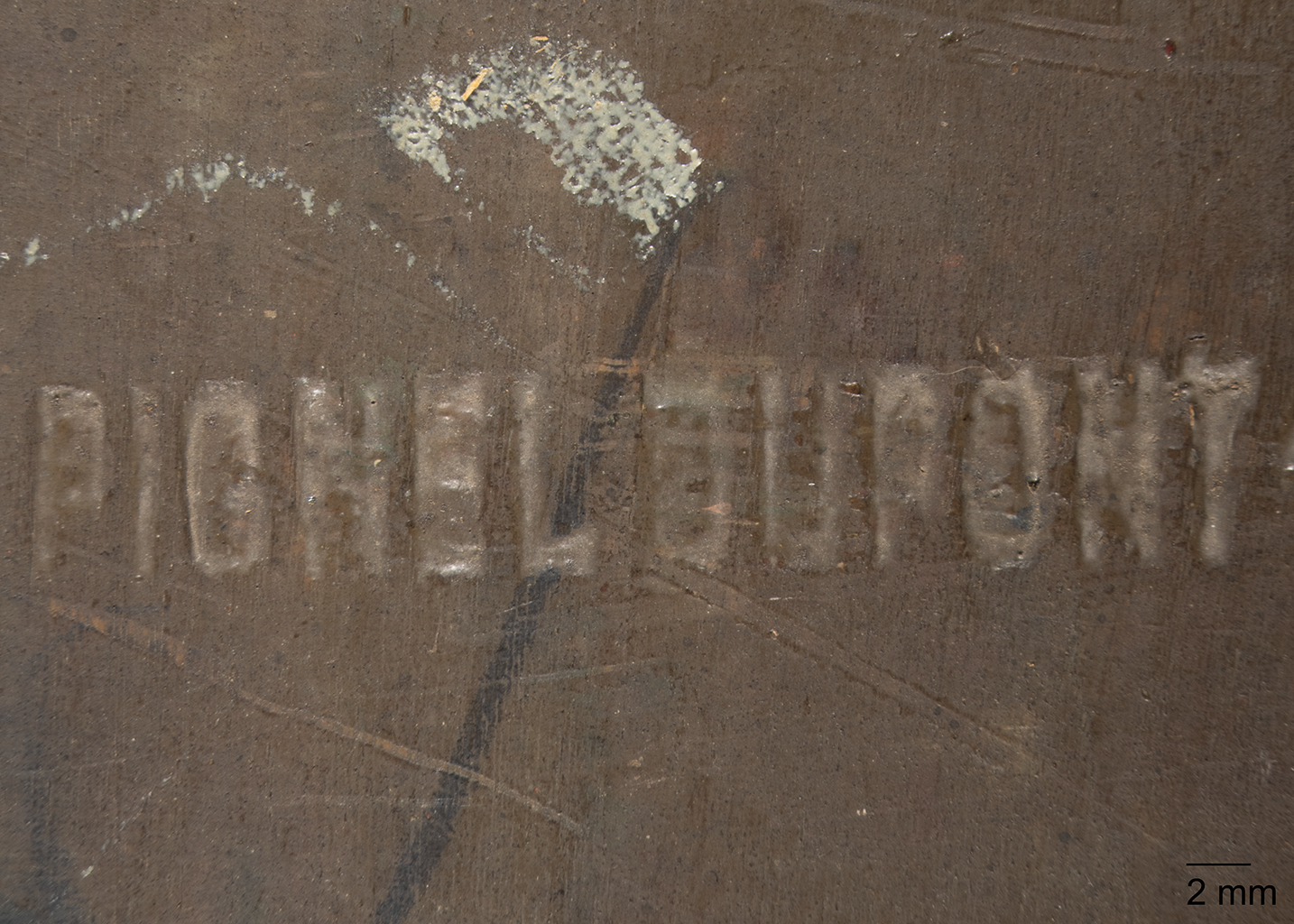
Boats Decorated with Flags in the Port of Deauville was painted on a wooden panel, estimated to be mahogany.1No testing was conducted; the wood was identified as mahogany by Scott A. Heffley (examination report, April 4, 1993, Nelson-Atkins conservation file, 2015.13.3), and the identification was corroborated by Joe Rogers, objects conservator at the Nelson-Atkins Museum of Art. The panel measures 26.8 x 34.9 x 7 centimeters,2The panel’s dimensions correspond in size to a French standard-format no. 5 paysage canvas, though not to any standard-format panel listed in Lefranc et Cie’s 1899 catalogue; see Anthea Callen, The Work of Art (London: Reaktion Books, 2015), 88–89. Few existing catalogues from the period include a list of sizes for standard-format panels, and it is entirely possible that artist suppliers stocked panels in these dimensions. and its reverse edges are beveled. The panel feels nearly weightless, a benefit to an artist like Eugène Boudin who carried his materials outdoors. “PIGNEL DUPONT 17 RUE LEPIC PARIS”3Pignel Dupont operated in Paris from 1885 to 1895 (Pascal Labreuche, “Pignel Dupont,” Guide Labreuche: Le guide des fournisseurs de matériel pour artistes, France, XVIIIe–XXe siècles, accessed July 16, 2025, https://www.guide-labreuche.com/en/collection/businesses/pignel-dupont). The words are punched into the panel, which has been rotated ninety degrees clockwise from upright. (Fig. 19) has been supplier mark: A mark (ink stamp, brand, impression, etc.), often present on the reverse of canvas, panel, or other support, signifying the company that sold or prepared the support. As these companies sometimes performed framing and restorations, these marks could also reflect these services. See also canvas stamp. into the back of the panel, and the entire reverse has been painted brown.4Panels with Pignel Dupont supplier stamps used by other artists (e.g. Alain Bonnaud, Barque sur la rivière, sold at Champagne Auctions, Montreal, May 28, 2019, https://www.invaluable.com/auction-lot/bonnaud-alain-barque-sur-la-riviere-45-c-da14bddb13) are unpainted on the reverse, suggesting that the reverse of the Nelson-Atkins panel was painted brown either by the artist or after it left his hands.
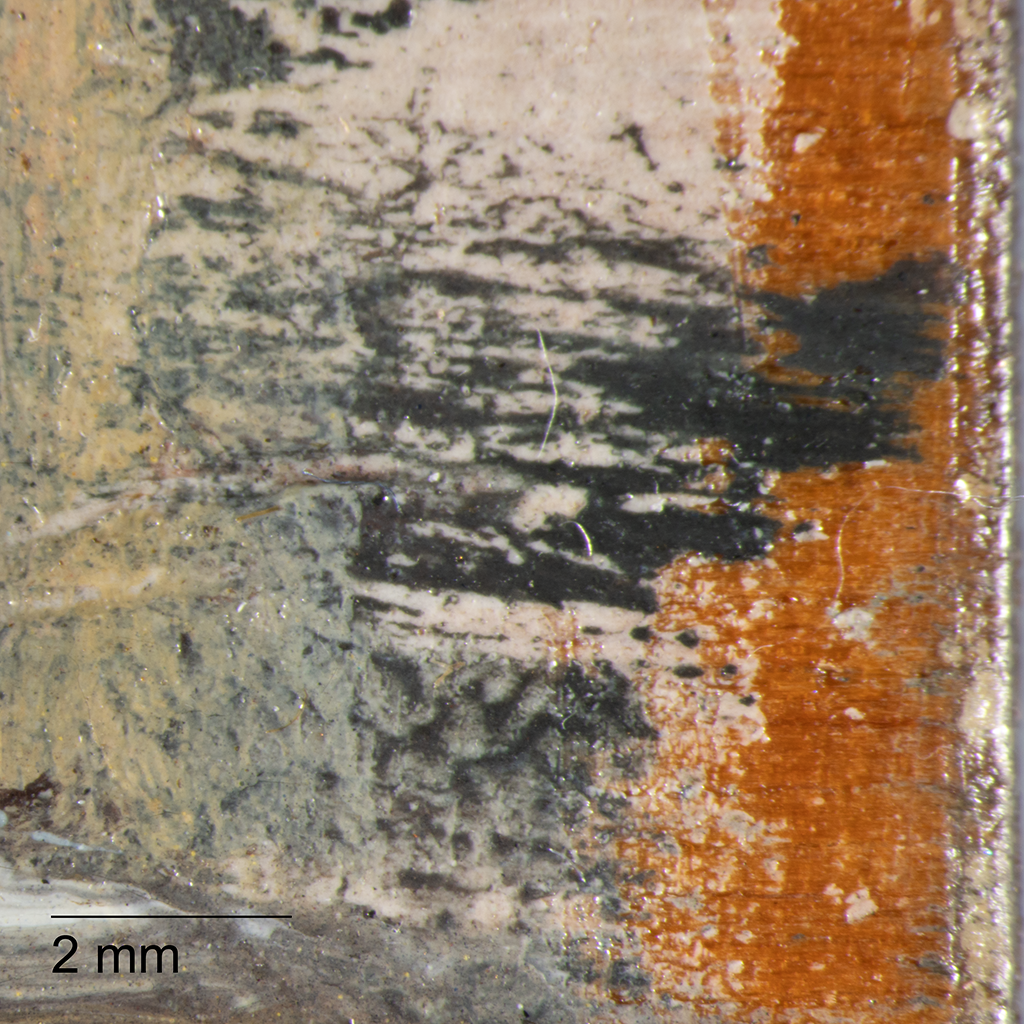
Despite purchasing the panel from an artist supplier(s): Also called colormen and color merchants. Artist suppliers prepared materials for artists. This tradition dates back to the Medieval period, but the industrialization of the nineteenth century increased their commerce. It was during this time that ready-made paints in tubes, commercially prepared canvases, and standard-format supports were available to artists for sale through these suppliers. It is sometimes possible to identify the supplier from stamps or labels found on the reverse of the artwork. See also canvas stamp, supplier mark, and color merchant., Boudin seems to have applied the ground layer: An opaque preparatory layer applied to the support, either commercially or by the artist, to prevent absorption of the paint into the canvas or panel. See also priming layer. himself. The off-white ground was thinly applied and does not extend to the edges of the panel, leaving areas of wood exposed along the sides (Fig. 20). In contrast to Port of Deauville (ca. 1884; The Nelson-Atkins Museum of Art),5See the accompanying technical entry by Susan Pavlik Enterline, “Eugène Boudin, Port of Deauville, ca. 1884,” https://doi.org/10.37764/78973.5.606.2088. there is no imprimatura: A thin layer of paint applied over the ground layer to establish an overall tonality. layer, though Boudin took advantage of the warm tones of the panel to achieve a similar end.6Lara Broecke mentions a similar phenomenon with the thin paint layer in Au Havre (1887; Fitzwilliam Museum, Cambridge) in Broecke, “Notes on the Technique of Eugène Boudin,” Hamilton Kerr Institute Bulletin, no. 4 (2013): 51. As in many of his works, large areas of ground are visible between passages of paint in the final composition. The ground retains a relatively smooth, matte surface compared to the thicker, glossier paint layers (Fig. 21).
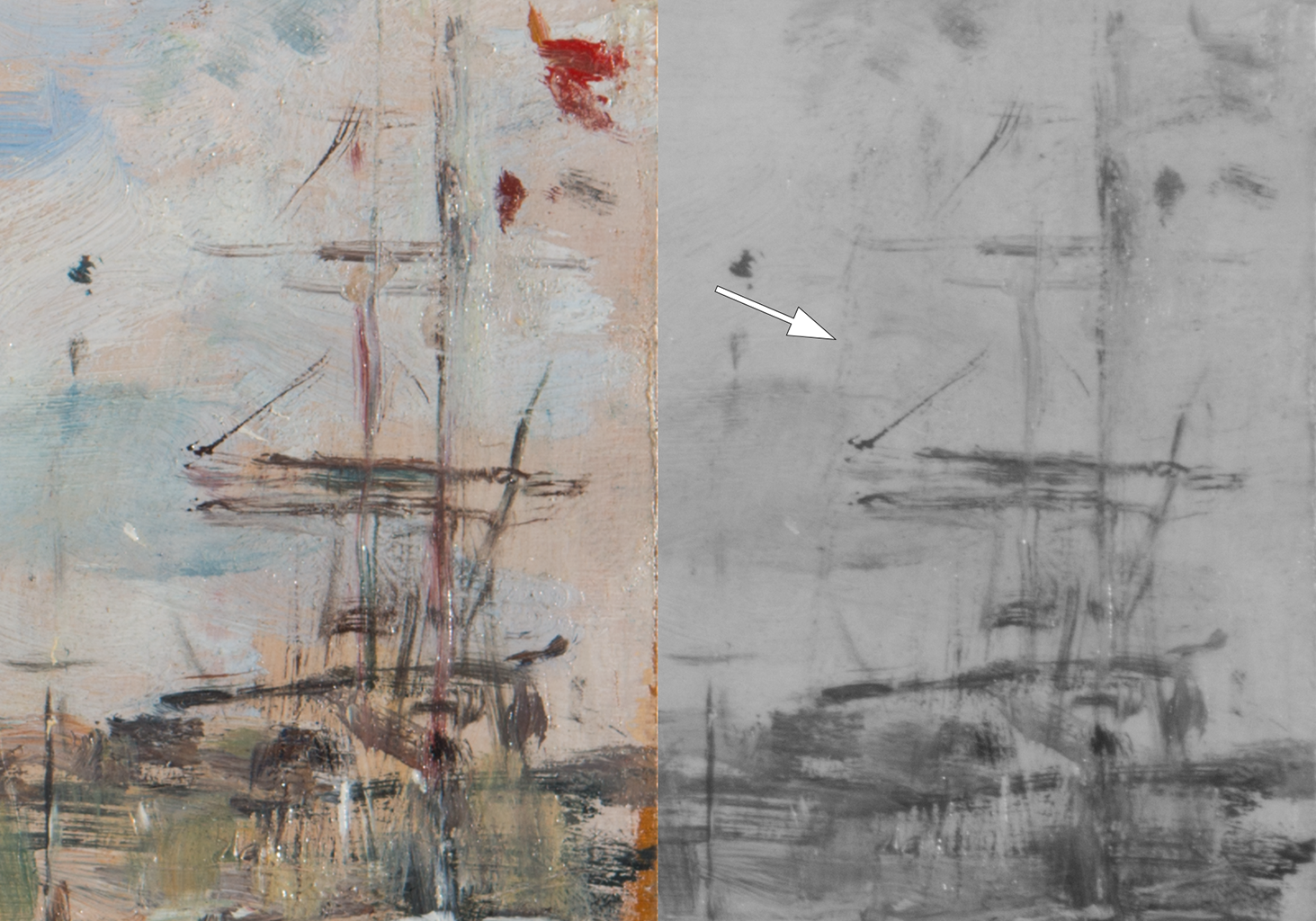
Under magnification, underdrawing: A drawn or painted sketch beneath the paint layer. The underdrawing can be made from dry materials, such as graphite or charcoal, or wet materials, such as ink or paint. estimated to be charcoal remains visible along the decks of the ships (Fig. 22) and beneath rigging. The reflected infrared digital photograph: An infrared image produced in the 700–1000 nanometer range, typically captured using an infrared-modified digital camera. See infrared photography. reveals a line of charcoal in the rightmost ship’s rigging, likely a rope that was never painted into the final composition (Fig. 23). Dispersed charcoal particles throughout the paint surface are likely the result of Boudin’s vigorous brushwork moving the dry media of the underdrawing.7Dispersed charcoal particles were also identified in The Port of Deauville, and by Virginia Nouwen in “An Investigation into the Materials and Techniques of Eugène Louis Boudin (1824–1898)” (PGDip final year project, Courtauld Institute of Art, 2018), 21.
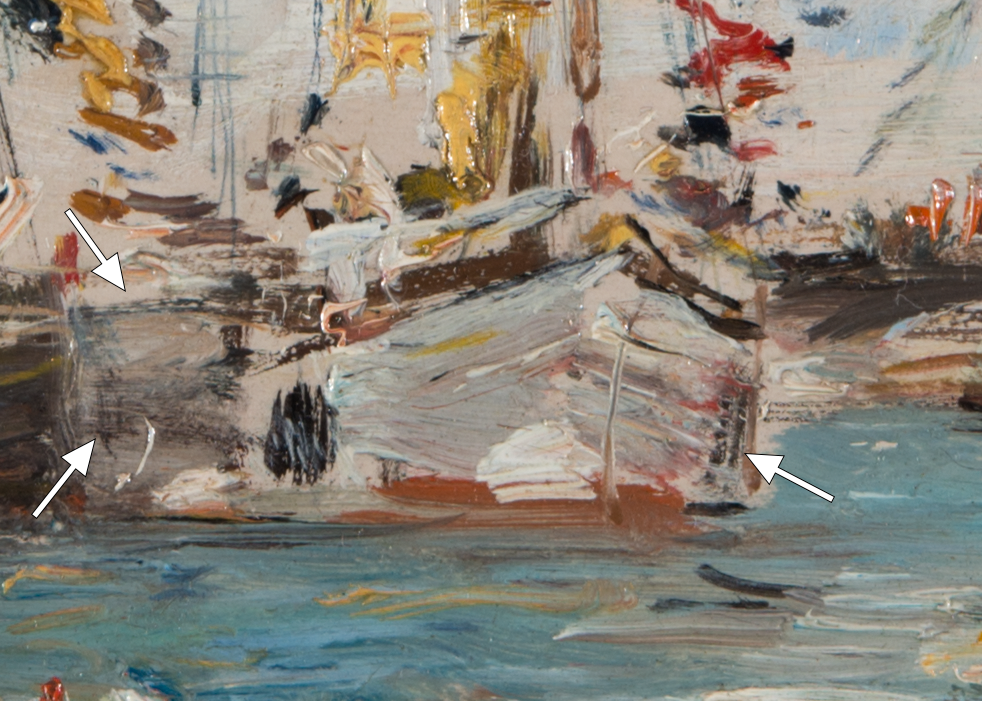
In addition to his charcoal sketch, Boudin developed the outlines of the boats and other details along the horizon using quick strokes of thin, wash: An application of thin paint that has been diluted with solvent. paint in blackish-brown and brownish-violet.8Nouwen writes of “a dilute oil paint layer . . . to outline the forms” in her discussion of underlayers in Boudin’s works. Nouwen, “An Investigation into the Materials and Techniques of Eugène Louis Boudin,” 19. This painted underdrawing remains visible in the negative space below the bridge and in the white hull of the ship to the left of the bridge (Fig. 24). Léon Leclerc recalls these early stages after watching Boudin work: “He sketched quickly in large masses without any concern for detail; from a distance one already had the impression of a finished painting, whereas up close one only saw shapeless tones placed side by side.”9Leclerc, director of the Honfleur Museum, related his experiences talking with Boudin and watching him paint in 1897. See Leclerc, “Le Centenaire du Peintre Eugène Boudin,” L’Echo Honfleurais, October 4, 1924, 2: “Il ébauchait vivement par larges masses sans aucun souci du détail, de loin on avait déjà l’impression d’un tableau achevé alors que de près on n’apercevait que tons informes mis les uns a cote des autres.” All translations are by Susan Pavlik Enterline, unless otherwise noted. Passages relevant to Boudin’s painting methods are paraphrased in English in Ruth L. Benjamin, “Eugène Boudin, King of Skies,” American Magazine of Art 23, no. 3 (September 1931): 200.
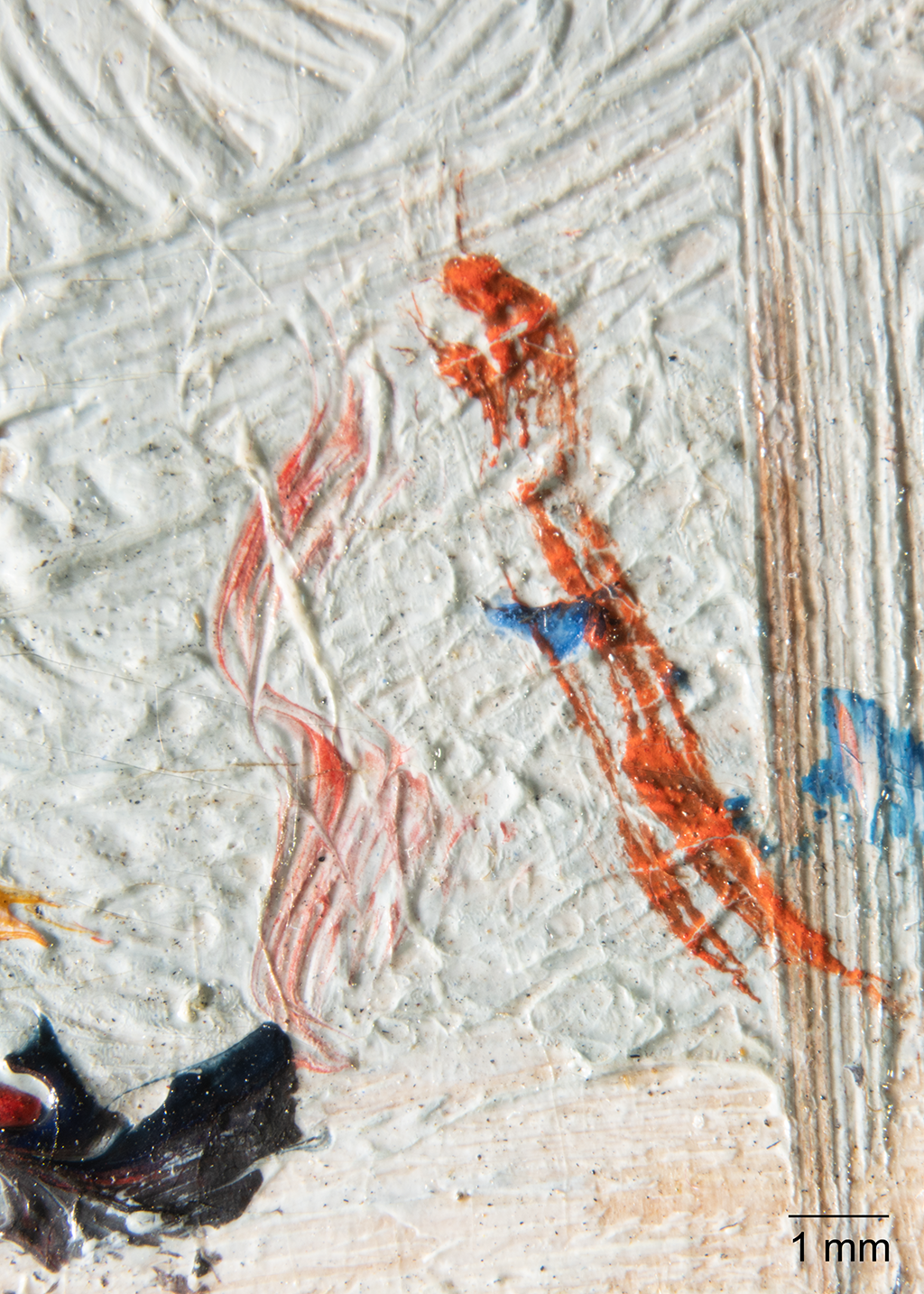
LeClerc continues: “He observed carefully, seemed to meditate, then suddenly, the brush laden with color would land on the canvas, marking sometimes a simple point, sometimes a line, sometimes a tache: French for “blot” or “stain.” An application of a single color of paint, quite thickly applied, using a bold, flat and even-loaded stroke.".”10Leclerc, “Le Centenaire du Peintre Eugène Boudin,” 2: “Il observait attentivement, semblait méditer, puis tout à coup, le pinceau chargé de couleur se posait sur la toile, marquant tantôt un simple point, tantôt une ligne, tantôt une tache.” For an overview of the tache, see Øystein Sjåstad, A Theory of the Tache in Nineteenth-Century Painting (Farnham, U.K.: Ashgate, 2014). This juxtaposition of quiet contemplation and bustling activity is evident in the blend of wet-over-wet: An oil painting technique which involves drawing a stroke of one color across the wet paint of another color. and wet-over-dry: An oil painting technique that involves layering paint over an already dried layer, resulting in no intermixing of paint or disruption to the lower paint strokes. brushwork throughout the composition (Fig. 25). Areas of wet-over-dry brushwork imply that the landscape was completed over a period of time. However, the combination of Boudin’s rapid brushwork and materials (thin ground applied to an absorbent panel),11The absorbency of an unprimed wood panel allowed for more rapid working. See Iris Schaefer, Caroline von Saint-George, and Katja Lewerentz, Painting Light: The Hidden Techniques of the Impressionists (Milan: Skira, 2008), 53. accompanied by warm, sunny weather,12Higher temperatures increase the rate of solvent evaporation and oxidation, leading to faster film formation. See Rutherford J. Gettens and George L. Stout, Painting Materials: A Short Encyclopaedia (1942; repr. New York: Dover, 1966), 38. may have allowed him to paint the landscape in one sitting.13It is likely Boudin worked on multiple panels in one sitting; Yacht Basin at Trouville-Deauville (1895–96; National Gallery of Art, Washington, DC) depicts the same boats with flags from the same vantage point. Working on multiple panels concurrently—setting one aside to work on another, then returning to the first—might allow time for film formation, the first step in the drying process., 14An opposing argument is made by Broecke, who argues that Boudin painted only the center band of detail en plein air, and the sky and sea (or land) in the studio. See Broecke, “Notes on the Technique of Eugène Boudin,” 50–51, 53. In one passage, for example, the paintbrush was dragged across the wet surface, creating a deep furrow in the underlying paint, while directly adjacent is a tache of similar color that lightly touches the white paint, wet-over-dry, without disrupting the outer skin of the curing paint (Fig. 26).
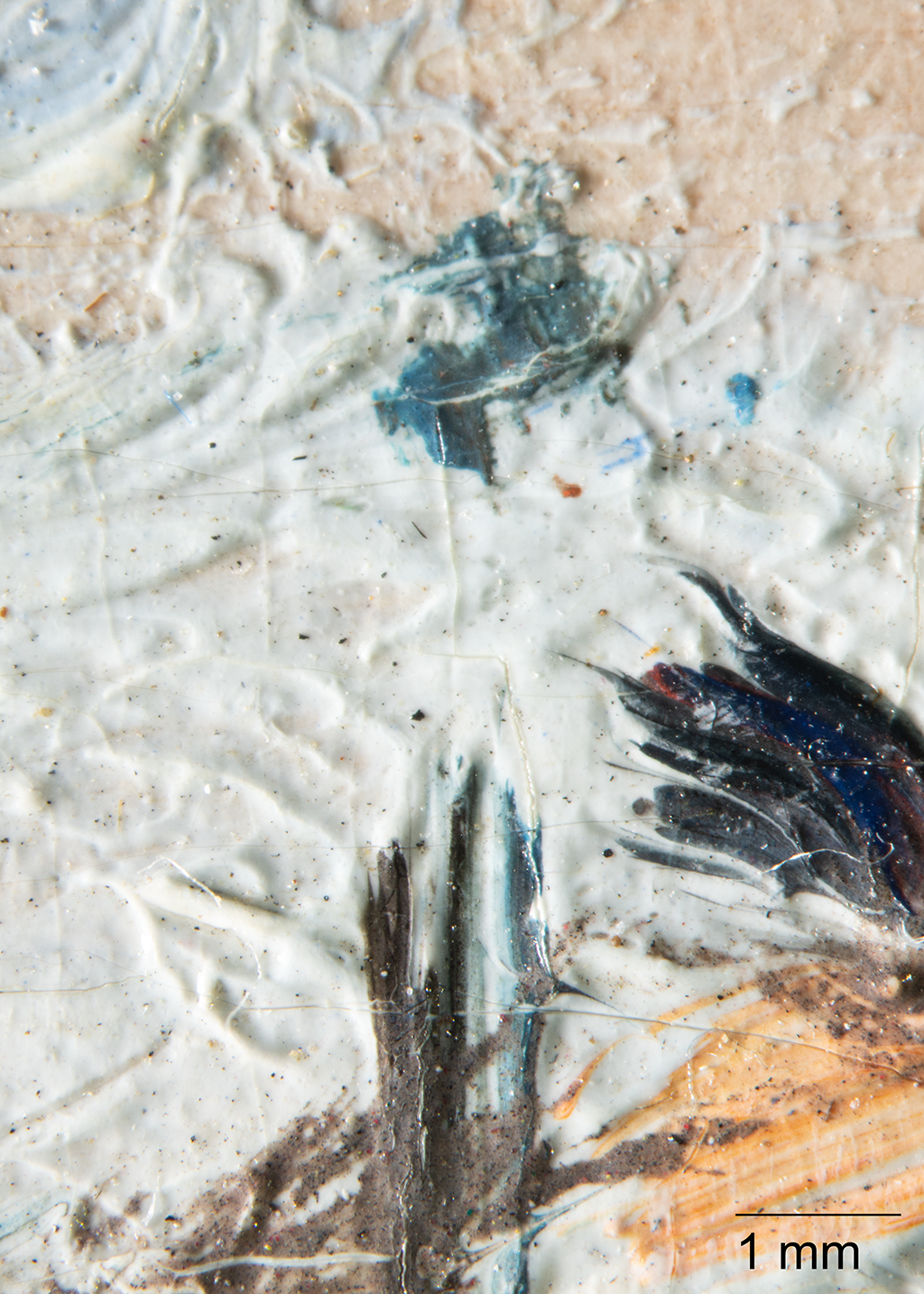
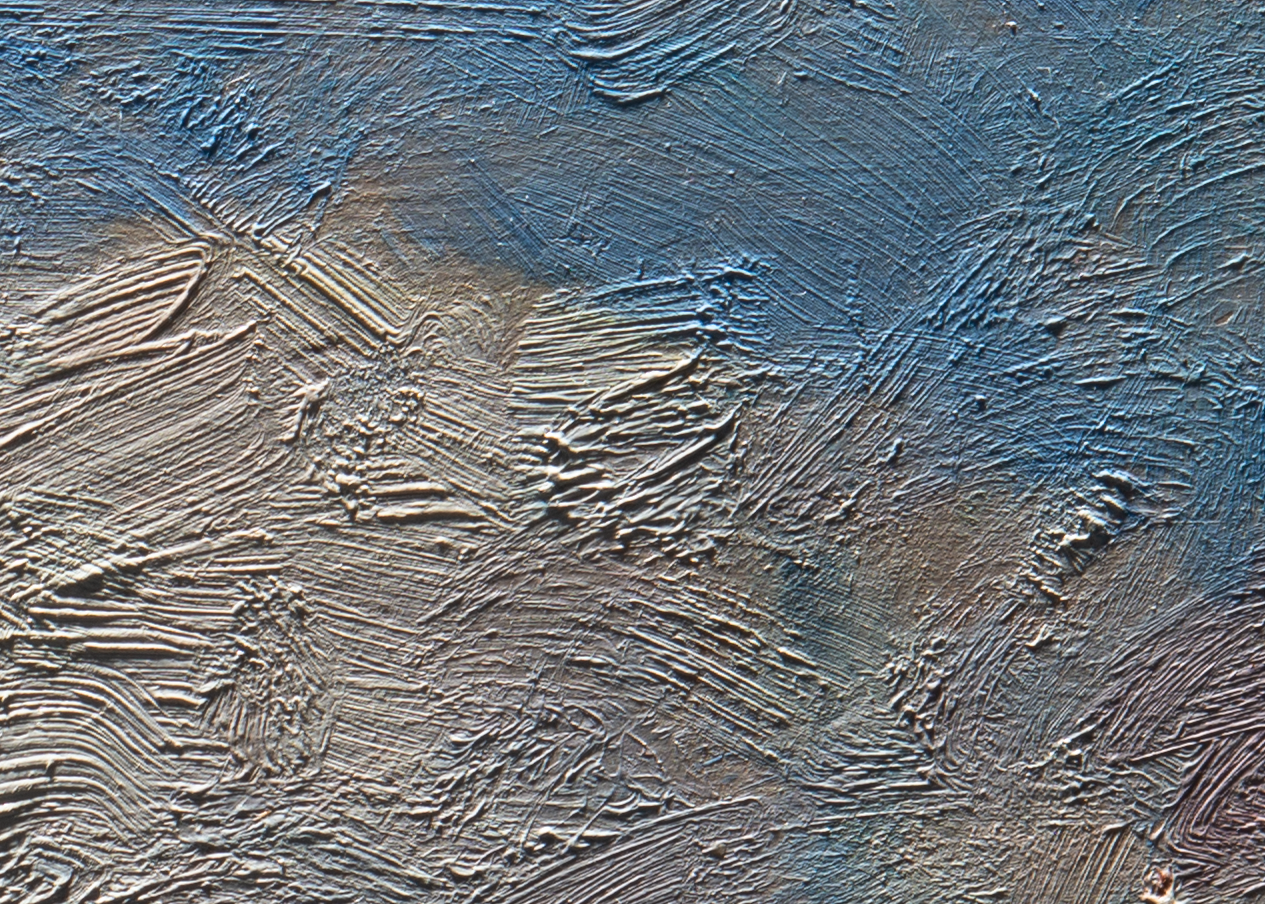
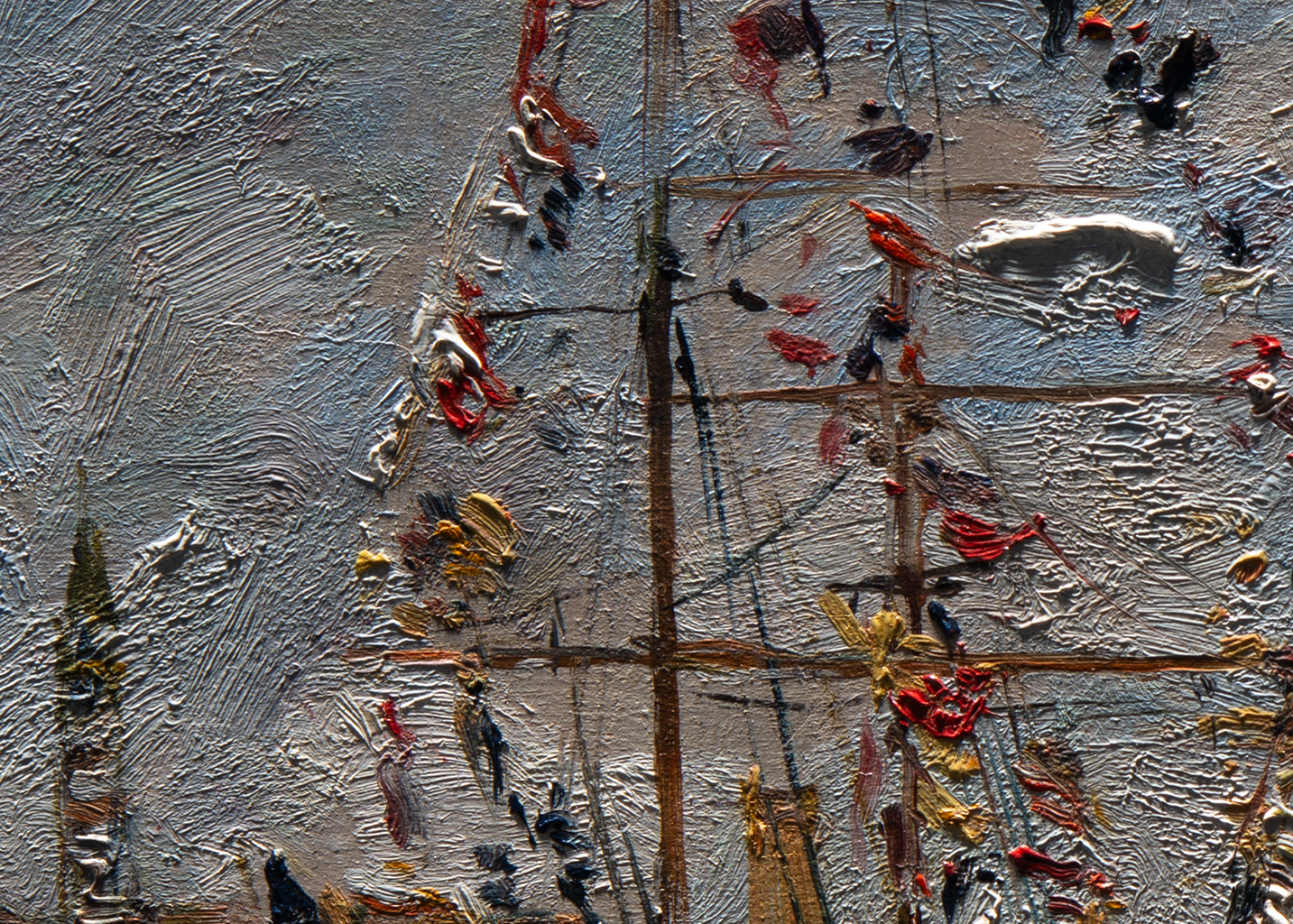
Boudin’s brushes moved back and forth between the sky, the sea, and the band of detail along the horizon, painting across the composition concurrently and returning to add a point, a line, or a tache. The sky was laid in using blue and white, and then masts and rigging were painted with a thin brush, using wet-over-wet strokes in brown, blue, and black. Boudin added thick, colorful brushstrokes to represent the flags strung along the rigging before returning to the sky. The expanse of brilliant blue in the upper right is layered over clouds already beginning to dry, leaving the impasto: A thick application of paint, often creating texture such as peaks and ridges. texture of the white brushstrokes intact (Fig. 27). There are strokes of muted red, yellow, and greenish blue, possibly indicating a shift of a flag’s location, or perhaps paint from the flag remained in Boudin’s brush as he continued painting the sky.
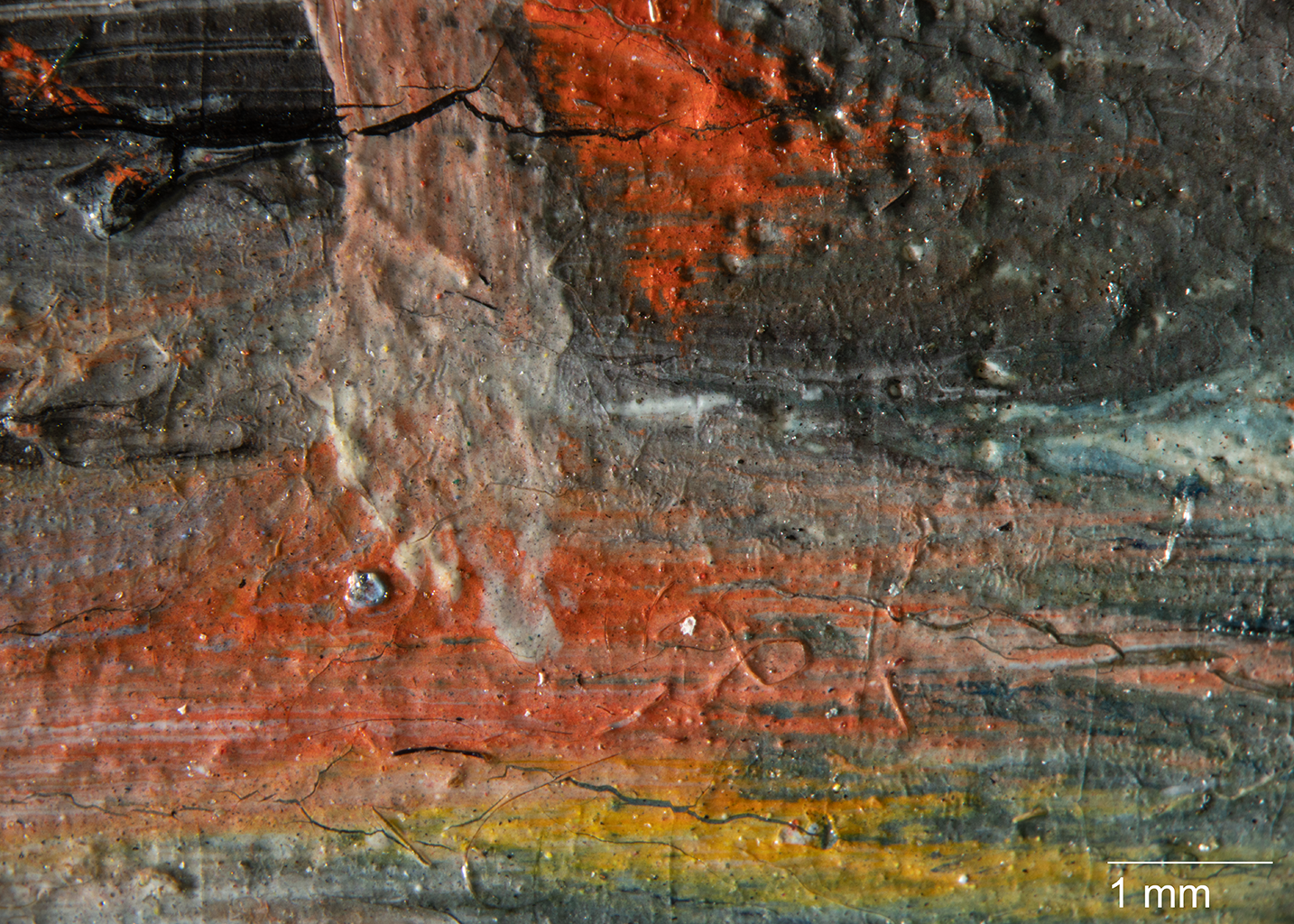
The harbor is mostly blue, white, and turquoise water, interspersed with swipes of red, green, and yellow representing reflections of boats. The luminous darkness of the lefthand ships’ hulls comes from a combination of deep brown, blue, and red, with thin lines of yellow highlights. The white ship at the center is a complex amalgam of red, pale blue, brown, and white, again highlighted with thin swipes of yellow, as seen in Figure 24. traction cracks: Also known as drying cracks, these are formed as the paint dries. They are usually the result of a “lean” paint with a small percentage of oil drying faster than an underlying “fat” paint layer with a higher percentage of oil. The quick drying of the top layer causes the paint layer to shrink and crack. appear throughout the painting, especially in the detail along the horizon. For example, cracks run through the hull of the ship to the left (Fig. 28), as well as throughout the figures to the right of the bridge.
The painting is generally in good condition. There are minor scrapes, indentations, and gouges around the back perimeter, indicating the panel was secured into a frame using nails. Along the upper edge of the panel, there are small losses, the two largest of which measure approximately one centimeter; there is also a small split measuring two centimeters, which appears stable. A small split in the lower proper left corner was stabilized during a 2018 treatment.15Mary Schafer, treatment report, January 12, 2018, Nelson-Atkins conservation file, 2015.13.3. There are a handful of tiny paint losses across the sky, and there are some abrasion: A loss of surface material due to rubbing, scraping, frequent touching, or inexpert solvent cleaning. around the perimeter. Abrasions, scattered losses, and old overpaint: Restoration paint that covers original paint that may or may not be damaged. Historically, overpaint has often been applied too broadly, altering the intended aesthetic of the painting and sometimes introducing conceptions foreign to the original artist, thereby altering our understanding of the work and the era to which it belongs. were retouching: Paint application by a conservator or restorer to cover losses and unify the original composition. Retouching is an aspect of conservation treatment that is aesthetic in nature and that differs from more limited procedures undertaken solely to stabilize original material. Sometimes referred to as inpainting or retouch. during a 1993 treatment.16Scott A. Heffley, treatment report, April 20, 1993, Nelson-Atkins conservation file, 2015.13.3. At the same time, the painting received two layers of synthetic varnish, which remain clear and have a moderate sheen, though the retouching is slightly discolored.
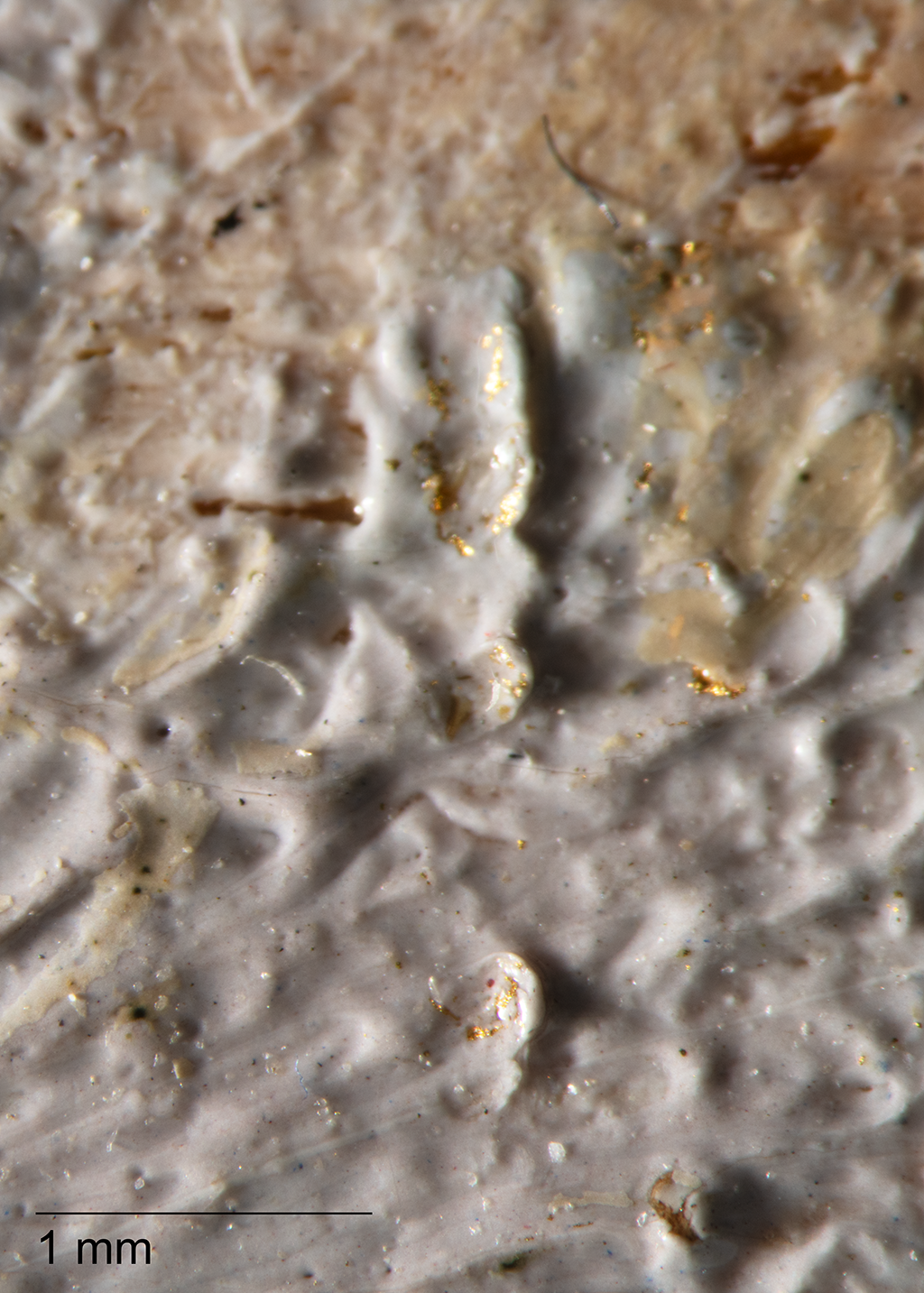
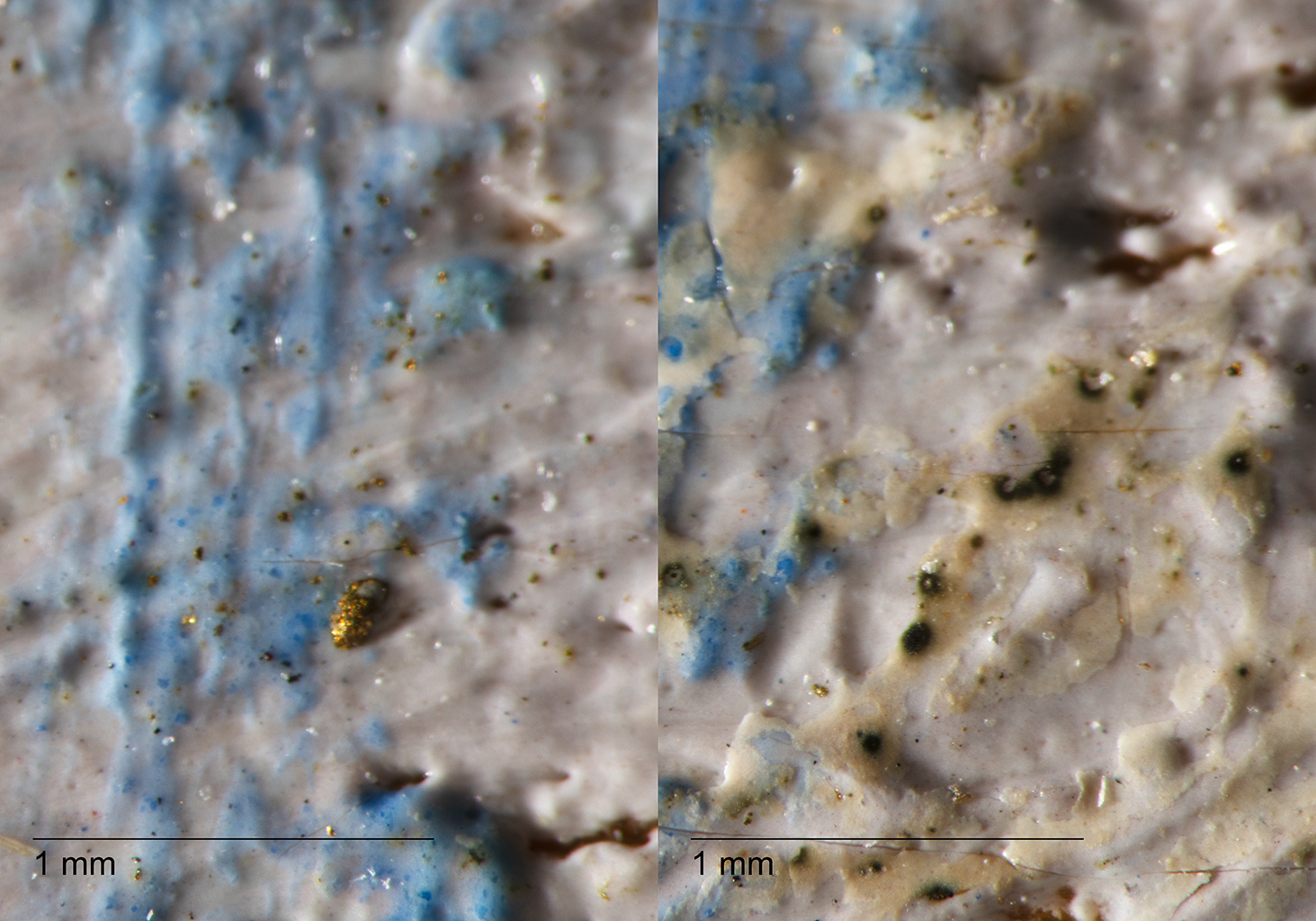
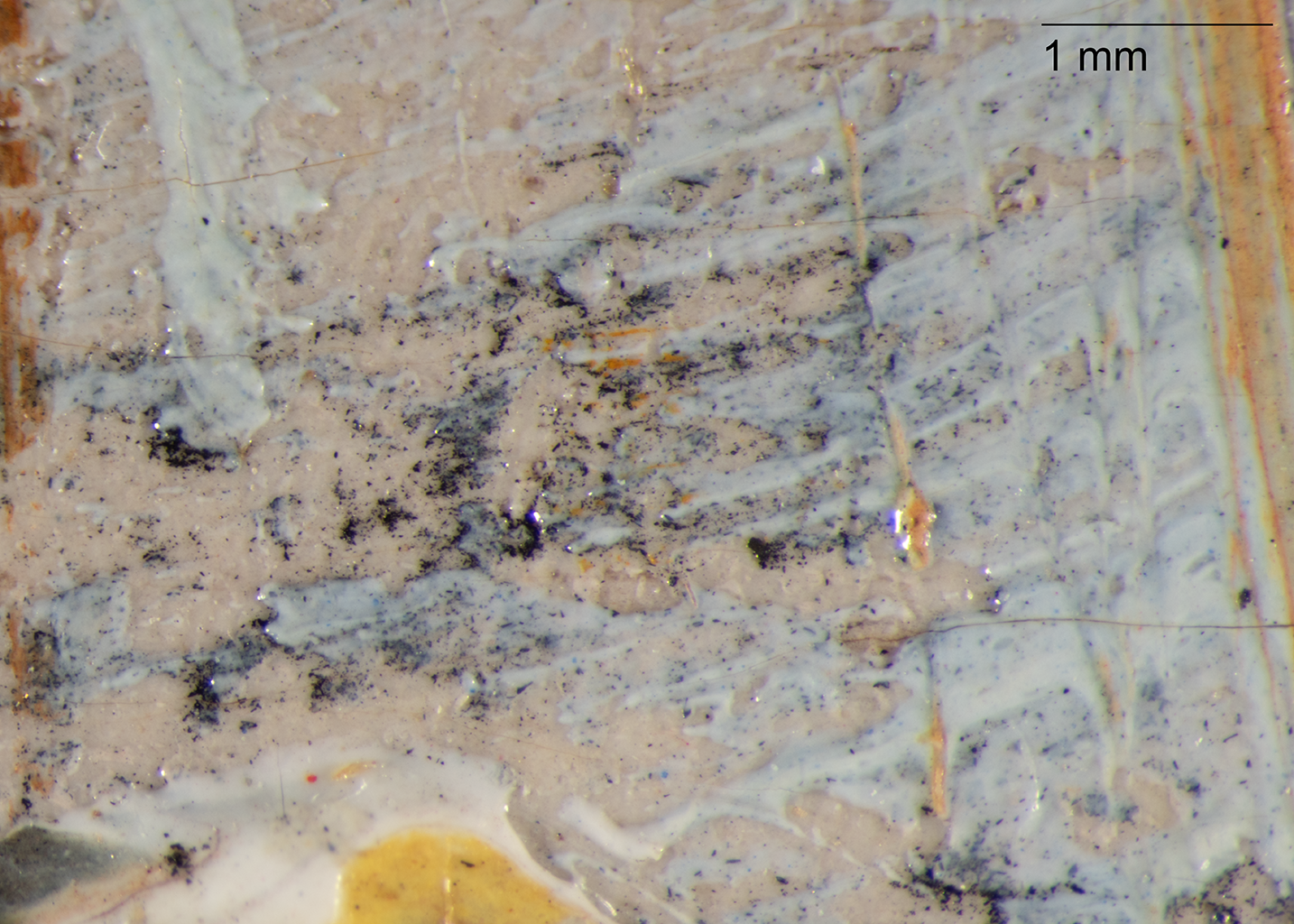
There is abundant plant matter, wood, and other material embedded in the wet paint, and some impasto has been flattened. There are also linear impressions in the wet paint along the sides of the painting;17See the accompanying technical entry by Pavlik Enterline, “Eugène Boudin, The Port of Deauville, ca. 1884,” https://doi.org/10.37764/78973.5.606.2088. microscopic examination reveals embedded gilding (Fig. 29), indicating the painting was framed before it was fully dry. On the far right above the red flag, there is a cluster of tiny dark spots, possibly related to framing. Under magnification, the spots are a mixture of gold-colored particles embedded in the paint and miniscule cavities surrounded by greenish staining (Fig. 30). In some areas, the particles remain intact, but where they are coated by retouching, it appears the metal has corroded, leaving behind a cavity and the associated staining.18Bronze paint was a common material on frames at the end of the nineteenth century, and its high copper content correlates with the greenish color of the corrosion present around the cavities. Instrumental analysis would be required to confirm the presence of bronze and its corrosion products on the surface of the painting.
Notes
-
No testing was conducted; the wood was identified as mahogany by Scott A. Heffley (examination report, April 4, 1993, Nelson-Atkins conservation file, 2015.13.3), and the identification was corroborated by Joe Rogers, objects conservator at the Nelson-Atkins Museum of Art.
-
The panel’s dimensions correspond in size to a French standard-format no. 5 paysage canvas, though not to any standard-format panel listed in Lefranc et Cie’s 1899 catalogue; see Anthea Callen, The Work of Art (London: Reaktion Books, 2015), 88–89. Few existing catalogues from the period include a list of sizes for standard-format panels, and it is entirely possible that artist suppliers stocked panels in these dimensions.
-
Pignel Dupont operated in Paris from 1885 to 1895 (Pascal Labreuche, “Pignel Dupont,” Guide Labreuche: Le guide des fournisseurs de matériel pour artistes, France, XVIIIe–XXe siècles, accessed July 16, 2025, https://www.guide-labreuche.com
/en ). The words are punched into the panel, which has been rotated ninety degrees clockwise from upright./collection /businesses /pignel-dupont -
Panels with Pignel Dupont supplier stamps used by other artists (e.g. Alain Bonnaud, Barque sur la rivière, sold at Champagne Auctions, Montreal, May 28, 2019, https://www.invaluable.com
/auction-lot ) are unpainted on the reverse, suggesting that the reverse of the Nelson-Atkins panel was painted brown either by the artist or after it left his hands./bonnaud-alain-barque-sur-la-riviere-45-c-da14bddb13 -
See the accompanying technical entry by Susan Pavlik Enterline, “Eugène Boudin, Port of Deauville, ca. 1884,” https://doi.org/10.37764/78973.5.606.2088.
-
Lara Broecke mentions a similar phenomenon with the thin paint layer in Au Havre (1887; Fitzwilliam Museum, Cambridge) in Broecke, “Notes on the Technique of Eugène Boudin,” Hamilton Kerr Institute Bulletin, no. 4 (2013): 51.
-
Dispersed charcoal particles were also identified in The Port of Deauville, and by Virginia Nouwen in “An Investigation into the Materials and Techniques of Eugène Louis Boudin (1824–1898)” (PGDip final year project, Courtauld Institute of Art, 2018), 21.
-
Nouwen writes of “a dilute oil paint layer . . . to outline the forms” in her discussion of underlayers in Boudin’s works. Nouwen, “An Investigation into the Materials and Techniques of Eugène Louis Boudin,” 19.
-
Leclerc, director of the Honfleur Museum, related his experiences talking with Boudin and watching him paint in 1897. See Leclerc, “Le Centenaire du Peintre Eugène Boudin,” L’Echo Honfleurais, October 4, 1924, 2: “Il ébauchait vivement par larges masses sans aucun souci du détail, de loin on avait déjà l’impression d’un tableau achevé alors que de près on n’apercevait que tons informes mis les uns a cote des autres.” All translations are by Susan Pavlik Enterline, unless otherwise noted. Passages relevant to Boudin’s painting methods are paraphrased in English in Ruth L. Benjamin, “Eugène Boudin, King of Skies,” American Magazine of Art 23, no. 3 (September 1931): 200.
-
Leclerc, “Le Centenaire du Peintre Eugène Boudin,” 2: “Il observait attentivement, semblait méditer, puis tout à coup, le pinceau chargé de couleur se posait sur la toile, marquant tantôt un simple point, tantôt une ligne, tantôt une tache.” For an overview of the tache, see Øystein Sjåstad, A Theory of the Tache in Nineteenth-Century Painting (Farnham, U.K.: Ashgate, 2014).
-
The absorbency of an unprimed wood panel allowed for more rapid working. See Iris Schaefer, Caroline von Saint-George, and Katja Lewerentz, Painting Light: The Hidden Techniques of the Impressionists (Milan: Skira, 2008), 53.
-
Higher temperatures increase the rate of solvent evaporation and oxidation, leading to faster film formation. See Rutherford J. Gettens and George L. Stout, Painting Materials: A Short Encyclopaedia (1942; repr. New York: Dover, 1966), 38.
-
It is likely Boudin worked on multiple panels in one sitting; Yacht Basin at Trouville-Deauville (1895–96; National Gallery of Art, Washington, DC) depicts the same boats with flags from the same vantage point. Working on multiple panels concurrently—setting one aside to work on another, then returning to the first—might allow time for film formation, the first step in the drying process.
-
An opposing argument is made by Broecke, who argues that Boudin painted only the center band of detail en plein air, and the sky and sea (or land) in the studio. See Broecke, “Notes on the Technique of Eugène Boudin,” 50–51, 53.
-
Mary Schafer, treatment report, January 12, 2018, Nelson-Atkins conservation file, 2015.13.3.
-
Scott A. Heffley, treatment report, April 20, 1993, Nelson-Atkins conservation file, 2015.13.3.
-
See the accompanying technical entry by Pavlik Enterline, “Eugène Boudin, The Port of Deauville, ca. 1884,” https://doi.org/10.37764/78973.5.606.2088.
-
Bronze paint was a common material on frames at the end of the nineteenth century, and its high copper content correlates with the greenish color of the corrosion present around the cavities. Instrumental analysis would be required to confirm the presence of bronze and its corrosion products on the surface of the painting.
Documentation
Citation
Chicago:
Brigid M. Boyle, “Eugène Boudin, Boats Decorated with Flags in the Port of Deauville, 1895,” documentation in French Paintings and Pastels, 1600–1945: The Collections of The Nelson-Atkins Museum of Art, ed. Aimee Marcereau DeGalan (Kansas City: The Nelson-Atkins Museum of Art, 2022), https://doi.org/10.37764/78973.5.608.4033.
MLA:
Boyle, Brigid M. “Eugène Boudin, Boats Decorated with Flags in the Port of Deauville, 1895,” documentation. French Paintings and Pastels, 1600–1945: The Collections of The Nelson-Atkins Museum of Art, edited by Aimee Marcereau DeGalan, Nelson-Atkins Museum of Art, 2022. doi: 10.37764/78973.5.608.4033.
Provenance
With Galerie Allard et Noël, Paris;
With Stephen Hahn, New York, by November 12, 1968 [1];
Eugene B. (1917–2003) and Lucy (née Harvey, 1921–2006) Sydnor, Jr., Richmond, VA, by May 7, 1972–April 1, 1993 [2];
Purchased from Eugene and Lucy Sydnor, Jr. through Martha Parrish, Inc., New York, by Marion (née Helzberg, 1931–2013) and Henry (1922–2019) Bloch, Shawnee Mission, KS, 1993–June 15, 2015 [3];
Their gift to The Nelson-Atkins Museum of Art, Kansas City, MO, 2015.
Notes
[1] November 12, 1968 is the opening date of XIX and XX Century French Paintings: Recent Acquisitions, an exhibition held at Stephen Hahn Gallery, New York, that included Boats Decorated with Flags in the Port of Deauville. According to a Hahn family representative, Stephen Hahn’s business records do not survive. See email from Janey Campbell, Music Academy of the West, to Brigid M. Boyle, NAMA, June 3, 2020, NAMA curatorial files.
[2] May 7, 1972 is the opening date of European and American Art from Princeton Alumni Collections, an exhibition to which the Sydnors lent Boats Decorated with Flags in the Port of Deauville. After Eugene B. and Lucy Sydnor, Jr., divorced in 1986, it is unclear if they retained joint ownership of the painting or if one of them assumed full ownership.
[3] See email from Ann Restak, James Reinish and Associates, Inc., to MacKenzie Mallon, NAMA, May 26, 2015, NAMA curatorial files. A label from Martha Parrish, Inc., can be found on the panel’s verso.
Exhibitions
XIX and XX Century French Paintings: Recent Acquisitions, Stephen Hahn Gallery, New York, November 12–December 14, 1968, unnumbered, as Deauville.
European and American Art from Princeton Alumni Collections, Princeton University Art Museum, Princeton, NJ, May 7–June 11, 1972, no. 53, as Regatta at Deauville.
Manet to Matisse: Impressionist Masters from the Marion and Henry Bloch Collection, The Nelson-Atkins Museum of Art, Kansas City, MO, June 9–September 9, 2007, no. 5, as Boats Decorated with Flags in the Port of Deauville (Bateaux pavoisiers dans le bassin, Deauville).
Magnificent Gifts for the 75th, The Nelson-Atkins Museum of Art, Kansas City, MO, February 13–April 4, 2010, no cat.
References
XIX and XX Century French Paintings: Recent Acquisitions, exh. cat. (New York: Stephen Hahn Gallery, 1968), unpaginated, (repro.), as Deauville.
Hedy B. Landman, ed., European and American Art from Princeton Alumni Collections, exh. cat. (Princeton, NJ: Princeton University Art Museum, 1972), 60, 69, (repro.), as Regatta at Deauville.
Robert Schmit, Eugène Boudin, 1824–1898 (Paris: Robert Schmit, 1973), no. 3554, pp. 3:356, CIX, CXIV, (repro.), as Deauville. Bateaux pavoisés dans le bassin.
Rebecca Dimling Cochran and Bobbie Leigh, “100 Top Collectors who have made a difference,” Art and Antiques 28, no. 3 (March 2006): 90.
Bobbie Leigh, “Magnificent Obsession,” Art and Antiques 28, no. 6 (June 2006): 60–61, (repro.).
Richard R. Brettell and Joachim Pissarro, Manet to Matisse: Impressionist Masters from the Marion and Henry Bloch Collection, exh. cat. (Kansas City, MO: Nelson-Atkins Museum of Art, 2007), 14, 38, 44–46, 156, (repro.), as Boats Decorated with Flags in the Port of Deauville (Bateaux pavoisiers dans le bassin, Deauville).
Alice Thorson, “A Tiny Renoir Began Impressive Obsession,” Kansas City Star 127, no. 269 (June 3, 2007): E4.
“Lasting Impressions: A Tribute to Marion and Henry Bloch,” Member Magazine (The Nelson-Atkins Museum of Art) (Fall 2007): 11–12.
Steve Paul, “Pretty Pictures: Marion and Henry Bloch’s collection of superb Impressionist masters,” Panache 4, no. 3 (Fall 2007): 20.
Alice Thorson, “Blochs add to Nelson treasures,” Kansas City Star 130, no. 141 (February 5, 2010): A1, A8.
Carol Vogel, “O! Say, You Can Bid on a Johns,” New York Times 159, no. 54,942 (February 5, 2010): C26.
Thomas M. Bloch, Many Happy Returns: The Story of Henry Bloch, America’s Tax Man (Hoboken: John Wiley and Sons, 2011), 174–75.
Diane Stafford, “Bloch gift to go for Nelson upgrade,” Kansas City Star 135, no. 203 (April 8, 2015): A8.
“Nelson-Atkins Museum of Art officially accessions Bloch Impressionist masterpieces,” Artdaily.org (July 25, 2015): http://artdaily.com/news/80246/Nelson-Atkins-Museum-of-Art-officially-accessions-Bloch-Impressionist-masterpieces.
Julie Paulais, “Le Nelson-Atkins Museum of Art reçoit des tableaux impressionnistes en échange de leurs répliques,” Le Journal des arts (July 30, 2015): http://www.lejournaldesarts.fr/patrimoine/le-nelson-atkins-museum-art-recoit-des-tableaux-impressionnistes-en-echange-de-leurs.
Josh Niland, “The Nelson-Atkins Museum of Art Acquires a Renowned Collection of Impressionist and Postimpressionist Art,” architecturaldigest.com (July 31, 2015): http://www.architecturaldigest.com/story/nelson-atkins-museum-accessions-bloch-art-collection
Nancy Staab, “Van Gogh is a Go!” 435: Kansas City’s Magazine (September 2015): 76.
“Nelson-Atkins to unveil renovated Bloch Galleries of European Art in winter 2017,” Artdaily.org (July 20, 2016): http://artdaily.com/news/88852/Nelson-Atkins-to-unveil-renovated-Bloch-Galleries-of-European-Art-in-winter-2017
“Nelson-Atkins Museum of Art celebrates generosity of Henry Bloch with new acquisition,” Artdaily.org (October 18, 2016): http://artdaily.cc/news/90923/Nelson-Atkins-Museum-of-Art-celebrates-generosity-of-Henry-Bloch-with-new-acquisition#.XnKATqhKiUk
Catherine Futter et al., Bloch Galleries: Highlights from the Collection of the Nelson-Atkins Museum of Art (Kansas City, MO: Nelson-Atkins Museum of Art, 2016), 59, (repro.), as Boats Decorated with Flags in the Port of Deauville.
Kelly Crow, “Museum Rewards Donor with Fake Art to Hang at Home,” Wall Street Journal (January 25, 2017): http://www.wsj.com/articles/museum-rewards-donor-with-fake-art-to-hang-at-home-1485370768
David Frese, “Bloch savors paintings in redone galleries,” Kansas City Star 137, no. 161 (February 25, 2017): 1A.
Albert Hecht, “Henry Bloch’s Masterpieces Collection to Go On Display at Nelson-Atkins Museum,” Jewish Business News (February 26, 2017): http://jewishbusinessnews.com/2017/02/26/henry-bloch-masterpieces-collection/
David Frese, “Inside the Bloch Galleries: An interactive experience,” Kansas City Star 137, no. 169 (March 5, 2017): 5D, (repro.), as Boats Decorated With Flags in the Port of Deauville.
“Editorial: Thank you, Henry and Marion Bloch,” Kansas City Star (March 7, 2017): http://www.kansascity.com/opinion/editorials/ article137040948.html [repr., “Thank you, Henry and Marion Bloch,” Kansas City Star 137, no. 172 (March 8, 2017): 16A].
Hampton Stevens, “(Not Actually) 12 Things To Do During The Big 12 Tournament,” Flatland: KCPT’s Digital Magazine (March 9, 2017): http://www.flatlandkc.org/arts-culture/sports/not-actually-12-big-12-tournament/
Laura Spencer, “The Nelson-Atkins’ Bloch Galleries Feature Old Masterworks and New Technology,” KCUR (March 10, 2017): http://kcur.org/post/nelson-atkins-bloch-galleries-feature-old-masterworks-and-new-technology#stream/0,(repro.).
Victoria Stapley-Brown, “Nelson-Atkins Museum’s new European art galleries come with a ‘love story,’” Art Newspaper (March 10, 2017): http://theartnewspaper.com/news/museums/nelson-atkins-museum-s-new-european-art-galleries-come-with-a-love-story/
Harry Bellet, “Don du ciel pour le Musée Nelson-Atkins,” Le Monde (March 13, 2017): http://www.lemonde.fr/arts/article/2017/03/13/don-du-ciel-pour-le-musee-nelson-atkins_5093543_1655012.html
Menachem Wecker, “Jewish Philanthropist Establishes Kansas City as Cultural Mecca,” Forward (March 14, 2017): http://forward.com/culture/365264/jewish-philanthropist-establishes-kansas-city-as-cultural-mecca/ [repr., in Menachem Wecker, “Kansas City Collection Is A Chip Off the Old Bloch,” Forward (March 17, 2017): 20–22].
Juliet Helmke, “The Bloch Collection Takes up Residence in Kansas City’s Nelson Atkins Museum,” Blouin ArtInfo International (March 15, 2017): http://www.blouinartinfo.com/news/story/2005267/the-bloch-collection-takes-up-residence-in-kansas-citys
Louise Nicholson, “How Kansas City got its magnificent museum,” Apollo: The International Art Magazine (April 7, 2017): http://www.apollo-magazine.com/how-kansas-city-got-its-magnificent-museum/
Lilly Wei, “Julián Zugazagoitia: ‘Museums should generate interest and open a door that leads to further learning,’” Studio International (August 21, 2017): http://studiointernational.com/index.php/julian-zugazagoitia-director-nelson-atkins-museum-of-art-kansas-city-interview
Robert D. Hershey Jr., “Henry Bloch, H&R Block’s cofounder, dies at 96,” Boston Globe (April 23, 2019): http://www3.bostonglobe.com/metro/obituaries/2019/04/23/henry-bloch-block-cofounder/?arc404=true.
Robert D. Hershey Jr., “Henry W. Bloch, Tax-Preparation Pioneer (and Pitchman), Is Dead at 96,” New York Times (April 23, 2019): http://www.nytimes.com/2019/04/23/obituaries/henry-w-bloch-dead.html
Megan McDonough, “Henry Bloch, whose H&R Block became world’s largest tax-services provider, dies at 96,” Washington Post (April 23, 2019): http://www.washingtonpost.com/local/obituaries/henry-bloch-whose-handr-block-became-worlds-largest-tax-services-provider-dies-at-96/2019/04/23/19e95a90-65f8-11e9-a1b6-b29b90efa879_story.html
Claire Selvin, “Henry Wollman Bloch, Collector and Prominent Benefactor of Nelson-Atkins Museum of Art, Is Dead at 96,” ArtNews (April 23, 2019): http://washingtonpost.com/local/obituaries/henry-bloch-whose-handr-block-became-worlds-largest-tax-services-provider-dies-at-96/2019/04/23/19e95a90-65f8-11e9-a1b6-b29b90efa879_story.html
Eric Adler and Joyce Smith, “Henry Bloch, co-founder of H&R Block, dies at 96,” Kansas City Star 139, no. 219 (April 24, 2019): 1A.
“Henry Wollman Bloch (1922–2019),” Artforum (April 24, 2019): http://www.artforum.com/news/henry-wollman-bloch-1922-2019-79547
Frank Morris, “Henry Bloch, Co-Founder Of H&R Block, Dies At 96,” NPR (April 24, 2019): http://www.npr.org/2019/04/24/716641448/henry-bloch-co-founder-of-h-r-block-dies-at-96
Ignacio Villarreal, “Nelson-Atkins mourns loss of Henry Bloch,” ArtDaily.org (April 24, 2019): http://artdaily.com/news/113035/Nelson-Atkins-mourns-loss-of-Henry-Bloch#.XMB76qR7laQ
Eric Adler and Joyce Smith, “H&R Block co-founder, philanthropist Bloch dies,” Cass County Democrat Missourian 140, no. 29 (April 26, 2019): 1A.
Eric Adler and Joyce Smith, “KC businessman and philanthropist Henry Bloch dies,” Lee’s Summit Journal 132, no. 79 (April 26, 2019): 1A.
Luke Nozicka, “Family and friends remember Henry Bloch of H&R Block,” Kansas City Star 139, no. 225 (April 30, 2019): 4A [repr., Luke Nozicka, “Family and friends remember Henry Bloch of H&R Block,” Kansas City Star 139, no. 228 (May 3, 2019): 3A].
Eric Adler, “Sold for $3.25 million, Bloch’s home in Mission Hills may be torn down,” Kansas City Star 141, no. 90 (December 16, 2020): 2A.